

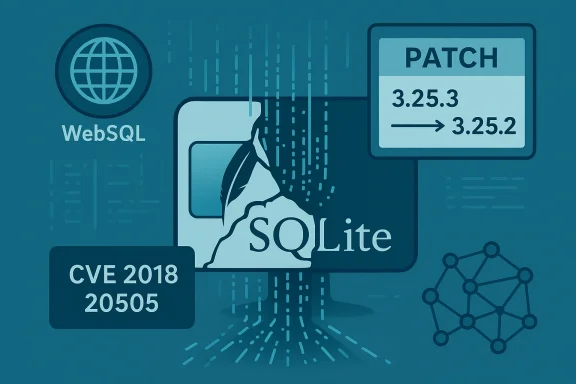
A denial-of-service flaw in SQLite 3.25.2 — tracked as CVE-2018-20505 — can be triggered by queries run against a table with a malformed PRIMARY KEY, allowing an attacker who can inject SQL (for example via certain WebSQL scenarios) to crash the host application and deny service to users.
Background / Overview
SQLite is the ubiquitous, embeddable SQL engine found inside browsers, mobile apps, desktop software, IoT devices and countless third‑party libraries. Its small footprint and permissive license mean that many applications ship their own copies of the SQLite library rather than relying on a platform package, which amplifies supply‑chain risk when a vulnerability is found.CVE‑2018‑20505 was disclosed publicly in early April 2019 and describes a fault in SQLite version 3.25.2: when certain queries are executed on a table whose PRIMARY KEY is malformed, code paths in the query handling can be abused to run arbitrary SQL commands and cause an application crash (a denial‑of‑service condition). Major vulnerability trackers and distribution vendors captured the same technical summary and high‑level impact.
Security researchers and vendors raised this class of issues as part of a broader set of SQLite/WebSQL problems in late 2018 and early 2019, with multiple threads and advisories noting how an SQL injection or arbitrary‑SQL capability in an embedding environment (for instance, a browser engine exposing WebSQL or an app exposing a poorly‑sanitised SQL interface) can convert a local parsing bug into a remote disruption. The problem is not purely theoreticity listings and vendor advisories have tied this specific bug to real‑world product updates.
What exactly is the flaw?
The technical essence
- A specific handling path in SQLite 3.25.2 treats a malformed PRIMARY KEY definition in a way that allows constructed queries to be interpreted as SQL rather than simple data.
- Attackers who can make the application run crafted SQL statements (the injection vector) can drive the vulnerable code path and induce a crash — producing a denial‑of‑service condition.
- The vulnerability is scoped to the behavior introduced or present in 3.25.2; upstream fixes were applied in the next upstream patch release.
Where the attack surface appears in practice
- WebSQL and similar browser‑oriented APIs were singled out in disclosures because a web page that can persuade a browser to execute SQL against an embedded SQLite instance has the prerequisite arbitrary‑SQL capability necessary to exploit this bug. Modern browsers have largely deprecated WebSQL, but legacy and specialized engines still exist.
- Native applications and services that accept SQL fragments from untrusted sources — for example, plugins, extension interfaces, or network services that forward SQL strings — may also present an attack surface if they embed the vulnerable SQLite build.
- Because many products ship their own SQLite copies, the presence of the vulnerability depends on the specific shipped or runtime-linked SQLite version rather than the operating system alone. Distribution trackers confirmed that the vulnerable code appeared in packages shipping SQLite 3.25.2 and earlier up to that release.
Who and what was affected?
Multiple vulnerability trackers and vendor advisories list SQLite up through 3.25.2 as affected. Downstream products that bundle or consume that upstream code — including some Apple products at the time of disclosure, and many Linux distribution packages — were called out in vendor advisories and CVE aggregators. The vulnerability record lists the affected upstream SQLite release explicitly.Distribution vendors moved to patch their packages by rebuilding against fixed SQLite releases or shipping backported patches. For example, popular Linux distributions updated their sqlite3 packages and published security notices indicating fixes were applied; canonical distro advisories and the Debian security tracker document how their rustings were fixed.
Fix and timeline
- SQLite upstream recorded a follow‑up patch series in the 3.25.x tree: the maintainers released 3.25.3 shortly after 3.25.2 to address several post‑release problems in that series. The SQLite release log records 3.25.3 as a corrective patch release and is the first place downstream maintainers referenced for the required fix.
- Security advisories and scanning tools recommend upgrading to 3.25.3 or later; vendor package updates (Ubuntu, Debian, SUSE and others) reflected that remediation in their published fixes.
- Public CVE and distribution trackers (NVD, Debian, SUSE, etc.) published the vulnerability description and recorded vendor responses and patch states. Those registries assign the canonical CVE ID and provide the cross‑platform status table administrators rely upon.
Why the severity matters — and where it doesn’t
Why this is serious
- The vulnerability requires only the ability to execute arbitrary SQL in the vulnerable SQLite instance to precipitate an application crash. In embedding environments that expose SQL execution to untrusted inputs (for example, a browser page via WebSQL), that precondition is achievable. That combination elevates the risk profile: an off‑path crash against a widely‑distributed library can cause large‑scale availability issues.
- The CVSS v3 listing attached to the vulnerability places the availability impact as the primary concern and gives a high base score in many vendor reports, reflecting a network‑accessible attack vector with low complexity and no required privileges.
- Embedded and containerized systems that rely on a shared SQLite binary — appliances, mobile apps, or server components that are not easy to patch in the field — multiply operational risk. Attackers can aim nuisance or high‑impact DoS campaigns at such fleets.
Why this is not the end of the world (context and limits)
- The vulnerability as described is a denial‑of‑service (application crash), not an authenticated remote code execution (RCE) in the typical public advisories. While some secondary analyses speculate about more serious consequences if arbitrary SQL execution can be chained to further memory corruption, mainstream vendor advisories and the upstream tracking entries focus on DoS as the primary confirmed impact. Claims of RCE should be treated as unverified unless demonstrated with proof‑of‑concept from a trustworthy source.
- Many modern browsers have removed or deprecated the WebSQL API that made remote exploitation via web pages easy to reason about; however, niche engines, legacy builds, and non‑browser embeddings still matter. The complexity of finding a real exploitation chain that turns malformed PRIMARY KEY parsing into full system compromise is nontrivial and — according to available public advisories — not the documented outcome. Treat RCE claims with caution unless supported by primary‑source proof.
Immediate guidance for defenders
If you manage systems, products or software that embed SQLite, treat CVE‑2018‑20505 as actionable. The following steps prioritize safety and operational practicality.- Inventory first: determine which binaries and packages in your environment include SQLite 3.25.2 or an inline copy of the sqlite engine compiled from that tree.
- Check packaged sqlite3 versions from your OS vendor (package metadata) and hunt for embedded sqlite amalgamation files in application bundles and installers.
- Use build records and SBOMs where available; because many vendors statically link SQLite into their executables, OS package version alone may not show the vulnerable instance.
- Patch where possible:
- Update the SQLite library to 3.25.3 or later; downstream distro packages were updated and many vendors shipped fixes for embedded products. Prioritise network‑facing and browser‑exposed components first.
- Rebuild static embeds:
- For applications that statically link sqlite3, obtain an updated sqlite3 amalgamation and rebuild the application. Replace the embedded binary rather than relying solely on an OS package update. Many successful mitigations in the wild required rebuilds because the vulnerable code was embedded in the app itself.
- Reduce attack surface:
- Disable or remove WebSQL and any API that allows untrusted content to run arbitrary SQL commands.
- For web‑facing products, prefer parameterised queries and prepared statements exposed through well‑audited server‑side APIs; never forward unvalidated SQL fragments from client to server.
- Monitor and harden:
- Watch crash metrics closely after patching windows — if crashes continue, investigate whether multiple sqlite instances or variants remain in the fleet.
- Implement rate limits and input validation at service boundaries to detect and mitigate injection attempts that could exploit parsing edge cases.
- Vendor coordination:
- If third‑party software (closed or SaaS) embeds SQLite and you cannot rebuild it yourself, contact the vendor for confirmation of vulnerability status and an expected timeline for updates.
Practical recovery and verification checklist
- Run an SBOM or binary scan and list all components linking against sqlite3. Prioritize those with 3.25.2 (or with ambiguous version metadata) for faster remediation.
- For each affected item, choose one of:
- Patch the system package (if the vulnerable code is provided by the OS).
- Rebuild the application with SQLite 3.25.3+ and redeploy (if statically linked).
- Apply vendor-supplied hotfix/firmware update.
- Validate by reproducing functional tests that previously triggered SQL paths touching PRIMARY KEY definitions. Monitor for crash log disappearance.
- If you operate public‑facing services, update incident response plans to include detection of suspicious SQL traffic patterns and pre‑authorization removal of affected functionality while the patch is applied.
Analysis: strengths of the public response and remaining risks
Strengths
- Upstream response was timely: SQLite maintainers published patch releases in short order and documented the release series; distribution vendors likewise produced security updates and advisories. That coordinated chain shortened the window for broad exploitation.
- The vulnerability was captured by major CVE trackers and distribution security teams (NVD, Debian, Ubuntu, SUSE), ensuring defenders had authoritative records to guide patching schedules.
- The primary confirmed impact is denial‑of‑service (availability), which is painful but easier to reason about and mitigate than reisolation, restarts and rate‑limiting reduce immediate operational harm while fixes are rolled out.
Residual risks and concerns
- Static linking and embedded copies of SQLite continue to complicate rapid remediation. Applications that bundle their own sqlite amalgamation require rebuilds and redeploys — a much slower path than simply applying an OS package update. The fragmentation in how SQLite is consumed remains the dominant operational risk. (an.org](https://security-tracker.debian.org/tracker/CVE-2018-20505?utm_source=openai))
- Public discourse around the vulnerability at times mixes DoS details with speculation about code execution. That conflation can cause misprioritization (panic vs. targeted patching) — defenders must focus on the confirmed outcomes while being alert for proof that expands the impact envelope.
- Deprecation of WebSQL in major browsers reduces generic web‑based exploitability, but it does not eliminate hosting products that still expose SQL execution to untrusted inputs (custom engines, legacy mobile apps, embedded browser components). Attackers targeting specialized stacks may still find exploitable deployments.
Tactical recommendations for Windows administrators and developers
- Windows product teams should:
- Inspect application folders, installer caches and the Windows Update patch cache for sqlite.dll or sqlite3.dll files and check compiled versions. Community discussions noted cases where older sqlite.dll copies were present inside Windows/installer caches and application bundles; auditing those artifacts is essential to find all occurrences.
- Coordinate with ISVs to obtain updated installers or patched binaries if third‑party apps are affected.
- Developers building on SQLite should:
- Adopt a policy of treating third‑party libraries as first‑class assets — maintain a registry of embedded versions and schedule rebuilds after upstream security releases.
- Use parameterised queries and avoid APIs that accept raw SQL from untrusted sources.
- Security operations should:
- Add crash signatures corresponding to SQLite exceptions to monitoring dashboards.
- Detect suspicious SQL injection attempts and tune IDS/IPS rules to flag patterns that attempt to craft PRIMARY KEY definitions or other schema objects dynamically.
Closing assessment
CVE‑2018‑20505 is an instructive example of how a relatively small parsing or schema‑handling bug in a widely embedded library can translate into a meaningful availability risk across a diverse ecosystem. The vulnerability’s principal impact is denial of service in versions of SQLite up to and including 3.25.2; the practical remediation is straightforward in concept (upgrade to 3.25.3+ or apply vendor patches), but operationally complex because of static links and embedded copies.The public response — coordinated upstream fixes, distro updates and advisories — reduced the exploitable window, but defenders must still actively inventory and rebuild embedded instances to fully close the risk. Treat claims beyond DoS (e.g., full RCE) as unverified until demonstrated; focus efforts on patching, rebuilding, reducing arbitrary‑SQL attack surfaces, and improving SBOM and binary inventory to accelerate future responses.
Appendix: quick reference (short, actionable items)
- Priority 1: Identify all sqlite3/sqlite.dll/sqlite3.c embedded in your environment and confirm version.
- Priority 2: Apply upstream fix — upgrade to SQLite 3.25.3+ or install the vendor package update for your distribution or product.
- Priority 3: Rebuild static embeds and redeploy applications that bundle the vulnerable code.
- Priority 4: Disable WebSQL or any interface that allows untrusted code to execute arbitrary SQL statements until the environment is confirmed patched.
Source: MSRC Security Update Guide - Microsoft Security Response Center
