

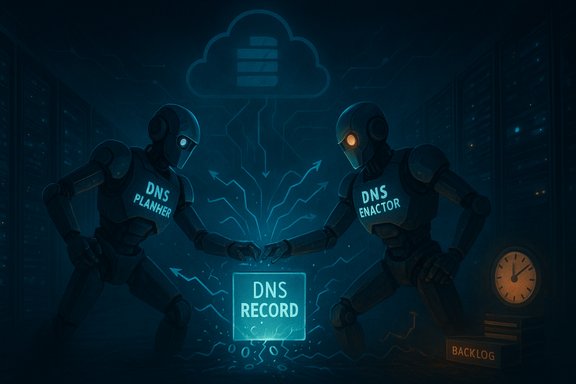
On October 19–20, a latent race condition inside Amazon Web Services’ DynamoDB DNS automation produced an empty DNS record for the regional service endpoint and set off a cascading, multi‑hour outage that left thousands of customer services partially or completely unavailable — a failure that exposed how concentrated hyperscaler control planes and DNS dependencies can convert a subtle software bug into a global availability incident.
Background
The October disruption originated in AWS’s US‑EAST‑1 (Northern Virginia) region and manifested as DNS resolution failures for the DynamoDB regional API endpoint. DNS, the internet’s address book, translates human‑readable hostnames into numeric IP addresses; when a high‑frequency control API like DynamoDB fails to resolve, SDKs and control‑plane components cannot establish new connections and normal orchestration processes stall. AWS’s own incident description and multiple third‑party analyses make the technical proximate cause clear: two independent automation components — a DNS Planner and redundant DNS Enactors — interacted under unusual timing conditions so that an older plan was re‑applied just as a cleanup process ran, deleting the plan that contained the active IP addresses and leaving the endpoint with an empty DNS answer. The outage was not an attack or a network fibre cut; it was an internal orchestration and automation failure whose effects reverberated through control planes, internal lease managers, and many customer workloads. Recovery required manual intervention to restore correct DNS state and then hours (and in some subsystems more than a day) for dependent queues and orchestration backlogs to drain.What actually broke: the technical anatomy
DNS Planner and DNS Enactor: the two halves of a brittle choreography
At scale, DynamoDB maintains vast numbers of DNS records to map traffic to balanced pools of IP addresses. AWS separates responsibilities into:- DNS Planner — monitors load balancers and creates "plans" that specify the desired DNS state for endpoints.
- DNS Enactors — distributed workers that pick up the latest plan and apply it to Route 53‑managed records.
- One Enactor experienced unusual delays and began applying an older plan while retrying updates on several endpoints.
- Meanwhile, a second Enactor picked up a newer plan and applied it rapidly.
- The second Enactor invoked a cleanup routine that deleted plans considered “many generations old.”
- The delayed first Enactor finally applied the older plan and overwrote the newer plan.
- The cleanup routine then deleted that older plan — and with it, all IP addresses for the regional endpoint — leaving an empty DNS record and preventing automatic correction by the automation itself.
Why an empty DNS record is worst‑case for a managed API
A DNS entry that returns no IP addresses is functionally equivalent to the service not existing at all. New connections cannot be formed; existing TCP sessions that remained established continued to work briefly, but the inability to accept or renew connections, write small critical state, or perform health checks incapacitated many control‑plane functions.Because DynamoDB often stores small but critical state (session tokens, leases, configuration flags), the outage quickly propagated:
- EC2 instance‑management subsystems that rely on DynamoDB lease records failed to operate correctly, delaying instance launches and replacements.
- Network Load Balancer (NLB) health checking and related routing subsystems saw failures and backlogs.
- Lambda, ECS and EKS orchestration and many asynchronous queues accumulated work that could only be cleared when dependent services returned to normal.
Timeline and scope
- Initial symptom detection and escalation were recorded late on October 19 U.S. time; AWS engineers identified DNS resolution abnormalities for dynamodb.us‑east‑1.amazonaws.com and began mitigations the following morning. The visible incident window stretched into the day, with DNS restored earlier but numerous dependent subsystems and customer workloads still recovering for many hours. Public reporting and telemetry place the incident’s most impactful window at roughly 7–15 hours depending on the service affected.
- Restoring correct DNS answers was necessary but not sufficient; the team needed to correct inconsistent internal state and allow queues and lease managers to reconcile, which produced a long tail of residual errors and throttled operations for some customers. Several independent monitoring vendors mapped out the staged recovery, showing DNS correction followed by a slower drainage of dependent backlogs.
Who was affected and how badly
The outage’s ripple effect touched a broad cross‑section of consumer and enterprise services:- Social and consumer apps reported degraded or unavailable features (messaging, feeds, sessions).
- Gaming platforms saw authentication and multiplayer interruptions.
- Payment rails and fintech services experienced timeouts or delays.
- Developer tooling, SaaS vendors, and certain public sector portals had intermittent failures.
- Some of Amazon’s own retail and device ecosystems reported degraded functionality while US‑EAST‑1 was impaired.
Why a single provider failure caused global pain: the hyperscaler concentration problem
The October outage is an example of a systemic property of the modern cloud: a handful of hyperscalers operate the majority of the world’s public cloud infrastructure and host critical managed primitives used by many services.Independent market research through 2025 generally shows the leading providers commanding the largest shares of cloud infrastructure spend (AWS roughly in the low‑30s percentage range, Microsoft Azure in the low‑20s, and Google Cloud in the low‑teens depending on vendor and quarter). That concentration means a regional control‑plane failure at a major provider can produce correlated failures across many downstream services. Hyperscalers offer compelling economics and rapid innovation, but they also centralize control planes, managed identity, CDN/edge fabrics, and critical platform services (like managed databases). When those primitives fail, the cost of re‑engineering around them is extremely high for most organisations, which is why the dependency remains widespread. The October incidents illustrate that convenience without contingency amplifies systemic fragility.
Comparing October’s hyperscaler incidents: AWS vs Azure
October’s incidents were technically different but operationally similar in lesson:- AWS (Oct 19–20): A latent race condition in DynamoDB’s DNS automation produced an empty DNS record for the regional endpoint; manual intervention was required and recovery consumed hours beyond DNS restoration as dependent systems reconciled.
- Microsoft Azure (Oct 29): An inadvertent configuration change in Azure Front Door (AFD) propagated invalid configuration state to edge nodes, producing DNS and routing anomalies and blocking token issuance for identity flows; Microsoft mitigated by rolling back to a last‑known‑good configuration and rebalancing PoPs. The AFD incident demonstrated how a single misapplied control‑plane change at the edge can produce broad authentication and management plane failures.
Operational lessons for Windows administrators and cloud architects
The pragmatic fallout of these events must translate into concrete, testable improvements in operational practice. For Windows‑centric IT teams and enterprise cloud architects, the following priorities are recommended:1. Map the dependency graph — start with the critical few
- Inventory external dependencies used by critical flows: identity (Azure AD/Entra), managed databases (DynamoDB, Cosmos DB), global ingress (AFD, CloudFront), and payment/identity providers.
- Classify dependencies by impact: which services, if unreachable for hours, will stop business‑critical operations?
2. Harden control‑plane fallbacks
- Maintain an out‑of‑band administrative access path that does not rely exclusively on provider portals (for example, preconfigured CLI/PowerShell tokens or alternate management endpoints).
- Ensure emergency service principals and recovery accounts are available and audited.
3. Reconsider DNS strategy
- Where possible, use low TTLs for critical endpoint records that you control, and prepare DNS failover plans (traffic manager / traffic director) that can switch clients to origin or alternative regions.
- Maintain local bootstrap caches for essential configuration and allow services to operate with eventual reconciliation rather than hard failures.
4. Tune client SDKs and retry behavior
- Avoid aggressive, synchronous retry patterns that create retry storms during provider outages.
- Prefer exponential backoff with jitter and fail open where graceful degradation is acceptable.
5. Practice and rehearse real‑world incident drills
- Simulate portal loss, identity token failure, and DNS corruption scenarios.
- Exercise rollbacks of inbound configuration changes and validate canarying behaviour.
- Measure recovery time objectives (RTOs) realistically and budget for the engineering work to meet them.
6. Procurement and contracting tactics
- Require transparency clauses for post‑incident reports and timelines in SLAs.
- Negotiate tenant‑level guarantees for critical control‑plane functions where possible.
- Factor the true cost of resilience (multi‑region, hybrid, or multi‑cloud fallbacks) into procurement decisions.
- Verify at least one management path that bypasses provider public portals.
- Test DNS failover for a critical web app.
- Run a simulated portal‑loss drill in a 30‑day window.
- Update incident communications templates and customer fallback messages.
Provider remedies and the governance question
Hyperscalers will respond on technical and governance fronts. Immediate technical remedies are likely to include:- Fixes to automation logic (e.g., stronger plan generation and apply semantics, idempotency checks, and stronger canarying before cleanup).
- Additional protections around cleanup routines and plan generation to avoid stale or overwritten state.
- Enhanced rollout controls and stricter validation for control‑plane changes (especially for global fabrics like AFD).
Insurance and economic impact
The outage also attracted attention from the insurance and reinsurance community. Cyber risk modelling firms produced preliminary insured loss estimates; CyberCube, for example, provided a range between US$38 million and US$581 million, while noting most insured losses are likely to cluster near the lower end of that interval. Those figures represent insured losses and do not directly equate to total economic disruption, but they matter because they influence cyber‑policy pricing, aggregation risk controls, and the appetite of insurers for correlated cloud exposures. The insurance industry will likely press customers and cloud providers for more granular incident data and aggregated loss modelling to refine contract language around systemic cloud events.Practical resilience patterns that scale
Enterprises can choose among several resilience strategies; the right mix depends on business risk tolerance and budget:- Selective multi‑region deployments: replicate only the small set of control‑plane or stateful services that matter most to operations, rather than replicating every component.
- Active/passive multi‑cloud for critical primitives: maintain a passive standby in an alternative cloud for authentication or core metadata, warmed periodically and scripted for rapid failover.
- Hybrid and edge caching: use on‑prem caching or edge proxies to store critical state for short intervals so that localized provider outages do not immediately become service outages.
- Greedy‑but‑controlled fallback heuristics: design clients to gracefully degrade features or read from cached state rather than hard‑failing on an unavailable managed primitive.
- Identify the top 3 control‑plane services that would cause catastrophic failure if they fail.
- Design and test a warm standby for those services in another region or provider.
- Implement monitoring outside the provider’s control plane (synthetic transactions from independent resolvers).
- Automate graceful degradation in client libraries and operator runbooks.
Risks moving forward
- Overconfidence in automation: automation reduces human error but can create subtle, large‑scale failure modes if cleanup semantics or concurrency checks are insufficient.
- Governance blind spots: opaque orchestration and rollout tooling can allow bad state to propagate faster than teams can detect and respond.
- Concentration risk: the economic and technical incentives that drive hyperscaler centralization are unlikely to disappear without regulatory or competitive pressure; the result is ongoing systemic exposure to similar incidents.
- Economic externalities: the insured loss envelope and vendor SLA structures mean many customers will bear much of the operational and reputational cost, not only the direct billable reimbursements from providers.
What to watch next
- The formal AWS post‑incident report and any corrective timelines it provides (automation fixes, rollout process changes, and telemetry improvements).
- Vendor SDK guidance on default retry behaviours and recommended client‑side mitigations.
- Regulatory or procurement changes that force greater transparency or contractual protections for critical control‑plane services.
- Insurance market responses, particularly changes to aggregate exposure models and cyber policy pricing for enterprises with concentrated hyperscaler dependencies.
Conclusion
The October DynamoDB DNS incident is a stark reminder that the internet’s reliability depends not only on physical networks and datacentres but also on the correctness of distributed automation and control‑plane software. A latent race condition and an empty DNS record did not merely inconvenience a small set of customers; they demonstrated how fragile modern service stacks can be when dozens of dependencies and automation layers are tightly coupled around a handful of global providers. The remedy is not abandoning the cloud, but professionalising resilience: map critical dependencies, harden control‑plane fallbacks, test realistic failure scenarios, and demand clearer transparency and contractual protections from providers.Hyperscalers deliver unmatched scale and innovation, but convenience without contingency is brittle. Organizations that convert this painful episode into funded, audited remediation will be the ones that avoid headline outages and keep services available when the next automation glitch inevitably occurs.
Source: Tech News TT When the cloud bursts
