

In an interview published on June 6, 2026, Tuxera enterprise storage CTO Ned Pyle argued that enterprise storage vendors now need unified NFS and SMB file services because mixed Windows, Linux, and macOS estates cannot safely treat file protocols as interchangeable plumbing. The claim is vendor-flavored, naturally, because Tuxera sells file-service software. But the underlying point is bigger than one product launch: the file server is quietly becoming strategic infrastructure again. After years of cloud object storage evangelism, enterprises are rediscovering that the boring old shared file system is still where a surprising amount of real work happens.
For two decades, the industry has tried to demote files. Databases were supposed to absorb structured business data, object stores were supposed to swallow unstructured data, and SaaS platforms were supposed to hide storage behind APIs. Yet the daily output of enterprises remains stubbornly file-shaped: CAD drawings, research images, video timelines, simulation output, code repositories, office documents, log archives, AI checkpoints, and millions of artifacts that somebody still wants to open, copy, lock, scan, version, or restore.
That is why Pyle’s central argument lands harder than the usual vendor pitch. NFS and SMB are not glamorous, but they sit directly in the path between applications and data. When they are slow, everything feels slow. When their security model is wrong, the storage layer becomes a liability. When their semantics do not match across clients, users discover corruption, permission weirdness, or inexplicable application failures at precisely the worst moment.
The file server’s apparent simplicity has always been misleading. A share path looks like a directory, but underneath it is a contract about identity, locking, metadata, durability, caching, encryption, failover, namespace behavior, and client expectations. The contract differs sharply between Unix-flavored NFS and Microsoft-flavored SMB, and enterprises that run both Windows and Linux cannot wish those differences away.
This is the real force behind the renewed interest in unified file services. It is not nostalgia for NAS appliances. It is the collision between mixed operating-system estates, containerized infrastructure, software-defined storage, high-performance networks, and workloads that treat remote files as active production data rather than a dumping ground.
Pyle’s argument is that this framing is now obsolete. The interesting question is no longer whether a storage product can speak NFS. It is which NFS it speaks, where the implementation lives, how it handles modern identity and security, whether it can exploit RDMA and flash-era I/O, and whether it can be deployed in the same operational model as the rest of a software-defined platform.
That distinction matters because NFS has not stood still. NFSv4 brought a more stateful model, stronger security assumptions, better firewall behavior, and features that made it more suitable for large enterprise environments than the older v3 world. NFSv4.1 and v4.2 added further machinery around sessions, layouts, server-side copy, and other modern behaviors. In practice, however, protocol capability and implementation reality are not the same thing.
Many enterprise administrators know this gap well. A spec may say a protocol can do something; a particular server, client, kernel, distribution, driver, or appliance may make that feature awkward, partial, unsupported, or fragile. The boring administrative question — “Will this behave predictably under our workload?” — often matters more than the theoretical protocol brochure.
That is why NFS implementation choices have become architectural decisions. Kernel NFS, user-space NFS, proprietary NFS inside an appliance, and clustered NFS inside a software-defined storage stack are not interchangeable delivery vehicles. They imply different trade-offs in performance, isolation, failure handling, observability, upgrade cadence, and container compatibility.
The modern SMB feature list reads less like office file sharing and more like infrastructure plumbing: multichannel, RDMA, encryption, persistent handles, transparent failover, scale-out file server support, compression, and, more recently, SMB over QUIC for secure connectivity across less trusted networks. Microsoft built much of its own storage and virtualization story around SMB, including scenarios where a remote file share is expected to behave like serious application infrastructure.
This is why Pyle’s “Formula 1 car versus horse cart” comparison, while colorful, is not entirely unfair. SMB’s reputation often lags behind its technical development. Administrators who last thought deeply about SMB during the SMB1 era are remembering a protocol that the modern Windows ecosystem has spent years trying to leave behind.
For WindowsForum readers, the Windows angle is especially important. SMB is not merely one protocol among many on Windows networks. It is tied into Active Directory habits, Group Policy expectations, logon scripts, home folders, administrative shares, enterprise backup patterns, and a long history of application assumptions. If an enterprise has Windows clients in any serious number, SMB is not optional in the practical sense.
At the same time, SMB is no longer confined to Windows. Linux clients and servers have improved, macOS relies heavily on SMB in many environments, and storage vendors have spent years implementing SMB compatibility. The result is a protocol that began as a platform marker and became a cross-platform necessity, even if its deepest integration remains in Microsoft’s world.
NFS and SMB do not merely use different packet formats. They carry different assumptions about identity, permissions, byte-range locking, opportunistic locking or leases, case sensitivity, share semantics, metadata mapping, and client-side caching. A Windows application opening a file over SMB and a Linux process touching the same data over NFS may both be doing legitimate things according to their own protocol rules, while still creating a mess if the server does not coordinate behavior across both worlds.
This is the heart of the multiprotocol problem. Unified access is not “support for NFS” plus “support for SMB.” It is a translation and arbitration layer that understands both models well enough to keep data safe. That means reconciling Windows security descriptors with POSIX permissions or NFSv4 ACLs, coordinating locks so applications do not trample one another, and presenting metadata consistently enough that users do not experience the storage system as a haunted house.
The demand for this has grown because enterprises rarely get to be ideologically pure. The Linux estate expands because of cloud-native applications, AI tooling, Kubernetes, analytics, and open-source infrastructure. The Windows estate persists because identity, desktops, collaboration workflows, line-of-business applications, and administrative muscle memory still matter. macOS appears in design, media, and developer pockets. The storage layer has to serve all of them without turning data governance into a protocol war.
The expensive alternative is migration absolutism: pick NFS or SMB and force everyone else to adapt. That can work in narrow environments, but it is often unrealistic in mature organizations. The more common outcome is coexistence, and coexistence is where unified file-service engineering either earns its keep or exposes itself as marketing.
But kernel code comes with a brutal bargain. A kernel crash can take the server with it, and a kernel compromise is often a full-system compromise. Kernel modules are harder to isolate, harder to containerize cleanly, and usually slower to iterate than user-space services. In an era when enterprises expect infrastructure components to be deployed, upgraded, observed, and rolled back like software, the old model looks less like purity and more like drag.
User-space file services are not automatically better. A poorly engineered user-space server can be slower, less predictable, and less integrated than a mature kernel implementation. But the trade-off has changed. Modern CPUs, faster memory, smarter NICs, io_uring-style Linux improvements, SPDK-like thinking in adjacent storage domains, and aggressive user-space networking patterns have made it much harder to say that kernel residence is the only path to performance.
Containers push the argument further. Kubernetes and other orchestration platforms want services that can be packaged, isolated, scheduled, monitored, and replaced. A file server that must live as a privileged kernel component does not fit that model naturally. A user-space file server, if engineered well, can look more like the rest of the platform.
This is not just a deployment preference. It affects the business model of storage. If file services can run as portable software on commodity Linux platforms, vendors and integrators can build storage systems without binding every customer to a proprietary appliance. That is the software-defined storage promise, stripped of buzzwords: the value moves from the box to the code and the operational model.
This is where Pyle draws a line between legacy open-source options and newer commercial implementations. His critique is predictable, because Tuxera competes in this space, but it highlights a real tension. Linux NFSD has the advantage of maturity and kernel proximity, while user-space projects such as NFS-Ganesha offer flexibility and safer deployment models. Samba remains the indispensable open-source SMB implementation across much of the non-Windows world. Yet enterprise storage vendors chasing performance, clustering, RDMA, and multiprotocol semantics often decide that the last 20 percent of capability is where the real differentiation sits.
That does not mean open source is inadequate across the board. Samba is one of the great interoperability projects in computing, and Linux NFS remains deeply important. But “works” and “forms the front end of a competitive enterprise storage product” are not identical tests. Storage vendors selling into AI, media, virtualization, private cloud, and high-density enterprise workloads are competing on latency, throughput, failover behavior, supportability, and feature completeness.
The protocol layer also becomes part of the sales argument because customers increasingly buy outcomes rather than boxes. They want to know whether a file service can saturate fast networks, preserve application correctness under failover, integrate with identity systems, expose telemetry, survive rolling upgrades, and support mixed clients without elaborate caveats. If the answer depends on a matrix of kernel versions and client behaviors, that complexity becomes part of the product whether the vendor admits it or not.
This is why NFS has moved from checkbox to design decision. It is not because NFS suddenly became new. It is because the environments around it changed enough that the implementation details now visibly affect cost, risk, and competitiveness.
Pyle’s provocative claim is that SMB 3 can outperform NFS 4 in certain AI training and checkpointing workloads, including stressful benchmark scenarios. That claim should be read carefully. Benchmark results are workload-specific, implementation-specific, and client-specific. They do not prove that SMB is universally “better” than NFS, any more than a fast NVMe result proves one file system wins every workload.
But the broader implication is important. Protocol choice can affect AI infrastructure in ways that many teams still underestimate. The storage conversation around AI often jumps to GPUs, parallel file systems, object stores, or exotic data platforms. Yet a lot of real AI work still touches ordinary files, and the path between accelerator nodes and stored datasets may run through NFS or SMB more often than architectural diagrams like to admit.
Checkpointing is especially unforgiving because it combines large writes, coordination pressure, and reliability expectations. If a training run depends on saving state frequently and recovering cleanly, file-service semantics become part of the compute pipeline. A remote file server is no longer a passive repository; it is an active participant in job throughput and recovery time.
The same applies beyond AI. Media rendering, EDA, scientific computing, financial simulation, genomics, and build farms all expose the same uncomfortable truth: remote files are production infrastructure. If they are treated as legacy convenience, they will fail like legacy convenience. If they are engineered as a high-performance data path, they can remain relevant even as workloads modernize.
SMB is one of the core protocols of Windows administration. Its security posture has changed dramatically over time, with Microsoft pushing enterprises away from SMB1, expanding signing and encryption expectations, and adding modern transport options. Windows Server’s file-service story is no longer merely a shared-folder story; it is part of the broader platform’s approach to secure and resilient data access.
The complication is that few serious enterprises are Windows-only anymore. Even organizations whose users live on Windows often run Linux in the data center, in Kubernetes clusters, in analytics environments, in security tooling, or in developer workflows. The question is not whether Windows can serve files to Windows. It is how Windows, Linux, and macOS clients can safely share enterprise data without each team creating a separate storage island.
This is where unified NFS and SMB becomes a Windows issue. If the storage platform cannot arbitrate between protocols properly, Windows users may see permission mismatches, stale locks, or application oddities caused by Linux-side access. Conversely, Linux users may find that data created through SMB carries metadata or access-control behavior that does not map cleanly into their tools.
Active Directory remains another gravity well. Many enterprises still anchor identity and access governance around AD or hybrid directory models. SMB fits naturally into that history, while NFS environments may use Kerberos, LDAP, FreeIPA, local IDs, or mapped identity models. A unified file service that cannot handle identity translation cleanly will push complexity back onto administrators, where it becomes scripts, exceptions, and late-night incident calls.
The Windows administrator’s instinct may be to standardize on SMB and be done with it. The Linux administrator’s instinct may be to standardize on NFS and do the same. The enterprise architect’s job is harder: accept that both sides have legitimate reasons, then force the storage layer to carry the complexity rather than dumping it on users.
The diagnosis is strong: file protocols matter more than many teams admit, NFS implementation quality varies, SMB 3 is more capable than its reputation, and multiprotocol access is genuinely hard. The prescription — buy a commercial file-service stack from a specialist vendor — may be right for some storage providers and integrators, but it is not the only possible answer for every enterprise.
Large organizations should test claims under their own conditions. That means real clients, real authentication, real directory structures, real file sizes, real failure scenarios, real antivirus or EDR overhead, and real application behavior. A synthetic throughput number is useful, but it is not a substitute for watching how a file service behaves when a node fails, a credential changes, a Windows client holds a lock, a Linux job renames a directory tree, and a backup product starts crawling metadata.
Storage buyers should also ask where protocol semantics are enforced. Does the product truly coordinate NFS and SMB locks? How does it map ACLs? What happens when a case-sensitive Linux workload meets a case-insensitive Windows expectation? How are audit events recorded? Can administrators see which client and protocol touched a file? Does failover preserve handles and sessions in a way applications tolerate?
These are not edge cases anymore. They are the difference between a unified storage platform and a collection of shares wearing the same logo. The more important files become to AI, media, engineering, and private-cloud workloads, the less tolerance enterprises will have for multiprotocol hand-waving.
Modern file service has to be observable. Administrators need to know not only that a share is up, but which clients are consuming bandwidth, where latency enters the path, which protocol behaviors are causing retries, and whether authentication or locking is the bottleneck. A file server that exposes little about its internal decisions becomes a black box precisely when the workload becomes most important.
It also has to be upgradeable. Enterprises are less willing to schedule dramatic maintenance windows for infrastructure components that should behave like software. Rolling upgrades, safe restarts, version-aware clusters, and clean rollback paths matter because file services sit under too many workflows to be casually interrupted.
Security is equally central. SMB signing and encryption, Kerberos-backed NFS, identity mapping, audit trails, and isolation boundaries are not optional niceties in an era of ransomware and insider-risk monitoring. File shares are attractive targets because they aggregate business value in a form humans and malware both understand. A weak file-service layer can undermine stronger controls elsewhere.
Finally, file service has to be honest about heterogeneity. Enterprises do not run mixed environments because they lack discipline. They run them because different platforms won different jobs. Windows won identity-bound desktop and business workflows. Linux won cloud-native infrastructure and much of technical computing. macOS won pockets of creative and developer work. The file layer lives at the intersection, and pretending otherwise only moves the pain downstream.
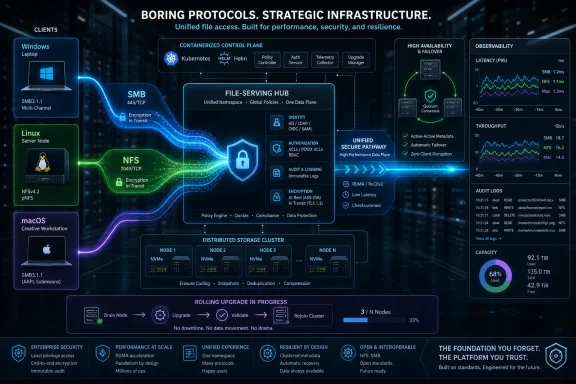 The File Server Refuses to Die Quietly
For two decades, the industry has tried to demote files. Databases were supposed to absorb structured business data, object stores were supposed to swallow unstructured data, and SaaS platforms were supposed to hide storage behind APIs. Yet the daily output of enterprises remains stubbornly file-shaped: CAD drawings, research images, video timelines, simulation output, code repositories, office documents, log archives, AI checkpoints, and millions of artifacts that somebody still wants to open, copy, lock, scan, version, or restore.That is why Pyle’s central argument lands harder than the usual vendor pitch. NFS and SMB are not glamorous, but they sit directly in the path between applications and data. When they are slow, everything feels slow. When their security model is wrong, the storage layer becomes a liability. When their semantics do not match across clients, users discover corruption, permission weirdness, or inexplicable application failures at precisely the worst moment.
The file server’s apparent simplicity has always been misleading. A share path looks like a directory, but underneath it is a contract about identity, locking, metadata, durability, caching, encryption, failover, namespace behavior, and client expectations. The contract differs sharply between Unix-flavored NFS and Microsoft-flavored SMB, and enterprises that run both Windows and Linux cannot wish those differences away.
This is the real force behind the renewed interest in unified file services. It is not nostalgia for NAS appliances. It is the collision between mixed operating-system estates, containerized infrastructure, software-defined storage, high-performance networks, and workloads that treat remote files as active production data rather than a dumping ground.
NFS Has Outgrown Its Checkbox Era
NFS became famous by being invisible. In Unix and Linux environments, it was the default way to make a remote directory feel local enough. It was easy to understand, widely implemented, and good enough for an enormous range of workloads. That success made it feel like a checklist item: does the box have NFS, yes or no?Pyle’s argument is that this framing is now obsolete. The interesting question is no longer whether a storage product can speak NFS. It is which NFS it speaks, where the implementation lives, how it handles modern identity and security, whether it can exploit RDMA and flash-era I/O, and whether it can be deployed in the same operational model as the rest of a software-defined platform.
That distinction matters because NFS has not stood still. NFSv4 brought a more stateful model, stronger security assumptions, better firewall behavior, and features that made it more suitable for large enterprise environments than the older v3 world. NFSv4.1 and v4.2 added further machinery around sessions, layouts, server-side copy, and other modern behaviors. In practice, however, protocol capability and implementation reality are not the same thing.
Many enterprise administrators know this gap well. A spec may say a protocol can do something; a particular server, client, kernel, distribution, driver, or appliance may make that feature awkward, partial, unsupported, or fragile. The boring administrative question — “Will this behave predictably under our workload?” — often matters more than the theoretical protocol brochure.
That is why NFS implementation choices have become architectural decisions. Kernel NFS, user-space NFS, proprietary NFS inside an appliance, and clustered NFS inside a software-defined storage stack are not interchangeable delivery vehicles. They imply different trade-offs in performance, isolation, failure handling, observability, upgrade cadence, and container compatibility.
SMB Became More Than the Windows Share
SMB carries its own burden of historical underestimation. To many Unix administrators, SMB was once “the Windows file-sharing thing,” tolerated for desktops and avoided for serious infrastructure. That view is increasingly out of date. SMB 3 changed the protocol’s role by turning it into a high-performance storage fabric for Microsoft’s server ecosystem.The modern SMB feature list reads less like office file sharing and more like infrastructure plumbing: multichannel, RDMA, encryption, persistent handles, transparent failover, scale-out file server support, compression, and, more recently, SMB over QUIC for secure connectivity across less trusted networks. Microsoft built much of its own storage and virtualization story around SMB, including scenarios where a remote file share is expected to behave like serious application infrastructure.
This is why Pyle’s “Formula 1 car versus horse cart” comparison, while colorful, is not entirely unfair. SMB’s reputation often lags behind its technical development. Administrators who last thought deeply about SMB during the SMB1 era are remembering a protocol that the modern Windows ecosystem has spent years trying to leave behind.
For WindowsForum readers, the Windows angle is especially important. SMB is not merely one protocol among many on Windows networks. It is tied into Active Directory habits, Group Policy expectations, logon scripts, home folders, administrative shares, enterprise backup patterns, and a long history of application assumptions. If an enterprise has Windows clients in any serious number, SMB is not optional in the practical sense.
At the same time, SMB is no longer confined to Windows. Linux clients and servers have improved, macOS relies heavily on SMB in many environments, and storage vendors have spent years implementing SMB compatibility. The result is a protocol that began as a platform marker and became a cross-platform necessity, even if its deepest integration remains in Microsoft’s world.
Unified Access Is Not Just Two Daemons Pointing at One Directory
The phrase “unified NFS + SMB” sounds simple in a way that can be dangerous. A naive implementation suggests mounting the same underlying file system through an NFS server and an SMB server and calling the problem solved. That is the storage equivalent of wiring two control panels to the same machine and hoping operators never press conflicting buttons.NFS and SMB do not merely use different packet formats. They carry different assumptions about identity, permissions, byte-range locking, opportunistic locking or leases, case sensitivity, share semantics, metadata mapping, and client-side caching. A Windows application opening a file over SMB and a Linux process touching the same data over NFS may both be doing legitimate things according to their own protocol rules, while still creating a mess if the server does not coordinate behavior across both worlds.
This is the heart of the multiprotocol problem. Unified access is not “support for NFS” plus “support for SMB.” It is a translation and arbitration layer that understands both models well enough to keep data safe. That means reconciling Windows security descriptors with POSIX permissions or NFSv4 ACLs, coordinating locks so applications do not trample one another, and presenting metadata consistently enough that users do not experience the storage system as a haunted house.
The demand for this has grown because enterprises rarely get to be ideologically pure. The Linux estate expands because of cloud-native applications, AI tooling, Kubernetes, analytics, and open-source infrastructure. The Windows estate persists because identity, desktops, collaboration workflows, line-of-business applications, and administrative muscle memory still matter. macOS appears in design, media, and developer pockets. The storage layer has to serve all of them without turning data governance into a protocol war.
The expensive alternative is migration absolutism: pick NFS or SMB and force everyone else to adapt. That can work in narrow environments, but it is often unrealistic in mature organizations. The more common outcome is coexistence, and coexistence is where unified file-service engineering either earns its keep or exposes itself as marketing.
Containers Changed the Politics of Where File Servers Run
One of Pyle’s sharper claims is that containerization weakened the old assumption that the kernel is the natural home for serious file-serving performance. Historically, this assumption made sense. Running file-service code in kernel space reduced overhead and put the protocol close to the operating system’s file, memory, and network machinery. When CPUs were slower and network links less forgiving, that mattered enormously.But kernel code comes with a brutal bargain. A kernel crash can take the server with it, and a kernel compromise is often a full-system compromise. Kernel modules are harder to isolate, harder to containerize cleanly, and usually slower to iterate than user-space services. In an era when enterprises expect infrastructure components to be deployed, upgraded, observed, and rolled back like software, the old model looks less like purity and more like drag.
User-space file services are not automatically better. A poorly engineered user-space server can be slower, less predictable, and less integrated than a mature kernel implementation. But the trade-off has changed. Modern CPUs, faster memory, smarter NICs, io_uring-style Linux improvements, SPDK-like thinking in adjacent storage domains, and aggressive user-space networking patterns have made it much harder to say that kernel residence is the only path to performance.
Containers push the argument further. Kubernetes and other orchestration platforms want services that can be packaged, isolated, scheduled, monitored, and replaced. A file server that must live as a privileged kernel component does not fit that model naturally. A user-space file server, if engineered well, can look more like the rest of the platform.
This is not just a deployment preference. It affects the business model of storage. If file services can run as portable software on commodity Linux platforms, vendors and integrators can build storage systems without binding every customer to a proprietary appliance. That is the software-defined storage promise, stripped of buzzwords: the value moves from the box to the code and the operational model.
Software-Defined Storage Needs Protocols That Behave Like Infrastructure
Software-defined storage has always promised to abstract hardware, pool capacity, and make storage scale more like compute. But that promise depends heavily on the protocols at the edge. A brilliant distributed back end is not enough if the front-end file service cannot expose data safely, quickly, and consistently to the clients that actually consume it.This is where Pyle draws a line between legacy open-source options and newer commercial implementations. His critique is predictable, because Tuxera competes in this space, but it highlights a real tension. Linux NFSD has the advantage of maturity and kernel proximity, while user-space projects such as NFS-Ganesha offer flexibility and safer deployment models. Samba remains the indispensable open-source SMB implementation across much of the non-Windows world. Yet enterprise storage vendors chasing performance, clustering, RDMA, and multiprotocol semantics often decide that the last 20 percent of capability is where the real differentiation sits.
That does not mean open source is inadequate across the board. Samba is one of the great interoperability projects in computing, and Linux NFS remains deeply important. But “works” and “forms the front end of a competitive enterprise storage product” are not identical tests. Storage vendors selling into AI, media, virtualization, private cloud, and high-density enterprise workloads are competing on latency, throughput, failover behavior, supportability, and feature completeness.
The protocol layer also becomes part of the sales argument because customers increasingly buy outcomes rather than boxes. They want to know whether a file service can saturate fast networks, preserve application correctness under failover, integrate with identity systems, expose telemetry, survive rolling upgrades, and support mixed clients without elaborate caveats. If the answer depends on a matrix of kernel versions and client behaviors, that complexity becomes part of the product whether the vendor admits it or not.
This is why NFS has moved from checkbox to design decision. It is not because NFS suddenly became new. It is because the environments around it changed enough that the implementation details now visibly affect cost, risk, and competitiveness.
AI Has Made Old File Assumptions Look Small
Artificial intelligence did not invent the need for fast shared storage, but it has made the limitations harder to ignore. Training pipelines, checkpointing, dataset staging, model artifacts, and distributed jobs can produce punishing I/O patterns. They also tend to sit in Linux-heavy environments where NFS is familiar, available, and easy to wire into existing workflows.Pyle’s provocative claim is that SMB 3 can outperform NFS 4 in certain AI training and checkpointing workloads, including stressful benchmark scenarios. That claim should be read carefully. Benchmark results are workload-specific, implementation-specific, and client-specific. They do not prove that SMB is universally “better” than NFS, any more than a fast NVMe result proves one file system wins every workload.
But the broader implication is important. Protocol choice can affect AI infrastructure in ways that many teams still underestimate. The storage conversation around AI often jumps to GPUs, parallel file systems, object stores, or exotic data platforms. Yet a lot of real AI work still touches ordinary files, and the path between accelerator nodes and stored datasets may run through NFS or SMB more often than architectural diagrams like to admit.
Checkpointing is especially unforgiving because it combines large writes, coordination pressure, and reliability expectations. If a training run depends on saving state frequently and recovering cleanly, file-service semantics become part of the compute pipeline. A remote file server is no longer a passive repository; it is an active participant in job throughput and recovery time.
The same applies beyond AI. Media rendering, EDA, scientific computing, financial simulation, genomics, and build farms all expose the same uncomfortable truth: remote files are production infrastructure. If they are treated as legacy convenience, they will fail like legacy convenience. If they are engineered as a high-performance data path, they can remain relevant even as workloads modernize.
Windows Shops Should Care Even When the Pitch Starts with Linux
At first glance, this debate may sound Linux-centric. NFS is the Unix file-sharing protocol, Tuxera is emphasizing Linux-based servers, and containerization tilts the conversation toward cloud-native infrastructure. But Windows-heavy organizations have just as much at stake.SMB is one of the core protocols of Windows administration. Its security posture has changed dramatically over time, with Microsoft pushing enterprises away from SMB1, expanding signing and encryption expectations, and adding modern transport options. Windows Server’s file-service story is no longer merely a shared-folder story; it is part of the broader platform’s approach to secure and resilient data access.
The complication is that few serious enterprises are Windows-only anymore. Even organizations whose users live on Windows often run Linux in the data center, in Kubernetes clusters, in analytics environments, in security tooling, or in developer workflows. The question is not whether Windows can serve files to Windows. It is how Windows, Linux, and macOS clients can safely share enterprise data without each team creating a separate storage island.
This is where unified NFS and SMB becomes a Windows issue. If the storage platform cannot arbitrate between protocols properly, Windows users may see permission mismatches, stale locks, or application oddities caused by Linux-side access. Conversely, Linux users may find that data created through SMB carries metadata or access-control behavior that does not map cleanly into their tools.
Active Directory remains another gravity well. Many enterprises still anchor identity and access governance around AD or hybrid directory models. SMB fits naturally into that history, while NFS environments may use Kerberos, LDAP, FreeIPA, local IDs, or mapped identity models. A unified file service that cannot handle identity translation cleanly will push complexity back onto administrators, where it becomes scripts, exceptions, and late-night incident calls.
The Windows administrator’s instinct may be to standardize on SMB and be done with it. The Linux administrator’s instinct may be to standardize on NFS and do the same. The enterprise architect’s job is harder: accept that both sides have legitimate reasons, then force the storage layer to carry the complexity rather than dumping it on users.
Vendor Claims Need Pressure, Not Dismissal
Tuxera’s position is not neutral. The company sells Fusion SMB and is bringing Fusion NFS to market, so it benefits from the argument that legacy implementations are insufficient and that user-space, multiprotocol file services are the future. That does not make the argument wrong, but it does mean buyers should separate the diagnosis from the prescription.The diagnosis is strong: file protocols matter more than many teams admit, NFS implementation quality varies, SMB 3 is more capable than its reputation, and multiprotocol access is genuinely hard. The prescription — buy a commercial file-service stack from a specialist vendor — may be right for some storage providers and integrators, but it is not the only possible answer for every enterprise.
Large organizations should test claims under their own conditions. That means real clients, real authentication, real directory structures, real file sizes, real failure scenarios, real antivirus or EDR overhead, and real application behavior. A synthetic throughput number is useful, but it is not a substitute for watching how a file service behaves when a node fails, a credential changes, a Windows client holds a lock, a Linux job renames a directory tree, and a backup product starts crawling metadata.
Storage buyers should also ask where protocol semantics are enforced. Does the product truly coordinate NFS and SMB locks? How does it map ACLs? What happens when a case-sensitive Linux workload meets a case-insensitive Windows expectation? How are audit events recorded? Can administrators see which client and protocol touched a file? Does failover preserve handles and sessions in a way applications tolerate?
These are not edge cases anymore. They are the difference between a unified storage platform and a collection of shares wearing the same logo. The more important files become to AI, media, engineering, and private-cloud workloads, the less tolerance enterprises will have for multiprotocol hand-waving.
The Real Storage Divide Is Operational, Not Religious
It is tempting to frame this as NFS versus SMB, or kernel versus user space, or open source versus commercial software. Those fights are emotionally satisfying and operationally incomplete. The real divide is between storage systems designed around modern operational requirements and systems still coasting on the assumption that file service is a solved problem.Modern file service has to be observable. Administrators need to know not only that a share is up, but which clients are consuming bandwidth, where latency enters the path, which protocol behaviors are causing retries, and whether authentication or locking is the bottleneck. A file server that exposes little about its internal decisions becomes a black box precisely when the workload becomes most important.
It also has to be upgradeable. Enterprises are less willing to schedule dramatic maintenance windows for infrastructure components that should behave like software. Rolling upgrades, safe restarts, version-aware clusters, and clean rollback paths matter because file services sit under too many workflows to be casually interrupted.
Security is equally central. SMB signing and encryption, Kerberos-backed NFS, identity mapping, audit trails, and isolation boundaries are not optional niceties in an era of ransomware and insider-risk monitoring. File shares are attractive targets because they aggregate business value in a form humans and malware both understand. A weak file-service layer can undermine stronger controls elsewhere.
Finally, file service has to be honest about heterogeneity. Enterprises do not run mixed environments because they lack discipline. They run them because different platforms won different jobs. Windows won identity-bound desktop and business workflows. Linux won cloud-native infrastructure and much of technical computing. macOS won pockets of creative and developer work. The file layer lives at the intersection, and pretending otherwise only moves the pain downstream.
The Boring Protocols Are Where the Future Keeps Its Data
The most concrete lesson from the Tuxera interview is that files are not a legacy side channel. They are still a primary unit of enterprise work, and the protocols that move them are becoming more consequential as workloads become faster, more distributed, and more mixed.- Enterprises should treat NFS and SMB implementation quality as an architectural decision, not a procurement checkbox.
- Unified NFS and SMB access is only safe when the storage layer understands identity, locking, metadata, and client semantics across both protocols.
- SMB 3 deserves to be evaluated as a modern storage fabric, not dismissed as a relic of Windows workgroup file sharing.
- Kernel-based file servers still have strengths, but containerized and software-defined environments make user-space designs increasingly attractive.
- AI, media, engineering, and private-cloud workloads are raising the performance and correctness bar for ordinary-looking file shares.
- Vendor claims about protocol superiority should be tested with real workloads, real clients, and real failure conditions rather than accepted from benchmark headlines.
References
- Primary source: Blocks & Files
Published: 2026-06-06T05:44:12.351773
Enterprises need unified NFS+SMB file services, and files and file servers will outlive us all
Interview: B&F was contacted by Ned Pyle, CTO Enterprise Storage at Tuxera, who wanted to say th ...www.blocksandfiles.com - Official source: learn.microsoft.com
SMB features in Windows and Windows Server | Microsoft Learn
Discover the SMB features available in different Windows versions to enhance security, performance, and availability for your file-sharing needs.learn.microsoft.com - Official source: azure.microsoft.com
Boost your client performance with Azure Files SMB Multichannel | Microsoft Azure Blog
Lower your deployment cost, while improving client performance with Server Message Block (SMB) Multichannel on premium tier. azure.microsoft.com
- Related coverage: snia.org
