

Modern MSPs are being pushed to stop treating Azure Virtual Desktop (AVD) and Microsoft 365 as separate silos and instead build a unified, multi-tenant cloud practice that treats identity, endpoints, collaboration, and virtual desktops as a single, interconnected Microsoft ecosystem. (rcpmag.com)
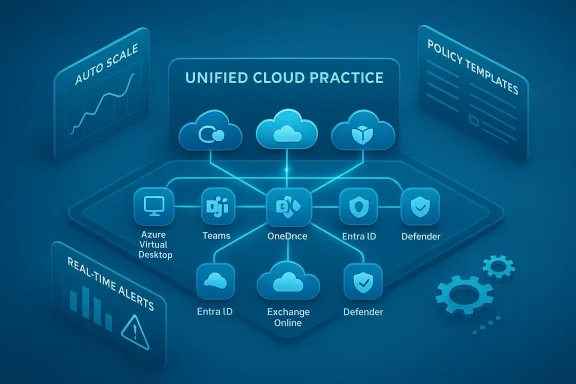
Microsoft’s cloud stack has evolved into a tightly integrated platform where identity (Microsoft Entra), device and endpoint management (Microsoft Intune and Defender), collaboration (Teams, OneDrive, SharePoint), and desktop virtualization (Azure Virtual Desktop) are no longer optional integrations—they are operationally and security-wise intertwined. Microsoft’s documentation and product guidance now explicitly reference conditional access, Intune-enrollment options, and identity/topology patterns that show these services must be managed together to keep users productive and secure.
Nerdio, a vendor focused on multi-tenant DaaS and Microsoft cloud management, has been positioning its platform to answer that market need with a consolidated management plane—Nerdio Manager for MSP (NMM). Recent product messaging and releases highlight unified Microsoft 365 and AVD management features, tenant monitoring, auto-scale automation, and expanded compliance support for government clouds. These are pitched as the operational glue that helps MSPs standardize configurations, reduce manual work, and control security drift across customer tenants.
But there are caveats and new responsibilities:
Vendors also publish efficiency claims—examples include vendor material that cites "55% cost savings" and "50% less time on manual tasks" when MSPs adopt a consolidated management platform. These figures are useful as directional benchmarks, but they are vendor-provided and should be validated in pilot engagements before being used in MSP sales promises. Flag ROI figures as vendor-sourced until you can demonstrate similar outcomes with your customers.
For MSPs, margin expansion often comes from:
Vendors like Nerdio have productized many of the capabilities MSPs need—autoscale, tenant monitoring, Microsoft 365 management templates, and government-cloud support—and market this as a path to efficiency and margin improvement.
For MSPs, the next step is deliberate: run small, measurable pilots; validate vendor claims against your tenants and operational metrics; and codify safe identity and RBAC patterns. Do that, and you’ll turn a tangle of portals and scripts into a repeatable, secure practice that lets you sell higher-value managed services and keep your customers productive across physical and virtual workspaces.
Source: Redmond Channel Partner From AVD to Microsoft 365: Building a modern cloud practice for MSPs -- Redmond Channel Partner
 Background
Microsoft’s cloud stack has evolved into a tightly integrated platform where identity (Microsoft Entra), device and endpoint management (Microsoft Intune and Defender), collaboration (Teams, OneDrive, SharePoint), and desktop virtualization (Azure Virtual Desktop) are no longer optional integrations—they are operationally and security-wise intertwined. Microsoft’s documentation and product guidance now explicitly reference conditional access, Intune-enrollment options, and identity/topology patterns that show these services must be managed together to keep users productive and secure.Nerdio, a vendor focused on multi-tenant DaaS and Microsoft cloud management, has been positioning its platform to answer that market need with a consolidated management plane—Nerdio Manager for MSP (NMM). Recent product messaging and releases highlight unified Microsoft 365 and AVD management features, tenant monitoring, auto-scale automation, and expanded compliance support for government clouds. These are pitched as the operational glue that helps MSPs standardize configurations, reduce manual work, and control security drift across customer tenants.
Why MSPs must link AVD and Microsoft 365 now
The business case for unifying AVD and Microsoft 365 management is practical and urgent.- Modern users expect the same productivity stack whether they log into a physical laptop, a cloud-managed device, or a virtual desktop session. Microsoft 365 licensing, Teams calling, OneDrive sync and SharePoint access are all central to user experience inside AVD-hosted Windows sessions. That means user and license provisioning, app access policies, and conditional access rules should be consistent across endpoints and virtual desktops.
- Security controls increasingly rely on cross-surface signals. Conditional Access and device compliance with Intune, for instance, are used to gate access to Microsoft 365 apps and AVD itself. Managing these as separate silos creates policy gaps that attackers can exploit. Microsoft’s guidance on device compliance and conditional access explicitly shows how Intune and Entra work together to secure AVD sessions.
- Operational scale and profitability hinge on automation and consistency. MSPs that administer each tenant with different scripts, consoles, and manual steps burn time and invite configuration drift. A standardized, multi-tenant automation layer reduces overhead and makes costing, SLA delivery, and scale predictable. Nerdio and industry coverage emphasize automation and multi-tenant monitoring as core MSP capabilities.
What Nerdio is promising — and what it delivers
Nerdio’s recent product positioning centers on NMM 6.0 and related MSP features that bundle Microsoft 365 management and AVD under a single administrative surface. The headline capabilities the vendor highlights include:- Auto-Scale Profiles to automate AVD host pool scaling based on time, workload, or user demand.
- Tenant Monitoring that provides real-time visibility and alerts across Microsoft 365 and AVD tenants.
- Microsoft 365 centralized management for Exchange Online, Teams, OneDrive, and Entra ID across tenants with bulk actions, templates, and policy standardization.
- Security and compliance additions, including CIS Intune benchmark policies and expanded support for Azure Government/GCC clouds.
Technical reality-check
Vendor feature lists are useful, but technical teams must verify that the platform integrates properly with Microsoft’s root services and does not rely on fragile workarounds. On that front:- Microsoft’s documentation shows that AVD relies on Entra ID for authentication and supports Intune-based compliance gating for client devices and some session host configurations. Any management platform claiming to control AVD and Microsoft 365 must operate through supported APIs and enrollment flows, and be compatible with Entra B2B/B2C patterns where relevant.
- Multi-tenant identity is powerful but complex. Microsoft’s Entra docs for multi-tenant organizations and cross-tenant access settings warn that resource isolation via B2B and cross-tenant constructs does not automatically deliver identity isolation; MSPs must design cross-tenant access, B2B invitations, cross-tenant sync, and conditional access with care to avoid privilege or data leakage. Any centralized tool that automates tenant configuration must expose the identity and trust topology to human review.
- Integration with Microsoft 365 workloads at scale (Exchange, Teams, OneDrive, SharePoint) needs safe automations that respect throttling, delegated admin permissions, and the variety of SKU/license states across customers. A robust multi-tenant manager should include rate-limit handling, delegated admin consent patterns, and telemetry to surface failed configurations. Industry reporting about NMM emphasizes tenant monitoring and PSA integrations, which are the right levers to make that work operationally.
The operational playbook: how MSPs should approach a unified practice
Moving from siloed operations to a unified Microsoft cloud practice is a combination of technology, process, and staffing. Below is a practical roadmap MSP leaders can follow.- Inventory and map risks. Catalog all customers that use Microsoft 365, AVD, Intune, Defender, and identity synchronization. Map who owns the identity (customer vs. MSP) and record licensing levels for Microsoft 365 and Windows. This single step exposes licensing gaps and identity topologies that will shape migration choices.
- Define a standard tenant baseline. Create a security and configuration baseline for Microsoft 365 and AVD that includes:
- Entra and conditional access templates.
- CIS-derived Intune policies for endpoint protection and configuration.
- Teams and Exchange retention/compliance settings to meet customer needs.
Standardization reduces drift and simplifies automation and monitoring. - Choose a multi-tenant management platform that champions supported APIs. Evaluate vendors for:
- Direct use of Entra, Graph, and Intune APIs rather than screen-scraping.
- Auditability and RBAC for MSP ops teams.
- Tenant monitoring and alerting tied to PSA and ticketing systems. Industry releases indicate these are table-stakes features for modern MSP platforms.
- Automate and test in pilot tenants. Build automation recipes for user provisioning, application delivery, image updates, and AVD autoscaling. Validate behavior under real load and test rollback procedures.
- Secure cross-tenant access. Apply cross-tenant access settings and least-privilege delegated admin rights, and document any B2B or cross-tenant synchronization you put in place. Microsoft guidance on multi-tenant organizations shows the pitfalls and the safe approaches for cross-tenant provisioning.
- Bake in cost governance. AVD costs are driven by compute, storage, networking, and licensing. Use automated auto-scale and RI/Spot strategies to control Azure compute spend and report margins at the customer level. Some vendor platforms provide cost-estimators and built-in optimization controls that can make quoting and billing cleaner.
- Operate with measurable SLAs and continuous improvement. Standardize runbooks, measure time-to-resolution, and track manual tasks eliminated by automation. Reinvest headcount savings into higher-value managed security and cloud optimization services.
Security: benefits and caveats
A unified management approach brings clear security benefits: consistent conditional access policies, fewer misconfigured tenants, and consolidated telemetry for incident detection. Centralized visibility over Microsoft Defender, Intune, and AVD activity can shorten mean time to detect (MTTD) and mean time to respond (MTTR).But there are caveats and new responsibilities:
- Centralization increases blast radius if a management plane is compromised. Ensure the multi-tenant management console is hardened with MFA, Conditional Access, least-privilege RBAC, and continuous audit logging. Confirm vendor certifications and compliance mappings for any platform that holds delegated rights across customers.
- Identity topology must be explicit. Microsoft’s Entra documentation warns that B2B resource isolation doesn't automatically produce identity isolation; operators must design cross-tenant access controls and avoid unintended identity elevation. MSPs must treat identity flows as first-class risk elements.
- Automated patching, image updates, and policy application may cause service disruption if not properly staged. Implement phased rollouts, in-console approvals, and canary hosts for image updates in AVD. Vendor-supplied automation must be transparent and reversible.
Cost, pricing, and margins
Nerdio and other vendors market per-tenant pricing and AVD user‑based pricing structures to make vendor costs predictable for MSPs. Nerdio’s public pricing pages and industry write-ups reference per-tenant plans for Microsoft 365 management and per-AVD user rates for AVD management—pricing models designed to simplify quoting and potentially keep costs stable as customer head counts change.Vendors also publish efficiency claims—examples include vendor material that cites "55% cost savings" and "50% less time on manual tasks" when MSPs adopt a consolidated management platform. These figures are useful as directional benchmarks, but they are vendor-provided and should be validated in pilot engagements before being used in MSP sales promises. Flag ROI figures as vendor-sourced until you can demonstrate similar outcomes with your customers.
For MSPs, margin expansion often comes from:
- Lower operational headcount per tenant via automation.
- Predictable pricing and faster time-to‑quote for AVD deals using integrated cost estimators.
- New revenue streams from managed security services and compliance attestation for regulated industries, especially where the management platform supports Azure Government and GCC High deployments.
Vendor selection checklist for MSPs
Choose a platform only after a hands-on evaluation that includes the following tests:- API-first integration: Does the product use Microsoft Graph, Entra, and Intune APIs natively?
- Multi-tenant RBAC and audit logs: Can you separate duties and generate tenant-level audit trails?
- Identity topology support: Does it support B2B, cross-tenant sync, and delegated admin models safely?
- AVD-specific controls: Are host pool provisioning, image management, and autoscale built-in and robust?
- Cost visibility: Does it provide per-tenant cost estimators and reporting for quoting?
- Compliance and government-cloud support: Does the vendor certify or support Azure Government/GCC High if you pursue regulated customers?
- Failure and rollback modes: Are automations reversible and can changes be tested in a canary tenant?
Practical example: how a migration pilot should look
- Week 0: Select 3 pilot customers representing different complexity levels (simple Microsoft 365-only SMB, AVD-heavy midmarket, and a regulated customer with compliance needs).
- Week 1: Run discovery—inventory users, licenses, Entra trust topology, and AVD host pools.
- Week 2: Apply a non-invasive monitoring-only configuration and collect telemetry for 7–10 days to baseline issues and policy gaps.
- Week 3: Implement standardized Intune/CIS policy packages and conditional access templates in a staged manner. Test for user impact.
- Week 4: Enable AVD auto-scale profiles with conservative thresholds and validate session stability and user experience.
- Week 5: Conduct a post-mortem, measure time saved relative to baseline, and produce a margin sensitivity analysis that isolates compute and licensing as variables.
Critical analysis: strengths, risks, and where MSPs should push vendors
Strengths:- A single-pane management model solves real operational problems (portal hopping, inconsistent baselines) and reduces human error in repeatable tasks. Vendor offerings that combine Microsoft 365 and AVD controls in one console address a genuine need cited across multiple industry write-ups.
- Automation for AVD cost control (auto-scale, RI management) and Microsoft 365 templates can materially reduce carbon/time/cost waste if implemented correctly, improving MSP margins. Vendor materials and marketplace listings show these capabilities are now standard considerations.
- Centralized management increases systemic risk if the platform or its credentials are compromised. MSPs must apply enterprise-grade security to the management plane, including hardware-backed credentials and continuous monitoring.
- Identity and cross-tenant trust are complex. Microsoft docs make it clear that tenants are not identity-isolated by default when using B2B constructs—MSPs must architect identity flows deliberately. Any vendor that automates identity actions should make those actions transparent and reversible.
- Vendor claims around percentage savings are marketing-oriented until validated in a production MSP’s environment. Treat vendor ROI figures as targets, not guarantees.
- Greater transparency about which Microsoft APIs are used and how permission scopes are granted.
- Built-in safe defaults for cross-tenant and delegated admin scenarios to prevent accidental privilege escalation.
- Playbooks for disaster recovery and recovery of the management plane itself.
- Formal compliance attestation (SOC 2, ISO, FedRAMP/DoD/Azure Government support where relevant) for MSPs pursuing regulated customers. Vendor announcements show movement in this direction, but MSPs should request audit reports as part of procurement.
Conclusion
The convergence of AVD and Microsoft 365 into a single operational domain is not theory—it’s the current state of the Microsoft cloud and the practical reality MSPs must manage. Platforms that unify multi-tenant Microsoft 365 and AVD management can remove friction, reduce manual toil, and allow MSPs to scale profitably. However, the shift brings new centralization risks and identity complexity that need disciplined architectural controls and rigorous piloting.Vendors like Nerdio have productized many of the capabilities MSPs need—autoscale, tenant monitoring, Microsoft 365 management templates, and government-cloud support—and market this as a path to efficiency and margin improvement.
For MSPs, the next step is deliberate: run small, measurable pilots; validate vendor claims against your tenants and operational metrics; and codify safe identity and RBAC patterns. Do that, and you’ll turn a tangle of portals and scripts into a repeatable, secure practice that lets you sell higher-value managed services and keep your customers productive across physical and virtual workspaces.
Source: Redmond Channel Partner From AVD to Microsoft 365: Building a modern cloud practice for MSPs -- Redmond Channel Partner
