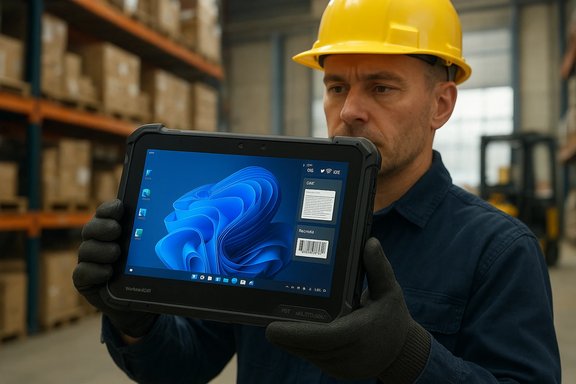
Unitech's announcement of the RT112 Windows tablet marks a milestone: a purpose-built, industrial-grade Windows-on-ARM device that pairs Qualcomm's Dragonwing-class QCM6490 platform with Windows 11 IoT Enterprise LTSC, promising full Windows application compatibility, long battery life, and rugged field-ready hardware for frontline work in logistics, manufacturing, retail and healthcare.
The industrial tablet market has long been dominated by rugged Android devices and x86 Windows tablets that trade off battery life, weight and connectivity for application compatibility. For organizations that depend on legacy Windows software, remote manageability and enterprise security, moving to ARM-based mobile silicon has been held back by software compatibility, driver maturity and vendor validation. Qualcomm’s Dragonwing family (including QCS6490 / QCM6490 variants) and Microsoft’s Windows 11 IoT Enterprise LTSC support have been narrowing that gap, and Unitech’s RT112 Windows is the first mainstream commercial attempt to deliver that combined stack in an industrial‑grade, handheld tablet platform. The RT112 Windows arrives as part of a broader trend toward ARM-based industrial edge devices that offer longer battery life and integrated NPUs for on-device inference. Qualcomm’s Dragonwing‑class silicon is now being integrated across modules and SOMs by multiple partners, and Microsoft has explicitly listed QCS6490 and QCM6490 among processors supported for Windows 11 IoT Enterprise LTSC and related IoT editions — a foundational software assurance for enterprises adopting Windows on Arm in production equipment.
The product’s strengths — integrated 5G/eSIM, Wi‑Fi 6E, rugged MIL‑STD/IP ratings, removable high‑capacity battery and an IoT‑validated Qualcomm platform — make it compelling for targeted frontline use cases. Equally important are the risks: emulation and driver edge cases, sustained thermal performance, and the need to translate vendor TOPS figures into application‑level throughput. A disciplined pilot program and contractual guarantees around images, drivers and spare parts will be essential to turn the RT112’s promise into a dependable production asset for enterprise fleets.
Source: Morningstar https://www.morningstar.com/news/pr...ringing-enterprise-mobility-to-the-frontline/
 Background
The industrial tablet market has long been dominated by rugged Android devices and x86 Windows tablets that trade off battery life, weight and connectivity for application compatibility. For organizations that depend on legacy Windows software, remote manageability and enterprise security, moving to ARM-based mobile silicon has been held back by software compatibility, driver maturity and vendor validation. Qualcomm’s Dragonwing family (including QCS6490 / QCM6490 variants) and Microsoft’s Windows 11 IoT Enterprise LTSC support have been narrowing that gap, and Unitech’s RT112 Windows is the first mainstream commercial attempt to deliver that combined stack in an industrial‑grade, handheld tablet platform. The RT112 Windows arrives as part of a broader trend toward ARM-based industrial edge devices that offer longer battery life and integrated NPUs for on-device inference. Qualcomm’s Dragonwing‑class silicon is now being integrated across modules and SOMs by multiple partners, and Microsoft has explicitly listed QCS6490 and QCM6490 among processors supported for Windows 11 IoT Enterprise LTSC and related IoT editions — a foundational software assurance for enterprises adopting Windows on Arm in production equipment. What Unitech is shipping: key specifications and claims
Form factor and ruggedization
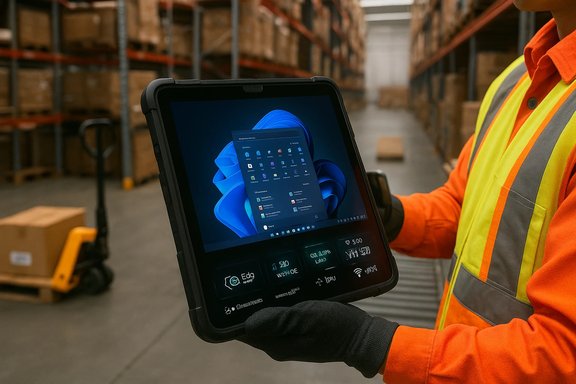
- 10.1" 1920×1200 IPS display with Gorilla Glass and 450 nits brightness; glove and wet‑touch modes supported.
- IP67 ingress protection and MIL‑STD‑810H certification; 1.5 m drop resistance claimed.
- Weight: 690 g; thickness: 12 mm — described as “ultra‑thin” and portable for frontline mobility.
Platform and OS
- Qualcomm Dragonwing QCM6490 5G IoT platform (QCM6490 / QCS6490 family) — an octa‑core Kryo configuration with an integrated Hexagon AI engine. Unitech positions this as the first industrial Windows on Dragonwing tablet.
- Windows 11 IoT Enterprise LTSC preinstalled — offering enterprise servicing cadence and long‑term support for industrial deployments.
Connectivity and power
- Integrated 5G, Wi‑Fi 6E, Bluetooth 5.2 and eSIM support to enable always‑connected workflows.
- 8,800 mAh removable battery intended for full‑shift operation (Unitech cites “full‑shift” runtimes but does not specify industry standard test conditions).
Enterprise features
- Optional long‑range barcode scanning modules (1D/2D up to 10 m), enterprise manageability via Windows tooling, and accessory ecosystem including straps and stylus support.
Why this matters: the practical case for a Windows on ARM industrial tablet
1) Native enterprise compatibility with modern edge efficiency
ARM platforms historically offered best‑in‑class battery efficiency and cellular integration, while Windows has been synonymous with enterprise application compatibility and management. By combining a Dragonwing‑class SoC validated for Windows IoT Enterprise LTSC and a rugged design, Unitech aims to deliver the familiar Windows management stack (Group Policies, Intune, secure boot, TPM/firmware protections) to frontline devices that need marathon battery life and cellular uptime. That mix reduces the friction for IT teams that need Windows‑centric tooling while letting field workers stay mobile for extended shifts.2) On‑device AI and local processing for frontline automation
Dragonwing platforms integrate Hexagon DSP/NPU capabilities (practical NPU ceilings vary by SKU). This enables basic edge inference tasks — barcode validation, OCR normalization, image‑based SKU recognition and simple anomaly detection — without round trips to cloud services. For retail and warehousing scenarios where latency, data cost and intermittent connectivity matter, local AI can materially improve throughput and privacy. Note that TOPS numbers are peak indicators; actual throughput depends on runtime support, thermal budget and memory bandwidth.3) Lower total cost of ownership through longevity and modularity
Industrial customers buy for lifecycle — 5 to 10 years is common. Unitech’s RT112 is built on Qualcomm’s IoT platform family that vendors position for long‑lifecycle availability and module‑level replaceability. The removable battery and modular accessory approach simplify depot servicing and lower MTTR for frontline fleets. However, buyers must confirm explicit lifecycle commitments from Unitech and their SOC/module vendor before large volume purchases.Strengths — where the RT112 Windows legitimately pushes the market forward
- Windows ecosystem access at the edge. Running Windows 11 IoT Enterprise LTSC on an industrial‑grade tablet gives ISVs and enterprise IT a known target for deployment, updates and device management, avoiding some emulation pitfalls of consumer ARM devices.
- Balanced silicon for edge workloads. The QCM6490 / QCS6490 family delivers a mix of CPU, GPU and NPU capability appropriate for typical industrial vision and classification tasks, combined with integrated cellular modems and Wi‑Fi 6E, reducing BOM complexity. Real‑world partners and module vendors are shipping QCS/QCM‑based boards and kits today, which supports integrator confidence.
- Rugged, portable design. Claims of IP67 and MIL‑STD‑810H, with a 690 g weight and 12 mm thickness, make the device a practical field tool where drop resistance, dust/water ingress and ergonomics matter. Swappable batteries and long runtimes reduce vehicle/depot returns.
- Carrier‑grade connectivity. Integrated 5G plus eSIM and Wi‑Fi 6E mean field teams can keep workflows online without tethering, improving real‑time inventory accuracy and operational visibility.
Risks and caveats — what IT buyers should verify before adopting
- Software and driver maturity on Windows‑on‑ARM for industrial peripherals. Industrial deployments depend on drivers for barcode scanners, custom I/O, radios and legacy serial devices. While Microsoft documents support for QCM/QCS‑class chips on Windows 11 IoT Enterprise, driver availability (GPU, NPU SDKs, modem firmware, hardware accelerators) and certified OEM images remain the gating factors for large rollouts. Demand validated, pre‑provisioned Windows IoT images with SLA’d driver support.
- NPU TOPS vs. real inference throughput. Vendors often quote TOPS figures that are helpful for marketing but not determinative for application performance. For vision OCR, SKU recognition and lightweight embedding tasks, the Dragonwing NPU is useful — but integrators must run their models at target quantization and resolution on the actual device under expected ambient temperatures to ensure acceptable latency and throughput. Treat vendor TOPS as an upper bound and require application‑level benchmarking.
- Thermal and sustained performance tradeoffs. Rugged tablets are constrained by passive cooling and thin enclosures. Sustained CPU/NPU performance at real‑world ambient conditions may be significantly lower than peak figures measured in lab profiles. For heavy multi‑camera or continuous inference workloads, test sustained performance across expected ambient ranges.
- Long‑term availability and BOM stability. Industrial customers need long‑term supply, not just a one‑year refresh cycle. Confirm Unitech and Qualcomm/module partner commitments to stocking critical SKUs, spare parts and replacement batteries across the lifetime of deployed fleets. Procure explicit lifecycle agreements where possible.
- Legacy x86 binaries and emulation behaviors. Windows on ARM supports emulation for x86 apps, but some legacy enterprise tools — especially device drivers, low‑level DLLs or custom COM components — may behave differently under emulation. Validate mission‑critical applications on an RT112 evaluation unit before a full fleet deployment.
Deployment and verification checklist for IT and procurement teams
- Request a factory‑provisioned Windows 11 IoT Enterprise LTSC image for the RT112, with a full list of included drivers and their update SLA.
- Run application‑level benchmarks with your actual workloads (barcode scanning cadence, OCR models, inventory lookup latency) on a representative RT112 device to measure latency, CPU/NPU utilization and battery draw.
- Conduct environmental soak tests—battery stress, thermal cycles and sustained inference at expected ambient temperatures—to assess throttling and real‑world throughput.
- Validate peripheral compatibility for enterprise scanners, printers, vehicle docks and legacy serial devices. Obtain signed drivers where necessary.
- Secure lifecycle and spare parts commitments from Unitech (and the QCM/QCS module partner if applicable), including replacement battery availability and depot repair SLAs.
- Confirm eSIM provisioning, carrier roaming rules, and any MNO certifications required for your geography and fleet size. Test in real network conditions and with planned roaming profiles.
Buying guide: who should consider the RT112 Windows
- Enterprises with existing Windows toolchains and ISVs that need a rugged tablet to run full Windows applications at the edge. The RT112 reduces migration cost by offering a Windows management and security model.
- Retailers and warehouses requiring always‑connected mobile terminals with barcode scanning, local OCR and occasional on‑device inference where latency and local privacy matter. The 5G + Wi‑Fi 6E radios and on‑device NPU make this device well‑suited for mobile POS and inventory counting.
- Field service operators and healthcare providers that need ruggedized, disinfectable devices with long battery life and enterprise manageability. Removable batteries and MIL‑STD ratings help keep teams operational.
- Deployments that require continuous, intensive multi‑camera analytics or heavy model inference (large vision models) — such use cases still favor higher‑power edge servers or devices with discrete accelerators.
Industry context and partner validation
Qualcomm’s Dragonwing family has gathered momentum across embedded and module vendors: development kits, SMARC modules and industrial SBCs based on QCS6490/QCM6490 are shipping from multiple suppliers (Tria, Advantech, Quectel et al., and firmware/UEFI providers such as AMI are rolling out support for Dragonwing IoT platforms — an ecosystem signal that the hardware and firmware stack are maturing for Windows and Linux industrial images. Microsoft’s public processor lists also show QCS6490 / QCM6490 explicitly supported for Windows 11 IoT Enterprise LTSC, which underpins Unitech’s claim of a Windows 11 IoT Enterprise device. These independent vendor and platform listings provide the cross‑validation enterprises require before certifying a device for production use. However, vendor ecosystem momentum is not a substitute for product‑level validation: module vendors and system integrators often ship reference designs that later diverge when cellular firmware, modem carrier approvals, or region‑specific certifications are applied. IT teams should therefore treat ecosystem support as a positive signal but still insist on device‑level test reports and SLAs.Unverified or cautionary claims
- Unitech’s PR and product pages reference “full‑shift operation” and long runtime with the 8,800 mAh battery, but they do not publish standardized battery test conditions (screen brightness, radio usage, barcode scanning duty cycle) that allow apples‑to‑apples comparison. Treat unspecified “full‑shift” claims as marketing shorthand until validated in your workload.
- The marketing phrase “world’s first industrial‑grade Windows on Dragonwing tablet” is supportable in the sense that Unitech appears to be the first mainstream OEM shipping a rugged Windows tablet based on the QCM6490 platform; nonetheless, independent third‑party lab verification of claims such as sustained NPU performance, MIL‑STD endurance and battery runtime is recommended before categorically accepting first‑to‑market assertions.
Practical recommendations for pilots and rollouts
- Begin with a 20–50 device pilot rather than a full fleet purchase. Use that pilot to validate not only performance but also manageability, patching cadence, and driver behavior across your critical apps. Include depot cycle testing for battery swaps and accessory interchange.
- Contractually require a signed list of supported peripherals, and insist Unitech provide vendor‑validated Windows IoT images and a driver update schedule for the device’s expected service life. This reduces the risk of stranded hardware due to missing or broken drivers after OS updates.
- If your workflows rely heavily on local computer vision, quantify model performance (fps, latency, energy/inference) on the RT112 under expected ambient temperatures and duty cycles. If results fall short, plan for a hybrid architecture that offloads heavier inference to nearby gateway devices.
- Plan for spare parts and repair logistics up front—removable batteries are an operational win, but you’ll need a depot and spares inventory aligned to expected replacement cycles. Negotiate RMAs, repair SLA windows and replacement part pricing in the contract.
Conclusion
Unitech’s RT112 Windows tablet represents a pragmatic and well‑timed convergence of three trends: Windows entering the ARM industrial edge in validated form, Qualcomm’s Dragonwing‑class platforms maturing for rugged IoT use, and frontline operations demanding devices that combine enterprise software compatibility with mobile efficiency and robust connectivity. For organizations that must keep Windows‑centric applications running at the edge while improving battery life and connectivity, the RT112 is a meaningful new option — provided procurement teams perform the standard industrial due diligence: driver validation, lifecycle commitments, and workload benchmarking.The product’s strengths — integrated 5G/eSIM, Wi‑Fi 6E, rugged MIL‑STD/IP ratings, removable high‑capacity battery and an IoT‑validated Qualcomm platform — make it compelling for targeted frontline use cases. Equally important are the risks: emulation and driver edge cases, sustained thermal performance, and the need to translate vendor TOPS figures into application‑level throughput. A disciplined pilot program and contractual guarantees around images, drivers and spare parts will be essential to turn the RT112’s promise into a dependable production asset for enterprise fleets.
Source: Morningstar https://www.morningstar.com/news/pr...ringing-enterprise-mobility-to-the-frontline/