

United Airlines passengers reported a nationwide systems outage on Saturday morning, July 18, disrupting check-in, boarding and flight operations at multiple airports just as a busy weekend travel day began. Downdetector recorded a sharp increase in reports beginning around 8:16 a.m. Eastern, while traveler accounts from Newark, Chicago O’Hare, San Francisco and Washington Dulles described airport agents unable to check bags or complete boarding.
The scope of the incident remains unclear. United had not publicly identified the cause by late Saturday morning, and neither the Federal Aviation Administration nor the airline had confirmed a nationwide ground stop tied to the outage. But reports from passengers and airline employees indicate the disruption reached beyond a slow website or malfunctioning mobile app: systems used at airport counters and gates appeared to be affected.
As first reported by International Business Times Australia, the outage sparked the #UnitedAirlinesDown tag across X after Downdetector flagged the surge. Subsequent traveler reports pointed to an operational interruption that appeared to be easing at some airports, although a recovery of frontline systems does not immediately erase delays already introduced into a tightly scheduled airline network.
For travelers, a major airline technology failure is rarely experienced as a single error message. It can mean an app that cannot display a boarding pass, a kiosk that cannot issue bag tags, an agent unable to rebook a missed connection, or a gate crew unable to close out a flight for departure.
Those functions are linked by reservation, passenger-service, departure-control, crew and flight-operations systems. A failure in one core service can force manual workarounds in others, particularly when an airline needs to confirm passenger manifests, baggage acceptance, seat assignments, ticket status and flight-release information before pushing back.
Reports Saturday suggested exactly that sort of cascading problem. Passengers at several airports said boarding had stopped or slowed because United systems were unavailable, while others reported delayed bag check-in. A number of travelers later said local announcements indicated systems were returning, but United had not provided a public technical explanation or a timeline for full restoration.
That distinction matters. “Back up” can mean a login page works again; it does not necessarily mean airport teams have cleared the queue of passengers, baggage and aircraft held during an outage. The visible recovery may be only the opening stage of operational recovery.
The difference is consequential. A nationwide FAA failure, such as the January 2023 outage involving the Notice to Air Missions system, restricts departures across the U.S. aviation system. An airline-specific incident can still be severe, but the airline may request its own ground stop, hold particular flights at gates, or delay departures while it restores the systems required to operate them safely.
That is also why the absence of a formal FAA ground-stop notice should not be read as proof that United operations were normal. Carriers can experience widespread passenger-service and flight-dispatch disruption without an FAA-imposed nationwide stop. The airline’s own systems, not the national airspace system, may be the limiting factor.
FlightAware’s nationwide dashboard showed hundreds of delays across U.S. aviation on Saturday, though that aggregate figure cannot establish how many were caused by United’s technology issue rather than weather, airport congestion or ordinary operational problems. United’s own network is especially exposed to disruption at its large hub airports, including Chicago O’Hare, Denver, Houston Intercontinental, Newark, San Francisco and Washington Dulles, where a brief departure pause can rapidly affect later flights and connections.
CBS News reported in February that United was preparing a major SHARES upgrade and had rehearsed its migration process. The airline scheduled a controlled overnight maintenance window around that work, temporarily taking offline its website, mobile app, call centers, agency channels and other booking services. United said flights would not depart during that planned outage, although aircraft already in the air would continue to their destinations.
Saturday’s incident has not been officially connected to SHARES, and it would be premature to make that claim. But the episode illustrates why core reservation infrastructure remains a high-stakes dependency even when most passenger interaction now happens through smartphones, self-service kiosks and web portals.
Airline infrastructure is not merely a consumer app stack. It is a live, interdependent system spanning identity, ticketing, passenger records, aircraft dispatch, crew assignment, payment, baggage and regulatory data. A resilient front end cannot fully protect operations when a central system becomes unavailable.
For Windows and enterprise IT readers, the comparison is familiar: a polished client interface does not eliminate the risk posed by a central identity provider, database cluster, message bus or legacy line-of-business platform. The failure domains are often hidden until a backend dependency blocks an entire workflow.
The lasting damage of an airline outage is frequently not the system downtime itself. Aircraft and crews become separated from their schedules, gates fill up, connection windows disappear, and crews may approach federally mandated duty-time limits. A two-hour systems event can therefore turn into a full-day problem for passengers booked on later legs.
The July 2024 CrowdStrike-related Windows outage provided an industry-wide demonstration of that dynamic. While the initial faulty cybersecurity update was external to the airlines, each carrier’s ability to recover depended on its internal operations, crew systems and customer-service capacity. Delta’s recovery became the most prolonged and costly, drawing scrutiny from the U.S. Department of Transportation after thousands of cancellations.
United’s immediate task Saturday is less about explaining every failed transaction than restoring stable operations and communicating clearly enough that passengers can make decisions. The company has previously emphasized transparency during disruptions, but passengers need details that are operationally useful: whether check-in is working, whether departures are moving, whether a travel waiver applies, and whether a delayed connection remains protected.
Travelers already at the airport should retain screenshots of delays, boarding messages and rebooking offers, along with receipts for eligible out-of-pocket costs. United may issue a travel waiver or flexible-change policy if the event proves broadly disruptive, but none had been formally announced in the early reporting.
The key unresolved point is whether United’s systems have recovered cleanly enough to prevent a second wave of cancellations and missed connections later Saturday. A restored booking or check-in service will be welcome; a stable afternoon operation across United’s hub network is the real test.
The scope of the incident remains unclear. United had not publicly identified the cause by late Saturday morning, and neither the Federal Aviation Administration nor the airline had confirmed a nationwide ground stop tied to the outage. But reports from passengers and airline employees indicate the disruption reached beyond a slow website or malfunctioning mobile app: systems used at airport counters and gates appeared to be affected.
As first reported by International Business Times Australia, the outage sparked the #UnitedAirlinesDown tag across X after Downdetector flagged the surge. Subsequent traveler reports pointed to an operational interruption that appeared to be easing at some airports, although a recovery of frontline systems does not immediately erase delays already introduced into a tightly scheduled airline network.
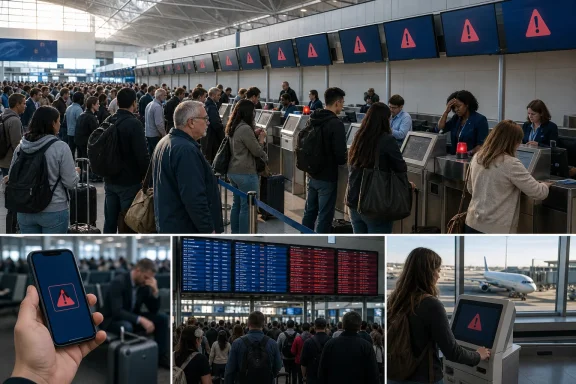 Check-In and Boarding Are the First Systems Passengers Notice
For travelers, a major airline technology failure is rarely experienced as a single error message. It can mean an app that cannot display a boarding pass, a kiosk that cannot issue bag tags, an agent unable to rebook a missed connection, or a gate crew unable to close out a flight for departure.Those functions are linked by reservation, passenger-service, departure-control, crew and flight-operations systems. A failure in one core service can force manual workarounds in others, particularly when an airline needs to confirm passenger manifests, baggage acceptance, seat assignments, ticket status and flight-release information before pushing back.
Reports Saturday suggested exactly that sort of cascading problem. Passengers at several airports said boarding had stopped or slowed because United systems were unavailable, while others reported delayed bag check-in. A number of travelers later said local announcements indicated systems were returning, but United had not provided a public technical explanation or a timeline for full restoration.
That distinction matters. “Back up” can mean a login page works again; it does not necessarily mean airport teams have cleared the queue of passengers, baggage and aircraft held during an outage. The visible recovery may be only the opening stage of operational recovery.
No Evidence Yet of an FAA-Wide Air-Traffic Failure
The FAA’s public operational reporting did not immediately identify a national air-traffic-control system failure connected to United’s Saturday problems. That makes this look, at least initially, like an airline-specific technology incident rather than an event affecting every U.S. carrier.The difference is consequential. A nationwide FAA failure, such as the January 2023 outage involving the Notice to Air Missions system, restricts departures across the U.S. aviation system. An airline-specific incident can still be severe, but the airline may request its own ground stop, hold particular flights at gates, or delay departures while it restores the systems required to operate them safely.
That is also why the absence of a formal FAA ground-stop notice should not be read as proof that United operations were normal. Carriers can experience widespread passenger-service and flight-dispatch disruption without an FAA-imposed nationwide stop. The airline’s own systems, not the national airspace system, may be the limiting factor.
FlightAware’s nationwide dashboard showed hundreds of delays across U.S. aviation on Saturday, though that aggregate figure cannot establish how many were caused by United’s technology issue rather than weather, airport congestion or ordinary operational problems. United’s own network is especially exposed to disruption at its large hub airports, including Chicago O’Hare, Denver, Houston Intercontinental, Newark, San Francisco and Washington Dulles, where a brief departure pause can rapidly affect later flights and connections.
SHARES Remains a Critical Point of Failure
United’s long-running core reservation platform, SHARES, has become a familiar name to frequent flyers whenever the airline suffers a technology interruption. The system sits at the center of reservations and many customer-facing transactions, and United has been working to modernize it rather than simply replace it in one move.CBS News reported in February that United was preparing a major SHARES upgrade and had rehearsed its migration process. The airline scheduled a controlled overnight maintenance window around that work, temporarily taking offline its website, mobile app, call centers, agency channels and other booking services. United said flights would not depart during that planned outage, although aircraft already in the air would continue to their destinations.
Saturday’s incident has not been officially connected to SHARES, and it would be premature to make that claim. But the episode illustrates why core reservation infrastructure remains a high-stakes dependency even when most passenger interaction now happens through smartphones, self-service kiosks and web portals.
Airline infrastructure is not merely a consumer app stack. It is a live, interdependent system spanning identity, ticketing, passenger records, aircraft dispatch, crew assignment, payment, baggage and regulatory data. A resilient front end cannot fully protect operations when a central system becomes unavailable.
For Windows and enterprise IT readers, the comparison is familiar: a polished client interface does not eliminate the risk posed by a central identity provider, database cluster, message bus or legacy line-of-business platform. The failure domains are often hidden until a backend dependency blocks an entire workflow.
Delays Can Outlast the Underlying Outage
United has experienced significant technology disruptions before. In August 2025, an airline technology issue led United to pause departures at major U.S. hubs; The Associated Press reported that more than 1,000 United flights were delayed and hundreds were canceled as the carrier worked through the effects.The lasting damage of an airline outage is frequently not the system downtime itself. Aircraft and crews become separated from their schedules, gates fill up, connection windows disappear, and crews may approach federally mandated duty-time limits. A two-hour systems event can therefore turn into a full-day problem for passengers booked on later legs.
The July 2024 CrowdStrike-related Windows outage provided an industry-wide demonstration of that dynamic. While the initial faulty cybersecurity update was external to the airlines, each carrier’s ability to recover depended on its internal operations, crew systems and customer-service capacity. Delta’s recovery became the most prolonged and costly, drawing scrutiny from the U.S. Department of Transportation after thousands of cancellations.
United’s immediate task Saturday is less about explaining every failed transaction than restoring stable operations and communicating clearly enough that passengers can make decisions. The company has previously emphasized transparency during disruptions, but passengers need details that are operationally useful: whether check-in is working, whether departures are moving, whether a travel waiver applies, and whether a delayed connection remains protected.
Travelers Should Treat Their Flight Status as Volatile
Passengers flying United on Saturday should verify their itinerary through more than one channel before leaving for the airport, particularly if the app or website behaves inconsistently. Airport departure boards, flight-tracking services and gate agents may have more current operational information during a recovery than a cached mobile itinerary.Travelers already at the airport should retain screenshots of delays, boarding messages and rebooking offers, along with receipts for eligible out-of-pocket costs. United may issue a travel waiver or flexible-change policy if the event proves broadly disruptive, but none had been formally announced in the early reporting.
The key unresolved point is whether United’s systems have recovered cleanly enough to prevent a second wave of cancellations and missed connections later Saturday. A restored booking or check-in service will be welcome; a stable afternoon operation across United’s hub network is the real test.
References
- Primary source: International Business Times Australia
Published: 2026-07-18T12:30:55+00:00
United Airlines Down? Service Hit by Nationwide Outage Reports Saturday Morning as Complaints Spike
United Airlines experienced a major system outage, causing widespread disruptions. Passengers faced delays and cancellations, with the airline's SHARES system at the centre of the issue.www.ibtimes.com.au - Related coverage: axios.com
O'Hare Airport capacity concerns: FAA may limit summer flights - Axios Chicago
United and American are being hauled before the FAA after both added several flights.www.axios.com
- Related coverage: cbsnews.com
- Related coverage: trip.com
United Airlines(UA) flights from Jacksonville to Chicago-2026 Cheap Flights | Trip.com
Book Cheap flights operated by United Airlines(UA) flights from Jacksonville to Chicago for less with Trip.com. Compare ticket fares and find the right price for your next trip.www.trip.com