

On May 21, 2026, Microsoft published a customer story saying the University of Kentucky has deployed Microsoft 365 Copilot and related Microsoft AI tools across its campus, organizing more than 150 existing AI efforts into a governed program reaching more than 70,000 students and employees. The headline is not that another university bought another enterprise AI license. It is that UK is trying to turn generative AI from a shadow-IT habit into institutional infrastructure. That makes the university a useful case study for anyone wondering whether Copilot is becoming an optional productivity add-on or the next layer of managed computing.
The University of Kentucky’s Copilot story begins in the same place many enterprise AI stories now begin: not with a procurement decision, but with a mess. By 2024, according to Microsoft’s account, UK found more than 150 separate AI initiatives already underway across classrooms, labs, administrative departments, and clinical settings. That number is the real tell. The AI era did not wait for central IT to finish a standards document.
For universities, that sprawl is both opportunity and threat. Faculty want experimentation, students want access, researchers want acceleration, administrators want efficiency, and clinicians want less paperwork. Left alone, those pressures produce a familiar pattern: scattered pilots, uneven data handling, inconsistent licensing, unclear ownership, and a governance model that arrives after the habits have already formed.
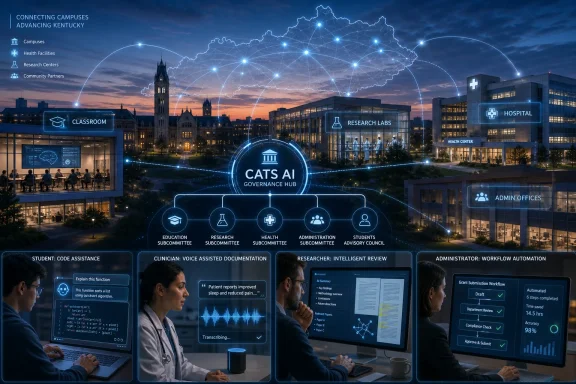
UK’s answer was to build what it calls the CATS AI framework, a governance structure with subcommittees for research, education, health, administration, and students. That may sound bureaucratic, but bureaucracy is not always the enemy here. In a large institution, governance is the price of scaling something beyond enthusiasts and early adopters.
The important move is that UK did not frame AI as merely an IT rollout. It framed AI as an institutional capability. That distinction matters because Copilot does not behave like a conventional application. It touches email, documents, meetings, code, clinical notes, student work, data access, and institutional culture. Treating it like a software deployment underestimates both its reach and its risk.
UK’s more interesting move is the way it maps that portfolio onto the university’s own complexity. The university is not just a campus with lecture halls. It has hospitals, clinics, research programs, professional schools, agricultural outreach, and a land-grant mission that extends across all 120 Kentucky counties. If Copilot can work there, Microsoft can argue that it can work almost anywhere.
That is the strategic value of this deployment for Redmond. Higher education is a particularly unforgiving test bed because it combines enterprise IT, consumer expectations, research computing, protected data, and political sensitivity. Students behave like consumers, faculty behave like independent operators, researchers behave like specialized power users, and healthcare staff operate under intense regulatory and safety pressure.
The Copilot pitch is that one platform can serve all of those constituencies without forcing them into the same workflow. The risk is that one platform can also become a monoculture. Once email, documents, code assistance, clinical documentation, low-code automation, and student-facing projects all orbit the same vendor ecosystem, switching costs become more than financial. They become cultural.
UK appears to understand that the platform decision is inseparable from governance. Its CATS AI model is not just a steering committee for Microsoft tools. It is an attempt to decide who gets to define responsible use when AI becomes ambient across the university.
Most institutions have approached generative AI cautiously, with pilots, opt-in cohorts, center-of-excellence experiments, or tightly bounded departmental programs. UK’s approach pushes in the opposite direction: make access universal, then shape usage through governance, training, and institutional norms. That is a bet that unequal access is itself a risk.
There is a fairness argument here that should not be dismissed. If only privileged students, well-funded departments, or technically confident employees get access to advanced AI tools, then generative AI becomes another accelerator of inequality. A rural first-generation student and a student who has been coding since middle school do not arrive at the same starting line. Universal access is one way to keep the gap from widening.
But universal access also changes the job of IT. The problem is no longer whether AI will be used. It is how to manage identity, permissions, retention, auditability, acceptable use, model output, student conduct, faculty autonomy, accessibility, and support at population scale. Copilot inherits the permissions and data boundaries of Microsoft 365, but institutional risk does not vanish just because access controls exist.
For WindowsForum readers, this is the enterprise lesson hiding inside the campus story. The next phase of AI adoption will not be defined by who runs the cleverest pilot. It will be defined by who can survive success.
The institutional sales pitch around AI often leans on abstractions: productivity, transformation, acceleration, innovation. Student use cases are messier and more concrete. They involve writing emails faster, building tools without waiting for a developer, studying difficult subjects, and turning an idea into a working artifact before motivation evaporates.
That is where GitHub Copilot becomes more than a developer tool. In a university setting, code assistance can collapse the distance between a student’s domain knowledge and a functioning prototype. A biomedical engineering student does not need to become a full-stack engineer to test an idea. A medical student does not need to master every layer of software development to build a learning tool.
This shift has a real pedagogical edge. If AI lets students produce more polished work faster, educators must separate output quality from learning quality. A better draft, a working prototype, or a fluent explanation is not proof that the student understands the material. It is proof that the student can operate with a powerful assistant.
That does not make AI bad for learning. It makes assessment harder. Universities that deploy Copilot broadly must stop pretending that banning or detecting AI use is a durable strategy. The more serious work is designing assignments, clinical exercises, lab work, writing tasks, and coding projects that assume AI exists and require students to demonstrate judgment.
Microsoft’s story highlights Dragon Copilot in clinical settings, using ambient listening to capture and transcribe patient encounters so clinicians can focus more directly on the people in front of them. This is the kind of AI use case that feels less like novelty and more like infrastructure. The computer fades slightly into the background, and the human interaction moves back toward the center.
That is the ideal. The hard part is everything around it. Clinical AI has to contend with protected health information, consent, record accuracy, liability, bias, workflow integration, and the social dynamics of being recorded in a medical setting. A generated note is not merely a productivity artifact. It becomes part of a patient’s history.
Still, the appeal is obvious. If a physician can listen rather than type, patients may feel more heard. If clinicians can leave work with fewer unfinished notes, burnout pressure may ease. If structured data improves downstream, care teams may benefit from better continuity.
The danger is that institutions confuse documentation speed with clinical improvement. An AI-generated note can be faster and still wrong. It can be complete and still misleading. The responsible measure is not whether the system saves time in isolation, but whether it improves care, reduces burden, and maintains trust under real operating conditions.
UK’s framework divides responsibility across research, education, health, administration, and students. That structure acknowledges that AI risk is not uniform. A chatbot used to brainstorm a campus newsletter does not carry the same stakes as a system used in clinical documentation or research involving sensitive data. A faculty member’s grading workflow raises different concerns than a student’s coding assistant.
This is where many AI strategies fail. They either centralize everything so tightly that no one can move, or decentralize everything so completely that no one is accountable. UK’s model tries to split the difference by creating a shared governance table while leaving room for domain-specific judgment.
That matters because generative AI is not a single technology with a single policy surface. It is a general-purpose layer that changes behavior differently depending on where it lands. In administration, it may compress routine writing and meeting work. In research, it may accelerate analysis or literature workflows. In education, it may challenge assessment. In healthcare, it may reshape documentation and patient interaction.
The uncomfortable truth is that governance will never be finished. Microsoft’s own products are evolving rapidly, and institutional practices will evolve with them. A policy written for today’s Copilot experience may be inadequate when agents become more autonomous, when workflows cross more systems, or when students and staff begin building custom automations at scale.
In that context, UK’s AI strategy is not simply a campus modernization project. It is presented as part of a statewide economic and civic mission. President Eli Capilouto frames the university’s role as helping Kentuckians participate in a rapidly advancing economy, not watching technological change concentrate opportunity somewhere else.
This framing matters because AI adoption is becoming politically charged. If institutions present AI as a cost-cutting tool, workers hear displacement. If they present it as a prestige technology, communities hear exclusion. If they present it as a shared capability, the argument becomes more defensible — but only if the benefits are visible beyond the executive slide deck.
UK’s statewide footprint gives it a chance to test that claim. A university with clinics, extension programs, professional schools, and county-level relationships can potentially spread AI literacy beyond campus boundaries. It can also discover where the promises break down: in broadband access, training gaps, procurement limits, privacy concerns, or skepticism from communities that have seen technology waves come and go.
That is why the rural-student argument in Microsoft’s story is not incidental. If AI access becomes another marker of institutional privilege, public universities will have failed one of their central obligations. If they can make AI competence part of broad public education, they may blunt some of the inequality that otherwise follows new technology.
That is classic Microsoft. The company’s greatest enterprise strength has always been bundling workflow, identity, administration, and developer gravity into something that feels inevitable. Windows did this on the desktop. Office did this for productivity. Active Directory did this for identity. Microsoft 365 did it again in the cloud. Copilot is Microsoft’s attempt to make AI the next managed layer.
The University of Kentucky is a particularly good showcase because it demonstrates breadth. The same institutional story can include student writing, coding, clinical notes, research acceleration, low-code automation, and governance. That breadth is precisely what Microsoft wants buyers to internalize: do not buy a chatbot; buy the stack.
There are benefits to that stack logic. A single vendor environment can reduce fragmentation, simplify licensing, centralize identity, improve compliance posture, and make training easier. If users already live in Microsoft 365, Copilot’s advantage is proximity. It meets them where their work already sits.
There are also risks. Platform consolidation can narrow institutional imagination. The more an organization standardizes on one vendor’s AI assumptions, the harder it becomes to evaluate alternatives on their merits. The governance question is not only “Is this tool safe?” It is also “Are we becoming dependent on one company’s definition of intelligent work?”
The old endpoint-centric worldview is insufficient. A managed Windows device still matters, but AI productivity now spans cloud identity, Microsoft Graph data, SharePoint permissions, Teams meetings, Exchange mailboxes, browser sessions, mobile access, and third-party integrations. The “PC” is increasingly just one window into a much larger governed data estate.
That makes hygiene work more important, not less. Organizations that have tolerated messy permissions, abandoned SharePoint sites, overbroad Teams access, poorly classified data, and inconsistent retention policies may find that Copilot turns old clutter into a new risk surface. AI does not magically know which institutional knowledge is authoritative. It retrieves from the environment it is allowed to see.
For sysadmins, this is a career inflection point. The valuable work is shifting from device control alone toward information architecture, identity governance, data lifecycle management, and user enablement. The administrator who can explain why Copilot surfaced the wrong document — and fix the underlying permissions model — will be more useful than the administrator who treats AI as a help desk curiosity.
This also means Windows shops need to get more serious about training. Not inspirational AI training, but operational training: what users should ask, what they should not paste, how they should verify output, where sensitive data belongs, how meeting summaries are retained, and when a generated answer is not evidence.
UK leadership appears to know this. The story points toward outcomes such as accelerating life-saving research and measuring whether AI helps find new drugs faster. That is the right level of ambition, but it is also where causality becomes difficult. Universities are complex systems. Many things can improve at once, and AI vendors will be tempted to claim more credit than the evidence supports.
The strongest AI measurement programs will combine productivity, quality, safety, equity, and adoption. A saved hour is not enough if the output requires more review. Higher usage is not enough if only confident users benefit. More generated content is not enough if faculty spend more time detecting shallow work. Faster documentation is not enough if clinical trust erodes.
The trap is measuring what Copilot makes easy to measure. Prompt counts, active users, generated summaries, and time-saved surveys can be useful indicators, but they can also flatter the deployment. The real questions are harder: Did students learn more? Did staff burn out less? Did research move faster? Did patients receive better care? Did rural communities gain access to opportunity that they otherwise would have missed?
For public institutions, those questions are not optional. A university can justify experimentation. It cannot justify permanent transformation on vibes.
Students may over-rely on generated explanations. Staff may paste sensitive information into the wrong workflow. Faculty may disagree about acceptable use. Clinicians may trust a draft note too quickly. Administrators may automate a process that should have been redesigned rather than accelerated. Researchers may face new questions about attribution, reproducibility, and data handling.
None of these risks is a reason to freeze adoption. They are reasons to treat AI as a managed institutional transition rather than a software perk. The organizations that do best will not be the ones that pretend AI is harmless. They will be the ones that build review, training, escalation, and accountability into daily practice.
There is also a labor dimension that universities should confront honestly. Productivity tools often arrive with the promise of relieving drudgery, and sometimes they do. But they can also raise expectations, compress timelines, and normalize higher output without reducing workload. If AI turns every employee into a faster producer of documents, meetings, notes, and messages, the institution may simply move the treadmill faster.
The better version is different. AI should remove low-value work so people can spend more time on teaching, discovery, care, mentoring, and service. That outcome will not happen automatically. It has to be designed.
 Kentucky Turns AI Sprawl Into an Operating Model
The University of Kentucky’s Copilot story begins in the same place many enterprise AI stories now begin: not with a procurement decision, but with a mess. By 2024, according to Microsoft’s account, UK found more than 150 separate AI initiatives already underway across classrooms, labs, administrative departments, and clinical settings. That number is the real tell. The AI era did not wait for central IT to finish a standards document.For universities, that sprawl is both opportunity and threat. Faculty want experimentation, students want access, researchers want acceleration, administrators want efficiency, and clinicians want less paperwork. Left alone, those pressures produce a familiar pattern: scattered pilots, uneven data handling, inconsistent licensing, unclear ownership, and a governance model that arrives after the habits have already formed.
UK’s answer was to build what it calls the CATS AI framework, a governance structure with subcommittees for research, education, health, administration, and students. That may sound bureaucratic, but bureaucracy is not always the enemy here. In a large institution, governance is the price of scaling something beyond enthusiasts and early adopters.
The important move is that UK did not frame AI as merely an IT rollout. It framed AI as an institutional capability. That distinction matters because Copilot does not behave like a conventional application. It touches email, documents, meetings, code, clinical notes, student work, data access, and institutional culture. Treating it like a software deployment underestimates both its reach and its risk.
Microsoft Sells the Suite, but UK Sells the System
Microsoft’s customer story naturally presents the deployment as a validation of its AI portfolio. Microsoft 365 Copilot is the broad access layer, Dragon Copilot is the healthcare workflow layer, GitHub Copilot is the creation and coding layer, Azure is the secure foundation, and Power Platform is the low-code extension layer. That is the commercial architecture Microsoft wants the market to see.UK’s more interesting move is the way it maps that portfolio onto the university’s own complexity. The university is not just a campus with lecture halls. It has hospitals, clinics, research programs, professional schools, agricultural outreach, and a land-grant mission that extends across all 120 Kentucky counties. If Copilot can work there, Microsoft can argue that it can work almost anywhere.
That is the strategic value of this deployment for Redmond. Higher education is a particularly unforgiving test bed because it combines enterprise IT, consumer expectations, research computing, protected data, and political sensitivity. Students behave like consumers, faculty behave like independent operators, researchers behave like specialized power users, and healthcare staff operate under intense regulatory and safety pressure.
The Copilot pitch is that one platform can serve all of those constituencies without forcing them into the same workflow. The risk is that one platform can also become a monoculture. Once email, documents, code assistance, clinical documentation, low-code automation, and student-facing projects all orbit the same vendor ecosystem, switching costs become more than financial. They become cultural.
UK appears to understand that the platform decision is inseparable from governance. Its CATS AI model is not just a steering committee for Microsoft tools. It is an attempt to decide who gets to define responsible use when AI becomes ambient across the university.
The 100 Percent Deployment Is the Provocation
The most attention-grabbing claim in Microsoft’s story is that UK achieved “100 percent deployment” across campus, giving more than 70,000 students and employees access to Copilot. In enterprise software terms, that is a remarkable number. In AI terms, it is also a provocation.Most institutions have approached generative AI cautiously, with pilots, opt-in cohorts, center-of-excellence experiments, or tightly bounded departmental programs. UK’s approach pushes in the opposite direction: make access universal, then shape usage through governance, training, and institutional norms. That is a bet that unequal access is itself a risk.
There is a fairness argument here that should not be dismissed. If only privileged students, well-funded departments, or technically confident employees get access to advanced AI tools, then generative AI becomes another accelerator of inequality. A rural first-generation student and a student who has been coding since middle school do not arrive at the same starting line. Universal access is one way to keep the gap from widening.
But universal access also changes the job of IT. The problem is no longer whether AI will be used. It is how to manage identity, permissions, retention, auditability, acceptable use, model output, student conduct, faculty autonomy, accessibility, and support at population scale. Copilot inherits the permissions and data boundaries of Microsoft 365, but institutional risk does not vanish just because access controls exist.
For WindowsForum readers, this is the enterprise lesson hiding inside the campus story. The next phase of AI adoption will not be defined by who runs the cleverest pilot. It will be defined by who can survive success.
The Classroom Becomes a Test of AI Literacy, Not Just AI Access
UK’s student examples are deliberately human-scale. A biomedical engineering sophomore uses GitHub Copilot to build a website for her sorority’s philanthropy and says the project doubled donations for a domestic violence shelter. Medical students build an AI-driven Socratic Tutor to help peers work through complex material. These are not moonshot examples, and that is why they matter.The institutional sales pitch around AI often leans on abstractions: productivity, transformation, acceleration, innovation. Student use cases are messier and more concrete. They involve writing emails faster, building tools without waiting for a developer, studying difficult subjects, and turning an idea into a working artifact before motivation evaporates.
That is where GitHub Copilot becomes more than a developer tool. In a university setting, code assistance can collapse the distance between a student’s domain knowledge and a functioning prototype. A biomedical engineering student does not need to become a full-stack engineer to test an idea. A medical student does not need to master every layer of software development to build a learning tool.
This shift has a real pedagogical edge. If AI lets students produce more polished work faster, educators must separate output quality from learning quality. A better draft, a working prototype, or a fluent explanation is not proof that the student understands the material. It is proof that the student can operate with a powerful assistant.
That does not make AI bad for learning. It makes assessment harder. Universities that deploy Copilot broadly must stop pretending that banning or detecting AI use is a durable strategy. The more serious work is designing assignments, clinical exercises, lab work, writing tasks, and coding projects that assume AI exists and require students to demonstrate judgment.
The Clinic Is Where the Productivity Argument Gets Serious
The healthcare piece of UK’s deployment is not just another vertical-market anecdote. It points to one of the strongest practical arguments for AI in institutional settings: professionals are drowning in documentation. If AI can reduce the administrative drag on clinicians without compromising safety, privacy, or accuracy, the value proposition becomes easier to understand.Microsoft’s story highlights Dragon Copilot in clinical settings, using ambient listening to capture and transcribe patient encounters so clinicians can focus more directly on the people in front of them. This is the kind of AI use case that feels less like novelty and more like infrastructure. The computer fades slightly into the background, and the human interaction moves back toward the center.
That is the ideal. The hard part is everything around it. Clinical AI has to contend with protected health information, consent, record accuracy, liability, bias, workflow integration, and the social dynamics of being recorded in a medical setting. A generated note is not merely a productivity artifact. It becomes part of a patient’s history.
Still, the appeal is obvious. If a physician can listen rather than type, patients may feel more heard. If clinicians can leave work with fewer unfinished notes, burnout pressure may ease. If structured data improves downstream, care teams may benefit from better continuity.
The danger is that institutions confuse documentation speed with clinical improvement. An AI-generated note can be faster and still wrong. It can be complete and still misleading. The responsible measure is not whether the system saves time in isolation, but whether it improves care, reduces burden, and maintains trust under real operating conditions.
Governance Is the Product Nobody Wants to Buy
The CATS AI framework is the least glamorous part of UK’s story, and probably the most important. Generative AI adoption has a way of exposing weak institutional muscles. If an organization cannot clearly answer who owns the policy, who approves tools, who evaluates risk, who trains users, and who responds when something goes wrong, AI will find the seams.UK’s framework divides responsibility across research, education, health, administration, and students. That structure acknowledges that AI risk is not uniform. A chatbot used to brainstorm a campus newsletter does not carry the same stakes as a system used in clinical documentation or research involving sensitive data. A faculty member’s grading workflow raises different concerns than a student’s coding assistant.
This is where many AI strategies fail. They either centralize everything so tightly that no one can move, or decentralize everything so completely that no one is accountable. UK’s model tries to split the difference by creating a shared governance table while leaving room for domain-specific judgment.
That matters because generative AI is not a single technology with a single policy surface. It is a general-purpose layer that changes behavior differently depending on where it lands. In administration, it may compress routine writing and meeting work. In research, it may accelerate analysis or literature workflows. In education, it may challenge assessment. In healthcare, it may reshape documentation and patient interaction.
The uncomfortable truth is that governance will never be finished. Microsoft’s own products are evolving rapidly, and institutional practices will evolve with them. A policy written for today’s Copilot experience may be inadequate when agents become more autonomous, when workflows cross more systems, or when students and staff begin building custom automations at scale.
The Land-Grant Mission Gives the Story Its Political Weight
Microsoft’s customer story leans heavily on the University of Kentucky’s identity as a land-grant institution. That is not mere branding. Land-grant universities carry a public-service mission that extends beyond credentialing students and publishing research. They are supposed to help translate knowledge into public benefit.In that context, UK’s AI strategy is not simply a campus modernization project. It is presented as part of a statewide economic and civic mission. President Eli Capilouto frames the university’s role as helping Kentuckians participate in a rapidly advancing economy, not watching technological change concentrate opportunity somewhere else.
This framing matters because AI adoption is becoming politically charged. If institutions present AI as a cost-cutting tool, workers hear displacement. If they present it as a prestige technology, communities hear exclusion. If they present it as a shared capability, the argument becomes more defensible — but only if the benefits are visible beyond the executive slide deck.
UK’s statewide footprint gives it a chance to test that claim. A university with clinics, extension programs, professional schools, and county-level relationships can potentially spread AI literacy beyond campus boundaries. It can also discover where the promises break down: in broadband access, training gaps, procurement limits, privacy concerns, or skepticism from communities that have seen technology waves come and go.
That is why the rural-student argument in Microsoft’s story is not incidental. If AI access becomes another marker of institutional privilege, public universities will have failed one of their central obligations. If they can make AI competence part of broad public education, they may blunt some of the inequality that otherwise follows new technology.
Copilot Becomes the New Enterprise Default
For Microsoft, the UK deployment is one more brick in a larger wall. Copilot is not being sold as a standalone chatbot. It is being woven into Microsoft 365, Teams, Outlook, Word, Excel, PowerPoint, GitHub, security tooling, healthcare documentation, and the broader Azure platform. The strategy is to make AI feel less like a destination and more like a native mode of work.That is classic Microsoft. The company’s greatest enterprise strength has always been bundling workflow, identity, administration, and developer gravity into something that feels inevitable. Windows did this on the desktop. Office did this for productivity. Active Directory did this for identity. Microsoft 365 did it again in the cloud. Copilot is Microsoft’s attempt to make AI the next managed layer.
The University of Kentucky is a particularly good showcase because it demonstrates breadth. The same institutional story can include student writing, coding, clinical notes, research acceleration, low-code automation, and governance. That breadth is precisely what Microsoft wants buyers to internalize: do not buy a chatbot; buy the stack.
There are benefits to that stack logic. A single vendor environment can reduce fragmentation, simplify licensing, centralize identity, improve compliance posture, and make training easier. If users already live in Microsoft 365, Copilot’s advantage is proximity. It meets them where their work already sits.
There are also risks. Platform consolidation can narrow institutional imagination. The more an organization standardizes on one vendor’s AI assumptions, the harder it becomes to evaluate alternatives on their merits. The governance question is not only “Is this tool safe?” It is also “Are we becoming dependent on one company’s definition of intelligent work?”
The Windows Angle Is Quiet but Real
This story is not about Windows in the narrow sense. There is no new Start menu, no driver model, no Patch Tuesday drama. But for Windows-oriented IT pros, the implications are unmistakable. Copilot’s rise is changing what it means to manage a Microsoft environment.The old endpoint-centric worldview is insufficient. A managed Windows device still matters, but AI productivity now spans cloud identity, Microsoft Graph data, SharePoint permissions, Teams meetings, Exchange mailboxes, browser sessions, mobile access, and third-party integrations. The “PC” is increasingly just one window into a much larger governed data estate.
That makes hygiene work more important, not less. Organizations that have tolerated messy permissions, abandoned SharePoint sites, overbroad Teams access, poorly classified data, and inconsistent retention policies may find that Copilot turns old clutter into a new risk surface. AI does not magically know which institutional knowledge is authoritative. It retrieves from the environment it is allowed to see.
For sysadmins, this is a career inflection point. The valuable work is shifting from device control alone toward information architecture, identity governance, data lifecycle management, and user enablement. The administrator who can explain why Copilot surfaced the wrong document — and fix the underlying permissions model — will be more useful than the administrator who treats AI as a help desk curiosity.
This also means Windows shops need to get more serious about training. Not inspirational AI training, but operational training: what users should ask, what they should not paste, how they should verify output, where sensitive data belongs, how meeting summaries are retained, and when a generated answer is not evidence.
The Productivity Story Still Needs Harder Measurements
Microsoft’s customer story includes striking examples: clinical documentation support, faster student communication, doubled donations through a student-built philanthropy site, and the creation of Socratic Tutor. These anecdotes are useful, but they are not the same as institutional proof. The next phase requires measurement that survives contact with budgets and audits.UK leadership appears to know this. The story points toward outcomes such as accelerating life-saving research and measuring whether AI helps find new drugs faster. That is the right level of ambition, but it is also where causality becomes difficult. Universities are complex systems. Many things can improve at once, and AI vendors will be tempted to claim more credit than the evidence supports.
The strongest AI measurement programs will combine productivity, quality, safety, equity, and adoption. A saved hour is not enough if the output requires more review. Higher usage is not enough if only confident users benefit. More generated content is not enough if faculty spend more time detecting shallow work. Faster documentation is not enough if clinical trust erodes.
The trap is measuring what Copilot makes easy to measure. Prompt counts, active users, generated summaries, and time-saved surveys can be useful indicators, but they can also flatter the deployment. The real questions are harder: Did students learn more? Did staff burn out less? Did research move faster? Did patients receive better care? Did rural communities gain access to opportunity that they otherwise would have missed?
For public institutions, those questions are not optional. A university can justify experimentation. It cannot justify permanent transformation on vibes.
The Risks Are Manageable, but Not Small
It is tempting to read UK’s campus-wide deployment as a clean success story: governance established, Microsoft stack selected, access expanded, innovation unleashed. The reality is more complicated. Broad AI deployment increases the number of people who can benefit, but it also increases the number of people who can make mistakes.Students may over-rely on generated explanations. Staff may paste sensitive information into the wrong workflow. Faculty may disagree about acceptable use. Clinicians may trust a draft note too quickly. Administrators may automate a process that should have been redesigned rather than accelerated. Researchers may face new questions about attribution, reproducibility, and data handling.
None of these risks is a reason to freeze adoption. They are reasons to treat AI as a managed institutional transition rather than a software perk. The organizations that do best will not be the ones that pretend AI is harmless. They will be the ones that build review, training, escalation, and accountability into daily practice.
There is also a labor dimension that universities should confront honestly. Productivity tools often arrive with the promise of relieving drudgery, and sometimes they do. But they can also raise expectations, compress timelines, and normalize higher output without reducing workload. If AI turns every employee into a faster producer of documents, meetings, notes, and messages, the institution may simply move the treadmill faster.
The better version is different. AI should remove low-value work so people can spend more time on teaching, discovery, care, mentoring, and service. That outcome will not happen automatically. It has to be designed.
Kentucky’s Copilot Bet Comes Down to These Practical Tests
The University of Kentucky’s deployment is best understood not as proof that campus-wide AI works, but as an unusually serious attempt to find out. The meaningful details are not just the Microsoft tools, but the combination of universal access, domain-specific governance, clinical integration, student creation, and a public-service mission.- UK’s most important move was organizing more than 150 scattered AI efforts into a governed institutional framework rather than letting adoption remain informal.
- The campus-wide Copilot deployment reframes AI access as an equity issue, not merely a productivity upgrade for selected departments.
- The healthcare use of Dragon Copilot offers one of the strongest value cases, but it also carries the highest burden for accuracy, privacy, and trust.
- GitHub Copilot’s role in student projects shows how AI can turn non-specialists into builders, which will force universities to rethink assessment and digital literacy.
- Microsoft’s platform advantage is real because Copilot sits close to existing work, but that same convenience raises long-term questions about dependency and lock-in.
- The deployment’s success should ultimately be judged by outcomes in learning, research, care, and public service, not by license coverage or anecdotal time savings.
References
- Primary source: Microsoft
Published: 2026-05-20T20:30:07.991866
University of Kentucky sparks campus-wide innovation with Microsoft 365 Copilot | Microsoft Customer Stories
The University of Kentucky uses its CATS AI framework to scale Microsoft AI solutions for 70,000+ users across campus and healthcare.www.microsoft.com
