

Microsoft’s AI Stack Still Needs a Data Plumbing Layer
The most important line in Unstructured’s Business Wire announcement is not the product list, the marketplace language, or the Fortune 1000 adoption claim. It is Brian Raymond’s blunt formulation: “Enterprise AI is only as effective as the data that powers it.” That sentence captures the problem Microsoft, Unstructured, and every enterprise AI vendor now has to solve: companies bought the cloud, adopted collaboration platforms, accumulated petabytes of files, and then discovered that large language models do not magically understand their internal sprawl.
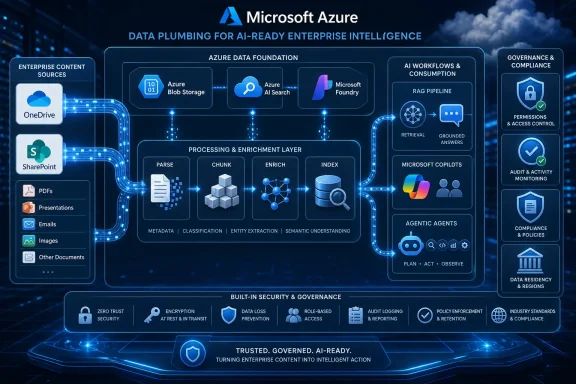
Unstructured describes itself as an enterprise platform for transforming unstructured data into AI-ready structured data. In practice, that means doing the work between storage and inference: ingesting content, parsing it, chunking it, enriching it, and preparing it for systems such as large language models, AI search, copilots, RAG pipelines, and agentic workflows. That middle layer is increasingly where enterprise AI projects are won or lost.
Microsoft has spent the past several years positioning Azure as the enterprise control plane for AI. But the company’s strongest customers are not greenfield AI startups with tidy datasets. They are banks, hospitals, insurers, pharmaceutical firms, government agencies, and large enterprises whose most valuable information is buried in files, emails, slide decks, PDFs, images, and content systems designed for humans rather than models.
That is why this collaboration matters. It places Unstructured directly inside the Azure enterprise AI story: native ingestion from Azure services such as Azure Blob Storage, preparation for indexing in Azure AI Search, and use with Microsoft Foundry. It also makes procurement easier through Microsoft Marketplace and private offer capabilities, a detail that sounds dull until you have watched a promising AI pilot die in vendor review, security review, or budget alignment.
The announcement is careful, but the implication is aggressive. Microsoft wants Azure to be where enterprise AI workloads run. Unstructured wants to be the data transformation layer that makes those workloads useful. The customer wants the output without losing control of the content, compliance posture, or governance model. This collaboration is built around that triangle.
The RAG Era Exposed a Hard Truth About Enterprise Content
Retrieval-augmented generation promised a practical bridge between general-purpose models and enterprise-specific knowledge. Instead of retraining a model on every internal document, a company could retrieve relevant information from its own corpus and feed that context into a model at query time. In theory, RAG gave enterprises a way to make AI accurate, current, and grounded in approved internal content.
In practice, RAG exposed the condition of the enterprise document estate. PDFs are inconsistent. Presentations bury key facts in visual layouts. Emails mix signal with conversational noise. Images require extraction and interpretation. Documents include headers, footers, tables, scanned pages, legal boilerplate, version conflicts, and permissions assumptions that were never designed for automated reasoning.
Unstructured’s pitch is that these problems are not edge cases; they are the normal state of enterprise data. The company says its platform can ingest and preprocess data from more than 64 file types, and the Azure collaboration emphasizes the ability to parse, chunk, enrich, and prepare large volumes of unstructured enterprise content. That is the work that determines whether a RAG system gives a useful answer or confidently retrieves the wrong paragraph from the wrong version of a policy document.
Gustavo Blum, Microsoft’s VP Partner Development and Sales, framed the same challenge from Microsoft’s side, saying that “preparing unstructured enterprise data for AI systems has become a critical challenge” as companies scale generative AI initiatives. That is a vendor quote, but it is also a realistic description of the production bottleneck. The first wave of enterprise AI was about access to models. The next wave is about access to clean, governed, semantically useful data.
The distinction matters for IT teams because most failed enterprise AI projects do not fail at the prompt box. They fail earlier, when teams underestimate how much normalization, extraction, indexing, access control mapping, and lifecycle management their content requires. A chatbot over a folder is easy. A reliable AI workflow over regulated enterprise content is not.
Azure Is Becoming the Place Where AI Data Preparation Gets Institutionalized
The Azure angle is not incidental. Unstructured’s announcement says the collaboration is designed for AI workloads running on Azure, with native connectors ingesting from Azure services and data prepared for Azure AI Search and Microsoft Foundry. That means the story is less about exporting enterprise data into a separate AI island and more about embedding data preparation inside the cloud environment many Microsoft customers already use.
That distinction matters to regulated industries. The announcement names financial services, healthcare, insurance, pharmaceuticals, and government as target enterprise sectors. Those organizations are not just asking whether an AI system works. They are asking where data flows, who can access it, how procurement is approved, how security controls are maintained, and whether the AI stack fits into existing governance.
Unstructured’s Azure-native deployment claim speaks directly to that anxiety. The company says Unstructured can run within customer Azure environments, enabling organizations to maintain security, compliance, and data governance controls. For enterprise IT, that is the difference between “upload your documents to a third-party AI service” and “process sensitive content inside the environment where your controls already live.”
This does not eliminate risk. It moves the risk into a more familiar operating model. Administrators still have to validate permissions, retention obligations, data classifications, connector behavior, and indexing boundaries. But they can do so inside the Azure procurement and deployment frame rather than inventing a parallel AI data pipeline with its own exceptions.
The Microsoft Marketplace piece is similarly practical. The announcement says enterprises can procure Unstructured through Microsoft Marketplace, with private offer capabilities supporting procurement and deployment flexibility. That matters because many large companies have cloud commitments, approved vendor paths, and negotiated procurement processes that shape technical decisions as much as architecture diagrams do. If an AI infrastructure component can ride through existing Microsoft procurement channels, it has a better chance of surviving the jump from pilot to production.
The Collaboration Is Really About the Layer Between Storage and Copilots
Microsoft’s public AI narrative often centers on copilots, models, developer tools, and cloud-scale services. Unstructured’s announcement focuses on the layer beneath that experience: the preparation of content so those systems can retrieve, reason over, and act on the right information. It is the least glamorous layer, but it may be the most operationally important.
The collaboration’s named capabilities show the shape of that layer. AI-ready data transformation covers parsing, chunking, enrichment, and preparation for RAG pipelines, AI agents, copilots, and enterprise search. Deep Azure AI integration connects the work to Microsoft Foundry, IQ described in the announcement as Azure AI Search, Azure Blob Storage, and Microsoft Foundry again. Azure-native deployment puts the processing inside customer Azure environments. Marketplace availability addresses procurement. Enterprise content connectivity brings in more than 30 connectors, including Microsoft OneDrive, SharePoint, and Azure Blob Storage.
That set of capabilities maps neatly to the actual sequence of enterprise AI adoption. First, find the content. Then extract it. Then structure it. Then index it. Then govern it. Then connect it to models, search, copilots, and agents. The industry talks about the last step because it is visible to executives and end users. The expensive failures usually happen in the first five.
For WindowsForum readers, the OneDrive and SharePoint references are not minor. In Microsoft-heavy organizations, those systems often hold the working memory of the business: proposals, policies, meeting artifacts, project histories, customer records, compliance evidence, and department-specific knowledge. If AI agents and copilots cannot reliably use that content, they remain generic assistants rather than enterprise systems.
The same is true of Azure Blob Storage. Many organizations use it as a landing zone for application data, archives, exports, logs, and document stores. A native connector into Blob Storage gives AI teams a path to process material already in Azure rather than moving it through improvised pipelines. The announcement does not claim that every governance challenge is solved, but it points to the right battleground.
| Enterprise AI layer | What Unstructured says it supports | Azure/Microsoft connection named | Practical consequence for IT |
|---|---|---|---|
| Data ingestion | More than 64 file types and more than 30 connectors | OneDrive, SharePoint, Azure Blob Storage | Broader coverage of real enterprise content sources |
| Data preparation | Parse, chunk, enrich, and prepare content | Azure-based AI workloads | Cleaner inputs for RAG, AI search, copilots, and agents |
| Indexing and retrieval | Prepared data for enterprise search applications | Azure AI Search | More usable retrieval layer for grounded AI responses |
| Application enablement | LLMs, RAG, copilots, and agentic workflows | Microsoft Foundry | Shorter path from prepared content to production AI apps |
| Deployment and procurement | Azure-native deployment and Marketplace availability | Microsoft Marketplace and private offers | Easier alignment with security, governance, and cloud purchasing |
More Than 64 File Types Is a Business Claim, Not Just a Parser Count
Unstructured’s “more than 64 file types” claim sounds like a product specification, but it is better understood as a statement about enterprise reality. The average large company does not have one content type problem. It has hundreds of small format problems that accumulate into one AI readiness problem.
A compliance workflow might involve PDFs, scanned documents, spreadsheets exported into other systems, presentations used as evidence, email threads, and image-heavy attachments. A customer support automation system might need historical ticket exports, knowledge-base documents, product manuals, internal escalation notes, and regional policy variants. A research workflow in pharmaceuticals might touch documents, presentations, images, and enterprise content repositories whose structure reflects years of organizational compromise.
The point is not that every file type is equally valuable. The point is that AI systems become less useful when they can only consume the cleanest slice of the organization’s knowledge. The hidden cost of a narrow ingestion pipeline is that users start trusting a system that sees only part of the business.
That is why parsing and chunking deserve more respect than they usually get. Chunking is not just splitting a document into arbitrary blocks. Done poorly, it separates definitions from exceptions, policy statements from scope, or tabular data from the labels that explain it. Done well, it preserves the context needed for retrieval and model reasoning.
Enrichment matters for the same reason. Enterprise documents often need metadata, structure, classification, provenance, and relationship cues before they become useful in an AI pipeline. A model may generate the answer, but the retrieval layer determines what the model sees. The retrieval layer depends on how the content was prepared.
This is the real strategic value Unstructured is selling into Azure. It is not just “we read many file types.” It is “we turn the messy surface area of enterprise knowledge into inputs that Microsoft’s AI and search stack can use.”
Agentic AI Makes Bad Data Preparation More Dangerous
The announcement names agentic AI workflows alongside generative AI and RAG, and that addition raises the stakes. A RAG chatbot that retrieves a weak answer may frustrate a user. An AI agent acting on poorly prepared or poorly governed enterprise data can create operational risk.
Agentic systems are expected to do more than respond. They may plan, search, summarize, route, trigger workflows, draft actions, or coordinate across systems. The more autonomy an AI workflow receives, the more important it becomes that its underlying data is accurate, current, permission-aware, and properly scoped.
This is where the enterprise AI conversation becomes less magical and more administrative. Agents need boundaries. They need reliable retrieval. They need content that reflects current policy rather than obsolete drafts. They need a way to distinguish an approved procedure from a brainstorming deck and a final contract from a redlined copy.
The Unstructured-Microsoft collaboration does not, by itself, solve agent governance. No data preparation vendor can. But it addresses a precondition for agent safety: usable structured inputs from messy unstructured sources. If the agent layer is the new execution surface, then data transformation is part of the control plane.
That should change how IT leaders evaluate AI projects. The question is not merely which model is best or which copilot interface users prefer. The question is whether the organization can prepare and govern the content that those systems depend on. Without that, agentic AI becomes automation over ambiguity.
The Regulated-Industry Focus Is the Tell
Unstructured and Microsoft specifically call out financial services, healthcare, insurance, pharmaceuticals, and government. That list is not accidental. These are sectors where the value of AI is high, the content burden is enormous, and the tolerance for uncontrolled data movement is low.
In financial services, AI systems may need to reason over policies, disclosures, transaction documentation, research, customer communications, and compliance records. In healthcare, the issue is not simply whether a model can summarize text, but whether it can do so within strict privacy and governance constraints. Insurance depends on claims documents, policy language, correspondence, images, and case histories. Pharmaceuticals deal with research, regulatory documentation, quality processes, and scientific records. Government agencies operate across public records, internal procedures, forms, correspondence, and security requirements.
The common denominator is that these industries cannot treat enterprise data as generic fuel. They need data preparation that respects provenance, control, deployment boundaries, and auditability. The announcement’s Azure-native deployment language is aimed directly at that requirement.
This also explains why Microsoft Marketplace availability matters. In regulated environments, procurement is part of governance. A tool that can be acquired through Microsoft Marketplace and aligned with existing Azure commitments may face less institutional friction than one that requires a separate purchasing path. That does not make it automatically approved, but it gives enterprise buyers a more familiar route.
The collaboration is therefore not just about technical integration. It is about reducing the number of reasons an enterprise AI deployment can be blocked. Data format support addresses technical blockage. Azure-native deployment addresses security and governance blockage. Marketplace and private offers address procurement blockage. Integration with Azure AI Search and Microsoft Foundry addresses platform blockage.
That is the full stack of enterprise adoption, and it is why this announcement is more consequential than a simple connector update.
The Open-Source Halo Meets Enterprise Procurement
Unstructured’s announcement says the company’s enterprise platform and open-source community support organizations seeking to operationalize AI across internal knowledge management, compliance workflows, customer support automation, research systems, and intelligent search applications. That pairing is important. Open-source credibility can get a tool into the hands of builders, but enterprise procurement determines whether it becomes sanctioned infrastructure.
Many AI teams begin with open-source components because experimentation moves faster than enterprise buying cycles. Developers prove a concept with available tools, demonstrate a RAG workflow, and then face the institutional question: can this become a supported, governed, paid production system? The Azure collaboration is designed to make that second step less painful.
The announcement’s claim that Unstructured is trusted by 87% of the Fortune 1000 is broad and promotional, but it tells us how the company wants to be perceived. Not as a niche parser. Not as a developer utility. As foundational infrastructure for enterprises building AI systems that depend on high-quality data pipelines.
That positioning makes sense in the current market. Model providers are consolidating attention. Cloud platforms are bundling AI services. Application vendors are embedding copilots. In that environment, the data preparation layer has to attach itself to platforms enterprises already trust. Azure is one of those platforms.
The recognitions listed in the announcement — Forbes AI50, Fast Company’s Most Innovative Companies, and the CB Insights AI 100 — add the usual startup credibility layer. But the more meaningful enterprise signal is not an award. It is whether the platform can run where the customer needs it, connect to the systems the customer actually uses, and be bought through a channel the customer already understands.
Windows and Microsoft 365 Shops Should Read This as an Architecture Story
For many Windows-centered organizations, AI adoption is already entangled with Microsoft’s productivity and cloud ecosystem. Users store files in OneDrive. Teams collaborate through SharePoint-backed content. IT teams use Azure for infrastructure, storage, identity-adjacent workloads, and application platforms. Executives hear “copilot” and assume the enterprise knowledge base is one configuration toggle away from intelligence.
It is not. The Unstructured announcement is a reminder that enterprise AI is an architecture project before it is a user experience project. The files may be in Microsoft systems, but that does not mean they are ready for retrieval, indexing, or agentic workflows.
This matters because business users often conflate access with understanding. If a document exists in SharePoint, they expect an AI system to find it. If a PDF is in a folder, they expect it to be searchable. If an image is attached to a case file, they expect the system to incorporate it. The gap between those expectations and production reliability is where data engineering, security, and information governance still matter.
Unstructured’s more than 30 connectors, including Microsoft OneDrive, SharePoint, and Azure Blob Storage, are a response to that gap. Connectors are not glamorous, but they determine whether AI initiatives can reach the content users care about without creating bespoke ingestion scripts for every repository.
Azure AI Search is another key piece of the puzzle. The announcement says Unstructured prepares data for indexing in Azure AI Search. That means the collaboration is not only about cleaning documents for model prompts; it is about improving the retrieval substrate that enterprise AI applications depend on. In a RAG system, search quality is model quality by another name.
Microsoft Foundry completes the application-side framing. By preparing enterprise content for use with Microsoft Foundry, Unstructured is positioning itself upstream of the AI application lifecycle. The prepared data flows into the places where enterprises build scalable AI applications, copilots, and workflows.
The Risk Is Believing the Integration Does the Governance Work for You
The strongest version of this collaboration is straightforward: enterprises keep AI data preparation close to Azure, use native connectors, prepare messy content for Azure AI Search and Microsoft Foundry, and procure through Microsoft Marketplace. The weakest version is equally easy to imagine: organizations treat the integration as a shortcut and skip the hard governance decisions that determine whether the resulting AI system is safe to use.
The announcement says Azure-native deployment enables organizations to maintain security, compliance, and data governance controls. That is an important enabling claim, not a magic shield. Running within a customer Azure environment can make governance more manageable, but the customer still has to define and enforce the rules.
Which repositories are in scope? Which file types are allowed? How are permissions mapped into the retrieval layer? How are stale, duplicate, or superseded documents handled? What metadata is preserved? Which indexes support which use cases? How are regulated records separated from general knowledge content? What happens when an AI agent retrieves information from a document the user should not have relied upon?
These are not theoretical questions. They are the questions that turn an AI pilot into an enterprise system. A clean ingestion pipeline can make mistakes faster if the governance model is weak. Conversely, a strong governance model without usable data preparation can leave AI projects stuck in manual curation.
The correct lesson is balance. Unstructured’s integration with Azure gives enterprises a more credible technical path. It does not remove the need for information architecture, records management, access review, data classification, and operational monitoring. If anything, it makes those disciplines more central, because prepared content is more powerful than dormant content.
Action checklist for admins
- Inventory the enterprise repositories most likely to feed AI workflows, especially OneDrive, SharePoint, Azure Blob Storage, and major content systems.
- Classify candidate content by sensitivity, retention requirements, business owner, and intended AI use case before ingestion.
- Validate how permissions and access boundaries will be preserved when content is parsed, chunked, enriched, indexed, and retrieved.
- Pilot with a narrow RAG or enterprise search scenario before enabling broader copilot or agentic workflows.
- Review Azure Marketplace and private offer options against existing Azure commitments, procurement rules, and vendor governance requirements.
- Establish a lifecycle process for stale, duplicate, superseded, or legally restricted documents before they enter AI indexes.
The Announcement Also Shows Where Microsoft’s AI Platform Needs Partners
Microsoft has the cloud platform, search services, developer tooling, marketplace, and enterprise relationships. What it does not have, by default, is clean access to every messy document and content type inside a customer’s estate. That is where partners such as Unstructured become strategically useful.
The collaboration is a reminder that enterprise AI platforms are ecosystems, not single products. Microsoft can provide Azure AI Search and Microsoft Foundry, but enterprises still need specialized tools to prepare content at scale. Unstructured can provide that transformation layer, but its enterprise credibility improves when it runs inside Azure environments and connects to Microsoft procurement and deployment channels.
This is not unusual. Cloud platforms routinely depend on specialist vendors to make complex workloads practical. Security, observability, data integration, backup, identity governance, and compliance all developed large partner ecosystems because the platform alone could not satisfy every enterprise requirement. AI data preparation appears to be moving into the same category.
That should temper expectations for any single-vendor AI story. Even in a Microsoft-first environment, production AI will involve multiple layers: storage, identity, connectors, parsers, transformation pipelines, search indexes, model endpoints, application frameworks, monitoring, compliance, and procurement controls. The question is whether those layers integrate cleanly enough that IT can manage them as infrastructure rather than a collection of experiments.
Unstructured’s announcement is an attempt to answer yes for the Azure side of the market. It says the company can sit close to the Microsoft stack, work with the content sources Microsoft customers use, feed the Azure services Microsoft wants them to adopt, and satisfy the buying patterns large enterprises require.
The Timeline Is Short, but the Direction Is Clear
Timeline
June 3, 2026 — Unstructured announced, through a Business Wire release from San Francisco, that it was collaborating with Microsoft to expand integration with Microsoft Azure for enterprise AI workflows.
June 3, 2026, 09:30 AM — The Business Wire publication timestamp listed the announcement as published, describing Unstructured’s platform as a way to transform unstructured data into AI-ready structured data.
June 3, 2026, 09:31 AM — The disclosure timestamp followed one minute later, with the announcement naming Azure Marketplace, private offer capabilities, Azure AI Search, Azure Blob Storage, Microsoft Foundry, OneDrive, and SharePoint as part of the broader enterprise AI story.
A one-day timeline does not make this a sudden strategic shift. It makes the announcement a marker in a longer movement: enterprise AI is being operationalized through cloud-native data pipelines, governed deployment environments, and procurement channels that fit existing enterprise buying behavior. The significance is not that everything changed on June 3. It is that the collaboration reflects where the market was already heading.
The timing also fits the maturation curve of generative AI inside large organizations. Early projects emphasized experimentation. Then came RAG proofs of concept. Then came copilots, internal search assistants, and agent pilots. Now the bottleneck is production discipline: data quality, indexing, governance, deployment boundaries, and repeatable procurement.
That is why the announcement’s most mundane details are the most revealing. More than 64 file types. More than 30 connectors. Azure-native deployment. Marketplace procurement. Private offers. These are not flashy AI claims. They are the scaffolding required when a company tries to move AI from a lab environment into regulated enterprise operations.
The Real Competition Is the Manual Work Nobody Wants to Fund
Every enterprise AI project has a hidden opponent: the manual cleanup effort that nobody budgets for. Business leaders expect AI to absorb institutional knowledge, but that knowledge often exists as fragmented documents, stale folders, image-heavy PDFs, email archives, and inconsistent content systems. Someone has to turn that into something retrievable and trustworthy.
Historically, that work fell into an uncomfortable gap. Data engineering teams focused on structured systems. Records teams focused on compliance. Search teams focused on indexing. Application teams focused on user experiences. AI teams focused on models and prompts. Unstructured’s proposition is that enterprise AI needs a dedicated data preparation layer for unstructured content, not a pile of one-off scripts.
The Azure collaboration makes that proposition easier for Microsoft customers to adopt. If Unstructured can connect to Microsoft content sources, run in Azure environments, prepare data for Azure AI Search, and support Microsoft Foundry use cases, it becomes part of the architecture rather than an external preprocessing step.
That does not mean every enterprise should rush to deploy it. The correct evaluation should be use-case driven. Internal knowledge management may have different requirements than compliance workflows. Customer support automation may need different freshness and accuracy thresholds than research systems. Intelligent search applications may tolerate broader retrieval than agentic workflows that trigger downstream action.
But the underlying question is consistent: how much of the organization’s valuable knowledge is trapped in formats that models cannot use well? If the answer is “most of it,” then AI readiness is not primarily a model problem. It is an information supply-chain problem.
What Smart Azure Customers Should Do Next
The organizations that benefit most from this kind of integration will not be the ones that ingest everything first and ask governance questions later. They will be the ones that identify a high-value workflow, define the content boundary, prepare the data properly, index it intentionally, and measure the quality of the resulting AI experience.
A practical starting point is enterprise search rather than full autonomy. Search use cases expose ingestion, parsing, chunking, metadata, freshness, and permission problems without immediately granting an AI agent the ability to act. Once retrieval quality is proven, the same prepared corpus can support RAG pipelines, copilots, and eventually more agentic workflows.
IT teams should also separate technical connectivity from organizational readiness. A connector to SharePoint does not mean every SharePoint site should be ingested. A path into Azure Blob Storage does not mean every container is appropriate for AI indexing. Marketplace availability does not replace risk review. Azure-native deployment does not automatically validate data classification.
The most valuable internal work may be deciding what not to include. Stale documents, legal drafts, sensitive records, duplicated policy versions, and abandoned project folders can all degrade AI quality. Data preparation can make content easier to use, but it cannot determine business authority on its own.
Procurement teams should look closely at the Microsoft Marketplace and private offer angle. If an organization already has Azure commitments, the ability to align AI infrastructure spending with those commitments may simplify budgeting. But that should be paired with technical evaluation, security review, and a clear understanding of where data is processed and how controls are maintained.
The Practical Meaning for WindowsForum Readers
For WindowsForum’s IT-heavy audience, the useful interpretation is simple: this is not a consumer AI feature, and it is not a magic copilot upgrade. It is an enterprise data infrastructure move tied to Azure. Its value depends on whether your organization has enough unstructured content, enough Microsoft ecosystem investment, and enough AI ambition to justify a formal preparation layer.
If your company is already building RAG applications on Azure, the announcement is directly relevant. Unstructured is pitching itself as the bridge from enterprise content to Azure AI Search, Microsoft Foundry, copilots, and agents. If your organization is still experimenting with small document sets, the collaboration is a preview of the architecture you may need later.
If you are responsible for Windows endpoints, Microsoft 365 administration, Azure storage, or enterprise content governance, the message is more immediate. AI projects will increasingly ask for access to the repositories you manage. Those requests should not be handled as casual data exports. They should be treated as production integration proposals with security, compliance, indexing, and lifecycle implications.
This is especially true for SharePoint and OneDrive. Those systems were not originally designed as curated AI knowledge bases. They are collaboration platforms with all the messiness collaboration creates. Turning them into AI fuel requires more than granting access. It requires selecting sources, preserving context, enforcing permissions, and preparing content so retrieval systems do not confuse noise for authority.
That is where Unstructured’s collaboration with Microsoft is likely to find its audience. Not among users asking for a smarter chatbot, but among IT leaders trying to build a trustworthy AI substrate out of the content estate they already own.
The Hard Lesson Hidden Inside the Partnership
The concrete lesson from the Unstructured-Microsoft collaboration is that enterprise AI is becoming less about model novelty and more about operational discipline. The organizations that win will be the ones that treat data preparation, retrieval, governance, and deployment as first-class infrastructure.
- Unstructured announced the Microsoft Azure collaboration on June 3, 2026.
- The collaboration targets generative AI, RAG, AI search, copilots, and agentic workflows running on Azure.
- The platform supports ingestion and preprocessing from more than 64 file types and more than 30 connectors.
- Named Microsoft ecosystem touchpoints include Azure Blob Storage, Azure AI Search, Microsoft Foundry, OneDrive, SharePoint, Microsoft Marketplace, and private offer capabilities.
- The strongest use cases are likely in regulated industries where data control, procurement, compliance, and governance matter as much as model capability.
- Admins should treat AI data ingestion as production infrastructure, not as a convenience feature.
The AI industry likes to present intelligence as something that arrives from the model downward, but the enterprise version is increasingly being built from the data layer upward. Unstructured’s Azure collaboration is important because it acknowledges that uncomfortable truth. If Microsoft’s enterprise AI ambitions are going to scale beyond polished demos, the content inside documents, PDFs, presentations, emails, images, SharePoint sites, OneDrive folders, and Azure storage accounts has to become structured, governed, and retrievable. The next phase of enterprise AI will belong less to the companies promising magic and more to the ones willing to do the plumbing.
References
- Unstructured Expands Integration with Microsoft Azure to Power Enterprise AI Workflows AOL.com · 2026-07-08T02:30:08.525650