

Marc Saltzman’s holiday “Tech It Out” Satellite Media Tour with News Media Group and ASUS put a clear marker on this year’s shopping calendar: upgrade to secure Windows 11 PCs and consider ASUS’s new Copilot+‑ready laptops and the ROG Xbox Ally family as this season’s headline tech gifts.
Marc Saltzman teamed with News Media Group and ASUS to deliver a nationwide Satellite Media Tour (SMT) that packages product demos and holiday gift picks into short, broadcast-ready segments aimed at local morning shows and lifestyle programming. The SMT’s creative framing is built around three core messages: upgrade away from unsupported Windows 10, prioritize Copilot+ and NPU‑enabled hardware for on‑device AI, and consider new form factors — notably the ROG Xbox Ally handhelds for gamers.
This push is timely because Microsoft formally ended mainstream support for Windows 10 on October 14, 2025 — a hard product lifecycle event vendors and experts can use as a practical buying prompt. Microsoft’s guidance and upgrade pathways are explicit: if your PC meets Windows 11 requirements, upgrade; if it does not, consider a new Windows 11 PC or enroll in the one‑year consumer Extended Security Updates (ESU) program as a temporary bridge. The SMT format is promotional by design — short, polished, sponsor‑backed segments intended to convert viewers into buyers — but it can be helpful as an inspiration list if paired with SKU verification and independent review checks. The remainder of this feature evaluates the SMT’s load‑bearing claims, verifies major technical specs against manufacturer pages and independent press, and offers a practical buyer’s playbook for the holiday season.
Source: Digital Journal Tech Expert Marc Saltzman and News Media Group, Inc. Partnered with ASUS for a “Tech it Out” Holiday Gifts 2025 Nationwide Satellite Media Tour (SMT)
 Background / Overview
Marc Saltzman teamed with News Media Group and ASUS to deliver a nationwide Satellite Media Tour (SMT) that packages product demos and holiday gift picks into short, broadcast-ready segments aimed at local morning shows and lifestyle programming. The SMT’s creative framing is built around three core messages: upgrade away from unsupported Windows 10, prioritize Copilot+ and NPU‑enabled hardware for on‑device AI, and consider new form factors — notably the ROG Xbox Ally handhelds for gamers.This push is timely because Microsoft formally ended mainstream support for Windows 10 on October 14, 2025 — a hard product lifecycle event vendors and experts can use as a practical buying prompt. Microsoft’s guidance and upgrade pathways are explicit: if your PC meets Windows 11 requirements, upgrade; if it does not, consider a new Windows 11 PC or enroll in the one‑year consumer Extended Security Updates (ESU) program as a temporary bridge. The SMT format is promotional by design — short, polished, sponsor‑backed segments intended to convert viewers into buyers — but it can be helpful as an inspiration list if paired with SKU verification and independent review checks. The remainder of this feature evaluates the SMT’s load‑bearing claims, verifies major technical specs against manufacturer pages and independent press, and offers a practical buyer’s playbook for the holiday season.
Why the timing matters: Windows 10 end of support and practical implications
Windows 10’s end of support on October 14, 2025 is the central factual hook behind the SMT’s “upgrade now” advice. Microsoft’s support pages make two things clear: Windows 10 will continue to run, but it will no longer receive routine security or feature updates after that date; and Microsoft recommends moving eligible devices to Windows 11 or enrolling in ESU if more time is needed. The PC Health Check tool remains the official first step for consumers to check upgrade eligibility. Why that matters for buyers:- Security: Unsupported OSes stop receiving patches, increasing exposure to vulnerabilities and mitigations that newer platforms already bake in.
- Features: Windows 11 is the platform Microsoft is evolving for on‑device Copilot and Copilot+ experiences; some AI features require modern hardware (TPM 2.0, supported NPUs, or coprocessors).
- Practical options: ESU exists as a stopgap, but it is temporary and has enrollment constraints. Many mainstream consumers will find a new Windows 11 laptop the simplest long‑term path.
SMT product roundup — what Saltzman showcased and what the specs actually say
ROG Xbox Ally and ROG Xbox Ally X — the handheld story
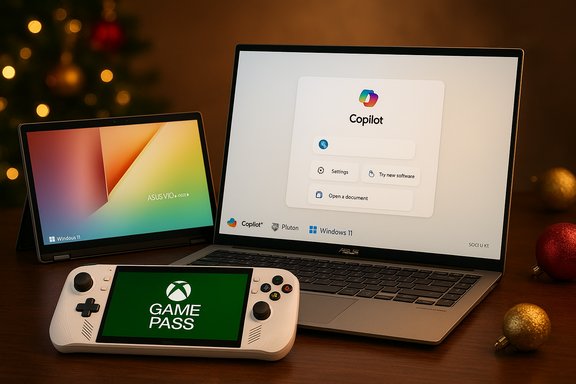
Saltzman showcased the ROG Xbox Ally family as a fresh holiday gift for gamers who want a portable, Windows‑powered gaming device with deep Xbox integration. The Ally lineup is a collaboration between ASUS ROG and Xbox; both the Xbox and ASUS announcements confirm an October 16, 2025 on‑shelf debut and two SKUs: the standard ROG Xbox Ally and a higher‑end ROG Xbox Ally X. Each model blends a handheld form factor with Windows 11, Game Pass access, and hardware targeting handheld‑friendly performance. What the official specs and launch copy verify:- Screen: 7‑inch Full HD (1080p) display at up to 120 Hz with VRR support on both models.
- Processors and memory: the base Ally ships with an AMD Ryzen Z2 A and 16 GB LPDDR5X, while the Ally X uses an AMD Ryzen AI Z2 Extreme and can offer 24 GB LPDDR5X on premium SKUs.
- Battery tiers: the base Ally is marketed with a ~60 Wh battery; the Ally X steps up to ~80 Wh for longer sessions.
- Game Pass trial: select markets and retailers offer a three‑month Xbox Game Pass trial with purchase in most launch messaging.
- Console‑like UX: Microsoft’s “Xbox full‑screen experience” and dedicated handheld mode simplify game discovery and controller mapping on a small device.
- Ecosystem: Native access to PC game launchers and Game Pass makes these handhelds flexible for both PC and cloud gaming.
- Battery and thermals: Independent hands‑on coverage and early reviews emphasize that battery life and heat depend heavily on game title, performance profile, and thermal tuning. Expect significant variation between real‑world playtime and vendor estimates.
- Availability and SKUs: The Ally X premium SKUs have more limited retailer distribution and sometimes staggered availability; check exact model numbers before assuming broad stock.
- Ergonomics: Handheld comfort is subjective; controller feel and weight distribution matter more than raw spec sheets for sustained play.
ROG Zephyrus G16 — a gaming laptop with thin‑and‑light credentials
Saltzman highlighted the ROG Zephyrus G16 as a powerful, portable 16‑inch companion for gamers and creators. ASUS’s product pages confirm the G16’s emphasis on advanced cooling (liquid metal, arc‑flow fans, vapor chambers), a premium aluminum alloy chassis, and high refresh‑rate OLED/Nebula display options. The official materials also list a 0.59‑inch thin profile and a ~90 Wh battery in many configurations. Independent reviews echo much of the marketing while adding nuance:- The Zephyrus G16 delivers strong performance for creative workflows and gaming, but measured battery life and thermals vary by CPU/GPU configuration and power profile. Reviewers praise the display and build but note tradeoffs in upgradability and price.
- For creators, prioritize SKU configurations with the display and GPU you need rather than assuming a single G16 SKU covers all use cases.
- Thermal and battery tests from trusted reviewers are essential for deciding between performance modes and whether to accept the thin‑and‑light tradeoffs.
ASUS Zenbook S16 — premium Copilot+ ultraportable
ASUS positions the Zenbook S16 as a Copilot+ flagship: an ultrathin 16‑inch laptop built from Ceraluminum with a 3K 120 Hz Lumina OLED panel, a dedicated Windows Copilot key, and NPUs quoted up to ~50 TOPS on higher‑end SKUs. ASUS product pages and press materials confirm the thin chassis (roughly 0.47–0.47 in / 1.1 cm in various markets), a 78 Wh battery, and Copilot/Pluton security features. Strengths verified by vendor materials:- Material and design: Ceraluminum outer lid and CNC finesse are highlighted as differentiators intended to improve durability and feel.
- AI capability: The Zenbook S16 is marketed with NPUs (TOPS counts) and Copilot‑integrated UX; ASUS explicitly calls out Copilot+ readiness on compatible SKUs.
- Security: Microsoft Pluton and Windows Hello IR camera are present on many SKUs for hardware‑backed protection.
- Which SKU ships with 50 TOPS NPU vs lower NPU tiers? The Zenbook S16 family contains multiple SKUs; verify exact model numbers and NPU claims on the product page for your region.
- How soon will Copilot+ features be fully enabled? Some Copilot+ experiences depend on Windows and app updates being rolled out after device launch; timing may vary by region and SKU. ASUS itself notes that some Copilot+ experiences require future updates.
ASUS Vivobook 14 Flip — convertible versatility, long battery claims
The Vivobook 14 Flip is pitched as a flexible, Copilot+‑ready convertible with a 360° hinge, FHD/3K OLED options, Windows Hello IR camera, and a Microsoft Pluton security presence on qualifying SKUs. ASUS pages list up to 28 hours of battery life on certain test conditions and up to 47 TOPS NPU on the top Intel Core Ultra configurations. What the official pages and regional press confirm:- NPU and Copilot readiness: Up to 47 TOPS in Intel Core Ultra 7 Series 2 configurations; dedicated Copilot key on certain models.
- Security and biometric login: IR camera for Windows Hello and Microsoft Pluton are included in product security descriptions.
- Battery claims are workload‑dependent. “Up to 28 hours” is an idealized vendor metric; independent reviews should be consulted for mixed workload battery life and OLED display power draw.
- Configuration variance: Make sure the SKU you buy matches the advertised NPU, memory, and display; Vivobook names cover a broad product family.
Separating marketing from real‑world value: four technical checks every buyer must do
The SMT is effective at generating gift‑list momentum — but buyers must do the last‑mile verification. Here’s a compact, actionable checklist Saltzman’s segments encourage; follow these steps before you hit purchase:- Run Microsoft PC Health Check to confirm Windows 11 upgrade eligibility or plan a fresh Windows 11 PC purchase. If you must keep Windows 10 for a short period, investigate the consumer ESU path.
- Record the exact SKU shown in the segment (example format: Zenbook S16 UM5606WA, ROG Ally RC73XA) and confirm the specs on the manufacturer’s region page. Marketing blurbs often omit key SKU differences.
- Read one or two independent hands‑on reviews for that specific SKU (not just the product family) to validate battery life, thermal behavior, display quality, and the availability of Copilot+ features today.
- Check retailer return windows, holiday‑season price protection, and extended warranty/accidental damage plans. Holiday purchases spike return rates; a clear return policy reduces risk.
The AI performance caveat: TOPS numbers are directional, not definitive
ASUS’s Copilot+ marketing leans on NPU TOPS figures to indicate local AI capability. This is a common industry shorthand — but TOPS are a theoretical peak metric and do not automatically translate into real‑world feature speed or capability. Independent industry reporting has repeatedly warned that peak TOPS often overstates usable inference throughput because of efficiency losses in real workloads, thermal limits, software maturity, and kernel/runtime support. Buyers should treat TOPS as one datapoint among many (memory bandwidth, memory type, software stack, and measured benchmarks). Practical meaning:- For small, latency‑sensitive Copilot features (e.g., on‑device transcription, noise suppression), modern NPUs can make a visible difference even at modest TOPS levels.
- For heavy generative workloads (large LLM inference, high‑res image synthesis), TOPS alone rarely replace the need for cloud compute or discrete GPUs for speed and model capacity.
Strengths of the SMT approach — and what it does well
- Clear messaging anchored to a real deadline: Windows 10 EoS gives consumers a legitimate reason to act now, not just “holiday pressure.”
- Broad reach with practical steps: The SMT’s broadcast footprint meets mainstream holiday buyers where they are and, when done well, adds concrete steps (PC Health Check, SKU checks) rather than mere product theatre.
- Product breadth across budgets: The SMT pairs flagship Copilot+ Zenbooks with accessible Vivobooks and a distinct handheld gaming story (ROG Ally), offering options for gamers, students, creators, and mainstream users.
Risks, disclosure and what the SMT may understate
- Sponsor bias: Saltzman’s picks are sponsor‑backed segments; viewers should treat the pieces as promotional plus expert commentary rather than fully independent reviews. Stations often disclose sponsored content, but that may be missed by quick viewers.
- SKU drift: Model family names conceal multiple SKUs; a device shown on air may not match the SKU a retailer lists. Always confirm exact model numbers.
- Availability and regional pricing: New or premium SKUs (Ally X, premium Zenbook trims) can have staggered availability and retailer exclusives. Confirm stock and delivery before promising a holiday gift.
- Software dependency: Copilot+ features are a two‑part play — hardware + evolving software. Some AI experiences will arrive over time via Windows and OEM updates; they may not be fully baked on day one. ASUS itself notes rollout timing may vary.
Practical buyer’s recommendations (short, usable)
- If your existing PC is Windows 10: run PC Health Check now. If you’re eligible, plan your upgrade schedule; if not, consider ESU only as a short bridge.
- For AI features: pick the feature you care about (transcription, noise removal, Auto SR) and verify hands‑on reviews for that SKU — don’t buy on TOPS alone.
- For handheld gifting: try to evaluate ergonomics or read multiple independent hands‑on impressions; battery life and thermal comfort vary substantially by title.
- For premium ultraportables: if you plan to keep a laptop for 3+ years, splurge on RAM and storage at purchase because many modern thin laptops solder memory. Check upgradeability.
Verdict — measured optimism with conditions
The Marc Saltzman / News Media Group SMT with ASUS delivers a tidy holiday narrative: Microsoft’s Windows 10 end of support is a real, verifiable deadline; ASUS’s 2025 portfolio legitimately pushes Copilot+ hardware into mainstream shopping channels; and the ROG Ally handhelds represent a meaningful evolution of Windows handheld gaming. These claims are backed by manufacturer pages and corroborated by major trade outlets and vendor announcements. That said, buyers must complete the last mile of due diligence. The SMT speeds discovery and provides a usable shopping script, but it cannot substitute for SKU verification, independent benchmarks, and retailer policy checks. Treat SMT segments as a curated shortlist, not a final shopping cart.Conclusion
This holiday season’s “Tech It Out” SMT is effective precisely because it ties marketing to a platform event: Windows 10’s October 14, 2025 end of support. ASUS’s 2025 lineup — from the ROG Xbox Ally family to Copilot+ Zenbook and Vivobook models — legitimately moves AI‑enabled hardware into mainstream availability, and the hardware claims are verifiable on vendor pages and through independent reviews. Consumers who follow the SMT’s suggestions will likely find good gift ideas, but the smartest shoppers will also apply a short verification routine: confirm SKU and region, read independent hands‑on tests for the exact configuration, check return and warranty policies, and run PC Health Check before deciding whether to upgrade an existing machine or buy a new Copilot+ device. Doing these four things turns a holiday impulse into a durable, secure, and future‑ready purchase.Source: Digital Journal Tech Expert Marc Saltzman and News Media Group, Inc. Partnered with ASUS for a “Tech it Out” Holiday Gifts 2025 Nationwide Satellite Media Tour (SMT)
