

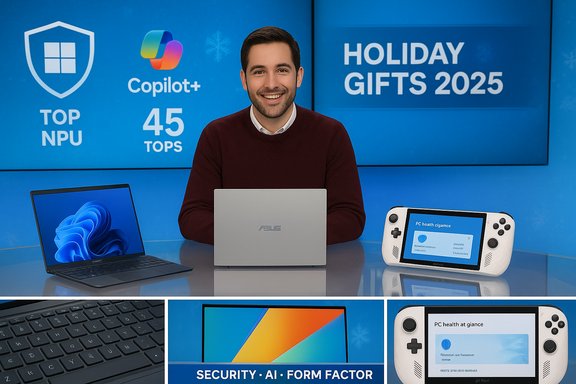
Marc Saltzman’s “Tech It Out” segments have gone national this holiday season: in partnership with News Media Group, Inc. and ASUS, Saltzman is fronting a paid Satellite Media Tour (SMT) that packages short, broadcast-friendly gift guides around three clear messages — upgrade away from unsupported Windows 10, favor Copilot+‑ready laptops with on‑device NPUs, and consider new handheld gaming hardware such as the ROG Xbox Ally family — a campaign designed to convert mainstream local morning‑show viewers into holiday buyers.
The SMT format is straightforward: produce 2–4 minute, turnkey segments that local morning and lifestyle shows can run as sponsored content. For holiday 2025, Saltzman’s segments foreground a platform deadline — Microsoft’s end of mainstream support for Windows 10 on October 14, 2025 — and pair that urgency with ASUS’s 2025 Copilot+ product slate and the new ROG Xbox Ally handhelds. That combination creates a tidy narrative: security + AI + new form factors = a justifiable reason to buy or upgrade during the holiday shopping season.
Microsoft’s official guidance is the campaign’s linchpin: Windows 10 reached end of support on October 14, 2025, after which routine security and feature updates ceased and Microsoft recommended moving eligible devices to Windows 11 or enrolling in a short Extended Security Updates (ESU) program where needed. That date is verifiable on Microsoft’s support and Windows pages. ASUS’s CES‑era and product messaging for 2025 explicitly positions many Zenbook, Vivobook, and premium ROG devices as Copilot+ PCs, advertising on‑device NPUs and concrete TOPS figures for certain SKUs — claims the SMT highlights on air as shorthand for “AI readiness.” ASUS’s press materials and product pages list TOPS numbers for selected Zenbook and Vivobook SKUs and describe the ROG handheld family’s specs; independent outlets have also corroborated many of those values. This feature breaks down the SMT’s claims, verifies the most important technical facts, evaluates the campaign’s strengths and limitations, and provides a practical buyer’s checklist so readers use the SMT as a shortlisting tool — not a substitute for SKU‑level due diligence.
Strengths
Source: StreetInsider Tech Expert Marc Saltzman and News Media Group, Inc. Partnered with ASUS for a "Tech it Out" Holiday Gifts 2025 Nationwide Satellite Media Tour (SMT)
Source: StreetInsider Tech Expert Marc Saltzman and News Media Group, Inc. Partnered with ASUS for a "Tech it Out" Holiday Gifts 2025 Nationwide Satellite Media Tour (SMT)
 Background / Overview
The SMT format is straightforward: produce 2–4 minute, turnkey segments that local morning and lifestyle shows can run as sponsored content. For holiday 2025, Saltzman’s segments foreground a platform deadline — Microsoft’s end of mainstream support for Windows 10 on October 14, 2025 — and pair that urgency with ASUS’s 2025 Copilot+ product slate and the new ROG Xbox Ally handhelds. That combination creates a tidy narrative: security + AI + new form factors = a justifiable reason to buy or upgrade during the holiday shopping season.Microsoft’s official guidance is the campaign’s linchpin: Windows 10 reached end of support on October 14, 2025, after which routine security and feature updates ceased and Microsoft recommended moving eligible devices to Windows 11 or enrolling in a short Extended Security Updates (ESU) program where needed. That date is verifiable on Microsoft’s support and Windows pages. ASUS’s CES‑era and product messaging for 2025 explicitly positions many Zenbook, Vivobook, and premium ROG devices as Copilot+ PCs, advertising on‑device NPUs and concrete TOPS figures for certain SKUs — claims the SMT highlights on air as shorthand for “AI readiness.” ASUS’s press materials and product pages list TOPS numbers for selected Zenbook and Vivobook SKUs and describe the ROG handheld family’s specs; independent outlets have also corroborated many of those values. This feature breaks down the SMT’s claims, verifies the most important technical facts, evaluates the campaign’s strengths and limitations, and provides a practical buyer’s checklist so readers use the SMT as a shortlisting tool — not a substitute for SKU‑level due diligence.
What the SMT is pitching: three core messages
1) Upgrade for security: Windows 11 as the practical baseline
Saltzman’s segments repeatedly frame Windows 11 as the long‑term, supported platform that brings modern security features (TPM 2.0 enforcement, Secure Boot, VBS/HVCI options) and also unlocks many Copilot integrations. The October 14, 2025 end‑of‑support date for Windows 10 gives that advice a factual anchor: Microsoft’s official pages make clear that after that date Windows 10 will no longer receive routine security fixes or feature updates. Practical implication: consumers should run Microsoft’s PC Health Check to see whether their PC is eligible for a free Windows 11 upgrade. If a PC is ineligible, ESU is available as a short bridge, but buying a Windows 11‑capable device is the longer‑term secure path. Saltzman’s on‑air checklist generally includes these steps, which translate well for broadcast audiences.2) Buy AI‑capable Copilot+ laptops — NPUs as a selling point
ASUS’s 2025 lineup — from Vivobook to Zenbook and across silicon vendors (Qualcomm Snapdragon X series, Intel Core Ultra Series 2, AMD Ryzen AI) — is marketed under the Copilot+ banner. ASUS materials explicitly call out NPU TOPS on certain SKUs (for example, up to ~50 TOPS on selected Zenbook models and up to ~48 TOPS on some Intel‑based SKUs), and emphasize Copilot keys, on‑device transcription, AutoSR upscaling and other AI features. The SMT converts those specs into a short, consumer‑facing message: “Pick Copilot+ if you want low‑latency on‑device AI.”3) Consider new form factors: ROG Xbox Ally handhelds for gamers
The SMT highlights ASUS’s handheld gaming story through the ROG Xbox Ally family (standard Ally and premium Ally X). These devices target gamers who want a portable Windows experience with access to Xbox Game Pass, Steam, and native Windows apps. Manufacturer and trade press specs for the Ally line (CPU family, RAM, battery size, display size and refresh rate) are published publicly and were used by the SMT to create holiday gift narratives.Technical verification: what’s provable, what needs caution
Consumer decisions should rest on the SMT’s load‑bearing claims — and those claims fall into three verifiable buckets.Windows 10 end of support — verified
Microsoft’s own channels confirm that Windows 10 mainstream support ended on October 14, 2025; the company recommends upgrading eligible PCs to Windows 11 or using ESU. This is the single most important factual anchor behind the SMT’s timing.ASUS Copilot+ claims — manufacturer documentation matches marketing
ASUS’s global press release and product pages list the Copilot+ expansion and specific hardware claims, including NPU TOPS ranges for select CPU/APU families and new Copilot+ badges across Zenbook and Vivobook families. Those manufacturer documents are the primary source for the SMT’s claims that certain SKUs are “Copilot+‑ready” and advertise TOPS figures. Because these are vendor statements, consumers should treat them as specifications to be confirmed at SKU level rather than performance guarantees.ROG Ally handheld specs — corroborated by trade press
Independent outlets that reviewed the launch and availability reports (retailer listings and hands‑on writeups) confirm the Ally family specs: 7‑inch high‑refresh displays, AMD Z2 family processors in the base models, memory tiers (e.g., 16GB vs 24GB), and differentiated battery capacities for the Ally X premium variant. These independent reports align with ASUS and Microsoft launch announcements. However, measured battery life, thermal performance, and docked gaming frame rates vary by title and configuration: those are empirical measurements reviewers must produce.Caveat — TOPS and marketing vs. real‑world AI performance
TOPS (tera operations per second) is a useful marketing shorthand for theoretical NPU throughput, but it does not directly translate to user‑visible performance for every AI feature. Real‑world behavior depends on software maturity (drivers, OS support, app integration), thermal constraints, and power management. The SMT’s reliance on TOPS numbers helps differentiate tiers quickly for broadcast viewers, but buyers should verify whether the specific Copilot+ feature they prioritize (transcription quality, AutoSR, local model recall, noise suppression) is implemented and performs well on the SKU they plan to buy. ASUS itself notes that some Copilot+ experiences will improve as software updates roll out.Why the SMT approach works — strengths and distribution math
- Local reach, national message: The Satellite Media Tour format is tailored to get a vendor message into local morning shows and lifestyle segments where older and mainstream holiday shoppers still discover product ideas. That local placement preserves Saltzman’s credibility as an “expert voice” while delivering a consistent ASUS message across many markets.
- Timely narrative hook: Tying the campaign to Windows 10’s end of support gives the SMT a defensible reason to suggest upgrades now — stronger than generic “best gifts” copy. Consumers facing the practicalities of an unsupported OS are likely to respond to guidance about security and migration.
- Product breadth for multiple budgets: The SMT pairs premium Copilot+ Zenbooks with more accessible Vivobooks and a distinct handheld gaming story, which helps viewers match products to recipients (students, creators, gamers, mainstream users). This breadth improves the campaign’s utility as a discovery engine.
- Actionable tips built in: The segments often include simple next steps — run PC Health Check, record SKU numbers, verify return policies — which convert a discovery moment into practical buyer actions. For broadcast audiences, this is valuable and reduces post‑purchase dissatisfaction risk.
Risks, disclosure, and what the SMT under‑emphasizes
This SMT is promotional by design; the content is sponsor‑backed. That creates a few practical caveats buyers should weigh.- Sponsor bias and disclosure may be missed: Local station pages and package labels typically note when content is advertiser‑sponsored, but viewers can miss those markers when watching clips or tuning in briefly. Slate the SMT’s recommendations as paid content — strictly speaking, Saltzman is delivering sponsor‑backed segments. That doesn’t make the advice invalid, but it does change the context in which the tips should be interpreted.
- SKU drift and configuration variance: Model family names (Zenbook S16, Vivobook 14, ROG Ally) can mask dozens of SKUs. A demo may show a higher‑end SKU that differs materially from the discounted retail unit your station’s viewer actually finds in store. Always record the exact SKU string mentioned on air and verify the spec sheet before purchase.
- Availability and price variance: SMTs can create an impression of immediate nationwide availability; real inventory and price vary by retailer, variant, and region. Premium devices like the Ally X historically have staggered availability windows and retailer exclusives. Confirm stock and pre‑order terms before counting on a device for a holiday gift.
- Software rollout dependency: Copilot+ is a two‑part proposition — hardware + evolving software. Some advertised capabilities depend on Windows updates, OEM drivers, or app integrations that may roll out after a device ships. Buyers expecting full feature parity on day one may be disappointed. ASUS and independent reviewers consistently note that software cadence matters.
Practical buyer’s checklist — use the SMT as a shortlisting tool
Follow this numbered routine before you buy:- Run Microsoft’s PC Health Check to determine whether your current PC is eligible for a free Windows 11 upgrade; treat Extended Security Updates (ESU) as a short bridge if you’re ineligible or need time.
- Record the exact SKU shown or mentioned in the segment (example SKU format: Zenbook S16 UM5606KA or ROG Xbox Ally RC73XA) and open the manufacturer’s official spec page to confirm CPU/APU family, NPU TOPS (if advertised), RAM, storage, display type, and battery capacity.
- Read one or two independent, hands‑on reviews for that exact SKU (not just the product family) to check measured battery life, thermal behavior, display quality, and real‑world availability of Copilot+ features. Independent reviewers will test battery life, docked gaming performance, and thermals.
- Validate retailer return windows, holiday price‑match protections, and extended warranty/accidental damage options. Gift returns spike over the holiday season; generous return policies reduce friction.
- For gamers: confirm docked performance and battery runtime for the titles your recipient plays; ergonomics and controller feel matter for handhelds more than headline specs. Read docked‑mode benchmarking results.
- Back up data and plan your upgrade path before performing a Windows 11 update on an existing machine — test app compatibility and have a restore plan ready.
Deep dive: verifying three headline claims
Claim A — Windows 10 end of support justifies an upgrade push
Verification: Microsoft’s support and Windows pages explicitly state October 14, 2025 as the end of mainstream support for Windows 10 and recommend upgrading or enrolling in ESU. That official notice is the canonical, provable fact underpinning the SMT. For consumers, this is not alarmist marketing — it’s an operationally relevant product milestone.Claim B — ASUS’s Copilot+ SKUs include measurable NPU TOPS
Verification: ASUS’s CES 2025 press release and product pages list TOPS figures for targeted SKUs (e.g., up to 50 TOPS on select AMD Ryzen AI models and up to ~48 TOPS on certain Intel Core Ultra variants). Those figures appear on ASUS’s official product pages and in press materials, and trade outlets routinely cite the same numbers when describing model differentiation. That makes the TOPS claims verifiable — but remember they are manufacturer‑provided numbers that must be interpreted alongside software maturity and thermal constraints.Claim C — ROG Xbox Ally handhelds provide a meaningful handheld Windows gaming experience
Verification: Manufacturer and reputable trade coverage list the Ally family specs (7‑inch displays, AMD Ryzen Z2 processors in base models, 16–24GB RAM options, substantial battery sizes for premium SKUs). Early hands‑on coverage praises ergonomics and Xbox integration while noting battery and thermal tradeoffs across titles. These are cross‑checked by Tom’s Hardware and Windows Central reporting on the family’s SKUs and positioning. Measured gaming performance will vary by title and thermal/power profile.Editorial analysis — measured optimism with necessary caveats
The SMT represents a classic modern vendor playbook: anchor to a credible platform milestone (Windows 10 end of support), position a set of differentiated SKUs (Copilot+ laptops and ROG handhelds) that address distinct buyer needs, and distribute the message through trusted local channels with an expert host. That combination is effective for discovery and early conversion among mainstream buyers who watch local television.Strengths
- Clear, defensible narrative: The Windows 10 end‑of‑support event is indisputable and creates legitimate urgency for upgrades.
- Product breadth: ASUS’s Copilot+ lineup spans price points, helping the SMT present gift options for multiple recipient types.
- Practical tips included: The segments typically include next steps that reduce post‑purchase friction (PC Health Check, SKU note‑taking, return policy checks).
- Promotional framing: The content is sponsored; viewers should treat suggestions as marketing‑adjacent advice and verify independently.
- Technical nuance lost to broadcast: TOPS figures and feature names are shorthand useful for TV, but actual user experience depends heavily on software rollouts and real‑world testing.
- Availability mismatch: Broadcast segments can create demand that outstrips regional supply for premium SKUs, especially handheld devices with staggered retail windows.
How ASUS, News Media Group, and Marc Saltzman benefit (and why that matters)
For ASUS, the SMT is an efficient way to show Copilot+ features in a demo format to mainstream viewers who may not consume tech press. For News Media Group, the expert‑plus‑brand model is repeatable and profitable: turnkey segments that local stations accept and run with minimal production overhead. For Saltzman, the trade‑off is reach vs. editorial independence — paid segments increase reach but must be disclosed and paired with buyer verification to preserve trust. The responsibility for final verification rests with consumers; the SMT accelerates discovery but cannot replace independent testing.Quick takeaways — actionable, SEO‑friendly summary for holiday shoppers
- Windows 10 reached end of mainstream support on October 14, 2025; plan an upgrade to Windows 11 or enroll in ESU as a short bridge.
- ASUS’s 2025 Copilot+ lineup (Zenbook, Vivobook, Snapdragon X models) advertises NPUs and TOPS numbers; treat TOPS as a directional metric and verify the exact SKU on ASUS’s product pages.
- ROG Xbox Ally handhelds are a serious handheld Windows play; check measured battery life, thermal behavior, and docked performance for your favorite games before you buy.
- Use SMT segments as a rapid shortlist engine — then confirm SKU numbers, read independent hands‑on reviews, and verify retailer return and warranty protections.
Conclusion
The “Tech It Out” Holiday Gifts 2025 SMT — Marc Saltzman, News Media Group, and ASUS — is a well‑timed, professionally executed campaign that uses a real platform milestone (Windows 10 end of support) and a credible product story (Copilot+ NPUs, Zenbook/Vivobook breadth, ROG handhelds) to create a usable holiday shopping script for mainstream viewers. The SMT’s real value is in discovery and motivation: it tells millions of local viewers what to look for and why the timing matters. The campaign’s limits are equally clear — it is promotional content that trades depth for brevity, relies on manufacturer specifications and marketing shorthand, and assumes that software rollouts will complete the Copilot+ experience promised in ads. Use the SMT for inspiration, follow the straightforward SKU verification checklist, and consult independent hands‑on reviews before you spend. That disciplined approach turns a persuasive holiday pitch into a durable, secure, and useful purchase.Source: StreetInsider Tech Expert Marc Saltzman and News Media Group, Inc. Partnered with ASUS for a "Tech it Out" Holiday Gifts 2025 Nationwide Satellite Media Tour (SMT)
Source: StreetInsider Tech Expert Marc Saltzman and News Media Group, Inc. Partnered with ASUS for a "Tech it Out" Holiday Gifts 2025 Nationwide Satellite Media Tour (SMT)
