

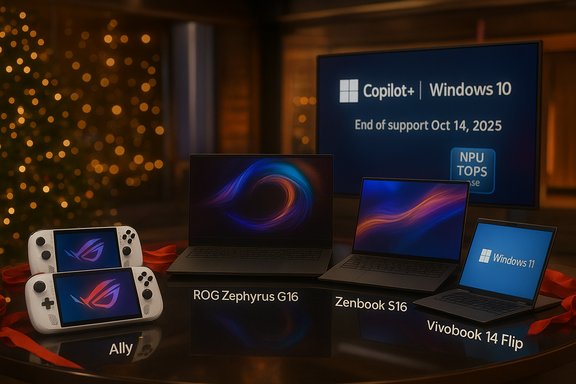
The holiday shopping season has an unmistakable tech beat this year: a nationwide Satellite Media Tour (SMT) led by Marc Saltzman in partnership with News Media Group, Inc. and ASUS has turned a real platform milestone — Microsoft’s end of mainstream support for Windows 10 — into a fast, broadcast-friendly playlist of “must-see” gift recommendations. That SMT spotlights the new ROG Xbox Ally and Ally X handhelds, the powerful ROG Zephyrus G16 gaming laptop, and ASUS’s AI-forward Zenbook S16 and Vivobook 14 Flip Copilot+ laptops — all positioned as timely, secure, and gift-ready picks for holiday tech shoppers.
Marc Saltzman’s “Tech It Out” SMT is classic broadcast marketing: brief, highly produced segments placed across dozens of local morning and lifestyle shows to surface curated holiday picks to mainstream viewers. In 2025 the segments carry three connected messages: upgrade away from unsupported Windows 10, favor Copilot+ and NPU-enabled laptops for on‑device AI, and consider new form factors — notably the ROG Xbox Ally family — for gaming gifts. That narrative is anchored by Microsoft’s formal end-of-support for Windows 10 on October 14, 2025, and amplified across local stations as sponsored content.
Why that matters: the Windows 10 deadline is a concrete, verifiable event that provides a defensible consumer prompt to consider new hardware, and ASUS’s 2025 product slate explicitly markets Copilot+ readiness and on‑device NPU figures (TOPS) as differentiators. The SMT stitches those elements into a short, actionable shopping script for mainstream audiences — efficient for discovery, but incomplete without SKU‑level due diligence.
That said, SMTs are promotional tools by design. The last mile — SKU verification, independent hands‑on testing, and retailer policy checks — cannot be replaced by a two‑minute TV segment. Treat the SMT as a curated shortlist and complete a short verification routine before you spend: record the SKU, confirm specs on the manufacturer page, read independent reviews for that configuration, and check return/warranty protections. Doing so turns a timely holiday idea into a durable, secure and future‑ready purchase.
The devices featured in the SMT — ROG Xbox Ally/Ally X, ROG Zephyrus G16, ASUS Zenbook S16, and ASUS Vivobook 14 Flip — are real products with verifiable specs and sensible scenarios where they are the right gifts. The SMT’s role is to accelerate discovery; the buyer’s role is to verify. Following the checklist above will convert holiday enthusiasm into a reliable, well‑matched gift that stands the test of real use.
Source: The Globe and Mail Tech Expert Marc Saltzman and News Media Group, Inc. Partnered with ASUS for a "Tech it Out" Holiday Gifts 2025 Nationwide Satellite Media Tour (SMT)
 Background / Overview
Marc Saltzman’s “Tech It Out” SMT is classic broadcast marketing: brief, highly produced segments placed across dozens of local morning and lifestyle shows to surface curated holiday picks to mainstream viewers. In 2025 the segments carry three connected messages: upgrade away from unsupported Windows 10, favor Copilot+ and NPU-enabled laptops for on‑device AI, and consider new form factors — notably the ROG Xbox Ally family — for gaming gifts. That narrative is anchored by Microsoft’s formal end-of-support for Windows 10 on October 14, 2025, and amplified across local stations as sponsored content.Why that matters: the Windows 10 deadline is a concrete, verifiable event that provides a defensible consumer prompt to consider new hardware, and ASUS’s 2025 product slate explicitly markets Copilot+ readiness and on‑device NPU figures (TOPS) as differentiators. The SMT stitches those elements into a short, actionable shopping script for mainstream audiences — efficient for discovery, but incomplete without SKU‑level due diligence.
What the SMT is pitching — the headline product picks
ROG Xbox Ally and Ally X — handheld Windows gaming, redesigned for Xbox integration
ASUS and Microsoft co‑developed the ROG Xbox Ally family to deliver a portable Windows experience with a console-style interface and deep Xbox integration. The family ships with Windows 11 Home and offers:- 7‑inch Full HD (1080p) displays at 120 Hz, FreeSync Premium support, and Gorilla Glass protection.
- Two models: the standard ROG Xbox Ally with an AMD Ryzen Z2 A part, 16GB LPDDR5X, a 60Wh battery and a 512GB SSD; and the premium ROG Xbox Ally X with an AMD Ryzen AI Z2 Extreme, an integrated NPU (advertised at 50 TOPS on some SKUs), 24GB LPDDR5X, a 1TB SSD and an 80Wh battery.
ROG Zephyrus G16 — thin, powerful gaming and creative workhorse
The 2025 ROG Zephyrus G16 continues the series’ thin‑and‑light promise while pushing performance and cooling. Key verified specs include:- Thinness down to approximately 0.59 inches on some configurations and weights in the ~4.0–4.3 lb range depending on GPU and battery choices.
- A large battery (90Wh on many SKUs), ROG Intelligent Cooling with liquid metal compound and upgraded fans, and modern connectivity including Thunderbolt/USB4 and HDMI 2.1.
ASUS Zenbook S16 — premium Copilot+ ultrabook with Ceraluminum finish
ASUS positions the Zenbook S16 as a premium AI‑capable ultrabook engineered for portability and on‑device AI:- Exceptional thinness (around 0.47 inches / 1.1 cm) and light weight (~3.3 lb for some SKUs) thanks to a Ceraluminum™ finish meant to be durable and premium.
- A 16‑inch 3K ASUS Lumina OLED 120 Hz touchscreen, up to 50 TOPS NPU (on higher‑end AMD Ryzen AI SKUs), six‑speaker audio, and deep Copilot integration including a dedicated Copilot key.
ASUS Vivobook 14 Flip — versatile 2‑in‑1 with Microsoft Pluton and long battery life
The Vivobook 14 Flip (TP3407) balances versatility and security:- A 360° hinge, FHD/14‑inch ASUS Lumina OLED display, an IR Windows Hello camera for facial login, and Microsoft Pluton built into supported CPU platforms to protect credentials and keys on‑device.
- Manufacturer specs list a 70 Wh battery and marketing claims of up to 28 hours of mixed-use battery life on certain configurations, alongside Copilot+ support on qualifying SKUs.
Verifying the load‑bearing claims — what’s proven and what to treat with caution
When a broadcast SMT points shoppers to hardware, some claims are both central and verifiable; others require careful interpretation.- Windows 10 end‑of‑support (October 14, 2025) is a canonical fact: Microsoft’s support pages state that routine security updates, technical assistance and feature updates for Windows 10 stopped after that date and that Microsoft recommends upgrading to Windows 11 or enrolling in a one‑year consumer Extended Security Updates (ESU) program where applicable. This is the SMT’s anchor for “upgrade now” advice.
- ASUS’s Copilot+ messaging and advertised NPU TOPS are documented across ASUS product pages and press releases: the Zenbook S16 lists up to 50 TOPS, Vivobook 14/16 and other Copilot+ SKUs list NPU figures in the 45–48 TOPS range on qualifying configurations, and ASUS explicitly notes that some Copilot+ experiences require Windows and OEM updates to arrive on specific dates. Treat TOPS as a directional throughput metric: useful for comparing tiers but not a standalone measure of user experience.
- ROG Xbox Ally hardware specs (display, memory, batteries, CPUs/APUs) are published by ASUS and repeated by major outlets; independent coverage confirms the Xbox Full‑Screen Experience and cross‑platform Game Pass integration. Early reviews show strong ergonomics but also note thermal and battery tradeoffs in heavy gaming. Verify the exact SKU you plan to buy; internal model variants influence weight, battery, and performance significantly.
- “Up to” battery life. Manufacturer battery numbers reflect controlled tests; real-world battery for tasks like gaming, video conferencing (with AI features active), or creative workloads will differ. Independent reviews frequently measure substantially lower runtimes than vendor claims.
- TOPS and NPUs are helpful for comparing product tiers but do not guarantee instant feature parity across apps. Software optimization and driver maturity determine how much on‑device AI improves real workflows; insist on hands‑on reviews of the specific Copilot+ features you care about (e.g., Live Captions, AutoSR, Recall).
- SKU drift: model family names (Zenbook S16, Vivobook 14 Flip, Zephyrus G16, ROG Ally) hide wide configuration matrices. The SMT’s brief segments may show a displayed unit that differs from the SKU that later ships or is stocked by your retailer. Record and cross‑check SKU numbers.
Buyer’s checklist — how to use the SMT as a shortlisting tool (practical verification steps)
The SMT is a discovery engine, not a purchase shortcut. Apply this short verification routine before you buy:- Record the exact SKU shown in the segment (example format: Zenbook S16 UM5606WA or ROG Xbox Ally RC73XA).
- Open the manufacturer’s official product page for that SKU to confirm CPU/APU, NPU TOPS, RAM, storage, display type, battery capacity and ports. Where ASUS lists “up to” values, match them to the SKU’s spec table.
- Read one or two independent, hands‑on reviews for that exact configuration to confirm measured battery life, thermal behavior and real‑world performance. Pay particular attention to tests of any Copilot+ features you will use.
- Check retailer return windows, holiday price‑match protections, and accidental damage or extended warranty options. Holiday returns spike; protection matters.
- If replacing a Windows 10 machine, run Microsoft’s PC Health Check to confirm whether your current device qualifies for a free Windows 11 upgrade; if not, evaluate ESU only as a short bridge (and note ESU account requirements in some markets).
Strengths of the SMT strategy — why the campaign is effective
- Clear, time‑sensitive narrative: tying product pitches to Microsoft’s October 14, 2025 end‑of‑support date creates legitimate urgency and a practical upgrade rationale for many viewers.
- Broad reach via local channels: SMTs place short, digestible segments on morning and lifestyle shows where mainstream holiday shoppers still consume content, making complex technology accessible.
- Product breadth for multiple recipients: the SMT bundles premium AI‑capable Zenbooks with accessible Vivobooks and gaming handhelds, providing gift options across budgets and use cases.
Risks, limitations and editorial caveats
- Promotional framing: the segments are paid content and designed to convert. Stations commonly label these as sponsored, but viewers scanning clips may miss that disclosure. Treat SMT picks as marketing‑adjacent editorial and verify independently.
- Technical nuance lost to TV: TOPS, NPUs, and Copilot+ are broadcast‑friendly shorthand; the user experience depends heavily on software rollouts, driver maturity and workload specifics. Whenever NPUs matter for your workflow, look for workload‑specific benchmarks and hands‑on tests rather than raw TOPS numbers.
- Availability mismatch: broadcast demand can outpace regional inventory for premium SKUs (particularly for handhelds with staggered rollouts). Confirm stock and shipping times before promising a device as a gift.
Short technical verification roundup (quick facts verified for buyers)
- Windows 10 reached end of mainstream support on October 14, 2025; Microsoft recommends upgrade to Windows 11 or enrollment in ESU as a bridge. Verified on Microsoft’s support pages.
- ROG Xbox Ally and Ally X specifications (7" 120Hz FHD, 60Wh / 80Wh batteries, Ryzen Z2 family APUs, 16–24GB LPDDR5X, Game Pass inclusion on some promotions) are published by ASUS and echoed in trade press. Confirm SKU pages for exact storage and memory options.
- ROG Zephyrus G16 (2025) thinness and weight ranges (down to 0.59" and ~4.0–4.3 lb) and its 90Wh battery and ROG Intelligent Cooling are listed on ROG product pages and corroborated by independent reviewers.
- Zenbook S16 Copilot+ claims (3K 120 Hz Lumina OLED, up to 50 TOPS on certain Ryzen AI SKUs, Ceraluminum finish, dedicated Copilot key) are confirmed on ASUS product pages; independent reviews validate display and build but call out thermal and battery tradeoffs.
- Vivobook 14 Flip security and battery claims (IR Windows Hello camera, Microsoft Pluton integration, 70 Wh battery and vendor‑quoted up to 28 hours) are published by ASUS; independent regional coverage repeats these specs but emphasizes that real-world runtime will vary.
Practical recommendations for holiday shoppers (concise)
- If your machine is running Windows 10, treat October 14, 2025 as the effective planning cutoff: run Microsoft’s PC Health Check, back up data and decide whether to upgrade the existing PC or buy a new Windows 11‑capable device. ESU is a temporary bridge, not a long‑term fix.
- Use SMT segments as inspiration: jot down the exact SKU, then validate the spec sheet and read hands‑on reviews for that SKU before checkout. Don’t buy on family names or marketing blurbs alone.
- For AI features: choose the specific Copilot+ experiences you need (transcription, noise removal, AutoSR, Recall) and confirm those features are available and tested on the SKU you intend to purchase. TOPS alone won’t tell you whether a feature is supported or well‑implemented today.
- For gamers considering handhelds: check measured battery life for the games your recipient plays, test ergonomics if possible, and verify docking/expandability options if docked performance matters.
Final analysis — measured optimism with a buyer’s responsibility
The Marc Saltzman / News Media Group SMT with ASUS is an effective, well‑timed holiday marketing campaign: it combines a real platform milestone (Windows 10 end‑of‑support), a credible product story (Copilot+ NPUs, Microsoft Pluton, and a renewed handheld gaming play), and broad distribution via local television. Those elements produce useful discovery for mainstream shoppers and give concrete buying signals for different recipient types — gamers, students, creators, and general users.That said, SMTs are promotional tools by design. The last mile — SKU verification, independent hands‑on testing, and retailer policy checks — cannot be replaced by a two‑minute TV segment. Treat the SMT as a curated shortlist and complete a short verification routine before you spend: record the SKU, confirm specs on the manufacturer page, read independent reviews for that configuration, and check return/warranty protections. Doing so turns a timely holiday idea into a durable, secure and future‑ready purchase.
The devices featured in the SMT — ROG Xbox Ally/Ally X, ROG Zephyrus G16, ASUS Zenbook S16, and ASUS Vivobook 14 Flip — are real products with verifiable specs and sensible scenarios where they are the right gifts. The SMT’s role is to accelerate discovery; the buyer’s role is to verify. Following the checklist above will convert holiday enthusiasm into a reliable, well‑matched gift that stands the test of real use.
Source: The Globe and Mail Tech Expert Marc Saltzman and News Media Group, Inc. Partnered with ASUS for a "Tech it Out" Holiday Gifts 2025 Nationwide Satellite Media Tour (SMT)
