

Microsoft’s security registry now lists CVE-2026-20929 as an Elevation of Privilege vulnerability in the Windows HTTP Protocol Stack (HTTP.sys), and the vendor’s published entry — together with the Security Response Center’s internal “confidence / exploitability” signals — should change how administrators prioritize patching, telemetry and containment for internet‑facing Windows hosts.
HTTP.sys is the kernel‑mode HTTP protocol stack that ships with Windows and powers Internet Information Services (IIS) along with a variety of user‑mode services that rely on the kernel HTTP listener. Vulnerabilities in HTTP.sys have historically yielded serious results — from denial‑of‑service conditions to wormable kernel‑mode remote code execution — because the component runs in ring‑0 and processes network‑facing input. Past incidents include high‑impact CVEs such as the 2021 wormable RCE in HTTP.sys and several other security advisories over the years that required urgent patching. CVE‑2026‑20929 is recorded in Microsoft’s Security Update Guide as an HTTP.sys Elevation of Privilege (EoP) entry. That classification alone places it among the class of vulnerabilities that allow a lower‑privileged local actor — or a process tricked into contacting the vulnerable stack — to obtain higher privileges (potentially SYSTEM) if an exploit chain is successful. Community patch trackers and forum summaries listing January’s security roll‑up also show CVE‑2026‑20929 identified as an HTTP.sys EoP entry in the January 2026 update cycle.
Appendix — quick reference checklist (operational)
Source: MSRC Security Update Guide - Microsoft Security Response Center
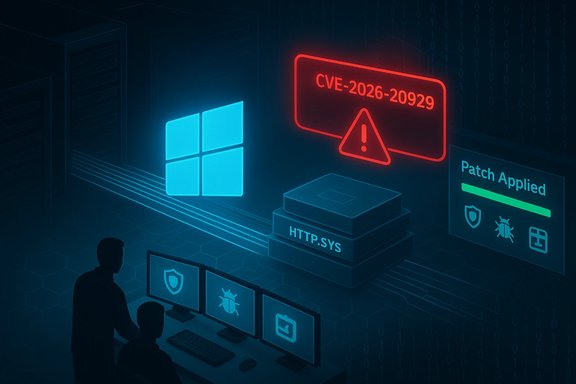 Background / Overview
HTTP.sys is the kernel‑mode HTTP protocol stack that ships with Windows and powers Internet Information Services (IIS) along with a variety of user‑mode services that rely on the kernel HTTP listener. Vulnerabilities in HTTP.sys have historically yielded serious results — from denial‑of‑service conditions to wormable kernel‑mode remote code execution — because the component runs in ring‑0 and processes network‑facing input. Past incidents include high‑impact CVEs such as the 2021 wormable RCE in HTTP.sys and several other security advisories over the years that required urgent patching. CVE‑2026‑20929 is recorded in Microsoft’s Security Update Guide as an HTTP.sys Elevation of Privilege (EoP) entry. That classification alone places it among the class of vulnerabilities that allow a lower‑privileged local actor — or a process tricked into contacting the vulnerable stack — to obtain higher privileges (potentially SYSTEM) if an exploit chain is successful. Community patch trackers and forum summaries listing January’s security roll‑up also show CVE‑2026‑20929 identified as an HTTP.sys EoP entry in the January 2026 update cycle. What the MSRC “confidence / exploitability” metric is — and why it matters
Microsoft’s Security Update Guide and related MSRC communications include signals designed to help administrators triage CVEs beyond the raw CVSS score. Historically, Microsoft has provided an Exploitability Index and, in more recent practice, a confidence / exploitability signal that communicates two separate but related things:- Existence certainty — whether Microsoft has validated and confirmed the vulnerability in the product (vendor acknowledgement).
- Technical detail credibility — how complete and exploitable the publicly published technical details are (ranging from terse impact descriptions to full exploitability notes or confirmed exploitation).
The recorded facts about CVE‑2026‑20929 (what is authoritative right now)
- Microsoft has recorded CVE‑2026‑20929 in the Security Update Guide and attached it to the HTTP.sys component. That vendor record establishes high confidence that a vulnerability exists in the HTTP protocol stack on affected Windows builds.
- Public advisory text in the initial MSRC entry appears concise: the CVE is categorized as Elevation of Privilege, but Microsoft’s initial public entry does not include low‑level exploit mechanics or a public proof‑of‑concept at the time the advisory was posted. This pattern — vendor confirmation plus limited public detail — is common for inbox, kernel, and management‑plane components while updates are staged.
- Community patch trackers and forum summaries published alongside January’s roll‑up list CVE‑2026‑20929 as the HTTP.sys entry for that release, indicating it is part of the vendor’s January 2026 remediation set. Administrators should therefore treat the entry as part of this month’s remediation work.
How HTTP.sys flaws have been exploited in the past — useful context for defenders
HTTP.sys has a well‑documented history of high‑severity issues. That history affects risk calculations for any new HTTP.sys CVE:- CVE‑2021‑31166 (wormable RCE): an HTTP.sys flaw allowing unauthenticated remote kernel RCE that attracted rapid proof‑of‑concept publishing and intense exploitation pressure; Microsoft assigned an “exploitation more likely” posture for that bug. The kernel‑mode context and network vector made remediation urgent.
- Earlier HTTP/2 and header‑parsing issues (multiple CVEs across 2018–2024) demonstrate recurring classes of bugs (parsing of malformed HTTP/2 frames, header edge‑cases, trailer processing, and pointer/tracking mistakes in kernel code). These reveal typical fault classes defenders should watch for: improper input validation, integer overflow, use‑after‑free and boundary checks in parsing code.
Practical risk assessment for CVE‑2026‑20929
Risk depends on three principal axes: exposure, exploitability maturity, and potential impact.- Exposure — Are vulnerable instances reachable from untrusted networks? Internet‑facing IIS or services bound to public interfaces increase risk dramatically. Organizations with publicly accessible web services that rely on HTTP.sys should assume a high exposure until patched.
- Exploitability maturity — Microsoft’s vendor record confirms the vulnerability exists; however, Microsoft’s initial public text is terse and no public PoC is widely available as of the advisory’s posting. That reduces immediate evidence of active exploitation in the public domain, but historically the absence of a public PoC does not prevent private weaponization or targeted exploitation.
- Impact — Because HTTP.sys runs in kernel context, a successful exploit can create high‑impact outcomes (privilege escalation to SYSTEM, kernel crashes, or as part of an RCE chain). Even a local elevation primitive is valuable in post‑compromise chains. Past HTTP.sys bugs have led to both denial‑of‑service and remote code execution outcomes.
Immediate actions for administrators — a prioritized checklist
- Patch first (highest priority)
- Use the Microsoft Security Update Guide / Microsoft Update Catalog to identify the exact KB(s) that map CVE‑2026‑20929 to the OS build(s) in your estate. Apply tested updates to pilot rings and then broaden the rollout. Microsoft’s Update Guide is the canonical source for KB ↔ SKU mappings.
- Reduce exposure (if you cannot patch immediately)
- Block or limit inbound HTTP/S ports (80, 443) and non‑standard HTTP listeners on perimeter routes to affected hosts. Where possible, place internet‑facing services behind an edge reverse proxy or WAF that can be updated with filtering rules.
- Disable unused HTTP.sys‑backed services or unbind services from public interfaces until patches are installed.
- Harden local attack surface and control execution
- Enforce least privilege and application allow‑listing to reduce the ability of a low‑privilege process to trigger an exploit that relies on local interactions.
- Harden web server configurations (remove extraneous modules, restrict request sizes, tune HTTP/2/trailer support if feasible based on vendor guidance).
- Detection and hunting (EDR / SIEM)
- Add hunts for anomalous behavior around HTTP listeners: unexpected process starts of privileged processes after web requests, kernel crashes (blue screens) correlated with HTTP connections, or sudden elevation of service accounts. Use WER and kernel crash dumps to triage suspected exploit attempts.
- Operational validation
- After patching, validate remediation by confirming that updated KBs are installed and by reviewing Windows Update inventories. Confirm that servers required to be patched are not using alternative servicing branches that require separate KBs. Microsoft’s Update Guide entries are often rendered client‑side; ensure your patch management tooling maps to the exact KB for each SKU.
- Communicate and document
- Notify helpdesk and SOC teams of the prioritized CVE, provide remediation scripts or playbooks, and collect forensic evidence for any host suspected of compromise prior to patching.
Hunting playbook — signals that matter
- Unsolicited crashes on HTTP.sys‑hosting processes: kernel memory corruption symptoms, or repeated WER reports with HTTP.sys listed as the faulting module, deserve immediate investigation. Historical HTTP.sys issues often produced stability problems before clear exploit code emerged.
- Elevated child processes spawned from user‑level processes that recently interacted with the web stack (e.g., an IIS worker process spawning system‑level installers) are suspicious.
- Outbound connections to unknown hosts immediately following web service access on previously idle endpoints can indicate post‑exploit callbacks.
- Sudden creation or modification of administrative accounts after unpatched web traffic hits a host.
Why Microsoft’s simple public wording is not a reason to delay patching
Microsoft’s initial advisory style often favors short, impact‑oriented descriptions for critical inbox components while fixes are staged across servicing branches. That is intentional: providing fewer exploit primitives reduces short‑term attack surface for opportunistic exploiters. However, the vendor’s confirmation of the CVE identifier and component is a strong operational signal — especially for kernel components — that the vulnerability is real and that administrators must map and deploy the vendor KBs rather than waiting for a public write‑up. Use Microsoft’s Update Guide and your patch pipeline as the authoritative sources for remediation mapping.What defenders should expect next (timeline and research behavior)
- Within days to weeks: public researchers commonly publish technical analyses and proof‑of‑concepts after patches are available. That cadence historically follows Microsoft’s initial disclosure as teams reverse patches and produce PoCs.
- Within hours to days: attacker scanning increases against IP ranges hosting HTTP services once the CVE identifier and component are public. Even when exploit code is not public, automated scanners often attempt known patterns that expose similar parsing faults.
- Longer term: if the underlying bug class is a memory‑safety error (UAF, heap overflow, integer overflow), exploit chains that convert EoP into reliable RCE may appear; defenders must watch for research write‑ups and prioritize patch deployment accordingly. Historical HTTP.sys issues show the technology can be weaponized quickly when a workable primitive is found.
Technical caveats and claims requiring verification
- The initial advisory for CVE‑2026‑20929 confirms component and impact class but — as of Microsoft’s entry and the January 2026 roll‑up notes — does not publish definitive exploitation primitives (for example: exact function names, trigger packets, or patched code diffs). Any public statement about the specific bug class (e.g., buffer overflow vs. integer overflow) must be treated as unverified until corroborated by Microsoft, NVD, or independent technical analysis.
- Where vendor text lacks low‑level detail, the operational imperative is unchanged: rely on the vendor patch mapping, stage and test updates, and increase detection for post‑compromise behaviors. The lack of public exploit code does not imply low risk.
Longer‑term mitigations and architectural hardening
- Minimize the attack surface for HTTP.sys: where possible, move services behind hardened reverse proxies, use network segmentation, and restrict which hosts can contact management or update endpoints.
- Enforce strict perimeter filtering: deny inbound HTTP traffic to hosts unless explicitly required, and restrict administrative protocols to management VLANs.
- Apply defense‑in‑depth for post‑exploit containment: implement EDR controls tuned to detect token theft, suspicious process injection, and sudden privilege escalations.
- Adopt rapid patch management workflows: leaning on pilot rings, automation (WSUS/ConfigMgr/Intune), and rollbacks validation ensures speed without breaking critical services. Recent Microsoft guidance repeatedly emphasizes the KB ↔ SKU mapping step before mass deployment.
Conclusion — what to do now
CVE‑2026‑20929 is an authoritative MSRC‑recorded Elevation of Privilege entry in HTTP.sys, and that vendor acknowledgement — even when publicly concise — is sufficient reason to treat affected hosts as high priority for remediation. Immediate steps are clear: verify the Microsoft KB mapping for the CVE, apply vendor updates in a controlled pilot then broadly, reduce public exposure for HTTP.sys‑backed services until remediation is confirmed, and push detection hunts tailored to HTTP listener instability and suspicious post‑request privilege escalations. Microsoft’s confidence/exploitability signals and the historical severity of HTTP.sys faults together argue for urgent operational action despite the initial lack of public exploit detail.Appendix — quick reference checklist (operational)
- Verify CVE‑2026‑20929 appearing in your Microsoft Update Guide entries and identify KB numbers for each affected SKU.
- Patch pilot group (admin hosts, internet‑facing web servers, domain controllers).
- Block or limit inbound HTTP/S to critical servers until patching completes.
- Hunt for recent HTTP.sys crashes, kernel dumps, and unusual elevations; collect artifacts for deep triage.
- Assume public PoC research will follow — stay ready to accelerate deployments if weaponization is observed.
Source: MSRC Security Update Guide - Microsoft Security Response Center
