Urgent WSUS Patch: CVE-2025-59287 RCE Fix Out-of-Band (2025)

  • Thread Author
Microsoft has released an out‑of‑band emergency patch to fix a critical remote code execution vulnerability in Windows Server Update Services (WSUS) — tracked as CVE‑2025‑59287 — and every WSUS host must be treated as a top‑tier remediation priority until it is patched or isolated. The flaw is a classic unsafe deserialization weakness that allows unauthenticated, network‑based attackers to trigger arbitrary code execution in the WSUS service context; Microsoft and independent trackers assign the issue a CVSS 3.x base score of 9.8 and assess exploitation likelihood as high, prompting the October 23, 2025 out‑of‑band updates that include the WSUS fix.

Server rack with neon security icons: CVE alert, green check shield, and out-of-band warning.Background​

What WSUS is and why it matters​

Windows Server Update Services (WSUS) is the on‑premises Microsoft update distribution platform used by enterprises to approve, stage, and deliver updates across thousands of endpoints. Because WSUS is a trusted distribution point, any vulnerability that allows an attacker to control or corrupt WSUS can have outsized consequences: malicious updates, tampered metadata, or persistent footholds across managed clients. Compromise of WSUS is therefore a supply‑chain style risk for the enterprise patching infrastructure.

The vulnerability at a glance​

  • CVE: CVE‑2025‑59287.
  • Type: Remote Code Execution (RCE) via deserialization of untrusted data (CWE‑502).
  • CVSS: 9.8 (Critical).
  • Attack vector: Network; no authentication and no user interaction required.
  • Scope: Any Windows Server with the WSUS Server Role enabled; WSUS is not enabled by default.
  • Patch: Out‑of‑band cumulative updates published by Microsoft on October 23, 2025.
Microsoft’s out‑of‑band package notes that the update addresses a remote code execution vulnerability in WSUS reporting web services and bundles servicing stack updates (SSU) with the cumulative update. The updates require rebooting the server to complete the remediation.

Technical overview: what the bug is and how it’s abused​

Unsafe deserialization in WSUS reporting services​

At a technical level, CVE‑2025‑59287 stems from WSUS accepting serialized object data from a network request, decrypting it, and then deserializing that content without adequate type validation. When an application uses insecure serializers (notably legacy .NET serializers) to reconstruct objects from attacker‑controlled input, the deserialization process can invoke constructors, delegates, or other callbacks that cause arbitrary code to run. Multiple independent researcher analyses and public write‑ups trace the vulnerable execution path to WSUS’s cookie/authorization handling — specifically the code path that processes an incoming AuthorizationCookie via WSUS web endpoints.

Concrete (reported) mechanics​

Independent researchers have reported the exploit chain as follows (summary, paraphrased):
  • An unauthenticated HTTP/SOAP request is made to a WSUS reporting endpoint (GetCookie/ClientWebService).
  • The request contains an encrypted AuthorizationCookie payload.
  • WSUS decrypts the payload and calls a .NET deserializer on the plaintext object stream.
  • Because the deserialization does not restrict allowed types, an attacker can craft a serialized payload that, when deserialized, executes attacker‑controlled code in the WSUS process context (typically SYSTEM).
Several independent technical write‑ups identify the use of legacy .NET BinaryFormatter-style deserialization in the susceptible code path. That serializer is widely known in the community to be unsafe for untrusted inputs and has been flagged repeatedly as a root cause in multiple high‑impact .NET‑era deserialization RCEs. Caution: some reports include granular implementation details such as a particular hardcoded key, IV handling, or exact method names. While those technical notes appear in PoC write‑ups and researcher blogs, specific hardcoded constants or internal strings should be treated as researcher findings and validated in your environment or via vendor advisories before relying on them for detection logic. Where such claims could not be corroborated by multiple authoritative sources, treat them as potentially useful but not authoritative.

Timeline and current exploitability​

  • October 14, 2025: vulnerability published in CVE feeds and tracked by vendors; early write‑ups and public PoCs began appearing.
  • October 23, 2025: Microsoft released out‑of‑band cumulative updates for affected Server SKUs that include the WSUS remediation (multiple KB articles for different Server SKUs). These OOB updates supersede the October 14 cumulative and require a reboot.
  • Mid‑ to late October 2025: public PoCs and detection signatures were published by multiple vendors and security researchers; several national CERTs and security outlets reported observed abuse or telemetry suggesting exploitation was occurring in the wild. Given public PoCs and the unauthenticated attack path, the practical exploit risk is high.
Multiple vendor and threat‑intel entries (NVD, security vendors, vendor IPS signatures) list this CVE as critical and describe the attack path as unauthenticated, network‑accessible RCE — a combination that materially lowers attacker effort and increases the urgency of patching.

What Microsoft patched (practical details)​

Microsoft published out‑of‑band cumulative updates for each affected Server SKU on October 23, 2025. These packages are delivered through normal Windows Update channels, WSUS catalogs, and the Microsoft Update Catalog; they include the SSU plus the updated cumulative (so you can install the single combined package). The KB numbers vary by SKU — example OOB KBs include KB5070881, KB5070879, KB5070887, KB5070884 (choose the KB that corresponds to your Server version and servicing channel). Microsoft’s KB pages explicitly state the WSUS RCE is fixed in these out‑of‑band updates. Important operational notes from Microsoft:
  • The OOB updates are cumulative and include the October 14, 2025 security rollup plus the WSUS fix.
  • Installation requires a reboot. Plan for the maintenance window.
  • After installing the update, WSUS may temporarily not display synchronization error details — Microsoft has documented this as a known and intentional change while the fix is in place. Validate WSUS behavior post‑patch.

Immediate, prioritized remediation checklist (apply in order)​

  • Identify WSUS servers now. Use inventory, Server Manager, or a query for servers with the WSUS Server Role enabled. Inventory replication partners and servers that act as update sources.
  • Install Microsoft’s relevant out‑of‑band update for each WSUS server immediately (the October 23, 2025 OOB packages). Reboot after installation. Verify the KB applied successfully.
  • If you cannot install the patch immediately, enforce one of these temporary mitigations (choose based on operational tolerance):
  • Disable the WSUS Server Role (stops update distribution).
  • Block inbound network access to ports 8530 (HTTP) and 8531 (HTTPS) to the WSUS server at the host firewall or network perimeter (this prevents remote exploit attempts but also stops clients from checking in).
  • Restrict WSUS replication and management networks to tightly controlled admin subnets only.
  • After patching, verify WSUS integrity: check update catalogs, signing artifacts, WSUS metadata, and update packages for unexpected changes. If you detect anomalies, isolate the server and preserve forensic artifacts.
  • Scan your estate for unpatched WSUS instances and prioritize remediation according to exposure (internet‑facing and cross‑business‑unit WSUS servers get top priority). Use vulnerability scanning tools and your asset database to map impacted hosts.
  • Update detection rules / IDS/IPS signatures and apply vendor IPS signatures that cover CVE‑2025‑59287 (vendors have released signatures detecting exploitation attempts). Monitor those sensors closely.

Detection and hunting guidance​

  • Watch for unauthenticated HTTP(S) SOAP POST requests to WSUS endpoints (ClientWebService / GetCookie). Unexpected POST requests with large or oddly formed AuthorizationCookie payloads are a high‑value signal.
  • Alert on WSUS process crashes, restarts, or anomalous child processes spawned from WSUS worker processes (e.g., cmd.exe, powershell.exe, or other unusual executables launched by the WSUS service account). Those behaviors are common in exploitation attempts.
  • Monitor for changes to update catalogs, metadata, or package manifests that were not initiated by authorized administrators (sudden addition of unsigned or unexpected updates is a critical indicator).
  • Use vendor detection rules (IDS/IPS, EDR) that specifically target the deserialization exploit pattern or the crafted AuthorizationCookie payload. Juniper, major EDR vendors, and other network security vendors published signatures soon after disclosure.
  • If you detect a suspected exploit, isolate the WSUS server immediately, take volatile and persistent forensic images, and treat adjacent systems as potentially impacted given WSUS’s distribution role. Engage IR if there is any evidence of compromise.

Operational trade‑offs and workarounds​

  • Disabling the WSUS role is the most direct way to close the attack surface, but it also stops controlled, on‑prem update distribution. Organizations that rely on WSUS for patch gating must plan for alternate update delivery (Windows Update for Business, Intune, or temporarily switching clients to Microsoft Update).
  • Blocking ports 8530/8531 prevents exploitation but prevents client check‑ins and replication flows. Use segmentation and temporary routing rules to limit impact while maintaining security.
  • Patching immediately is the least disruptive long‑term fix. Because Microsoft published OOB cumulative packages that include SSUs, the single combined package is the correct deployment path in most environments. Validate KB mapping and install the package that matches your Server SKU.

Why this vulnerability is unusually dangerous (analysis)​

  • Trusted distribution point: WSUS’s role as the update management backbone gives a successful attacker the ability to push code (or tamper with metadata) that clients will accept as legitimate, vastly amplifying the attacker’s blast radius. A wormable exploit could cascade quickly in a poorly segmented environment.
  • No authentication required: the vulnerability is exploitable over the network with no credentials and no user interaction; that lowers attacker effort and increases scale.
  • Public PoC: proof‑of‑concept code and public write‑ups circulated early, which accelerates exploit development and increases the chance of in‑the‑wild exploitation. Public PoCs materially change the calculus for defenders.
  • High privilege context: WSUS typically runs with elevated service privileges; remote code execution in that process often maps to SYSTEM or equivalent, enabling broad post‑exploit options for lateral movement, persistence, and supply‑chain manipulation.

Long‑term recommendations and hardening​

  • Remove reliance on legacy unsafe serializers. If you operate custom update/management services, ensure no code path performs deserialization of untrusted input using BinaryFormatter or similar unsafe mechanisms. Use modern, safe serializers with explicit type whitelists.
  • Segment update infrastructure onto dedicated management networks and enforce strict firewall policies so only approved admin hosts can access WSUS management endpoints.
  • Minimize WSUS privileges: run WSUS processes with the least privilege necessary, avoid expansive service accounts, and lock down the file system and update package directories with strict ACLs.
  • Consider cloud‑based or vendor‑managed update delivery (Windows Update for Business, Intune) where appropriate; these services reduce the local attack surface that on‑prem WSUS introduces — but weigh the tradeoffs of control vs. risk.
  • Strengthen monitoring around update catalogs and signing artifacts. Implement routine integrity checks on update metadata, check cryptographic signatures, and alert on unexpected package changes.

Caveats, verification, and things to watch​

  • Vendor‑provided KB pages are authoritative for package mapping and installation instructions; always confirm the exact KB that applies to your Server SKU before deploying packages. Microsoft’s OOB KB entries explicitly reference CVE‑2025‑59287 and list the WSUS fix. Cross‑check KB numbers in your deployment pipeline.
  • Treat single‑source technical claims (for example, exact hardcoded encryption keys or IV handling) cautiously unless confirmed by Microsoft or multiple independent, high‑quality technical analyses. Such details can be useful for research and detection tuning but may be implementation‑specific or misinterpreted in early PoCs. Flag them as provisional in your detection rules.
  • If you see indicators of compromise, prioritize containment and forensics. Because WSUS can be abused as a distribution vector, investigators should expect potential downstream compromise of client endpoints and plan response accordingly. Preserve logs, WSUS DB snapshots, and update packages for investigation.

Final assessment: what administrators must do now​

This is a high‑consequence vulnerability in a high‑trust component. The combination of an unauthenticated network RCE, high CVSS score, public PoCs, and WSUS’s privileged position inside most enterprise networks elevates CVE‑2025‑59287 to an emergency patch event.
Action checklist — immediate (next 24–72 hours):
  • Install the October 23, 2025 out‑of‑band WSUS updates that match your Server SKUs and reboot to complete the installation. Confirm successful KB application.
  • If you cannot patch immediately, disable the WSUS role or block ports 8530/8531 at the host or perimeter and restrict access to WSUS management interfaces.
  • Update detection/IPS/EDR rules and hunt for unexpected SOAP requests, WSUS process anomalies, and unauthorized update catalog changes. Apply vendor IPS signatures for CVE‑2025‑59287 where available.
  • After patching, validate WSUS integrity and audit update artifacts for signs of tampering. If compromise is suspected, isolate and perform IR.
The patch is available and should be installed promptly. Do not treat WSUS servers as “less critical” — they are a trusted choke point for enterprise updates and must be defended and monitored accordingly. The October out‑of‑band release and the widespread vendor analysis underscore that CVE‑2025‑59287 is one of the most operationally significant vulnerabilities disclosed in this cycle. Apply the fix, validate your estate, and assume adversaries will attempt rapid exploitation of any unpatched WSUS instances.

Source: Cyber Press Critical Windows Server Update Service RCE Fixed in Emergency Patch
 

Microsoft released an emergency, out‑of‑band update on October 23, 2025 to address a critical remote code execution vulnerability in Windows Server Update Services (WSUS) that allows unauthenticated attackers to execute code as SYSTEM. The bug — tracked as CVE‑2025‑59287 and carrying a CVSS v3.1 base score of 9.8 — stems from unsafe deserialization in WSUS’s cookie handling and was rapidly weaponized after public proof‑of‑concept material appeared. Organizations that run WSUS must treat this as an immediate, high‑priority emergency: apply the October 23 cumulative updates, or, if that is not possible, implement the mitigations Microsoft and national security agencies have recommended without delay.

Dark data center with Windows Server racks, a glowing WSUS sign, and security shields.Background / Overview​

WSUS is the long‑standing on‑premises update distribution service used by enterprise administrators to manage patch delivery across Windows fleets. Although WSUS is not enabled by default and some WSUS features have been placed into a no‑longer‑actively‑developed state, it remains widely deployed in production environments where centralized, offline, or regulatory‑constrained update workflows are required.
In mid‑October 2025 Microsoft published an initial Patch Tuesday fix for a deserialization issue in WSUS. That initial update proved incomplete after public technical analysis and proof‑of‑concept exploit code were released. In response, Microsoft issued an out‑of‑band (OOB) cumulative update on October 23, 2025 that re‑addresses the vulnerability comprehensively and supersedes earlier October updates for affected Windows Server SKUs. Within 24–48 hours of the OOB release, multiple security firms reported in‑the‑wild exploitation attempts against exposed WSUS instances — prompting national agencies to list the flaw as a Known Exploited Vulnerability and to urge immediate remediation.

What was wrong: the technical root cause​

Unsafe deserialization in WSUS cookie handling​

At its core the vulnerability is an unsafe deserialization bug (CWE‑502) in the WSUS reporting/client web services. The vulnerable code path processes AuthorizationCookie objects submitted by clients. When certain cookie payloads are received, WSUS decrypts the payload (the implementation uses AES‑128‑CBC in the vulnerable builds) and then hands the decrypted bytes to a .NET legacy deserializer without sufficient type or input validation.
  • The deserialization step uses legacy serialization mechanisms (BinaryFormatter / SoapFormatter style patterns) that are unsafe for untrusted input.
  • Because the WSUS worker process and WSUS service typically run with SYSTEM privileges, a successful deserialization exploit results in remote code execution as SYSTEM.
  • The endpoint vectors observed in exploitation attempts include WSUS SOAP endpoints such as the ClientWebService and ReportingWebService (POSTs to ApiRemoting30/WebService.asmx and ReportingWebService/ReportingWebService.asmx).

Why this matters — privileges and reach​

The combination of unauthenticated network access, SYSTEM execution context, and integration into update infrastructure turns this into a high‑impact issue:
  • A single exploited WSUS server yields full control of a critical on‑premises infrastructure node.
  • Attackers can use a compromised WSUS instance as a pivot or persistence mechanism inside a corporate network.
  • Because WSUS is in the trusted update path, a compromised WSUS server could — in a worst case — be used to distribute malicious updates to clients that trust that server (supply‑chain / distribution risks).
  • Security researchers described the defect as potentially wormable between WSUS servers because of the unauthenticated, networked nature of the flaw; that potential drove Microsoft’s decision to publish an emergency OOB update.

Timeline: discovery, public disclosure, patching and exploitation​

  • October 14, 2025 — Microsoft included a WSUS fix in the regular October Patch Tuesday bundle and published the initial advisory for the WSUS deserialization issue.
  • October 18–22, 2025 — Security researcher Batuhan Er of HawkTrace published a technical analysis and working proof‑of‑concept demonstrating unauthenticated RCE via crafted AuthorizationCookie payloads and the vulnerable decryption/deserialization chain.
  • October 23, 2025 — Microsoft issued an out‑of‑band cumulative update (a re‑issued, comprehensive fix) for multiple Windows Server SKUs that explicitly addresses the confirmed incomplete mitigation from the initial Patch Tuesday release. Affected KB packages were published for the different server versions (for example, KB5070881 for Windows Server 2025 and corresponding KBs for other SKUs). Microsoft noted that the OOB packages are cumulative and require a reboot.
  • October 23–24, 2025 — Security operations teams from several vendors observed scanning, targeted POSTs to WSUS endpoints, and exploitation attempts against servers with default WSUS ports (TCP 8530 and 8531) exposed. Huntress and other incident responders reported multiple customer incidents; Eye Security reported discovery of exposed WSUS instances and at least one confirmed compromise pattern. On October 24, U.S. agencies added CVE‑2025‑59287 to the Known Exploited Vulnerabilities catalog and set accelerated remediation timelines for federal networks.
Note: reporting around these events was fast‑moving; specific timestamps and telemetry vary between vendors. Administrators should assume exploitation began as soon as proof‑of‑concept code was public and treat the vulnerability as actively exploited.

Affected systems and the emergency update​

Only Windows servers that have the WSUS Server Role enabled are vulnerable. Systems where the WSUS role is not installed are not affected. Microsoft published out‑of‑band cumulative updates for all supported server SKUs; these OOB packages include the WSUS fix and servicing‑stack updates and are intended to be applied immediately.
Key operational facts verified in the updates:
  • The OOB updates are cumulative and supersede the October 14 Patch Tuesday rollups for the affected SKUs.
  • Installation of the OOB updates requires a restart to complete remediation.
  • Microsoft temporarily removed some WSUS diagnostic output (synchronization error details) as part of the fix; this is an expected functional change that administrators should plan around during verification and troubleshooting.
Administrators should install the OOB KB appropriate for their server SKU and reboot to ensure the mitigation is complete.

Verified mitigation and emergency workarounds​

If you cannot install the October 23 out‑of‑band update immediately, Microsoft and national CERTs recommend the following temporary mitigations — do not revert these until the update has been applied:
  • If the WSUS Server Role is enabled on your server, disable the WSUS Server Role. This prevents WSUS from being operational and removes the exposed attack surface; however, disabling WSUS stops clients from receiving updates from that server.
  • Block inbound traffic to TCP ports 8530 and 8531 on the host firewall (this must be done at the server/host firewall level, not only at the network perimeter). Blocking these ports renders WSUS non‑operational to external clients.
  • Do not re‑enable WSUS or open those ports until the patched OOB update has been installed and the server rebooted.
These mitigations are blunt but effective: they remove or isolate the vulnerable code path until a proper patch is deployed.

What incident responders observed in the wild​

Active exploitation patterns reported by incident responders include:
  • Multiple POST requests to WSUS SOAP endpoints (ApiRemoting30/WebService.asmx and ReportingWebService.asmx) that carry malicious AuthorizationCookie payloads.
  • The WSUS worker process (w3wp.exe) or wsusservice.exe spawned cmd.exe and PowerShell, executing Base64‑encoded PowerShell payloads.
  • Attack activity included domain reconnaissance commands (whoami, net user /domain, ipconfig /all) and exfiltration of collected output to attacker‑controlled webhooks.
  • Attackers used proxy networks to obscure their origin and relied on the default WSUS ports (8530/8531) where servers were publicly reachable.
Threat intelligence providers noted the number of publicly accessible WSUS instances is relatively small compared with other services; however even a modest number of exposed hosts is problematic because of WSUS’s trust and privilege.

Risk analysis: why this is particularly dangerous for enterprises​

  • High privilege execution: Exploiting WSUS yields SYSTEM‑level control on the server, a privileged position that enables lateral movement and persistence.
  • Trusted distribution point: WSUS is a trusted update source; a compromised WSUS server can be a powerful vector for supply‑chain style attacks if attackers alter catalogs or push signed‑looking content.
  • Network worm potential: The vulnerability is unauthenticated and network accessible. In misconfigured environments (WSUS servers able to contact each other or exposed to the internet), the flaw could be used to propagate automatically between vulnerable WSUS servers.
  • Legacy codebase issues: The root cause — unsafe use of legacy .NET serializers like BinaryFormatter/SoapFormatter — illustrates broader engineering and maintenance challenges in long‑running enterprise tooling. These serializers were long recommended against for handling untrusted data; their presence in infrastructure software raises systemic risk.

Practical, prioritized checklist for Windows administrators​

Apply the list below in the order presented. Each item advances containment and recovery.
  • Inventory: Immediately identify all servers with the WSUS Server Role enabled. Use Server Manager, PowerShell scripts, CMDB queries, or your configuration management tools to build an accurate list.
  • Patch: Apply the October 23, 2025 out‑of‑band cumulative update that corresponds to each server SKU. Reboot servers to complete installation.
  • If you cannot patch immediately: disable the WSUS Server Role or block inbound TCP 8530/8531 at the host firewall (not merely at perimeter devices).
  • Monitor and hunt: look for the following indicators:
  • Unexpected POSTs to ApiRemoting30/WebService.asmx or ReportingWebService.asmx.
  • w3wp.exe or wsusservice.exe spawning cmd.exe/powershell.exe.
  • PowerShell launch patterns with Base64 payloads and outbound HTTP(S) calls to unknown webhooks.
  • Unusual WSUS package publishes, approvals, or catalog changes.
  • For suspected compromises: isolate the host from the network, preserve volatile data (memory and process lists), collect IIS/WSUS logs, and engage full IR procedures. Consider rebuilding from a trusted image if persistence is suspected.
  • Validate integrity post‑patch: audit WSUS catalogs and update packages for unexpected changes, check signing artifacts if used, and verify server and database integrity.
  • Rotate credentials and keys if the WSUS host was used for administrative tasks (service accounts, API keys, etc..
  • Communicate: notify internal stakeholders and compliance teams; if you’re in a regulated sector or government contractor environment, follow mandated reporting paths and timelines.

Incident response: hunting and remediation tips​

  • Preserve WSUS log files (C:\Program Files\Update Services\LogFiles\SoftwareDistribution.log) and IIS logs (C:\inetpub\logs\LogFiles\W3SVC*). These are critical for reconstructing exploit activity.
  • Dump memory if compromise is suspected; deserialization exploits can leave little on disk and run in memory.
  • Use EDR to hunt for parent/child process chains where WSUS binaries spawn cmd.exe or PowerShell. Look for encoded command‑lines and remote webhook destinations.
  • If WSUS catalog content or approvals look suspicious, treat the server as potentially poisoned: remove it from production, validate backup integrity for the WSUS database, and rebuild if necessary.
  • After recovery, harden WSUS access: restrict management access to a small, well‑controlled administrative layer and require multi‑factor authentication for any web/management plane.

Broader implications: WSUS lifecycle and lessons learned​

This incident underscores two larger trends and lessons for enterprise IT:
  • Legacy serialization patterns are dangerous. The use of BinaryFormatter/SoapFormatter for untrusted data has been repeatedly flagged as insecure for years. Infrastructure code that relies on such patterns must be prioritized for refactoring or replacement.
  • On‑premises update infrastructure remains critical and high‑value. Even as vendors push cloud alternatives (Intune, Windows Update for Business, Azure Update Manager), many organizations continue to run on‑prem systems like WSUS for regulatory, connectivity, or control reasons. These deployments require sustained security investment.
  • Deprecation ≠ immediate removal. Microsoft has documented WSUS as no longer actively developed in its feature lifecycle guidance, but the product continues to ship and receive security fixes. That mixed lifecycle status creates an operational tension: WSUS is supported and in production, yet it has features that are deprecated and no future functional investment. IT teams must weigh migration planning to modern cloud update tooling against the immediate need to harden and patch legacy on‑prem systems.

What to watch next​

  • Confirmed exploitation patterns: continue monitoring vendor telemetry for new IOCs or attacker tradecraft variants.
  • Restorative updates: Microsoft indicated the removal of certain WSUS diagnostic output is temporary; watch for follow‑up updates that restore functionality without reintroducing the flaw.
  • Regulatory and compliance action: organizations in the U.S. federal space should track mandated timelines tied to the Known Exploited Vulnerabilities catalog.
  • Supply‑chain hygiene: review WSUS approval and update distribution policies to reduce the blast radius of any future server compromise (minimize automatic approvals, enforce strict signing/validation where possible).

Caveats and unverifiable or time‑sensitive claims​

  • Public telemetry counts are fluid. Different vendors reported various numbers of publicly reachable WSUS instances — for instance, one vendor reported roughly 2,500 externally accessible WSUS endpoints at a point in time; another vendor’s partner telemetry saw only ~25 susceptible hosts within their partner base. These figures refer specifically to publicly exposed WSUS servers and are time‑sensitive; they do not represent the total number of WSUS deployments overall. Treat such counts as snapshots rather than definitive totals.
  • CVE identifier accuracy: some early summaries and republished articles contained typographical errors in the CVE number. The correct identifier for this WSUS deserialization vulnerability is CVE‑2025‑59287. Any reference to a different CVE number in earlier or third‑party posts should be treated as a likely typo until cross‑checked.
  • Rapidly changing advisories: vendor guidance, KB numbers and mitigation advice changed quickly during the incident window as Microsoft reissued fixes. Administrators must rely on the most recent official updates for deployment decisions, and rollbacks or altered guidance may follow as Microsoft refines remediations.

Final recommendations — practical checklist to close the loop​

  • Immediately identify servers with the WSUS Server Role enabled and apply the October 23, 2025 out‑of‑band update for each SKU. Reboot after installation.
  • If patching cannot be done immediately, disable the WSUS Server Role or block inbound TCP 8530 and 8531 at the host firewall; do not re‑enable until the OOB update is installed and validated.
  • Hunt for indicators of compromise in WSUS and IIS logs and on endpoints that sync from WSUS. Pay special attention to process trees involving w3wp.exe, wsusservice.exe, cmd.exe and powershell.exe.
  • Prepare full incident response and recovery playbooks for any WSUS server found to be compromised — including isolation, forensic capture, rebuild from trusted images, and integrity checks of WSUS catalogs.
  • Reassess long‑term strategy: build a migration plan for update management that balances control, security, and cloud readiness. Consider phased movement to cloud‑native services where appropriate, while maintaining rigorous hardening and monitoring of any remaining on‑prem systems.

This WSUS incident is a stark reminder that trusted infrastructure services are high‑value targets. The combination of unauthenticated network access, legacy serialization code, and SYSTEM execution context made CVE‑2025‑59287 a uniquely urgent risk. Organizations that run WSUS must act now: patch, isolate where necessary, and validate the integrity of their update pipeline. The operational cost of delay may be far higher than the short‑term disruption of applying emergency fixes and controls.

Source: thestack.technology Microsoft pushes emergency patch for WSUS 0day
 

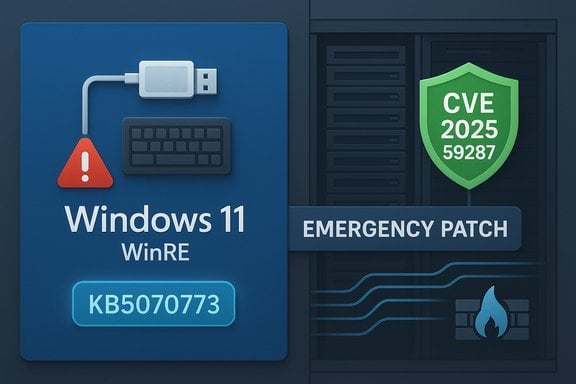
Windows 11 WinRE emergency patch KB5070773 for CVE-2025-59287.
Microsoft released two out-of-band emergency updates in late October that demand immediate attention from both consumers running Windows 11 and IT teams managing Windows Server infrastructure: an urgent Windows 11 fix (KB5070773) restoring USB input inside the Windows Recovery Environment (WinRE), and a critical Windows Server Update Services (WSUS) security patch that mitigates a remotely exploitable RCE vulnerability tracked as CVE-2025-59287. These simultaneous patches address two very different but equally urgent failure modes — one that can leave individual PCs unrecoverable without special workarounds, and another that can let unauthenticated attackers seize control of WSUS servers and potentially push malicious updates across entire corporate estates. This is what to know, what to do now, and how to reduce the risk of repeating this scenario.

Background and overview​

October’s regular Patch Tuesday delivered a cumulative update that, while intended to harden and maintain Windows, produced a pair of significant regressions and a quickly escalating security risk. Within days of the October rollup, reports surfaced that USB keyboards and mice stopped working inside WinRE for many Windows 11 systems running versions 24H2 and 25H2, preventing users from interacting with recovery options such as Reset this PC, Startup Repair, and other troubleshooting tools. Microsoft acknowledged the regression and issued an out-of-band quality update, KB5070773, on October 20, 2025 that restores USB input functionality in the recovery environment and updates affected Windows 11 build numbers to 26100.6901 (24H2) and 26200.6901 (25H2).
Independently, a dangerous vulnerability was discovered in Windows Server Update Services (WSUS) that allows for remote code execution via unsafe deserialization of untrusted data — tracked as CVE-2025-59287. This bug can be exploited without authentication and has active proof-of-concept and observed exploitation. Microsoft pushed a targeted security update for WSUS on Windows Server (rollouts starting October 23–24, 2025) to remediate the defect. National cyber agencies and emergency vulnerability catalogs have classified the WSUS flaw as actively exploited and set expedited mitigation timelines for government and critical organizations.
Both incidents underline two recurring themes: even well-tested cumulative updates can create serious regressions in constrained environments like the WinRE safe OS image; and server-side management tooling like WSUS, when vulnerable, offers an attacker the ability to weaponize distribution infrastructure and cause rapid, large-scale compromise.

Why this matters: the real risks explained​

WinRE regression: more than an annoyance​

  • Recovery blocked: If USB input is unrecognized inside WinRE, the recovery UI is effectively unusable for affected users. That includes the inability to run system restores, reset, or access other troubleshooting options — turning what should be a last-resort path into a dead end.
  • Not limited to consumers: The regression was reported on consumer and enterprise hardware, and also on server SKUs that share the same servicing baseline.
  • Partial scope and surprising behavior: The peripherals often continue to work during normal Windows operation; the failure manifests only in the Safe OS context used by WinRE. That disparity hints at a packaging or driver-selection problem within the recovery image rather than a universal USB driver failure.
  • Workarounds are fragile: Touchscreen users may be able to use the on-screen keyboard; PS/2 ports (where available) can restore functionality; a previously created USB recovery drive can help. Many users, however, lack these options when a system is unbootable.

WSUS RCE: a systemic, high-impact threat​

  • Unauthenticated RCE: The vulnerability allows unauthenticated attackers to send a crafted request that triggers vulnerable deserialization routines and achieves remote code execution as SYSTEM.
  • Supply-chain danger: A compromised WSUS server can be leveraged to distribute malicious update packages to managed clients — making this a supply-chain-style vector with potentially catastrophic enterprise impact.
  • Active exploitation and high severity: Proof-of-concept exploits were made public and real-world exploitation has been observed. The vulnerability carries a critical severity profile and is included on accelerated remediation lists used by national cybersecurity agencies.
  • Scope-limited but critical: Only servers running the WSUS server role are affected; endpoints that simply receive updates are not directly vulnerable. Still, WSUS is widespread in enterprise environments, and exposed WSUS endpoints on the network perimeter are at extreme risk.

What Microsoft shipped (exacts and build numbers)​

  • Windows 11 out-of-band update: KB5070773 — released October 20, 2025. This cumulative OOB update includes the October 14 security rollup plus targeted fixes for WinRE USB input problems. Affected OS builds are updated to 26200.6901 (25H2) and 26100.6901 (24H2).
  • WSUS security update: WSUS-specific security patches were released as out-of-band security updates in late October 2025 to remediate CVE-2025-59287. Those server updates require installation and a reboot on servers with WSUS enabled. The patch reduces reported error detail in WSUS error reporting as a temporary side effect.
These updates were made available through standard Microsoft distribution channels: Windows Update, Microsoft Update Catalog, and enterprise deployment tools. The WSUS patch is standalone for servers running the WSUS role and should be prioritized for any server that receives inbound connections on WSUS ports.

Immediate actions for Windows 11 users (home and power users)​

  1. Check for and install updates now: Open Settings > Windows Update and select Check for updates. If KB5070773 or later cumulative rollups are available, allow them to install and reboot when prompted.
  2. Don’t delay or pause critical updates: If you’re still on Windows 11 24H2 or 25H2, this fix addresses a recovery-mode regression that can leave your system unrecoverable without special workarounds.
  3. Verify build number after reboot: Use winver (Press Win+R, type winver, press Enter) to confirm the OS Build is at or above 26100.6901 (24H2) or 26200.6901 (25H2).
  4. Create or refresh a recovery drive: Use the built-in Create a recovery drive tool on another healthy PC and keep that USB recovery media accessible. This can bypass WinRE issues if your PC becomes unbootable.
  5. Keep alternate input options handy: If your device has PS/2 ports, keep a PS/2 keyboard/mouse or an appropriate adapter available. Touchscreen owners should be aware the on-screen keyboard can sometimes be used inside WinRE.
  6. If you’re stuck in WinRE now: If WinRE is inaccessible and the system won’t boot normally, try a cold power-off and reboot into the normal OS (if possible) to apply Windows Update; use a USB recovery drive or PS/2 peripherals if you have them. If none of those are available, professional repair may be needed.

Immediate actions for IT admins and enterprises​

  • Prioritize WSUS servers for immediate patching.
    • Identify all servers with the WSUS server role enabled and check whether ports 8530 (HTTP) and 8531 (HTTPS) are reachable externally.
    • Apply the WSUS out-of-band security update to every WSUS host immediately and reboot those servers to complete the mitigation.
    • If a WSUS server is publicly accessible on those ports, treat it as high-priority for incident response and assume potential compromise until proven otherwise.
  • Isolate and harden WSUS where possible.
    • Block inbound access to WSUS ports at the perimeter unless explicitly needed and secured.
    • Implement network segmentation to isolate WSUS servers from critical administrative networks.
  • Validate integrity of WSUS:
    • Check WSUS update metadata and package catalog for unexpected or modified entries.
    • Audit recent WSUS logs and system event logs for unusual activity, process spawns, or changes to update packages.
  • Follow emergency vulnerability guidance: Observe national guidance and apply mitigations within recommended timelines. For systems under government or regulated contracts, follow the accelerated remediation deadlines.
  • Test and stage patches but don’t over-delay: While standard patching discipline requires testing, the active exploitation of CVE-2025-59287 may mandate rapid deployment. Use a staged roll-out, starting with high-priority systems and WSUS itself.

How to verify installations and confirm protection​

  • For Windows 11 consumer devices:
    • Open Settings > Windows Update > Update history to confirm KB5070773 or subsequent cumulative updates are installed.
    • Run winver to confirm the OS build is 26100.6901 or 26200.6901 or higher.
  • For Windows Server/WSUS:
    • Use the Update Catalog or server update history and confirm the presence of the WSUS security update package (the KB name appears in the server’s update history).
    • Reboot WSUS servers after installing the patch — the update requires restart to finalize mitigation.
  • For enterprise verification:
    • Query endpoint management tools (SCCM, Intune, or equivalent) to locate devices that have not yet received the update and generate compliance reports.
    • Use PowerShell to check update presence centrally (for example, remote query of installed updates or use of vendor management APIs).

What to watch for after installing updates​

  • Post-patch regressions: Emergency updates are tightly scoped but can occasionally cause secondary regressions. Watch for unusual peripheral behavior, application issues, or changes to WSUS reporting after installing server patches.
  • WSUS UI behavior: Some WSUS error-reporting detail may be suppressed as a temporary side effect of the WSUS security update; this is an intentional change to limit information disclosure and is documented as a known issue for the emergency patch. Teams should plan for reduced error visibility for a brief window.
  • Signs of compromise: For WSUS servers, look for unknown service installations, unexpected outbound connections, or unauthorized modifications to update packages. If exploitation is suspected, treat the server as compromised and follow incident response procedures — collect logs, isolate the host, and restore from a trusted backup when remediation is complete.

Short-term mitigations if you can’t patch immediately​

  • Block access to WSUS ports (8530/8531) at the network perimeter to reduce the exposure of WSUS servers to remote exploitation.
  • Restrict WSUS administration: Limit access to WSUS management interfaces to trusted administration networks or use jump hosts and multi-factor authentication for remote access.
  • Disable WSUS if feasible: If a WSUS server’s presence cannot be secured immediately and the role can be temporarily disabled without disrupting operations, consider disabling it until the patch is applied.
  • Backups and offline archives: Ensure critical WSUS metadata and update binaries are backed up; maintain offline copies of critical server configurations and have a recovery plan in place that does not rely solely on WSUS.

Root causes, testing failures, and what this exposes about update governance​

The WinRE regression and the WSUS RCE highlight two different but related gaps in modern update governance:
  • Testing in constrained environments: WinRE uses a minimal safe OS image and a lean driver set. Regressions that affect only that reduced runtime can easily escape standard functional testing if test suites focus on the full desktop experience. This suggests Microsoft’s test matrices must emphasize Safe OS scenarios and recovery-image validation across a broader set of device configurations.
  • Complexity and coupling: The WinRE issue was introduced as part of an otherwise standard cumulative update, demonstrating how tightly coupled components (drivers, Safe OS packaging, servicing stacks) can produce surprising failures when a particular combination of changes reaches devices.
  • Rapid exploitability of management tooling: WSUS is a trusted, high-privilege service. Vulnerabilities in management tooling are high-value targets for attackers because they offer a path to mass compromise. This incident reinforces the need for defensive-in-depth around management servers.
  • Communication and speed: Microsoft’s rapid deployment of out-of-band fixes shows responsiveness. At the same time, the frequency of emergency patches this year will increase pressure on admins to maintain a faster testing-to-deployment cadence and could reduce confidence in the predictable Patch Tuesday rhythm.
Where the precise root-cause analysis for the WinRE regression still lacks a public, line-by-line postmortem, that absence should be treated with cautious curiosity: vendor post-incident reports are important for broader engineering learning and for customers to understand mitigation strategies beyond patch application. Until such a postmortem is published, the community must rely on observed behavior and vendor-supplied patch notes.

Recommended long-term actions for organizations​

  • Tighten perimeter controls for update infrastructure: WSUS servers should never be directly exposed to the internet. Use reverse proxies, VPN tunnels for management, and strict firewall policies.
  • Adopt canary and staged rollouts: Reduce blast radius by testing updates on a small number of representative systems (including recovery-mode exercises), then expand deployment once validated.
  • Expand test coverage to recovery scenarios: Ensure recovery-image testing is part of regular QA routines — validate WinRE functionality after cumulative updates and before broad deployment.
  • Monitor threat intelligence feeds and KEV lists: Maintain visibility on known-exploited vulnerability catalogs and short-notice advisories issued by national authorities to accelerate triage and patching.
  • Harden WSUS servers: Apply least-privilege principals, restrict administrative access, enforce MFA for management, and log all administrative actions for auditability.
  • Plan for rapid incident response: Keep validated backups and tested restore procedures for WSUS and other critical management infrastructure, and rehearse recovery from compromise.

Practical checklist — what to do now (consolidated)​

  • Home users:
    • Install Windows updates and reboot.
    • Create a USB recovery drive.
    • Keep alternate input devices available (PS/2 or touchscreen).
    • Verify OS build with winver.
  • IT administrators:
    • Immediately apply WSUS security updates and reboot WSUS servers.
    • Audit WSUS exposure: block ports 8530/8531 from the public internet.
    • Check for indicators of compromise on WSUS servers.
    • Stage and test KB5070773 (or later cumulative updates) across device rings, with recovery-mode checks included.
    • Communicate to stakeholders the urgency and any required downtime or emergency maintenance windows.

Final analysis: what this episode teaches Windows users and administrators​

Microsoft’s October out-of-band activity demonstrates a complex reality: modern operating systems and management platforms are simultaneously resilient and fragile. Resilient because the vendor can assemble, test, and distribute emergency fixes rapidly; fragile because a single cumulative update can disable a critical subsystem used only in exceptional circumstances (like WinRE), or expose management infrastructure to severe exploitation.
For Windows 11 users, the headline is simple: install the recovery-environment fix now and take the opportunity to create or refresh recovery media. For administrators, the WSUS vulnerability is a wake-up call: treat management infrastructure as a crown-jewel asset, accelerate patching on servers, and ensure network controls prevent direct exposure.
Both problems also underscore a deeper lesson for enterprise IT governance: the imperative to test updates not only for the running desktop experience but for recovery and management pathways that attackers prize. The next logical step for organizations is to formalize recovery-mode testing in their update acceptance criteria and to review the exposure of update-management servers against the most conservative threat models.
The immediate danger has been addressed by emergency patches — but the broader questions about testing rigor, update trust, and the security of distribution systems remain. Organizations that respond swiftly, patch comprehensively, and harden their management plane will be best positioned to avoid being surprised the next time a critical update cycle goes off-script.

Source: Forbes Microsoft Issues 2 Emergency Windows Updates—What You Do Now
 

Microsoft has confirmed an emergency out‑of‑band patch for a critical Windows Server Update Services (WSUS) remote code execution flaw — and threat actors moved quickly, exploiting internet‑exposed WSUS instances within days of public proof‑of‑concept code appearing.

Dim data center with an Emergency Patch shield, alert banners, and a remediation flowchart.Background​

WSUS is the Windows Server role many administrators use to centralize Windows update distribution in corporate networks. The vulnerability, tracked as CVE‑2025‑59287, stems from unsafe deserialization in WSUS and carries a CVSS v3 score of 9.8 (Critical); Microsoft released an out‑of‑band (OOB) update after initial fixes were found to be incomplete. Unsafe deserialization vulnerabilities have long been a high‑risk class of defects because they allow attackers to craft serialized objects that, when deserialized by a vulnerable application, can run attacker‑controlled code in the context of that process. In this WSUS case, the vulnerable code path accepts an encrypted cookie object (an AuthorizationCookie) at the GetCookie endpoint, decrypts it, and deserializes it using the legacy BinaryFormatter mechanism — a pattern security engineers have warned against for years. Because WSUS frequently runs with high privileges and is often trusted by downstream endpoints, exploitation of this flaw presents exceptional risk: a compromised WSUS server can be used to execute arbitrary commands on the server itself, stage additional payloads, and — in the worst case — distribute malicious updates to client machines. Governments and incident responders moved quickly; CISA added CVE‑2025‑59287 to its Known Exploited Vulnerabilities (KEV) catalog and issued emergency guidance to federal agencies and network owners.

What happened — timeline and observed attacks​

How the issue surfaced​

  • Researchers publicly disclosed the deserialization issue and published proof‑of‑concept (PoC) exploit code in mid‑ to late October, prompting Microsoft to push an emergency update. The PoC accelerated exploitation risk because it provided a repeatable method attackers could adapt.
  • Security vendors and national CERTs reported active exploitation almost immediately after the PoC surfaced, with multiple vendors describing targeted probes and successful execution attempts against exposed WSUS endpoints.

Observed attacker behavior​

Security firms reported a consistent pattern in early attacks:
  • Attackers scanned for WSUS instances exposed on the default listener ports 8530/TCP and 8531/TCP, targeting systems that left the WSUS Server Role reachable from the internet.
  • Exploit attempts involved multiple crafted POST requests to WSUS web services that triggered deserialization, spawning cmd.exe and PowerShell processes under the WSUS worker process. Payloads were frequently delivered or executed as Base64 strings, and attackers leveraged headers (notably a request header named aaaa in one observed campaign) to smuggle commands and avoid plain‑text presence in logs.
  • Post‑exploit behavior included network reconnaissance (enumerating logged‑on users, domain accounts, and network topology) and exfiltration to attacker‑controlled webhooks. In at least one case, a .NET executable with a gadget chain consistent with ysoserial.net was dropped.

Vendor and government response​

  • Microsoft released the out‑of‑band security update and recommended immediate installation and a reboot for affected WSUS hosts. The vendor also published mitigation options — including disabling the WSUS Server Role or blocking inbound traffic on ports 8530 and 8531 at the host firewall — for organizations unable to patch immediately.
  • CISA added the issue to its KEV catalog and set a remediation date for federal civilian agencies, elevating the incident to an urgent, cross‑sector priority.

Technical root cause explained​

Unsafe deserialization and BinaryFormatter​

At the core of the exploit is unsafe deserialization: the WSUS GetCookie handling accepts encrypted serialized objects and deserializes them without robust type validation. The pipeline reportedly uses AES‑128‑CBC to decrypt the cookie content, then hands the decrypted bytes to .NET’s legacy BinaryFormatter for deserialization. BinaryFormatter is inherently dangerous when used with untrusted data because it supports polymorphic deserialization and can activate gadget chains that execute code. Microsoft itself previously advised developers to stop using BinaryFormatter and removed its implementation from .NET 9.

Why WSUS magnifies the risk​

WSUS typically runs with high privileges and is trusted to manage software updates for large endpoint populations. That makes any pre‑authentication remote code execution (RCE) especially dangerous:
  • A compromised WSUS can run code as SYSTEM, create persistence, and manipulate the update distribution pipeline.
  • Because endpoints trust WSUS for updates, a compromised server can be a vector for supply‑chain like attacks, distributing malicious payloads at scale.
  • Many WSUS instances are forgotten or misconfigured and may be exposed to the internet, increasing the attack surface.

Practical impact for admins and organizations​

Likely targets and exposure​

  • Organizations that publish WSUS to the internet (often for remote management or because of historical network designs) are highest risk. Public internet exposure of ports 8530 and 8531 dramatically increases the chance of opportunistic compromise.
  • Even internal WSUS servers present risk if lateral movement is achievable from the compromised host, enabling domain compromise and ransomware deployment.

Realistic attacker outcomes​

  • Full server takeover with SYSTEM privileges.
  • Deployment of additional payloads (ransomware, backdoors, credential stealers).
  • Reconnaissance of domain and Active Directory, enabling privilege escalation and lateral movement.
  • Potential for malicious update distribution, turning a central management service into a potent supply‑chain vector.

Immediate actions: a prioritized playbook​

  • Apply the Microsoft out‑of‑band update to every WSUS server immediately, then reboot the hosts to complete remediation. This is the only guaranteed fix.
  • For environments that cannot patch immediately, implement temporary mitigations and keep them in place until the patch and a full validation are completed:
  • Disable the WSUS Server Role on servers where feasible (note: endpoints will stop receiving updates from that server while disabled).
  • Block inbound traffic to ports 8530 and 8531 at the host firewall (not only at perimeter devices) to render the WSUS web interface unreachable from untrusted networks.
  • Immediately inventory all WSUS instances across the estate and identify which servers have WSUS enabled and which of those are reachable from untrusted networks. Use network discovery tools and firewall logs.
  • If any WSUS server was internet‑exposed and unpatched during the PoC/initial exploit window, assume compromise and proceed with a full incident response:
  • Isolate the server from the network.
  • Capture volatile artifacts and full memory images if possible.
  • Preserve WSUS databases and application logs for forensic analysis.
  • Scan for persistence mechanisms and indicators of compromise (IOCs) such as unusual child processes of WSUS worker processes.

Detection guidance — what to look for​

  • Multiple POST requests to WSUS web service endpoints from external sources, especially to the GetCookie or similar endpoints.
  • WSUS worker processes spawning cmd.exe and powershell.exe processes in close succession or with unusual parent/child process relationships.
  • PowerShell commands decoding and executing Base64 payloads or suspicious network callbacks to webhook endpoints or unknown domains.
  • Presence of unexpected .NET assemblies or dropped executables in WSUS working directories or temporary folders.
  • Unusual outbound traffic from WSUS hosts to unknown IPs or domains immediately after exploit attempts (reconnaissance and exfiltration patterns).
Detection steps (ordered):
  • Query SIEM for POST calls to WSUS endpoints and correlate with source IPs and timestamps.
  • Hunt for WSUS worker process anomalies in endpoint telemetry and EDR logs.
  • Scan for decoded PowerShell commands or Base64 strings executed in processes spawned by WSUS.
  • Use the Sigma rules and YARA signatures shared by vendors (where available) to accelerate detection and triage.

Forensic indicators and artifacts seen in the wild​

  • Base64‑encoded PowerShell payloads fetched and executed by child PowerShell processes.
  • A .NET payload that reads a specific HTTP header (observed as aaaa in one campaign) and executes its contents with cmd.exe, used to avoid dropping readable commands in logs.
  • Evidence of ysoserial.net style gadget chains embedded in dropped .NET assemblies; these are consistent with unsafe deserialization exploitation.
If any of these artifacts are present, treat the WSUS server as compromised and follow the full incident response playbook: isolate, image, analyze, and rebuild with validated backups and a clean OS image.

Why this matters: systemic risks and lessons​

Centralized services are high‑value targets​

WSUS is a classic single‑point‑of‑failure when misconfigured or exposed. A well‑timed compromise of update infrastructure could allow an attacker to reach broad classes of endpoints without needing initial access to each one individually. This WSUS incident underscores the need to treat internal management systems as crown jewels and apply zero‑trust access controls.

Legacy APIs and unsafe defaults persist​

The root cause touches a recurring theme: legacy serialization mechanisms (BinaryFormatter) and a code path that implicitly trusted cookie contents. Modern secure coding guidelines discourage these constructs, and platforms have gradually deprecated them — yet many enterprise products still contain legacy code. The fix should be coupled with a code hygiene push to remove unsafe serializers and introduce strict type validation.

Patch cadence vs. PoC availability​

This case also illustrates the friction between regular patch cycles and real‑time risk: a Patch Tuesday update initially included a remediation, but the vendor re‑released an OOB update when researchers and the vendor determined the initial release did not fully mitigate exploitation. When PoC or exploit code appears, attackers move fast; defense posture must be able to react faster.

Risk assessment for different organizational sizes​

  • Small organizations with single WSUS servers that are internet‑exposed: Extremely high risk. If WSUS is reachable externally, immediate mitigation (patch or host firewall block) is mandatory.
  • Mid‑sized enterprises with segmented networks and centralized patching: High risk if WSUS servers are reachable from untrusted segments or if lateral movement controls are weak. Rapid inventory and mitigation should be prioritized.
  • Large enterprises and service providers: High to critical risk because of scale and the potential for downstream impact. Incident response playbooks and forensics must be ready; CISA guidance and KEV deadlines apply to public sector entities.

Long‑term fixes and hardening recommendations​

  • Replace or refactor any use of BinaryFormatter and other insecure serialization technologies. Adopt safer serializers and strict type whitelisting for deserialization routines.
  • Limit WSUS network exposure: WSUS should not be directly reachable from the internet. If remote management is needed, place WSUS behind VPNs, jump hosts, or zero‑trust access brokers.
  • Apply defense‑in‑depth controls:
  • Host‑based firewall rules restricting inbound access to WSUS to management subnets.
  • Network segmentation that prevents a compromised management server from reaching domain controllers or sensitive resources.
  • Endpoint detection and response (EDR) coverage on WSUS hosts to detect process injection, unusual child processes, and suspicious PowerShell activity.
  • Keep update testing and emergency patching playbooks current: practice OOB patch deployment scenarios so operations teams can move quickly when critical vulnerabilities arise.

What remains unknown or unverified​

  • Public attribution: at the time of reporting, no authoritative public attribution to a named APT or ransomware group has been confirmed. Observed tooling varies from simple ysoserial gadget chains to more sophisticated .NET payloads; this mixed picture does not identify a single actor definitively. Treat attribution claims with caution until formal intelligence releases provide evidence.
  • Prevalence of compromise: some security vendors reported thousands of exposed WSUS instances, but exploitation is likely opportunistic and may be limited by the proportion of WSUS servers that remain internet‑exposed and unpatched. Still, any internet‑reachable, unpatched WSUS should be assumed at risk.

Bottom line and executive summary​

  • CVE‑2025‑59287 is a critical WSUS deserialization vulnerability enabling unauthenticated remote code execution with SYSTEM‑level impact on affected servers.
  • Proof‑of‑concept exploit code was published publicly and multiple vendors observed exploitation attempts almost immediately; CISA placed the CVE on its KEV catalog and Microsoft issued an out‑of‑band update and emergency guidance.
  • Immediate action: apply the Microsoft OOB patch and reboot WSUS servers. If that cannot be done at once, disable the WSUS role or block ports 8530/8531 at the host firewall until remediation is complete.
  • Longer term, remove legacy insecure serialization patterns, reduce internet exposure of management services, and harden WSUS with segmentation, monitoring, and EDR.

This incident is a stark reminder that update infrastructure is a high‑value target. Secure coding, rigorous network hygiene, fast patching capability, and careful exposure management are essential to prevent a trusted service from becoming an attacker's distribution channel.
Source: SC Media Critical WSUS RCE flaw targeted by attackers after patch
 

Microsoft has pushed emergency, out‑of‑band updates after security researchers and multiple incident responders confirmed active exploitation of a critical remote‑code‑execution flaw in Windows Server Update Services (WSUS), forcing organizations to treat every WSUS host as a top‑tier remediation priority until it is patched or isolated.

WSUS server guarded by a big yellow plus shield as Microsoft Update streams from the cloud.Background / Overview​

Windows Server Update Services (WSUS) is the on‑premises Microsoft update distribution platform many enterprises use to approve, stage, and deliver Microsoft updates across domain‑joined endpoints. Because WSUS is a trusted distribution point inside corporate networks, a compromise of WSUS can be weaponized to deliver malicious updates or tamper with update metadata — a high‑impact, supply‑chain style risk for any organization.
The vulnerability at the center of the response is tracked as CVE‑2025‑59287, the root cause is unsafe deserialization in WSUS reporting/management web services, and vendors assigned the defect a CVSS v3 base score of 9.8 (Critical). The flaw allows an unauthenticated, network‑accessible attacker to trigger remote code execution (RCE) in the WSUS process context, which typically runs with SYSTEM privileges. Microsoft initially shipped a partial fix in the October Patch Tuesday rollups, then released out‑of‑band (OOB) cumulative updates on October 23–24, 2025 after researchers demonstrated remaining attack paths and proof‑of‑concept (PoC) exploit code circulated publicly.
Multiple vendors and national cyber authorities observed exploitation attempts around the same timeframe and the U.S. Cybersecurity and Infrastructure Security Agency (CISA) added the vulnerability to its Known Exploited Vulnerabilities (KEV) catalog, accelerating remediation expectations for federal and critical infrastructure organizations.

Why WSUS matters — the attack surface and stakes​

WSUS is not an ordinary server role. It is a trusted update authority inside an enterprise:
  • WSUS runs with elevated privileges on servers and interacts directly with endpoints during normal update flows.
  • Compromise of WSUS can allow tampering with approved update metadata or payloads, turning an attacker into an internal update distributor.
  • Because WSUS communicates with many clients, an exploited WSUS server can amplify impact across an entire fleet.
That combination — unauthenticated network RCE that yields SYSTEM privileges on a trusted distribution server — is why the industry response was rapid and forceful. Treating WSUS like a crown‑jewel asset (alongside domain controllers and PKI servers) is not hyperbole in this context.

Technical summary: what the bug is and how it’s abused​

At a high level, CVE‑2025‑59287 is a deserialization of untrusted data vulnerability (CWE‑502) inside WSUS’s reporting and client web service endpoints.
  • WSUS accepts an encrypted AuthorizationCookie or similar payload via HTTP/SOAP POST requests on its management endpoints (default ports 8530 for HTTP and 8531 for HTTPS).
  • The server decrypts the cookie payload and passes the plaintext bytes into a legacy .NET deserializer (BinaryFormatter/SoapFormatter style) without enforcing type or input validation.
  • Legacy .NET serializers can be abused to build so‑called “gadget chains” that execute code during object reconstruction; an attacker who crafts the serialized payload can cause arbitrary code to run in the WSUS process context (usually SYSTEM).
This is a classic unsafe deserialization chain that has been repeatedly dangerous across web platforms; WSUS’ use of legacy serialization in a network‑facing service made it especially vulnerable. Public proof‑of‑concept write‑ups and independent analysis quickly demonstrated the exploitability of the chain and the remaining attack paths that the initial October rollup did not fully remediate, prompting Microsoft to issue the October 23–24 OOB fixes.

Timeline — disclosure, PoC, patching and exploitation (concise)​

  • Mid‑October 2025 — independent researchers published technical analysis and PoC exploit code demonstrating the unsafe deserialization chain in WSUS.
  • October 14, 2025 — Microsoft issued an initial fix in the regular Patch Tuesday rollups; follow‑up research showed alternative paths remained exploitable.
  • October 23–24, 2025 — Microsoft released out‑of‑band cumulative updates that supersede the October rollups and include the comprehensive WSUS fix; packages require a server reboot to complete mitigation.
  • October 23–24, 2025 onward — multiple security vendors and incident responders reported in‑the‑wild exploitation attempts and scanning for internet‑exposed WSUS hosts; CISA added the vulnerability to its KEV catalog and set accelerated remediation expectations.
Note: several vendor telemetry reports described both automated exploitation attempts and hands‑on‑keyboard activity on compromised hosts, reinforcing that this was not a theoretical risk.

Immediate operational impacts and observable side effects​

Administrators who installed Microsoft’s OOB packages should be aware of operational side effects that Microsoft documented:
  • The OOB updates require a reboot of WSUS servers to complete remediation. Plan for downtime and coordinate reboots across maintenance windows.
  • Microsoft’s mitigation temporarily removes some synchronization error details from the WSUS console as part of the fix; administrators should expect reduced debug information immediately after patching and plan for validation steps accordingly.
  • If patching cannot be done immediately, the two practical mitigations are to disable the WSUS Server Role or to block inbound traffic to ports 8530/8531 at the host firewall or perimeter — both prevent exploitation but also render WSUS non‑operational until restored.

What you must do now — prioritized checklist​

Apply this checklist in order and treat WSUS remediation as a high‑urgency task.
  • Inventory
  • Identify every Windows Server with the WSUS Server Role installed and enabled. Only hosts with the role enabled are vulnerable; servers without WSUS are not affected.
  • Patch
  • Obtain and install the October 23–24, 2025 out‑of‑band cumulative update appropriate for each affected Windows Server SKU, including the required servicing‑stack update (SSU) and latest cumulative update. Reboot the server to complete remediation.
  • Isolate if you cannot patch immediately
  • Temporarily disable the WSUS Server Role or block inbound access to ports 8530 (HTTP) and 8531 (HTTPS) on the host firewall or network ACLs. This prevents WSUS from accepting the crafted requests that trigger the bug but also stops update distribution.
  • Detection and hunt
  • Hunt for indicators of compromise (IoCs) and anomalous activity on WSUS hosts and related infrastructure: unexpected processes, new scheduled tasks, modified update metadata, unexpected outbound connections, or suspicious command execution traces. Several incident responders reported shells and active reconnaissance on exploited hosts.
  • Validate WSUS catalog and update integrity
  • After mitigation, verify the authenticity and integrity of WSUS catalog data and approved updates. Look for tampered metadata or unexpected packages, and re‑establish trust boundaries where necessary.
  • Post‑incident recovery (if compromise suspected)
  • If compromise is confirmed, isolate the host, preserve forensic artifacts, perform a full incident response (IR) investigation, and rebuild or redeploy WSUS from known‑good binaries and backups only after thorough validation. Treat a compromised WSUS host as a serious breach due to its distribution trust.

Detection tips — what to look for​

  • Unexplained inbound HTTP/SOAP POSTs to WSUS management endpoints, especially with anomalous AuthorizationCookie payloads.
  • Unexpected child processes or command shells spawned by the WSUS worker process (w3wp.exe/app pool context), or SYSTEM‑level process creation following web requests.
  • Sudden changes in approved update metadata, newly signed packages that were not authorized by Windows Update, or modified classifications/approval dates. These can indicate tampering.
  • Network scanning or reconnaissance from external IPs targeting ports 8530/8531 — several security vendors documented scanning activity tied to exploitation attempts.
If any of these appear in your telemetry, escalate to your IR team immediately and apply isolation measures.

Why the first patch didn’t fully fix the problem — and the developer lesson​

Microsoft’s initial October Patch Tuesday rollup included mitigations for WSUS, but independent researchers quickly found alternative deserialization flows that remained reachable, and public PoC material showed the exploit still worked in certain scenarios. That rapid public analysis and PoC sharing drove Microsoft to reissue an out‑of‑band cumulative update that comprehensively closes the remaining paths. This sequence illustrates several enduring software‑security lessons:
  • Legacy serialization frameworks are risky: BinaryFormatter and similar legacy .NET serializers are unsafe for untrusted input and are a recurring source of deserialization vulnerabilities.
  • Network‑facing services require defensive coding: Any component that accepts serialized objects from external sources must validate types, use safe serialization patterns, or avoid deserialization entirely.
  • Patch verification matters: Initial remediation must be validated against public PoCs and independent analysis; where proof of exploitability persists, vendors may need to follow up with OOB fixes.

Broader risk analysis — strengths and potential weak points​

Strengths
  • Microsoft responded rapidly with an out‑of‑band update once research demonstrated remaining risk, and national authorities were engaged to accelerate remediation. The OOB fixes bundle SSUs and LCUs to simplify administrator actions.
  • The community’s quick public analysis and PoC disclosure increased visibility and pushed organizations to prioritize remediation before wider exploitation occurred.
Potential risks and open concerns
  • WSUS remains widely deployed on‑premises and often under‑monitored compared with cloud update services; its trust level makes any vulnerability disproportionately dangerous.
  • The presence of PoC code and observed exploitation reduces the window for safe remediation; automated mass‑scanning and opportunistic exploitation can quickly turn a high‑severity bug into a large incident.
  • Operational side effects (reduced console error visibility, required reboots) complicate fast rollouts in large environments and may cause administrators to delay patching — increasing exposure.
Cautionary note: Some claims about “wormability” or mass exploitation potential are context‑dependent. While the bug’s properties make rapid spread possible in poorly segmented networks, confirmed mass‑worm outbreaks had not been documented at the time of initial reporting; however, multiple targeted intrusions and automated scanning were observed. Treat wormability as a realistic risk that justifies urgent action, not as a guaranteed outcome.

Longer‑term recommendations — beyond immediate patching​

  • Treat update infrastructure as a first‑class security boundary: apply segmentation, stricter admin controls, logging and SIEM integration, and restrict management ports to required admin hosts.
  • Move away from legacy serialization patterns in critical services; adopt safer serializers or explicit contract‑based deserialization with strict type allowlists. Legacy BinaryFormatter usage should be phased out.
  • Reassess whether on‑prem WSUS is necessary for every environment. For many organizations, cloud‑based update management provides simpler patching and centralized security controls; where WSUS must remain, establish hardened baselines and tested IR playbooks.
  • Implement and exercise incident response plans that specifically include update‑infrastructure compromise scenarios, including catalog validation and controlled redeployment of update services.

Practical recovery steps if you suspect compromise​

  • Immediately isolate the WSUS host from the network and preserve memory and disk images for forensic analysis.
  • Collect logs: IIS logs, WSUS event logs, Windows Security and System logs, and endpoint telemetry for the period of suspected compromise.
  • Validate WSUS catalog integrity — compare hashes of approved updates against known Microsoft metadata sources and inspect for unexpected packages or signature anomalies.
  • If compromise is confirmed, rebuild the WSUS server from clean images and reinstall from trusted sources; do not attempt to sanitize an actively compromised server.
  • Rotate credentials that may have been exposed and perform broad enterprise hunts for lateral movement stemming from the WSUS compromise.

Final assessment and takeaways​

CVE‑2025‑59287 is a high‑impact vulnerability because it targets an inherently trusted piece of enterprise infrastructure and enables unauthenticated, SYSTEM‑level remote code execution via unsafe deserialization. The rapid disclosure timeline, presence of public proof‑of‑concept code, and observed exploitation attempts made Microsoft’s out‑of‑band updates and national‑level guidance appropriate and necessary. Administrators must act immediately: inventory WSUS servers, install the October 23–24 OOB cumulative updates and required SSUs, reboot, or, if patching cannot be performed immediately, disable the WSUS role or block ports 8530/8531 while preparing a validated remediation and validation plan.
This incident is also a sobering reminder that legacy code patterns — especially unsafe deserialization — remain a persistent enterprise risk when present in network‑facing, high‑trust services. Long‑term risk reduction requires architectural changes, stronger segmentation, and treating update infrastructure as a crown‑jewel that must be monitored and defended accordingly.
If your environment runs WSUS, prioritize remediation now, validate the integrity of your update pipeline after patching, and assume adversaries will continue to test and weaponize any available gaps until every vulnerable host is addressed.

Source: HotHardware Microsoft Windows Server Update Service Is Under Attack, What You Need To Know
 

Back
Top