

On June 2, 2026, the United States Trade Representative proposed new forced-labour tariffs of 10 to 12.5 percent on imports from 60 economies, placing New Zealand in the higher 12.5 percent group alongside Australia, China, Japan, South Korea, Vietnam and the United Kingdom. The move is formally about modern slavery, but it is also about tariff architecture after the courts clipped Donald Trump’s earlier trade regime. For Wellington, the uncomfortable part is that the American case lands on a real vulnerability: New Zealand has talked about ethical trade faster than it has built enforceable systems to police it. A country that sells itself as clean, fair and rules-based is now being asked whether that brand extends to the people who pick, process, pack and ship its exports.
The most important thing about the new U.S. tariff proposal is not the exact number, though 12.5 percent is enough to hurt. It is the legal wrapper. The Trump administration is using Section 301 of the Trade Act of 1974, a tool designed to respond to foreign practices deemed unreasonable or discriminatory and burdensome to U.S. commerce.
That framing matters because it transforms a blunt tariff into a compliance test. The U.S. is not simply saying it dislikes imports. It is saying trading partners have failed to impose or effectively enforce bans on goods made with forced labour, and that those failures distort competition against American firms and workers.
There is a cynical reading available, and it is not hard to see why. Trump’s second-term tariff strategy has already run into legal constraint, and forced labour gives the administration a sturdier moral and statutory footing than a generalized economic emergency. But cynicism should not become evasion. The policy may be opportunistic; the exposure it reveals is not imaginary.
New Zealand’s problem is that it is caught between two stories it likes to tell about itself. One is the story of a small, high-trust democracy that trades on quality and values. The other is the more awkward story of a labour market that has repeatedly depended on temporary migrant workers with limited bargaining power, sometimes in sectors central to the export economy.
But reporting is not the same as prohibition. Nor is a statement on a register the same thing as a credible import ban, a well-resourced labour inspectorate, or a procurement system that can trace risk through subcontractors, labour-hire chains and offshore suppliers. The American complaint is not just that countries disapprove of forced labour insufficiently. It is that many have failed to build enforceable mechanisms that stop tainted goods from entering commerce.
That distinction is brutal for New Zealand because the country’s reputation has often been allowed to substitute for infrastructure. “Clean and green” did not eliminate agricultural emissions. “Fair go” did not eliminate wage theft or migrant exploitation. “High trust” did not remove the need for audit trails, penalties, and public enforcement capacity.
Modern slavery is not always a locked factory gate or a trafficked worker hidden in a basement. In developed economies it can look like debt bondage through recruitment fees, fear of visa loss, underpayment, excessive hours, withheld documents, overcrowded accommodation and threats against workers who complain. Those patterns are harder to police than a single shipment of banned goods, but they are exactly what supply-chain law is increasingly being built to expose.
The larger risk is reputational. New Zealand exporters do not compete only on volume. They compete on provenance, environmental claims, animal welfare, food safety, worker treatment and the implied premium of distance: if a customer is paying to bring goods from the South Pacific, the story attached to those goods had better be worth it.
That story is vulnerable when temporary migrant exploitation keeps surfacing in the domestic economy. Enforcement agencies have brought cases involving underpayment, misleading immigration information and coercive work arrangements. Government agencies already recognise migrant exploitation as a serious enough problem to have created a Migrant Exploitation Protection Work Visa, allowing workers to leave exploitative employers without immediately losing lawful status.
That policy is humane and necessary. It is also an admission. If a country needs a dedicated visa to help people escape exploitative employment, it cannot plausibly argue that exploitation is an occasional aberration unconnected to the wider economic model.
The horticulture and dairy sectors should therefore read the U.S. move less as a diplomatic insult than as a preview of the next compliance era. Importers, retailers and regulators increasingly want evidence, not assurances. They want to know who recruited the worker, who paid the fee, who controlled the accommodation, who set the roster, who inspected the contractor, and what happened when a complaint was made.
That may sound like a separate housing-market story, but it speaks to the same political economy. New Zealand is very good at identifying structural problems after they become expensive. It is much less good at sustaining the regulatory, financing and delivery systems that would prevent them.
Auckland needs more housing, especially well-located apartments near jobs, transport and services. Yet the development pipeline is being crushed by high costs, weak presales, financing constraints and buyer caution. Developers abandon projects, buyers wait for price certainty, lenders demand evidence of demand, and the city’s long-term shortage is preserved by short-term market paralysis.
The housing lesson is that systems fail when risk is pushed onto the party least able to carry it. In apartments, that party may be the buyer asked to purchase off the plan into uncertainty, or the developer asked to carry cost inflation and financing risk before revenue arrives. In labour markets, it is often the migrant worker who has borrowed heavily, tied their status to an employer, and cannot complain without jeopardising their future.
Different sector, same habit: New Zealand lets fragility accumulate in private arrangements and then acts surprised when the aggregate result becomes a national problem.
The LNG argument appeals because it promises dispatchable security. Dry winters are real. Hydro risk is real. Gas supply has declined faster than policymakers once assumed. No serious energy plan gets to wave those constraints away.
But importing LNG also imports price exposure, infrastructure lock-in and geopolitical vulnerability. It can look like prudence while embedding a new dependency. The alternative path — electrification, distributed solar, grid-scale renewables, batteries, demand response and carefully limited backup generation — requires coordination across households, firms, networks and regulators. It is more complex, but complexity is not the same as impracticality.
This is where New Zealand’s political class often loses patience. It prefers announcements to systems, projects to markets, and ribbon-cutting to maintenance. But the cheapest energy system over decades is not necessarily the one that feels most reassuring in a ministerial press conference.
That number should sting because it describes a tax voters never approved but keep paying. Every time a project is scoped, paused, redesigned and revived, expertise disperses, contractors reprice risk, communities lose confidence and future governments inherit a more expensive version of the same problem.
Infrastructure is often discussed as concrete, pipes, roads and wires. It is also a credibility market. Builders, engineers and financiers decide whether New Zealand is a place where a pipeline of work can justify investment in people and equipment. If the political system treats long-term planning as a partisan whiteboard exercise, the private sector prices that uncertainty into every bid.
This matters for the modern-slavery debate too. Enforcement is infrastructure. Labour inspection is infrastructure. Supply-chain traceability is infrastructure. Procurement capability is infrastructure. Countries that underinvest in those systems eventually pay through tariffs, litigation, reputational harm or worker abuse.
The Budget’s longer-term support for the centralised Food Network hub may improve logistics, but distribution efficiency does not solve the underlying demand. If households cannot cover food after rent, power, transport and debt, a better warehouse only makes the crisis more orderly.
This matters because poverty policy, labour exploitation and migration policy are linked. Low-income workers are easier to exploit when the cost of exit is high. Migrant workers are easier to exploit when their visa, housing and debt obligations narrow their choices. Families are more vulnerable when public services assume charities will fill the gap.
New Zealand’s political debate often treats these issues as moral categories: poverty belongs to social policy, worker exploitation to employment law, tariffs to trade policy, housing to planning, energy to climate. The lived economy does not respect those borders. A worker underpaid in a labour-hire arrangement may be renting in a constrained housing market, sending money offshore, relying on charity food support and paying higher power bills because the energy transition has been mishandled.
The issue is not whether Copilot is useful. In many settings, it will be. Summarising documents, drafting emails, searching internal knowledge stores and accelerating routine administrative work are obvious use cases in a state sector under pressure to do more with less.
The issue is lock-in. When government agencies adopt a platform deeply integrated into Microsoft 365, identity systems, document repositories and security controls, procurement decisions become architecture decisions. Once staff workflows, training, compliance processes and data governance are built around a single vendor’s AI layer, switching becomes expensive even if the subscription price later rises or the product direction changes.
There is a parallel with LNG, infrastructure pipelines and supply-chain compliance. The cheapest-looking decision at the point of purchase can become costly if it narrows future options. Government procurement should not treat AI as a normal software licence when it is increasingly a layer between public servants and public information.
The U.S. tariff threat is an external deadline on modern slavery enforcement. Auckland’s apartment slump is a market deadline on housing delivery. Dry-year electricity risk is a physical deadline on energy planning. The $18 billion infrastructure estimate is a fiscal deadline on political churn. Food bank strain is a social deadline on poverty policy. Copilot’s rise is a digital deadline on public-sector procurement governance.
None of these problems is solved by outrage at Washington, developers, councils, charities or Microsoft. The harder truth is that each reflects a governing culture that accepts fragility as long as it remains dispersed. Workers absorb it, renters absorb it, contractors absorb it, food banks absorb it, households absorb it, and eventually exporters absorb it at the border.
The modern-slavery tariff should therefore be read as a warning shot about more than forced labour. It is a signal that the next era of trade will increasingly punish countries that cannot prove how their economies work. Values will need paperwork. Brand will need enforcement. Public claims will need private audit trails.
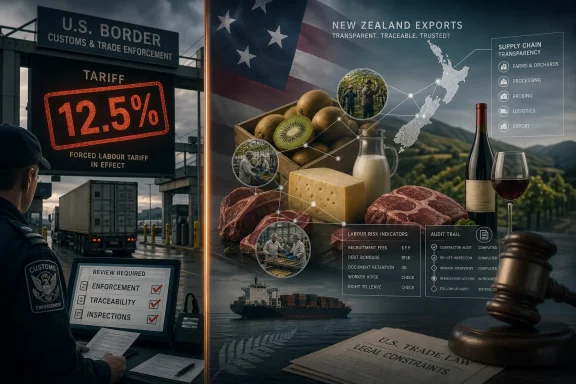 Washington Has Found a Moral Lever for an Economic Weapon
The most important thing about the new U.S. tariff proposal is not the exact number, though 12.5 percent is enough to hurt. It is the legal wrapper. The Trump administration is using Section 301 of the Trade Act of 1974, a tool designed to respond to foreign practices deemed unreasonable or discriminatory and burdensome to U.S. commerce.That framing matters because it transforms a blunt tariff into a compliance test. The U.S. is not simply saying it dislikes imports. It is saying trading partners have failed to impose or effectively enforce bans on goods made with forced labour, and that those failures distort competition against American firms and workers.
There is a cynical reading available, and it is not hard to see why. Trump’s second-term tariff strategy has already run into legal constraint, and forced labour gives the administration a sturdier moral and statutory footing than a generalized economic emergency. But cynicism should not become evasion. The policy may be opportunistic; the exposure it reveals is not imaginary.
New Zealand’s problem is that it is caught between two stories it likes to tell about itself. One is the story of a small, high-trust democracy that trades on quality and values. The other is the more awkward story of a labour market that has repeatedly depended on temporary migrant workers with limited bargaining power, sometimes in sectors central to the export economy.
New Zealand’s Brand Was Always Doing More Work Than Its Law
New Zealand has made progress on modern slavery policy, but it has moved slowly. A Modern Slavery Bill was introduced in 2026 with cross-party support from National and Labour MPs, and it would impose reporting obligations on covered entities while bringing directors and public-sector procurement into view. That is a serious step, especially in a political system where business compliance costs are usually treated as a form of natural disaster.But reporting is not the same as prohibition. Nor is a statement on a register the same thing as a credible import ban, a well-resourced labour inspectorate, or a procurement system that can trace risk through subcontractors, labour-hire chains and offshore suppliers. The American complaint is not just that countries disapprove of forced labour insufficiently. It is that many have failed to build enforceable mechanisms that stop tainted goods from entering commerce.
That distinction is brutal for New Zealand because the country’s reputation has often been allowed to substitute for infrastructure. “Clean and green” did not eliminate agricultural emissions. “Fair go” did not eliminate wage theft or migrant exploitation. “High trust” did not remove the need for audit trails, penalties, and public enforcement capacity.
Modern slavery is not always a locked factory gate or a trafficked worker hidden in a basement. In developed economies it can look like debt bondage through recruitment fees, fear of visa loss, underpayment, excessive hours, withheld documents, overcrowded accommodation and threats against workers who complain. Those patterns are harder to police than a single shipment of banned goods, but they are exactly what supply-chain law is increasingly being built to expose.
The Export Sectors Cannot Treat This as Someone Else’s Problem
For exporters, the immediate commercial risk is obvious. A 12.5 percent duty can alter margins, contract negotiations and shelf competitiveness, particularly in price-sensitive categories. Kiwifruit, apples, dairy, wine, meat and processed food all depend not only on production quality but on confidence in the systems behind that production.The larger risk is reputational. New Zealand exporters do not compete only on volume. They compete on provenance, environmental claims, animal welfare, food safety, worker treatment and the implied premium of distance: if a customer is paying to bring goods from the South Pacific, the story attached to those goods had better be worth it.
That story is vulnerable when temporary migrant exploitation keeps surfacing in the domestic economy. Enforcement agencies have brought cases involving underpayment, misleading immigration information and coercive work arrangements. Government agencies already recognise migrant exploitation as a serious enough problem to have created a Migrant Exploitation Protection Work Visa, allowing workers to leave exploitative employers without immediately losing lawful status.
That policy is humane and necessary. It is also an admission. If a country needs a dedicated visa to help people escape exploitative employment, it cannot plausibly argue that exploitation is an occasional aberration unconnected to the wider economic model.
The horticulture and dairy sectors should therefore read the U.S. move less as a diplomatic insult than as a preview of the next compliance era. Importers, retailers and regulators increasingly want evidence, not assurances. They want to know who recruited the worker, who paid the fee, who controlled the accommodation, who set the roster, who inspected the contractor, and what happened when a complaint was made.
The Apartment Slump Shows the Same Institutional Weakness in Another Market
The forced-labour tariff is not happening in isolation. It arrives in the same news cycle as CBRE’s latest Auckland apartment research showing the pipeline of new units has fallen to its lowest level in more than a decade, with project abandonments rising and a backlog of unsold apartments still needing to clear.That may sound like a separate housing-market story, but it speaks to the same political economy. New Zealand is very good at identifying structural problems after they become expensive. It is much less good at sustaining the regulatory, financing and delivery systems that would prevent them.
Auckland needs more housing, especially well-located apartments near jobs, transport and services. Yet the development pipeline is being crushed by high costs, weak presales, financing constraints and buyer caution. Developers abandon projects, buyers wait for price certainty, lenders demand evidence of demand, and the city’s long-term shortage is preserved by short-term market paralysis.
The housing lesson is that systems fail when risk is pushed onto the party least able to carry it. In apartments, that party may be the buyer asked to purchase off the plan into uncertainty, or the developer asked to carry cost inflation and financing risk before revenue arrives. In labour markets, it is often the migrant worker who has borrowed heavily, tied their status to an employer, and cannot complain without jeopardising their future.
Different sector, same habit: New Zealand lets fragility accumulate in private arrangements and then acts surprised when the aggregate result becomes a national problem.
Energy Policy Is Becoming a Test of Whether Wellington Can Count
The same pattern is visible in energy. Sapere’s report for Rewiring Aotearoa argues that more wind, solar, batteries and occasional diesel backup during dry winters would be cheaper than the Government’s plan to import liquefied natural gas. The debate is partly technical, but the politics are familiar. New Zealand is again weighing a system-wide transition against the temptation of a centralized, imported fix.The LNG argument appeals because it promises dispatchable security. Dry winters are real. Hydro risk is real. Gas supply has declined faster than policymakers once assumed. No serious energy plan gets to wave those constraints away.
But importing LNG also imports price exposure, infrastructure lock-in and geopolitical vulnerability. It can look like prudence while embedding a new dependency. The alternative path — electrification, distributed solar, grid-scale renewables, batteries, demand response and carefully limited backup generation — requires coordination across households, firms, networks and regulators. It is more complex, but complexity is not the same as impracticality.
This is where New Zealand’s political class often loses patience. It prefers announcements to systems, projects to markets, and ribbon-cutting to maintenance. But the cheapest energy system over decades is not necessarily the one that feels most reassuring in a ministerial press conference.
Stop-Start Infrastructure Has Become a Tax Without a Name
Shamubeel Eaqub’s report for Water New Zealand, Infrastructure New Zealand and Civil Contractors New Zealand puts a price on another national habit: stop-start infrastructure decision-making. The estimate is stark — $18 billion in cost over 25 years from projects delayed, cancelled, restarted or reshaped as governments and councils change priorities.That number should sting because it describes a tax voters never approved but keep paying. Every time a project is scoped, paused, redesigned and revived, expertise disperses, contractors reprice risk, communities lose confidence and future governments inherit a more expensive version of the same problem.
Infrastructure is often discussed as concrete, pipes, roads and wires. It is also a credibility market. Builders, engineers and financiers decide whether New Zealand is a place where a pipeline of work can justify investment in people and equipment. If the political system treats long-term planning as a partisan whiteboard exercise, the private sector prices that uncertainty into every bid.
This matters for the modern-slavery debate too. Enforcement is infrastructure. Labour inspection is infrastructure. Supply-chain traceability is infrastructure. Procurement capability is infrastructure. Countries that underinvest in those systems eventually pay through tariffs, litigation, reputational harm or worker abuse.
Poverty Policy Is Being Asked to Survive on Emergency Settings
The Salvation Army’s warning about food bank closures after the Budget funded food banks for only one year is another signal that temporary patches are becoming permanent institutions. Food banks were once framed as emergency relief. They are now load-bearing parts of the welfare state.The Budget’s longer-term support for the centralised Food Network hub may improve logistics, but distribution efficiency does not solve the underlying demand. If households cannot cover food after rent, power, transport and debt, a better warehouse only makes the crisis more orderly.
This matters because poverty policy, labour exploitation and migration policy are linked. Low-income workers are easier to exploit when the cost of exit is high. Migrant workers are easier to exploit when their visa, housing and debt obligations narrow their choices. Families are more vulnerable when public services assume charities will fill the gap.
New Zealand’s political debate often treats these issues as moral categories: poverty belongs to social policy, worker exploitation to employment law, tariffs to trade policy, housing to planning, energy to climate. The lived economy does not respect those borders. A worker underpaid in a labour-hire arrangement may be renting in a constrained housing market, sending money offshore, relying on charity food support and paying higher power bills because the energy transition has been mishandled.
Copilot’s Public-Sector Rise Is the Digital Version of the Same Procurement Question
Microsoft’s Copilot gaining a dominant position across New Zealand’s Government through a range of contracts reportedly awarded without competitive tender may seem like the outlier in this news mix. For WindowsForum readers, it is the item that brings the story closest to home: Microsoft’s AI stack is no longer just a productivity add-on. It is becoming public-sector infrastructure.The issue is not whether Copilot is useful. In many settings, it will be. Summarising documents, drafting emails, searching internal knowledge stores and accelerating routine administrative work are obvious use cases in a state sector under pressure to do more with less.
The issue is lock-in. When government agencies adopt a platform deeply integrated into Microsoft 365, identity systems, document repositories and security controls, procurement decisions become architecture decisions. Once staff workflows, training, compliance processes and data governance are built around a single vendor’s AI layer, switching becomes expensive even if the subscription price later rises or the product direction changes.
There is a parallel with LNG, infrastructure pipelines and supply-chain compliance. The cheapest-looking decision at the point of purchase can become costly if it narrows future options. Government procurement should not treat AI as a normal software licence when it is increasingly a layer between public servants and public information.
Wellington Cannot Keep Outsourcing the Cost of Delay
The through-line across the past day’s news is not that New Zealand faces one crisis. It is that New Zealand keeps encountering the bill for decisions postponed or softened until outside forces impose a deadline.The U.S. tariff threat is an external deadline on modern slavery enforcement. Auckland’s apartment slump is a market deadline on housing delivery. Dry-year electricity risk is a physical deadline on energy planning. The $18 billion infrastructure estimate is a fiscal deadline on political churn. Food bank strain is a social deadline on poverty policy. Copilot’s rise is a digital deadline on public-sector procurement governance.
None of these problems is solved by outrage at Washington, developers, councils, charities or Microsoft. The harder truth is that each reflects a governing culture that accepts fragility as long as it remains dispersed. Workers absorb it, renters absorb it, contractors absorb it, food banks absorb it, households absorb it, and eventually exporters absorb it at the border.
The modern-slavery tariff should therefore be read as a warning shot about more than forced labour. It is a signal that the next era of trade will increasingly punish countries that cannot prove how their economies work. Values will need paperwork. Brand will need enforcement. Public claims will need private audit trails.
The Bill Is Arriving in More Than One Currency
New Zealand still has room to respond, but the response has to be more concrete than diplomatic annoyance. A small trading country cannot control Washington’s tariff politics, but it can control the credibility of its own systems.- New Zealand is in the proposed 12.5 percent U.S. tariff group because Washington says it lacks an adequately imposed and enforced forced-labour import prohibition.
- The proposed tariff is not only a trade dispute; it is a test of whether New Zealand can verify the labour conditions behind its exports and imports.
- The Modern Slavery Bill is a meaningful step, but reporting obligations alone will not satisfy a world moving toward enforceable supply-chain controls.
- Exporters in agriculture and food should assume customers and regulators will demand worker-level evidence, not broad assurances about national reputation.
- The same weakness appears in housing, energy, infrastructure and public-sector AI procurement: New Zealand delays system design until the cost of delay becomes visible.
- The practical answer is not one grand reform but a harder state capacity agenda: inspectors, procurement expertise, traceability systems, long-term infrastructure pipelines and rules that survive election cycles.
References
- Primary source: The Kākā by Bernard Hickey
Published: 2026-06-03T22:50:11.426468
NZ to pay for turning a blind eye to modern slavery
Trump includes NZ in 54 countries facing new 12.5% tariff for turning a blind eye to imports made with forced labour; NZ's own migrant exploitation problem adds to risks; Apartment pipeline dies upthekaka.substack.com - Related coverage: mfat.govt.nz
Combatting modern slavery | New Zealand Ministry of Foreign Affairs and Trade
Modern slavery including forced labour is a major issue globally. New Zealand is committed to eradicating all forms of modern slavery.www.mfat.govt.nz - Related coverage: laneneave.co.nz
New Zealand Parliament advances Modern Slavery Bill - Lane Neave
Explore the significance of the Modern Slavery Bill passed by New Zealand's Parliament, aiming to end exploitation and forced labour.www.laneneave.co.nz
- Related coverage: iod.org.nz
Modern slavery legislation arrives: directors come into scope | IoD NZ
Passive disclosure is ending. The new regime proposes enforceable reporting and personal accountability for directors.www.iod.org.nz - Related coverage: lawsociety.org.nz
- Related coverage: mbie.govt.nz
