

Apple A12 and A13 devices, including the iPhone XS, iPhone XR, and iPhone 11 families released in 2018 and 2019, are affected by a newly disclosed BootROM exploit called usbliter8 that researchers say cannot be fixed with a normal iOS update. The flaw is serious because it lives below the operating system, in code burned into the chip itself. It is also narrow because an attacker needs physical possession of the device, USB access, and the ability to place the phone into a low-level recovery state. That tension — permanent weakness, limited reach — is exactly why this is not a panic story, but it is a meaningful one for anyone still relying on older iPhones as trusted endpoints.
The most important thing about usbliter8 is not that it can help jailbreak an iPhone. Jailbreaks have always had a dual identity: hobbyist liberation on one side, security boundary failure on the other. The more consequential fact is where the new exploit lands — in Apple’s SecureROM, also known as the BootROM, the first code an iPhone runs when it starts.
That matters because the BootROM is not just another component in the stack. It is the beginning of the chain of trust. iOS, Secure Enclave interactions, signature checks, recovery behavior, and the rest of Apple’s security model all depend on the premise that the device’s earliest boot code behaves as designed.
When a flaw is found in ordinary software, Apple can ship a patch. When a flaw is found in immutable boot code, Apple can only design around it in future silicon. The affected chips are already in the world, already soldered into devices, and already beyond the reach of an over-the-air fix.
That is why the word unpatchable carries so much weight here. It does not mean every affected iPhone is suddenly open to remote compromise. It means the vulnerable behavior is part of the hardware generation’s permanent character.
That makes the exploit far less useful for mass surveillance or criminal drive-by attacks. A scammer cannot simply send a link and trigger usbliter8 from across the world. A compromised website cannot quietly run it in the background.
But physical-access exploits occupy a very real place in the security world. Phones are lost, stolen, seized, repaired, traded in, resold, and briefly handed to other people all the time. A vulnerability that is useless against a phone in your pocket can become highly relevant once the device is on someone else’s bench.
The distinction is important because consumer security coverage often flattens risk into two categories: safe or doomed. usbliter8 is neither. It is a low-probability event for most users and a high-interest capability for people who specialize in device access.
That comparison is useful because it shows how Apple’s hardware security failures age. They do not disappear when a new iOS version ships. They follow devices into the second-hand market, into enterprise drawers, into classrooms, into developing markets, and into forensic labs.
But usbliter8 is not simply checkm8 with a new sticker. Early reporting and researcher descriptions indicate that it affects A12 and A13-era devices and relies on behavior in the USB controller and boot-time configuration rather than being a clone of the older exploit. The result may feel familiar — code execution at a privileged early stage — but the path matters to researchers and defenders.
The bigger point is that Apple’s security architecture keeps forcing attackers downward. iOS itself has become harder to exploit at scale. That makes the deepest layers of the device more attractive, precisely because a win there is difficult or impossible to erase on shipped hardware.
But a foothold is not the same as a finished jailbreak for everyone, on every version, with every convenience users remember from older jailbreak eras. Modern iPhones are protected by multiple layers, and getting unsigned code to run early in the boot process is only one part of building a usable jailbreak. Persistence, SEP interactions, filesystem behavior, kernel patches, and modern mitigations still matter.
That nuance is often lost once the word jailbreak enters the story. A jailbreak is a consumer-facing outcome. A BootROM exploit is a technical primitive. The former depends on turning the latter into a repeatable toolchain that ordinary users can run without bricking devices or accepting unacceptable trade-offs.
For defenders, that same primitive is the concern. A researcher’s proof-of-concept may be limited, but once a low-level exploit is public, others can study it, adapt it, and combine it with additional vulnerabilities. Security failures become more powerful when they are chained.
That makes this flaw more relevant than a vulnerability in truly obsolete hardware. The iPhone XR and iPhone 11 in particular had long commercial lives and remain common in families, small businesses, repair channels, refurbished inventories, and emerging markets. They are exactly the kinds of devices that keep working long after the technology press stops treating them as current.
For WindowsForum readers, the enterprise angle is obvious. Mixed-device environments often include iPhones that no one thinks about until mobile device management flags them, an executive loses one, or a compliance review asks how old the fleet really is. An unpatchable hardware exploit does not mean every A12 or A13 phone must be thrown out tomorrow, but it does change the asset-risk conversation.
Consumer resale also complicates the picture. A used iPhone can look perfectly serviceable while carrying a hardware-level weakness that cannot be remediated. Buyers usually ask about battery health, storage, camera condition, and iOS support. Security posture is harder to inspect, and therefore easier to ignore.
That is not unique to Apple. Hardware trust anchors are powerful because they are difficult to modify. The same immutability that protects them from ordinary tampering also makes design mistakes expensive. Security engineers love roots of trust until the root itself turns out to be crooked.
This is the uncomfortable bargain of modern device security. Users want phones that resist malware, thieves, rogue repair shops, and hostile operating systems. Vendors respond by pushing trust into silicon. When it works, the result is strong and largely invisible. When it fails, the result is a permanent footnote attached to an entire chip generation.
Apple can, and probably already has, learned from this class of failure in later chips. The A14 generation and newer devices are not reported as affected by usbliter8. But for the installed base, future design discipline is not a remedy. It is only reassurance that the same door may not be open on newer hardware.
For most people, the answer is mundane. The device is in a pocket, on a desk, in a bag, or charging at home. If it is lost, Find My, Activation Lock, a strong passcode, and encryption still matter. The exploit does not magically reveal a passcode over the air.
For journalists, activists, executives, lawyers, and people crossing borders, the answer may be more complicated. If a phone can be taken away and connected to specialized equipment, physical-access vulnerabilities become more relevant. The same is true for employees carrying sensitive corporate data or authentication tokens on older company phones.
This is where “unpatchable” becomes operational rather than theatrical. You cannot eliminate the flaw with an update, so you reduce the situations in which it can be used. That means better device custody, shorter replacement cycles for high-risk users, and policies that treat lost devices as security events rather than mere inventory annoyances.
The weakest passcode habits are still the easiest path around strong hardware. A four-digit PIN on an older device is a much softer target than a long alphanumeric passcode. If a user is worried about physical access, passcode strength is one of the few defenses that remains directly under their control.
The same goes for what is stored locally. Many modern compromises aim less at the files on a phone and more at the tokens, sessions, and accounts the phone can unlock. If an older iPhone is still signed into work email, password managers, developer tools, banking apps, or admin consoles, the device is not merely a phone. It is a keyring.
That is why the right advice is not “panic and upgrade today” for everyone. It is to classify the device honestly. A spare iPhone XR used for music in the kitchen is one thing. An iPhone 11 carried by a founder with access to payroll, customer data, and cloud dashboards is another.
usbliter8 does not automatically mean every affected iPhone can be unlocked. Modern iPhone data protection is not a single wall that collapses when BootROM code execution is achieved. The Secure Enclave, passcode-derived keys, and iOS version-specific mitigations all shape what is possible.
Still, a permanent low-level exploit is valuable because it can reduce uncertainty. It gives researchers and toolmakers a stable entry point that Apple cannot patch away on the affected hardware. Over time, that can change what is feasible in labs, especially when combined with other bugs or device states.
This is why high-risk users should not dismiss physical-only attacks as irrelevant. Physical access is exactly the condition under which forensic workflows operate. If your threat model includes confiscation, compelled access, hostile inspection, or targeted theft, usbliter8 belongs in the risk register.
Enterprise IT already understands this with PCs. Firmware vulnerabilities, TPM issues, BIOS updates, aging chipsets, and platform support windows all affect how long a device should remain trusted. Phones deserve the same treatment, especially now that they hold corporate credentials and frequently serve as MFA devices.
The challenge is cultural. Organizations tend to manage phones as consumables or perks, not as high-value endpoints. A laptop with an unpatchable boot flaw would trigger meetings. A six-year-old iPhone in an executive’s drawer may not even appear in the asset inventory.
That gap is no longer defensible. If mobile devices can access corporate mail, source code, financial systems, or customer records, their hardware generation matters. The security review cannot stop at “Is it still receiving iOS updates?” It must also ask whether the underlying silicon has known permanent weaknesses.
That is the paradox. Long support windows are good for users and good for the environment, but they also extend the life of hardware mistakes. A device that still runs modern software can carry a flaw from the day it left the factory. Software longevity does not equal hardware innocence.
Second-hand markets make this even more complicated. Refurbished iPhones are popular because they offer strong performance and long app compatibility at lower prices. But buyers rarely receive a security briefing with the device. The market prices scratches and battery cycles more visibly than exploitability.
The rational response is risk-based. A student buying a used iPhone 11 for messaging and photos faces a different risk profile than a sysadmin using the same model for privileged MFA and emergency access. The phone is the same. The consequences are not.
But integration also concentrates responsibility. When a flaw is in Apple’s silicon, there is no OEM partner to blame and no carrier delay to hide behind. The company owns the entire chain, including the parts that cannot be changed.
usbliter8 does not destroy Apple’s security reputation. The iPhone remains one of the most hardened consumer computing platforms available. But it does puncture the comforting idea that a fully updated device is always as safe as Apple can make it.
The more accurate story is less marketable: a fully updated device is as safe as its hardware generation allows. That distinction will matter more as phones stay in service longer, security researchers push deeper into chips, and governments and forensic vendors keep investing in physical-access capabilities.
That makes repair and resale channels worth attention. Users should be cautious about handing unlocked or trusted devices to unknown shops. Businesses should have clear procedures for decommissioning and wiping older phones. Lost devices should trigger account revocation and session invalidation, not merely remote-wipe hopes.
USB restricted behavior and lock-screen protections still matter, but users should not assume software settings can neutralize a BootROM-class issue. The attack lives too early in the boot process for ordinary toggles to be a complete answer. Policy and custody do the work that patches cannot.
The same lesson applies to travel. If an affected phone leaves your sight in a high-risk environment, you should treat it differently when it comes back. That may mean changing passwords, rotating tokens, reviewing account activity, or replacing the device entirely for sensitive roles.
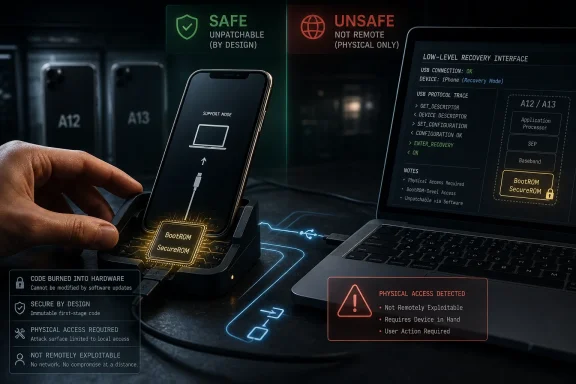 Apple’s Oldest Code Is Again the Weakest Link
The most important thing about usbliter8 is not that it can help jailbreak an iPhone. Jailbreaks have always had a dual identity: hobbyist liberation on one side, security boundary failure on the other. The more consequential fact is where the new exploit lands — in Apple’s SecureROM, also known as the BootROM, the first code an iPhone runs when it starts.That matters because the BootROM is not just another component in the stack. It is the beginning of the chain of trust. iOS, Secure Enclave interactions, signature checks, recovery behavior, and the rest of Apple’s security model all depend on the premise that the device’s earliest boot code behaves as designed.
When a flaw is found in ordinary software, Apple can ship a patch. When a flaw is found in immutable boot code, Apple can only design around it in future silicon. The affected chips are already in the world, already soldered into devices, and already beyond the reach of an over-the-air fix.
That is why the word unpatchable carries so much weight here. It does not mean every affected iPhone is suddenly open to remote compromise. It means the vulnerable behavior is part of the hardware generation’s permanent character.
This Is a Physical Attack, Not an Internet Worm
The practical risk starts with a constraint that should calm most ordinary users: usbliter8 is not remotely exploitable. It is not the kind of bug that arrives through iMessage, Safari, Wi-Fi, Bluetooth, or a malicious app. The attacker needs the device in hand and must connect it over USB.That makes the exploit far less useful for mass surveillance or criminal drive-by attacks. A scammer cannot simply send a link and trigger usbliter8 from across the world. A compromised website cannot quietly run it in the background.
But physical-access exploits occupy a very real place in the security world. Phones are lost, stolen, seized, repaired, traded in, resold, and briefly handed to other people all the time. A vulnerability that is useless against a phone in your pocket can become highly relevant once the device is on someone else’s bench.
The distinction is important because consumer security coverage often flattens risk into two categories: safe or doomed. usbliter8 is neither. It is a low-probability event for most users and a high-interest capability for people who specialize in device access.
The Checkm8 Comparison Is Fair, but Not Complete
The obvious historical comparison is checkm8, the 2019 BootROM exploit that affected older Apple devices using A5 through A11 chips, including models up to the iPhone X. Like usbliter8, checkm8 was unpatchable because it abused code permanently built into the chip. Like usbliter8, it became important both to jailbreak developers and to security researchers.That comparison is useful because it shows how Apple’s hardware security failures age. They do not disappear when a new iOS version ships. They follow devices into the second-hand market, into enterprise drawers, into classrooms, into developing markets, and into forensic labs.
But usbliter8 is not simply checkm8 with a new sticker. Early reporting and researcher descriptions indicate that it affects A12 and A13-era devices and relies on behavior in the USB controller and boot-time configuration rather than being a clone of the older exploit. The result may feel familiar — code execution at a privileged early stage — but the path matters to researchers and defenders.
The bigger point is that Apple’s security architecture keeps forcing attackers downward. iOS itself has become harder to exploit at scale. That makes the deepest layers of the device more attractive, precisely because a win there is difficult or impossible to erase on shipped hardware.
Jailbreak Culture Gets a Win, but Attackers Get a Primitive
For jailbreak enthusiasts, the disclosure is exciting because A12 and A13 devices have been among the more stubborn generations. A BootROM-level exploit changes the long-term research landscape because it gives developers a foothold that Apple cannot revoke with a routine software update.But a foothold is not the same as a finished jailbreak for everyone, on every version, with every convenience users remember from older jailbreak eras. Modern iPhones are protected by multiple layers, and getting unsigned code to run early in the boot process is only one part of building a usable jailbreak. Persistence, SEP interactions, filesystem behavior, kernel patches, and modern mitigations still matter.
That nuance is often lost once the word jailbreak enters the story. A jailbreak is a consumer-facing outcome. A BootROM exploit is a technical primitive. The former depends on turning the latter into a repeatable toolchain that ordinary users can run without bricking devices or accepting unacceptable trade-offs.
For defenders, that same primitive is the concern. A researcher’s proof-of-concept may be limited, but once a low-level exploit is public, others can study it, adapt it, and combine it with additional vulnerabilities. Security failures become more powerful when they are chained.
The Affected Devices Are Old Enough to Be Cheap and New Enough to Matter
The affected iPhones sit in an awkward but important middle age. The iPhone XS and XR arrived in 2018. The iPhone 11 lineup followed in 2019. These are not current flagship devices, but they are also not museum pieces.That makes this flaw more relevant than a vulnerability in truly obsolete hardware. The iPhone XR and iPhone 11 in particular had long commercial lives and remain common in families, small businesses, repair channels, refurbished inventories, and emerging markets. They are exactly the kinds of devices that keep working long after the technology press stops treating them as current.
For WindowsForum readers, the enterprise angle is obvious. Mixed-device environments often include iPhones that no one thinks about until mobile device management flags them, an executive loses one, or a compliance review asks how old the fleet really is. An unpatchable hardware exploit does not mean every A12 or A13 phone must be thrown out tomorrow, but it does change the asset-risk conversation.
Consumer resale also complicates the picture. A used iPhone can look perfectly serviceable while carrying a hardware-level weakness that cannot be remediated. Buyers usually ask about battery health, storage, camera condition, and iOS support. Security posture is harder to inspect, and therefore easier to ignore.
Apple Can Patch the Future, Not the Past
Apple’s likely response is already visible in the nature of the bug. For affected chips, there is no true software fix. Apple can harden surrounding behavior where possible, warn enterprise customers if warranted, and make sure newer silicon does not repeat the design mistake. But it cannot rewrite BootROM code burned into A12 and A13 devices years ago.That is not unique to Apple. Hardware trust anchors are powerful because they are difficult to modify. The same immutability that protects them from ordinary tampering also makes design mistakes expensive. Security engineers love roots of trust until the root itself turns out to be crooked.
This is the uncomfortable bargain of modern device security. Users want phones that resist malware, thieves, rogue repair shops, and hostile operating systems. Vendors respond by pushing trust into silicon. When it works, the result is strong and largely invisible. When it fails, the result is a permanent footnote attached to an entire chip generation.
Apple can, and probably already has, learned from this class of failure in later chips. The A14 generation and newer devices are not reported as affected by usbliter8. But for the installed base, future design discipline is not a remedy. It is only reassurance that the same door may not be open on newer hardware.
The Real Threat Model Is Custody
The most useful way to think about usbliter8 is not “Can my iPhone be hacked?” but “Who can get custody of my iPhone, and for how long?” That reframing turns a scary chip flaw into a practical security question.For most people, the answer is mundane. The device is in a pocket, on a desk, in a bag, or charging at home. If it is lost, Find My, Activation Lock, a strong passcode, and encryption still matter. The exploit does not magically reveal a passcode over the air.
For journalists, activists, executives, lawyers, and people crossing borders, the answer may be more complicated. If a phone can be taken away and connected to specialized equipment, physical-access vulnerabilities become more relevant. The same is true for employees carrying sensitive corporate data or authentication tokens on older company phones.
This is where “unpatchable” becomes operational rather than theatrical. You cannot eliminate the flaw with an update, so you reduce the situations in which it can be used. That means better device custody, shorter replacement cycles for high-risk users, and policies that treat lost devices as security events rather than mere inventory annoyances.
Passcodes Still Matter More Than Panic
A BootROM exploit weakens an early layer of defense, but it does not make basic security hygiene irrelevant. In fact, it makes the boring controls more important. Strong passcodes, rapid lost-device reporting, MDM enforcement, remote wipe readiness, and account-level protections remain the difference between a stolen handset and a broader compromise.The weakest passcode habits are still the easiest path around strong hardware. A four-digit PIN on an older device is a much softer target than a long alphanumeric passcode. If a user is worried about physical access, passcode strength is one of the few defenses that remains directly under their control.
The same goes for what is stored locally. Many modern compromises aim less at the files on a phone and more at the tokens, sessions, and accounts the phone can unlock. If an older iPhone is still signed into work email, password managers, developer tools, banking apps, or admin consoles, the device is not merely a phone. It is a keyring.
That is why the right advice is not “panic and upgrade today” for everyone. It is to classify the device honestly. A spare iPhone XR used for music in the kitchen is one thing. An iPhone 11 carried by a founder with access to payroll, customer data, and cloud dashboards is another.
Forensic Vendors Will Be Paying Attention
Public BootROM exploits are interesting to jailbreak communities, but they are also interesting to companies that specialize in device extraction. The lawful-access and forensic market has long depended on chaining vulnerabilities, physical custody, and proprietary tooling to recover data from locked devices.usbliter8 does not automatically mean every affected iPhone can be unlocked. Modern iPhone data protection is not a single wall that collapses when BootROM code execution is achieved. The Secure Enclave, passcode-derived keys, and iOS version-specific mitigations all shape what is possible.
Still, a permanent low-level exploit is valuable because it can reduce uncertainty. It gives researchers and toolmakers a stable entry point that Apple cannot patch away on the affected hardware. Over time, that can change what is feasible in labs, especially when combined with other bugs or device states.
This is why high-risk users should not dismiss physical-only attacks as irrelevant. Physical access is exactly the condition under which forensic workflows operate. If your threat model includes confiscation, compelled access, hostile inspection, or targeted theft, usbliter8 belongs in the risk register.
The Enterprise Lesson Is Asset Age, Not Apple Exceptionalism
It would be easy to frame usbliter8 as an Apple embarrassment, and in a narrow sense it is. Apple markets the iPhone as a security appliance as much as a consumer device, and a permanent flaw in a recent-enough chip generation undercuts that story. But the broader lesson is not that Apple is uniquely careless. It is that hardware security has a shelf life.Enterprise IT already understands this with PCs. Firmware vulnerabilities, TPM issues, BIOS updates, aging chipsets, and platform support windows all affect how long a device should remain trusted. Phones deserve the same treatment, especially now that they hold corporate credentials and frequently serve as MFA devices.
The challenge is cultural. Organizations tend to manage phones as consumables or perks, not as high-value endpoints. A laptop with an unpatchable boot flaw would trigger meetings. A six-year-old iPhone in an executive’s drawer may not even appear in the asset inventory.
That gap is no longer defensible. If mobile devices can access corporate mail, source code, financial systems, or customer records, their hardware generation matters. The security review cannot stop at “Is it still receiving iOS updates?” It must also ask whether the underlying silicon has known permanent weaknesses.
The Upgrade Advice Is Simple, but the Economics Are Not
For Apple and security researchers, the clean mitigation is straightforward: move to newer hardware. For users, that advice collides with money, availability, and sustainability. The iPhone 11 remains useful precisely because Apple builds devices that last.That is the paradox. Long support windows are good for users and good for the environment, but they also extend the life of hardware mistakes. A device that still runs modern software can carry a flaw from the day it left the factory. Software longevity does not equal hardware innocence.
Second-hand markets make this even more complicated. Refurbished iPhones are popular because they offer strong performance and long app compatibility at lower prices. But buyers rarely receive a security briefing with the device. The market prices scratches and battery cycles more visibly than exploitability.
The rational response is risk-based. A student buying a used iPhone 11 for messaging and photos faces a different risk profile than a sysadmin using the same model for privileged MFA and emergency access. The phone is the same. The consequences are not.
The Security Story Apple Prefers Is Getting Harder to Tell
Apple’s public security narrative depends on integration. The company designs the chip, controls the operating system, operates the app marketplace, and pushes updates directly to users. That model has real security benefits, especially compared with fragmented ecosystems where patches stall for months or never arrive.But integration also concentrates responsibility. When a flaw is in Apple’s silicon, there is no OEM partner to blame and no carrier delay to hide behind. The company owns the entire chain, including the parts that cannot be changed.
usbliter8 does not destroy Apple’s security reputation. The iPhone remains one of the most hardened consumer computing platforms available. But it does puncture the comforting idea that a fully updated device is always as safe as Apple can make it.
The more accurate story is less marketable: a fully updated device is as safe as its hardware generation allows. That distinction will matter more as phones stay in service longer, security researchers push deeper into chips, and governments and forensic vendors keep investing in physical-access capabilities.
The Cable Is the Boundary Now
The most concrete defense against usbliter8 is also the oldest one in security: control physical access. That sounds almost quaint in an era of cloud compromise and zero-click exploits, but the cable is the boundary in this case. If an attacker cannot take the device, put it into the required mode, and connect the right hardware, the exploit remains theoretical.That makes repair and resale channels worth attention. Users should be cautious about handing unlocked or trusted devices to unknown shops. Businesses should have clear procedures for decommissioning and wiping older phones. Lost devices should trigger account revocation and session invalidation, not merely remote-wipe hopes.
USB restricted behavior and lock-screen protections still matter, but users should not assume software settings can neutralize a BootROM-class issue. The attack lives too early in the boot process for ordinary toggles to be a complete answer. Policy and custody do the work that patches cannot.
The same lesson applies to travel. If an affected phone leaves your sight in a high-risk environment, you should treat it differently when it comes back. That may mean changing passwords, rotating tokens, reviewing account activity, or replacing the device entirely for sensitive roles.
The Practical Read on usbliter8 Fits in One Pocket
The new exploit deserves attention because it is permanent, but it deserves proportion because it is physical. That combination makes it a major research milestone, a meaningful forensic-development opportunity, and a selective user risk — not a universal iPhone emergency.- usbliter8 affects Apple A12 and A13-era devices, including the iPhone XS, iPhone XR, and iPhone 11 families.
- The flaw sits in BootROM-level behavior, which means Apple cannot remove it from affected chips with a normal software update.
- The attack requires physical possession of the device, USB access, and specialized exploit conditions rather than remote delivery over the internet.
- Strong passcodes, fast lost-device response, account revocation, and careful custody remain the most practical defenses for users who keep affected phones.
- Organizations should treat older iPhones as managed endpoints and decide whether A12 and A13 devices still belong in sensitive roles.
- The cleanest long-term mitigation for high-risk users is replacement with newer hardware that is not known to be affected.
References
- Primary source: Lapaas Voice
Published: 2026-06-23T10:50:38.108954
Apple Chip Flaw: Unpatchable iPhone Jailbreak Explained
A new unpatchable Apple chip flaw (usbliter8) can jailbreak iPhone XS, XR and 11. What it means, who is at risk, and why no update can fix it.voice.lapaas.com - Related coverage: techradar.com
Apple users told to watch out for 'unpatchable' iPhone security issues - here's what we know | TechRadar
Experts warns iOS bug is physical and also very difficult to exploitwww.techradar.com - Related coverage: techcrunch.com
A new unpatchable flaw in Apple chips opens the door to an iPhone jailbreak | TechCrunch
European offensive cybersecurity company Paradigm Shift released details of a flaw and a technique to exploit it that opens the door for hackers to unlock and break into older iPhones.techcrunch.com - Related coverage: 9to5mac.com
New unpatchable exploit targets Apple devices with A12 and A13 chips - 9to5Mac
Researchers at Paradigm Shift have published the technical details of usbliter8, a new unpatchable iPhone BootROM vulnerability.9to5mac.com - Related coverage: hoploninfosec.com
usbliter8 Exploit: Apple A12/A13 SecureROM Flaw Explained
usbliter8 exploit breaks Apple A12 and A13 SecureROM with no software fix possible. See affected devices, how it works, and what security teams should do.hoploninfosec.com - Related coverage: brightnexus.com
Unpatchable ‘usbliter8’ Exploit Breaks Apple A12 and A13 SecureROM Boot Chain | Bright Nexus
SeverityMedium  Detail Security researchers have released a working exploit called usbliter8 that can break the SecureROM boot chain on Apple devices usingwww.brightnexus.com
- Related coverage: securityaffairs.com
usbliter8 Brings Unpatchable BootROM Exploit to Apple A12 and A13 Devices - Security Affairs
usbliter8 is an unpatchable BootROM exploit affecting Apple A12 and A13 devices, enabling code execution....securityaffairs.com
- Related coverage: newmobilelife.com
A12 與 A13 晶片發現無法修補的 BootROM 漏洞 - 流動日報
安全研究公司 Paradigm Shift 今日發佈一項影響 Apple A12 及 A13 晶片的 BootROM 漏洞細節,並提供名為「usbliter8」的完整概念驗證攻擊程式。該漏洞存在於晶片出廠時燒錄的 SecureROM 中,無法透過軟體更新修補,受影響裝置將永久處於風險之中。www.newmobilelife.com - Related coverage: ad-hoc-news.de
usbliter8-Exploit: Apple-Geräte mit A12/A13 nicht zu patchen
Forscher enthüllen Sicherheitslücke in Apples BootROM, die sich nicht durch Software-Updates schließen lässt. Betroffen sind Millionen ältere iPhones, iPads und Watches.www.ad-hoc-news.de - Related coverage: gossipherald.com
Apple devices exposed by unpatchable 'usbliter8' hardware bug
Security researchers at Paradigm Shift have disclosed an unfixable hardware vulnerability affecting millions of Apple devices. The flaw, named usbliter8, sits within the USB controller and cannot be resolved through any software update.The...www.gossipherald.com - Related coverage: networkustad.com
Unpatchable 'usbliter8' Exploit Breaks Apple A12 a
A critical vulnerability known as "usbliter8" has been discovered in Apple's A12 and A13 SoCs, breaking the SecureROM boot chain and rendering the chips effectively unpatchable. This exploit, disclosed by...networkustad.com - Related coverage: techxplore.com
