

Vadzo Imaging announced in June 2026 that its Falcon-821CRS, an 8MP USB 3.2 Gen1 camera built around Onsemi’s AR0821 rolling-shutter sensor, has been validated on Ubuntu 22.04 LTS and Windows 11 using native USB Video Class support without proprietary driver installation. The product news is narrow, but the pitch is bigger than one camera module: in industrial vision, the most valuable driver is often the one you never have to install. For Windows shops, Linux edge deployments, and embedded developers straddling both worlds, Vadzo is selling predictability as much as pixels.
The Falcon-821CRS is not arriving into a market starved of camera modules. Industrial buyers can already choose from USB, MIPI CSI-2, GigE Vision, GMSL, and proprietary camera stacks, each with its own tradeoffs around latency, cable length, synchronization, and software control. What Vadzo is emphasizing here is less glamorous but often more decisive: the camera enumerates as a standard UVC device.
That matters because cameras are one of those peripherals that look simple until they become part of a production image. A webcam-like device plugged into a developer workstation may work instantly, while the same imaging pipeline deployed on a locked-down factory PC or embedded Linux board can turn into a kernel-module archaeology project. If the device depends on a vendor SDK, an out-of-tree driver, or a fragile installer, the camera becomes part of the operating system maintenance burden.
Vadzo’s claim is that the Falcon-821CRS avoids that class of problem by relying on the USB Video Class model already understood by Windows and Linux. On Windows 11, that means the built-in USB video driver path. On Ubuntu 22.04, it means the standard Linux UVC and V4L2 path that tools such as GStreamer, OpenCV, and ROS2 commonly expect.
This does not make the camera magical, and it does not make every machine-vision problem disappear. UVC can also impose compromises, especially around vendor-specific controls, synchronization, and advanced sensor tuning. But for a large category of inspection, robotics, prototyping, and embedded vision work, the ability to get frames without modifying the host OS is not a convenience. It is a deployment strategy.
By naming both operating systems, Vadzo is aiming at the mixed reality of modern factory and lab environments. A vision system may be prototyped on Windows, trained or tuned on a Linux workstation, then deployed to an embedded Ubuntu box mounted on a line. The camera does not have to care, provided the host exposes the standard camera stack and the application can consume the device through the expected API.
That is the strongest part of the announcement. “Works on Linux and Windows” is a common peripheral claim; “validated on Ubuntu 22.04 and Windows 11 using native UVC” is more operationally useful. It gives integrators a defined baseline rather than a generic compatibility promise.
For WindowsForum readers, the Windows 11 angle is not that this camera turns a PC into a machine-vision appliance by itself. The more interesting point is that Windows remains a first-class part of industrial edge computing, even as Linux dominates much of the embedded and robotics conversation. A driverless UVC camera keeps Windows workstations useful in a pipeline that may ultimately deploy on Linux.
Resolution matters in factory vision because defects do not politely resize themselves to fit a low-cost sensor. Surface scratches, printed markings, small dimensional deviations, and barcode edges all benefit from more spatial detail, especially when the camera must be mounted at a practical working distance rather than an ideal one. At 8MP and 4K-class output, the Falcon-821CRS has enough headroom for cropping, downsampling, and inference pipelines that do not always need the full frame but benefit from capturing it.
HDR is the other important part of the spec sheet. Industrial scenes often mix harsh illumination, reflective materials, shadowed edges, and changing ambient light. A camera that can preserve more highlight and shadow detail gives engineers more usable data before they reach for additional lighting, shielding, or post-processing.
The rolling shutter is the caveat. For many inspection and monitoring tasks, rolling shutter is perfectly acceptable. For very fast motion, precise metrology, or strobe-synchronized capture, engineers may still prefer global shutter sensors. Vadzo is not positioning this as the universal camera for every machine-vision problem; it is positioning it as a high-resolution, driverless, cross-platform module for the broad middle of industrial imaging.
Windows has long provided its own class-driver support for UVC devices. Linux’s uvcvideo driver and V4L2 userspace interface have similarly become the expected path for many USB cameras. When a device behaves properly within those standards, applications can often treat it as a regular camera rather than as a vendor platform.
That “properly” is doing a lot of work. UVC compliance on a spec sheet is not always the same thing as clean behavior across hosts, hubs, cables, power conditions, and application frameworks. Industrial buyers will still want to test frame formats, exposure controls, bandwidth behavior, thermal stability, and long-run capture reliability under their actual workload.
Still, Vadzo’s emphasis on validation is a useful signal. It suggests the company understands that developers are not impressed by another SDK if the operating system already has a camera path. The best integration story is often the shortest one: plug in, enumerate, capture frames, and move on to the actual vision problem.
That does not mean every deployment will run full-resolution uncompressed video continuously. In practical systems, engineers often choose a lower resolution, compressed format, region of interest, or application-specific frame rate to match inference latency, storage, CPU load, and bus topology. But starting with USB 3.x bandwidth gives the system designer more options.
It also keeps the host requirements relatively ordinary. USB is everywhere on Windows PCs, industrial mini-PCs, embedded x86 systems, and many single-board computers. That ubiquity is a reason USB cameras remain attractive even when other interfaces may offer better determinism or longer cable runs.
The tradeoff is that USB remains a host-centric, topology-sensitive interface. Cable quality, hub behavior, power delivery, and competing USB devices can affect reliability. A driverless camera still needs disciplined system design if it is going into a production line rather than a lab bench.
Industrial Windows environments are often less flexible than consumer PCs. Images are validated, change windows are limited, and downtime carries a cost. If a camera replacement requires a driver reinstall or a compatibility exception, the peripheral has become an operational risk.
Native UVC support does not remove all Windows complexity. Applications may still differ in whether they use DirectShow, Media Foundation, vendor extensions, or custom capture code. Privacy settings, device permissions, and corporate endpoint policies can still interfere with camera access. But the absence of a third-party kernel driver reduces one of the more brittle layers.
That is why this announcement belongs on a Windows-focused site even though it is framed as a Linux USB camera. Windows 11 is still part of the industrial imaging stack, and the most useful cross-platform devices are the ones that do not force Windows and Linux teams into separate integration paths.
UVC and V4L2 do not eliminate integration work, but they move it into well-known territory. If the Falcon-821CRS appears as a normal video device under
The embedded platform list in Vadzo’s release—Jetson, Raspberry Pi, NXP i.MX8, Rockchip RK3588, and x86—also reflects how fragmented this world can be. A camera requiring different low-level plumbing for every board family is expensive to productize. A USB UVC camera offers a more portable starting point, even if final validation still has to happen on the exact board and OS image.
This is the quiet attraction of “driverless” hardware in Linux environments. It is not anti-driver; the driver is still there. The difference is that the driver is part of the platform rather than part of the vendor relationship.
Medical and life-sciences imaging, for example, involves more than resolution and driver installation. It can involve calibration, repeatability, sterilization constraints, regulatory documentation, color accuracy, optics, illumination, enclosure design, and validation over long service lives. Smart infrastructure deployments may care about weatherproofing, remote manageability, power budgets, temperature range, and cable runs as much as sensor capability.
Even in factory vision, a camera is only one element of the system. Lighting, optics, mounting rigidity, lens distortion, trigger behavior, latency, software models, and maintenance procedures often determine success. An 8MP HDR sensor is a useful ingredient, not a finished inspection solution.
That does not undercut the announcement. It puts it in proportion. Vadzo is offering a camera module that reduces one integration burden. It is not offering a free pass around the engineering work that makes vision systems reliable.
This is where UVC’s simplicity can meet its limits. Standard video capture is straightforward; exposing auxiliary IMU data cleanly across platforms can be more complicated. If the IMU data arrives through a separate interface, vendor SDK, serial endpoint, or custom control path, then part of the “driverless” story may not apply to every feature.
Vadzo’s broader product material has emphasized USB operation and onboard IMU capability, but buyers should ask a practical question before assuming the IMU is production-ready for their stack: how exactly does my application read it, timestamp it, and correlate it with frames? For a Windows inspection workstation, the answer may not matter. For a ROS2 robot, it could be central.
That distinction is important because camera announcements often compress “the hardware includes it” and “your software can use it cleanly” into the same sentence. Integrators should separate the two. The video path may be standard UVC, while advanced controls or sensor-fusion data may still require closer vendor documentation.
That is especially true in environments where devices remain deployed for years. The first installation may be easy; the pain arrives during OS refreshes, kernel updates, security audits, hardware replacements, and supplier changes. A peripheral that survives those transitions with fewer custom components has real economic value.
There is also a security argument. Every driver and background service expands the software estate. Even when vendor software is well maintained, it adds another update channel and another dependency. Using the operating system’s built-in class support is not automatically more secure in every case, but it is simpler to govern.
This is where the Falcon-821CRS story intersects with WindowsForum’s broader beat. Windows 11, Linux LTS releases, and embedded platforms are increasingly part of the same operational fabric. Devices that respect native OS boundaries are easier to manage than devices that try to drag every host into a vendor-specific ecosystem.
That makes the driverless claim strategically smart. Image quality can be subjective and application-specific. Integration time is a more universal pain point. If a team can evaluate the Falcon-821CRS quickly on both Windows 11 and Ubuntu 22.04, Vadzo lowers the barrier to trial.
The lack of a minimum order requirement, as stated in the release, also matters for this audience. Embedded and industrial teams often want to prove a pipeline before committing to a production interface or volume purchase. Evaluation kits with the module, lens, USB cable, and platform documentation make the first test easier to justify.
The harder phase comes later. Production buyers will ask about availability, lifecycle commitments, firmware update policy, mechanical consistency, optical options, environmental ratings, support responsiveness, and failure analysis. Driverless startup wins the first hour. Industrial trust is earned over the next several years.
For Windows 11 environments, the camera’s native UVC behavior should reduce installation friction and simplify endpoint management. For Ubuntu 22.04 deployments, V4L2 enumeration gives developers a familiar capture path. For mixed fleets, the same hardware can potentially travel from prototype to workstation to embedded node without a rewrite at the driver layer.
The most important unanswered questions are not unusual for a product announcement. What frame rates are available in each format? How are HDR modes exposed and controlled? How does the IMU present itself to host software? What are the supported pixel formats, compression modes, thermal limits, and long-run stability characteristics? Those details will matter more than the headline once engineers move beyond evaluation.
Still, the direction is right. The more industrial hardware behaves like a well-supported operating-system citizen, the less time teams spend maintaining glue code and the more time they spend solving application problems.
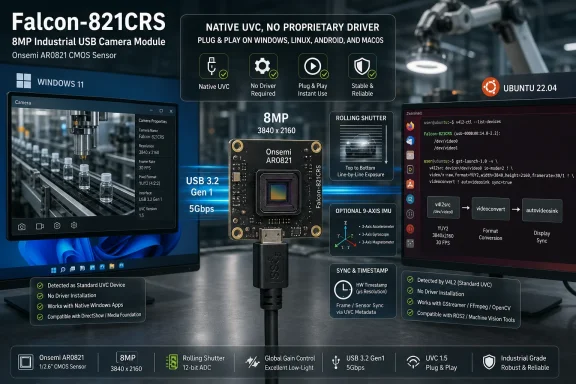 Vadzo Is Selling the Absence of a Driver as a Feature
The Falcon-821CRS is not arriving into a market starved of camera modules. Industrial buyers can already choose from USB, MIPI CSI-2, GigE Vision, GMSL, and proprietary camera stacks, each with its own tradeoffs around latency, cable length, synchronization, and software control. What Vadzo is emphasizing here is less glamorous but often more decisive: the camera enumerates as a standard UVC device.That matters because cameras are one of those peripherals that look simple until they become part of a production image. A webcam-like device plugged into a developer workstation may work instantly, while the same imaging pipeline deployed on a locked-down factory PC or embedded Linux board can turn into a kernel-module archaeology project. If the device depends on a vendor SDK, an out-of-tree driver, or a fragile installer, the camera becomes part of the operating system maintenance burden.
Vadzo’s claim is that the Falcon-821CRS avoids that class of problem by relying on the USB Video Class model already understood by Windows and Linux. On Windows 11, that means the built-in USB video driver path. On Ubuntu 22.04, it means the standard Linux UVC and V4L2 path that tools such as GStreamer, OpenCV, and ROS2 commonly expect.
This does not make the camera magical, and it does not make every machine-vision problem disappear. UVC can also impose compromises, especially around vendor-specific controls, synchronization, and advanced sensor tuning. But for a large category of inspection, robotics, prototyping, and embedded vision work, the ability to get frames without modifying the host OS is not a convenience. It is a deployment strategy.
Ubuntu 22.04 and Windows 11 Are the Real Product Targets
The choice of validation platforms is telling. Ubuntu 22.04 LTS is not the newest Ubuntu release in 2026, but it remains a conservative baseline in industrial and robotics deployments because long-term-support operating systems move more slowly than developer laptops. Windows 11, meanwhile, is the current mainstream Windows client platform for new industrial PCs and workstations.By naming both operating systems, Vadzo is aiming at the mixed reality of modern factory and lab environments. A vision system may be prototyped on Windows, trained or tuned on a Linux workstation, then deployed to an embedded Ubuntu box mounted on a line. The camera does not have to care, provided the host exposes the standard camera stack and the application can consume the device through the expected API.
That is the strongest part of the announcement. “Works on Linux and Windows” is a common peripheral claim; “validated on Ubuntu 22.04 and Windows 11 using native UVC” is more operationally useful. It gives integrators a defined baseline rather than a generic compatibility promise.
For WindowsForum readers, the Windows 11 angle is not that this camera turns a PC into a machine-vision appliance by itself. The more interesting point is that Windows remains a first-class part of industrial edge computing, even as Linux dominates much of the embedded and robotics conversation. A driverless UVC camera keeps Windows workstations useful in a pipeline that may ultimately deploy on Linux.
The AR0821 Gives the Pitch Its Industrial Credibility
The Falcon-821CRS is built around Onsemi’s AR0821, an 8MP color CMOS sensor with a 3848 × 2168 active-pixel array, 1/1.7-inch optical format, 2.1 µm pixels, rolling shutter, and embedded HDR capabilities. Those numbers are not merely brochure decoration. They place the module above the commodity 1080p webcam tier and closer to the needs of inspection, traffic monitoring, robotics, and edge AI capture.Resolution matters in factory vision because defects do not politely resize themselves to fit a low-cost sensor. Surface scratches, printed markings, small dimensional deviations, and barcode edges all benefit from more spatial detail, especially when the camera must be mounted at a practical working distance rather than an ideal one. At 8MP and 4K-class output, the Falcon-821CRS has enough headroom for cropping, downsampling, and inference pipelines that do not always need the full frame but benefit from capturing it.
HDR is the other important part of the spec sheet. Industrial scenes often mix harsh illumination, reflective materials, shadowed edges, and changing ambient light. A camera that can preserve more highlight and shadow detail gives engineers more usable data before they reach for additional lighting, shielding, or post-processing.
The rolling shutter is the caveat. For many inspection and monitoring tasks, rolling shutter is perfectly acceptable. For very fast motion, precise metrology, or strobe-synchronized capture, engineers may still prefer global shutter sensors. Vadzo is not positioning this as the universal camera for every machine-vision problem; it is positioning it as a high-resolution, driverless, cross-platform module for the broad middle of industrial imaging.
UVC Is the Boring Standard That Keeps Winning
USB Video Class has survived because it solves a mundane but persistent problem: how to make a camera recognizable to a host without a bespoke driver. In consumer computing, that means webcams that work in Teams, Zoom, OBS, and browsers. In industrial computing, the same principle can reduce friction across frozen OS images, security-constrained environments, and mixed development fleets.Windows has long provided its own class-driver support for UVC devices. Linux’s uvcvideo driver and V4L2 userspace interface have similarly become the expected path for many USB cameras. When a device behaves properly within those standards, applications can often treat it as a regular camera rather than as a vendor platform.
That “properly” is doing a lot of work. UVC compliance on a spec sheet is not always the same thing as clean behavior across hosts, hubs, cables, power conditions, and application frameworks. Industrial buyers will still want to test frame formats, exposure controls, bandwidth behavior, thermal stability, and long-run capture reliability under their actual workload.
Still, Vadzo’s emphasis on validation is a useful signal. It suggests the company understands that developers are not impressed by another SDK if the operating system already has a camera path. The best integration story is often the shortest one: plug in, enumerate, capture frames, and move on to the actual vision problem.
The 5Gbps USB Link Is Necessary, Not Decorative
The USB 3.2 Gen1 interface is easy to treat as a checkbox, but it is central to the product’s argument. A camera that wants to move 8MP or 4K video cannot lean on USB 2.0 assumptions without quickly running into bandwidth limits, compression tradeoffs, or reduced frame rates. USB 3.2 Gen1’s 5Gbps link gives the device room to support higher-resolution modes over a standard cable.That does not mean every deployment will run full-resolution uncompressed video continuously. In practical systems, engineers often choose a lower resolution, compressed format, region of interest, or application-specific frame rate to match inference latency, storage, CPU load, and bus topology. But starting with USB 3.x bandwidth gives the system designer more options.
It also keeps the host requirements relatively ordinary. USB is everywhere on Windows PCs, industrial mini-PCs, embedded x86 systems, and many single-board computers. That ubiquity is a reason USB cameras remain attractive even when other interfaces may offer better determinism or longer cable runs.
The tradeoff is that USB remains a host-centric, topology-sensitive interface. Cable quality, hub behavior, power delivery, and competing USB devices can affect reliability. A driverless camera still needs disciplined system design if it is going into a production line rather than a lab bench.
The Windows Story Is About Operations, Not Just Compatibility
For Windows 11 users, the Falcon-821CRS fits into a familiar class-driver model: the device should appear through the operating system’s built-in USB video path rather than requiring a vendor installer. That is appealing in ordinary desktop terms, but the bigger value is administrative. Every extra driver package is another artifact to approve, patch, inventory, and troubleshoot.Industrial Windows environments are often less flexible than consumer PCs. Images are validated, change windows are limited, and downtime carries a cost. If a camera replacement requires a driver reinstall or a compatibility exception, the peripheral has become an operational risk.
Native UVC support does not remove all Windows complexity. Applications may still differ in whether they use DirectShow, Media Foundation, vendor extensions, or custom capture code. Privacy settings, device permissions, and corporate endpoint policies can still interfere with camera access. But the absence of a third-party kernel driver reduces one of the more brittle layers.
That is why this announcement belongs on a Windows-focused site even though it is framed as a Linux USB camera. Windows 11 is still part of the industrial imaging stack, and the most useful cross-platform devices are the ones that do not force Windows and Linux teams into separate integration paths.
The Linux Story Is About Escaping Kernel Debt
On Linux, the appeal is sharper. Proprietary camera drivers can become a long-term maintenance liability because kernel versions move, distributions patch, and embedded vendors ship their own board-support packages. A camera that depends on a vendor-maintained module may work beautifully on one kernel and become a blocker on the next.UVC and V4L2 do not eliminate integration work, but they move it into well-known territory. If the Falcon-821CRS appears as a normal video device under
/dev/video, then developers can start with standard tools and frameworks rather than a custom SDK. That matters for Ubuntu 22.04 because many robotics and edge-AI deployments already have pipelines built around GStreamer, OpenCV, ROS2, or similar userspace components.The embedded platform list in Vadzo’s release—Jetson, Raspberry Pi, NXP i.MX8, Rockchip RK3588, and x86—also reflects how fragmented this world can be. A camera requiring different low-level plumbing for every board family is expensive to productize. A USB UVC camera offers a more portable starting point, even if final validation still has to happen on the exact board and OS image.
This is the quiet attraction of “driverless” hardware in Linux environments. It is not anti-driver; the driver is still there. The difference is that the driver is part of the platform rather than part of the vendor relationship.
The Press Release Overreaches Where All Camera Marketing Overreaches
Vadzo’s release makes a broad case for industrial inspection, factory automation, robotics, medical imaging, smart infrastructure, and embedded prototyping. That breadth is typical of camera-module marketing, and readers should treat it as a map of possible markets rather than proof of fitness for each one. A sensor module that is plausible for all of those environments is not automatically qualified for any particular regulated, safety-critical, or mission-critical deployment.Medical and life-sciences imaging, for example, involves more than resolution and driver installation. It can involve calibration, repeatability, sterilization constraints, regulatory documentation, color accuracy, optics, illumination, enclosure design, and validation over long service lives. Smart infrastructure deployments may care about weatherproofing, remote manageability, power budgets, temperature range, and cable runs as much as sensor capability.
Even in factory vision, a camera is only one element of the system. Lighting, optics, mounting rigidity, lens distortion, trigger behavior, latency, software models, and maintenance procedures often determine success. An 8MP HDR sensor is a useful ingredient, not a finished inspection solution.
That does not undercut the announcement. It puts it in proportion. Vadzo is offering a camera module that reduces one integration burden. It is not offering a free pass around the engineering work that makes vision systems reliable.
The IMU Is Interesting, but the Software Path Will Decide Its Value
The Falcon-821CRS spec list includes a 9-axis IMU, which is noteworthy for robotics, mobile platforms, drones, and AGVs. In theory, combining visual frames with inertial data can help with navigation, motion estimation, stabilization, and sensor fusion. In practice, the usefulness depends on synchronization, timestamping, host access, and software support.This is where UVC’s simplicity can meet its limits. Standard video capture is straightforward; exposing auxiliary IMU data cleanly across platforms can be more complicated. If the IMU data arrives through a separate interface, vendor SDK, serial endpoint, or custom control path, then part of the “driverless” story may not apply to every feature.
Vadzo’s broader product material has emphasized USB operation and onboard IMU capability, but buyers should ask a practical question before assuming the IMU is production-ready for their stack: how exactly does my application read it, timestamp it, and correlate it with frames? For a Windows inspection workstation, the answer may not matter. For a ROS2 robot, it could be central.
That distinction is important because camera announcements often compress “the hardware includes it” and “your software can use it cleanly” into the same sentence. Integrators should separate the two. The video path may be standard UVC, while advanced controls or sensor-fusion data may still require closer vendor documentation.
Driverless Hardware Fits the Moment in Enterprise IT
The timing of this kind of product positioning is not accidental. Enterprise IT and industrial operators are under pressure to standardize systems, reduce endpoint risk, and keep OS images maintainable. Hardware that demands privileged vendor software is a harder sell than it used to be.That is especially true in environments where devices remain deployed for years. The first installation may be easy; the pain arrives during OS refreshes, kernel updates, security audits, hardware replacements, and supplier changes. A peripheral that survives those transitions with fewer custom components has real economic value.
There is also a security argument. Every driver and background service expands the software estate. Even when vendor software is well maintained, it adds another update channel and another dependency. Using the operating system’s built-in class support is not automatically more secure in every case, but it is simpler to govern.
This is where the Falcon-821CRS story intersects with WindowsForum’s broader beat. Windows 11, Linux LTS releases, and embedded platforms are increasingly part of the same operational fabric. Devices that respect native OS boundaries are easier to manage than devices that try to drag every host into a vendor-specific ecosystem.
The Real Competition Is Not Another 8MP Camera
Vadzo is not competing only against other AR0821 modules or other 4K USB cameras. It is competing against the inertia of existing vision stacks. Many industrial teams already have cameras, SDKs, calibration routines, and supplier relationships. A new module has to justify not only its price and image quality, but the cost of qualification.That makes the driverless claim strategically smart. Image quality can be subjective and application-specific. Integration time is a more universal pain point. If a team can evaluate the Falcon-821CRS quickly on both Windows 11 and Ubuntu 22.04, Vadzo lowers the barrier to trial.
The lack of a minimum order requirement, as stated in the release, also matters for this audience. Embedded and industrial teams often want to prove a pipeline before committing to a production interface or volume purchase. Evaluation kits with the module, lens, USB cable, and platform documentation make the first test easier to justify.
The harder phase comes later. Production buyers will ask about availability, lifecycle commitments, firmware update policy, mechanical consistency, optical options, environmental ratings, support responsiveness, and failure analysis. Driverless startup wins the first hour. Industrial trust is earned over the next several years.
The Practical Reading for Windows and Linux Shops
The Falcon-821CRS is best understood as a pragmatic camera for teams that value standards-based host integration over maximum vendor-specific control. That does not make it the highest-end machine-vision choice, and it does not replace specialized interfaces where deterministic triggering, long cable runs, or global shutter capture are mandatory. It does make it a credible candidate for fast-moving industrial, robotics, and embedded projects where USB is acceptable and OS friction is the enemy.For Windows 11 environments, the camera’s native UVC behavior should reduce installation friction and simplify endpoint management. For Ubuntu 22.04 deployments, V4L2 enumeration gives developers a familiar capture path. For mixed fleets, the same hardware can potentially travel from prototype to workstation to embedded node without a rewrite at the driver layer.
The most important unanswered questions are not unusual for a product announcement. What frame rates are available in each format? How are HDR modes exposed and controlled? How does the IMU present itself to host software? What are the supported pixel formats, compression modes, thermal limits, and long-run stability characteristics? Those details will matter more than the headline once engineers move beyond evaluation.
Still, the direction is right. The more industrial hardware behaves like a well-supported operating-system citizen, the less time teams spend maintaining glue code and the more time they spend solving application problems.
The Small Camera Story Hiding a Bigger Platform Lesson
The announcement leaves Windows and Linux teams with a few concrete points to carry into evaluation:- The Falcon-821CRS is an 8MP USB 3.2 Gen1 camera built on Onsemi’s AR0821 rolling-shutter HDR sensor.
- Vadzo says the module has been validated on Ubuntu 22.04 LTS and Windows 11 using native UVC support rather than proprietary driver installation.
- The camera’s V4L2 path should make it easier to test with common Linux tools such as GStreamer, OpenCV, and ROS2-based workflows.
- The Windows 11 value is less about novelty and more about avoiding another vendor driver package in managed workstation environments.
- The 9-axis IMU is potentially useful for robotics and mobile systems, but buyers should verify exactly how its data is exposed and synchronized.
- The camera is a strong fit for rapid evaluation and mixed-OS prototyping, while production deployment still requires application-specific validation.
References
- Primary source: newswire.com
Published: Tue, 23 Jun 2026 16:00:00 GMT
Vadzo Validates Falcon-821CRS as a Linux USB Camera for Ubuntu 22.04 and Windows 11 with Native UVC Support | Newswire
The Falcon-821CRS is an 8MP color rolling shutter Linux USB Camera built on the Onsemi AR0821 sensor and validated for Ubuntu 22.04 and Windows 11 with native UVC compliance. Designed for industrial inspection, factory vision, and embedded Linux deployments, the camera delivers 4K HDR color...www.newswire.com - Related coverage: vadzoimaging.com
- Related coverage: accessnewswire.com
AR0821 USB Camera for Traffic Monitoring | Vadzo Imaging
Vadzo launches Falcon-821CRS AR0821 USB Camera with 8MP iHDR for traffic monitoring, smart intersection systems, and ITS applications.www.accessnewswire.com - Related coverage: pressrelease.com
Vadzo Imaging Launches Onsemi AR0821 Falcon-821CRH USB Camera: The First M12 VCM Autofocus Camera to Combine 4K HDR and Plug-and-Play USB for Embedded Vision | PressRelease.com
8.3MP 4K HDR USB Camera | Onsemi AR0821 HyperLux Sensor | VCM Autofocus | >140 dB eHDR | UAV, Robotics, Surveillance & Edge AI | USB 3.2 Gen 1 UVC | Plug-and-Play | VISPA ARC SDK Supportwww.pressrelease.com - Related coverage: investor.wedbush.com
Vadzo Imaging Launches Onsemi AR0821 Falcon-821CRH USB Camera: The First M12 VCM Autofocus Camera to Combine 4K HDR and Plug-and-Play USB for Embedded Vision
Vadzo Imaging Launches Onsemi AR0821 Falcon-821CRH USB Camera: The First M12 VCM Autofocus Camera to Combine 4K HDR and Plug-and-Play USB for Embedded Visioninvestor.wedbush.com - Official source: learn.microsoft.com
USB Video Class Driver Overview - Windows drivers | Microsoft Learn
Provides information about using the system-supplied USB Video Class (UVC) driver, Usbvideo.sys.learn.microsoft.com
