

Valve’s quiet, long-running bet on Arm just turned public: the company is funding and integrating open-source translation tools so that Windows (x86/x64) games can run on Arm-based SteamOS devices, and it’s actively porting Proton and SteamOS to Arm to make that future practical for handhelds, consoles, and desktops.
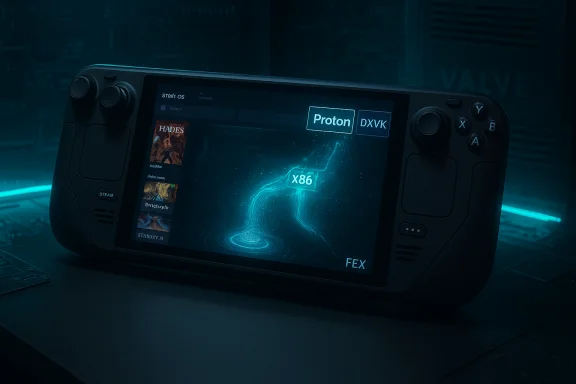
Valve’s Proton compatibility layer — a gaming-focused distribution of Wine that translates Windows APIs to Linux equivalents and maps Direct3D to Vulkan — has been the foundation of the Steam Deck era, letting millions of Windows-only games run on Linux without developer ports. Recent comments from Valve engineers indicate the same strategy is being applied to Arm: instead of forcing publishers to ship separate Arm builds, Valve is backing an x86→Arm translation/emulation stack so existing Windows titles keep running transparently on new Arm hardware. This effort pairs Proton with the FEX usermode emulator to give Arm SteamOS an “x86 games work” story similar to what Proton delivered for x86 Linux systems. At a tactical level Valve’s approach is twofold:
For now, the picture is one of cautious optimism: the tools exist and are maturing, the engineering approach is sound, and Valve’s willingness to fund key open-source projects lowers the economic barrier for a broader Arm ecosystem. The next six to twelve months of independent benchmarks, anti-cheat vendor announcements, and OEM SteamOS Arm releases will be decisive. Until then, consumers and developers should treat Valve’s claims as a credible platform strategy with real potential — but one that requires verification through independent testing and publisher cooperation before it fully displaces the x86/Windows status quo.
Source: Thurrott.com Valve is Bringing SteamOS, Windows Games to Arm
 Background / Overview
Valve’s Proton compatibility layer — a gaming-focused distribution of Wine that translates Windows APIs to Linux equivalents and maps Direct3D to Vulkan — has been the foundation of the Steam Deck era, letting millions of Windows-only games run on Linux without developer ports. Recent comments from Valve engineers indicate the same strategy is being applied to Arm: instead of forcing publishers to ship separate Arm builds, Valve is backing an x86→Arm translation/emulation stack so existing Windows titles keep running transparently on new Arm hardware. This effort pairs Proton with the FEX usermode emulator to give Arm SteamOS an “x86 games work” story similar to what Proton delivered for x86 Linux systems. At a tactical level Valve’s approach is twofold:- Keep Proton as the game-facing compatibility runtime (the Wine-derived layer that implements Windows APIs and game-friendly translations),
- Add an efficient x86→Arm usermode emulator (FEX) so the game code itself — which is often x86/x64 Windows binaries — can be executed on Arm hardware with the Proton runtime providing the same API shims and GPU translations it already does on x86 Linux.
Why this matters: the market and technical rationale
The practical problem Valve is solving is simple and commercial: porting games to a new CPU architecture is expensive and error-prone, and publisher willingness to create separate Arm builds is mixed. Valve’s proposition is to remove the architecture as a gating factor for both gamers and developers.- For users: fewer hurdles when picking a device — games in your Steam library should “just work” regardless of whether the machine is x86 or Arm.
- For developers: less incentive to spend months porting code or building and testing separate binaries; instead they can invest in game quality and new titles.
The stack: Proton, FEX, and how translation is handled
Proton: Wine plus gaming shims
Proton is Valve’s open-source gaming distribution built on Wine, augmented with several important game-focused components (DXVK/VKD3D translation of Direct3D to Vulkan, specialized audio and input plumbing, and other performance/compatibility work). Proton is integrated with Steam’s runtime so games launch, save, and behave similarly to real native builds without developer changes. The key point for Arm is that Proton already implements the API-level compatibility — the missing piece is executing x86/x64 machine code on Arm hardware.FEX: a fast usermode x86/x86-64 emulator for Arm64 Linux
FEX (also seen as FEX-Emu on GitHub) is an open-source usermode emulator that translates x86/x86-64 instructions to Arm64 at runtime using a just-in-time translator and caches translated blocks to reduce repeat-translation overhead. FEX aims to forward graphics and system library calls to the host where possible (for example, forwarding Vulkan or OpenGL) to minimize emulation work and maximize throughput. It supports per-app configuration and experimental features like a code cache to minimize in-game stutters. The project explicitly targets Arm64 Linux and is already used by the community to run x86 games under Wine/Proton on Arm devices. Key FEX technical characteristics verified in the public repo:- It is a usermode emulator (not full-system virtualization), which reduces overhead and complexity for desktop/game workloads.
- It performs JIT-based translation of x86/x64 into Arm64 instructions and keeps a code cache to improve repeat execution speed.
- Host APIs (Vulkan/OpenGL/alsa/pulse) can be forwarded so only CPU instruction translation is required for game binaries, reducing total emulation cost.
How Proton + FEX fit together
Under Valve’s proposed model the pieces roughly stack like this:- Steam/SteamOS boots on Arm and launches a game as usual.
- Proton provides the Windows API compatibility layer, mapping Direct3D to Vulkan, handling Windows runtime calls, file paths, input, and other expectations.
- When the game binary is x86/x64, FEX sits under Proton as the execution engine: it JIT-translates the game’s CPU instructions to Arm64 so the game’s code can actually run on the CPU.
- Because Proton and the game-facing components are compiled as Arm-native where possible, the translation burden is limited to the original x86 game payload; Proton code paths themselves run natively, which is intended to reduce performance penalties.
How this compares to Microsoft’s Prism (Windows on Arm)
Microsoft’s Prism emulator — rolled into Windows 11’s Arm support — also uses JIT translation to run x86/x64 code on Arm. Prism is an OS-level emulation integrated into Windows that includes caching of translated code, feature emulation (including simulated CPU feature flags like AVX/AVX2 in newer updates), and optimizations for specific Qualcomm Snapdragon features. Microsoft positions Prism as a transparent, OS-provided way to run x86/x64 apps on Windows 11 on Arm. The high-level differences are pragmatic:- Prism is an integrated OS/service-level emulator inside Windows, with tight hooks into Windows kernel, feature flags, and OS components.
- FEX is a usermode emulator targeted at Linux/SteamOS. It is optimized to pair with Wine/Proton rather than being a generic OS emulation service.
- Valve’s model intentionally keeps Proton native on Arm and only translates the game machine code, which Valve claims reduces overhead; Microsoft’s approach translates x86/x64 code in a Windows-native context and exposes emulated CPU features to applications.
Valve’s hardware roadmap and measured claims
Valve is not only talking about software: the company has signalled multiple Arm-focused hardware pushes that make this work necessary and strategic. Examples discussed in the press and in Valve remarks include:- SteamOS on Arm for handhelds and portable PCs (third-party devices like the Lenovo Legion Go S have already demonstrated SteamOS on non-Valve handhelds).
- A living-room SteamOS device (a new Steam Machine) and an Arm-powered VR headset reference (the “Steam Frame” in reporting), which use Arm silicon and a SteamOS build that contains the compatibility stack.
Strengths: what’s promising about Valve’s approach
- Developer friction reduction. The biggest practical win is that developers don’t need to ship or test separate Arm builds for most games; that materially lowers the cost of supporting new Arm form factors and widens the market quickly.
- Reuse of proven tech. Proton’s long track record of bringing Windows PC games to Linux means Valve can reuse established translation and graphics layers (DXVK/VKD3D) while focusing emulation effort where it matters: CPU instruction translation.
- Open-source ecosystem leverage. Funding and collaborating with projects like FEX accelerates community contributions and tooling maturity. FEX’s public repo already documents the design, host API forwarding behavior, and optimization targets.
- Form-factor diversity enabled. With a credible compatibility story, OEMs can confidently ship Arm handhelds, ultraportable SteamOS laptops, or living-room boxes knowing a large share of the Steam catalog will be usable to end users. Early Valve partner examples and press coverage show OEMs are already exploring this route.
Risks and limits: what could go wrong (or slow adoption)
- Anti-cheat and kernel-mode dependencies. Games that require kernel-mode anti-cheat drivers or other low-level Windows-only components remain the most significant compatibility risk. Even when usermode emulation works, kernel-mode or driver-dependent features require vendor cooperation or native ports. Proton has made progress with anti-cheat vendors, but publisher opt-in and QA remain the gating factors.
- Performance uncertainty for high-end titles. JIT translation is impressive, but emulating complex x86 instruction sets — especially SIMD/AVX-heavy code paths — can incur nontrivial overhead. Microsoft’s Prism has explicitly targeted emulation of AVX/AVX2 to unlock more games on Windows on Arm; whether FEX+Proton on available Arm silicon can match that level of performance in CPU-bound heavy AAA workloads still needs independent verification. Expect good results in many titles but mixed outcomes in the heaviest CPU-bound cases.
- Anti-cheat, DRM, and launcher ecosystems. Games tied to proprietary launchers, backend DRM, or multi-launcher ecosystems may need custom handling; the overhead of managing those integrations on SteamOS (or in translated environments) can be high and in some cases may prevent multiplayer features from working reliably.
- Thermal and battery constraints on small Arm devices. Arm can be extremely power-efficient, but Arm devices are still thermally and power-limited compared to desktop x86 hardware. Even with effective translation, some compromises in settings, resolution, or frame pacing may be necessary to reach acceptable battery life and temperatures in handheld form factors.
- Fragmentation and support variance. If Valve’s SteamOS Arm ports are paired with OEM-custom images that diverge in drivers or packaging, consumer experiences could vary. Valve’s “verified” labeling and reference devices mitigate this, but unknowns remain until an ecosystem of vetted OEM images matures.
What is verifiable today — and what remains provisional
Verifiable facts:- FEX is an open-source usermode x86/x86-64 emulator targeting Arm64 Linux, with an active public repository and installation/documentation for distributions. The repo confirms JIT translation and code caching features.
- Proton is a Wine-derived compatibility layer maintained by Valve that includes DXVK/VKD3D and is widely used to run Windows games on Linux/SteamOS. Its role as a gaming-focused Wine distribution is well-documented.
- Microsoft’s Prism emulator is an OS-level JIT translation engine for Windows 11 on Arm, and Microsoft documentation describes its design and recent support for emulated CPU features (AVX/AVX2) in certain updates.
- Absolute performance parity or concrete performance hit numbers for Proton+FEX vs native x86/Windows: not yet independently verified at scale. Valve engineers have claimed the performance hit can be minimal because Proton runs natively and only the game code is translated, but the real-world difference will be game- and CPU-dependent and should be validated by independent testing. Treat performance claims as promising but unproven until lab benchmarks are available.
- Market adoption timelines and the degree to which publishers will change anti-cheat/DRM policies because of Valve hardware: plausible but uncertain, and likely to be a multi-year process that involves multiple stakeholders.
Practical guidance: what gamers, OEMs and developers should do now
For gamers (short checklist)
- Identify mission-critical games and check anti-cheat/DRM status before moving to any Arm-only device.
- Use Proton’s experimental branches and community tools (Proton Experimental, Proton GE) to trial how specific titles behave today.
- Hedge with a Windows fallback (dual-boot, spare PC for competitive titles) if you rely on multiplayer titles with strict anti-cheat.
- Wait for independent long-session benchmark coverage for the specific Arm SteamOS devices you’re considering.
For OEMs and system integrators
- Partner with Valve early to get validated SteamOS Arm images and driver stacks.
- Prioritize driver quality and long-term firmware/driver support to reduce fragmentation and customer confusion.
- Work with anti-cheat vendors and publishers to coordinate certification and QA for Proton+FEX compatibility.
For game developers and publishers
- Assess feasibility of publishing Arm-native builds where performance-critical code paths demand it; otherwise, test and certify your title on Proton+FEX stacks to ensure a good cross-architecture experience.
- For titles that require kernel-mode components, coordinate with anti-cheat vendors about Proton and Arm support paths, or consider Arm-native alternatives where necessary.
- Use Arm64EC (where applicable) or mixed-mode approaches to stage performance-sensitive porting work as needed on Windows on Arm targets.
The strategic picture: why Valve is placing this bet
Steam’s value proposition is its library and its ubiquity. If Valve can extend that library to Arm devices without forcing rework by publishers, it lowers the software risk for OEMs and gives consumers more hardware choices. The approach also plays to Valve’s strengths: a software-first, open-source, community-friendly model that can iterate rapidly while upstreaming improvements (Proton contributions often seed Wine improvements that benefit the wider ecosystem). The move mirrors broader industry dynamics: chip vendors (Qualcomm, Apple silicon, future Arm PC entrants) are pushing better CPU/GPU performance at lower power envelopes, and software interoperability is the final axis that will decide whether Arm becomes a dominant platform for portable gaming.Conclusion
Valve’s funding and integration of FEX with an Arm-aware Proton and SteamOS marks a consequential step toward making Arm a first-class citizen for PC gaming. The technical approach — run Proton natively on Arm and translate only x86 game binaries via a JIT-coded usermode emulator — is sensible and leverages existing wins from the Steam Deck era. However, the hard limits are not purely technical: anti-cheat, kernel extensions, driver parity, and real-world sustained performance on various Arm SoCs will determine the pace of adoption.For now, the picture is one of cautious optimism: the tools exist and are maturing, the engineering approach is sound, and Valve’s willingness to fund key open-source projects lowers the economic barrier for a broader Arm ecosystem. The next six to twelve months of independent benchmarks, anti-cheat vendor announcements, and OEM SteamOS Arm releases will be decisive. Until then, consumers and developers should treat Valve’s claims as a credible platform strategy with real potential — but one that requires verification through independent testing and publisher cooperation before it fully displaces the x86/Windows status quo.
Source: Thurrott.com Valve is Bringing SteamOS, Windows Games to Arm
