

Valve published official Windows 11 drivers for the 2026 Steam Machine on July 7, 2026, giving owners downloadable support for graphics, Wi-Fi, Bluetooth, and the SD card reader if they replace SteamOS with Microsoft’s operating system. As GamesRadar+ framed it with appropriate horror-comedy, this is now technically possible even if it feels spiritually wrong. The bigger story is not that Valve has invited Windows into its living-room cube; it is that Valve has made Windows a supported escape hatch while still betting that most users will not want to use it.
That distinction matters. A device like the Steam Machine lives or dies not by whether it can behave like a generic PC, but by whether it can make the generic PC feel unnecessary on a couch. Valve’s new driver drop is therefore less a surrender to Windows than a confidence play: the company is acknowledging Microsoft’s gaming gravity while trying to prove SteamOS can remain the default center of the experience.
The practical news is straightforward. Valve’s Windows resources now include Steam Machine drivers alongside the company’s existing Steam Deck Windows packages, according to GamesRadar+ and other outlets tracking the update. The driver set covers the hardware pieces Windows is least likely to handle gracefully on its own: the AMD graphics stack, wireless networking, Bluetooth, and removable storage.
That is enough to make the Steam Machine function more like a normal small-form-factor gaming PC. It is not, however, the same as Valve blessing Windows as a first-class Steam Machine identity. Valve’s long-standing posture with Steam Deck Windows resources has been closer to “here are the parts you need, good luck” than to a fully supported OEM-style Windows deployment.
The most important limitation remains dual boot. GamesRadar+ notes that users cannot yet install Windows side-by-side with SteamOS through an official wizard, which means today’s path is closer to replacement than coexistence. If you want Windows on the Steam Machine right now, you are not just adding another launcher; you are taking the console-like appliance and turning it back into a PC.
That is the central tension of the Steam Machine project. Valve sells the fantasy of PC gaming without PC maintenance, but PC gaming’s messiness always returns through the side door. Windows drivers do not erase that tension. They formalize it.
GamesRadar+ points to the usual suspects: kernel-level anti-cheat, Easy Anti-Cheat, BattlEye, and the broader universe of games that either do not trust Linux or do not bother to support it. Proton is an extraordinary compatibility layer, but it cannot unilaterally change a publisher’s risk model. If a game’s business depends on policing cheating at the deepest layers of the operating system, Windows remains the safe commercial default.
That is why the Steam Machine’s Windows support is not merely a hobbyist feature. It is a compatibility insurance policy. A buyer who primarily lives in SteamOS may still want the option to boot Windows for Game Pass, a stubborn multiplayer title, or a launcher that behaves badly outside Microsoft’s ecosystem.
This is also where Microsoft’s advantage is less about elegance than inertia. Windows does not need to be beautiful on a TV to remain necessary. It only needs to be the place where the one game you care about works without ritual, forum archaeology, or launch-option incantations.
Windows can run games. SteamOS can make a PC feel like it belongs under a television. Those are not the same achievement.
Microsoft knows this, which is why the company has spent the last few years trying to make Windows more console-like for handhelds and living-room devices. The Xbox app, Game Bar, controller improvements, and newer full-screen experiences are all attempts to sand down the desktop. But Windows still carries the mental model of a general-purpose OS: accounts, pop-ups, background services, driver panels, update restarts, and the occasional reminder that your couch PC is still a computer with opinions.
Valve’s advantage is focus. SteamOS does not have to be the operating system for accountants, CAD users, enterprise fleets, point-of-sale terminals, and gaming handhelds at the same time. It can be tuned around the narrower question of what happens when someone presses the power button with a controller in hand.
That is why the driver release is so interesting. Valve is not pretending Windows has no role. It is betting that Windows’ role can be reduced to a fallback, while SteamOS owns the default emotional experience.
Valve has talked for years around the idea of cleaner Windows-and-SteamOS coexistence on Steam Deck-class hardware, but the official experience has lagged behind community workarounds. On the Steam Machine, that gap is more visible because the device is explicitly pitched for the living room. A handheld owner may tolerate tinkering; a living-room box is judged by harsher console standards.
If Valve ships a polished dual-boot wizard, the Steam Machine becomes far more threatening to Microsoft’s living-room ambitions. SteamOS could remain the default for most play, while Windows becomes the compatibility compartment for Game Pass and problem titles. That would turn Microsoft’s operating system into an app-like utility inside Valve’s hardware story.
Without that wizard, the decision is too binary. Wipe SteamOS and gain compatibility, or keep SteamOS and accept some gaps. Enthusiasts will cross that bridge, but mainstream buyers do not buy a $1,049 living-room box because they want to partition drives and debug bootloaders.
The irony is that dual boot would probably make users less likely to abandon SteamOS permanently. When Windows is available as a safety valve, people can afford to keep Valve’s system as the daily driver. When Windows requires a wipe, the choice becomes ideological, and ideology is a poor substitute for convenience.
The opportunity is compatibility. Microsoft can credibly argue that a Windows-based gaming device has native access to Game Pass, Xbox services, PC storefronts, anti-cheat-protected games, and decades of Windows software. That is a powerful pitch in a world where players increasingly expect libraries to follow them across screens.
The trap is user experience. If Microsoft ships something that feels like Windows with a console mask, Valve will have the cleaner story. SteamOS already behaves more like a purpose-built gaming environment because it is one. Microsoft has to make a sprawling desktop OS disappear without breaking the compatibility that makes it valuable.
Valve’s Windows driver release raises the stakes because it lets the Steam Machine borrow Microsoft’s biggest advantage while keeping Microsoft at arm’s length. If a user can eventually dual boot into Windows for the handful of things SteamOS cannot do, then a Windows-first Xbox PC hybrid has to justify itself on more than compatibility. It has to be better at being a console-like PC than Valve is.
That is a hard argument for Microsoft, because Valve’s incentives are simpler. Valve wants users in Steam. Microsoft wants users in Windows, Xbox, Game Pass, the Microsoft Store, and a broader platform strategy that has to serve hardware partners as well as its own devices. The messiness is structural.
At that price, buyers will reasonably expect flexibility. If the hardware is expensive enough to resemble a boutique mini PC, users will want the freedom of a PC. Valve’s driver drop is part of satisfying that expectation, even if the company would plainly prefer SteamOS to remain the main event.
But the same price also makes the SteamOS experience more important, not less. A $1,049 box that merely runs Windows is competing against every other small gaming PC, many of which can be upgraded, customized, or bought from vendors with traditional Windows support pipelines. The Steam Machine only makes sense if Valve’s software turns commodity PC ingredients into something more cohesive.
That is why wiping SteamOS for Windows feels like buying a nice espresso machine and using it to boil water. It works. It may even solve a specific problem. But it bypasses the thing you paid a premium to get.
The sensible read is not panic. Early hardware launches generate anecdotes, and a single dramatic failure does not establish a systemic defect. But perception matters, especially when a device borrows the language and placement of a console.
Console buyers expect failure states to be legible and rare. PC buyers expect some troubleshooting. The Steam Machine is trying to live between those worlds, which means every bug is judged twice: once as a PC issue and once as a console betrayal.
That is another reason Windows support cuts both ways. On one hand, it reassures buyers that the machine is not a locked box. On the other, it expands the support surface. The moment users install Windows, every driver quirk, sleep bug, controller oddity, and performance mismatch becomes part of the Steam Machine’s reputation, even if Valve would rather call it unsupported tinkering.
That is a very different strategy from the old console model. Traditional consoles win by restricting what users can do. Modern PC-console hybrids may win by making the preferred path so good that users rarely bother to leave it.
Valve has been moving in this direction for years. Proton reduced the need for native Linux ports. Steam Deck proved that a Linux gaming handheld could feel normal. SteamOS 3.8’s broader PC ambitions suggest Valve wants the operating system to escape Valve hardware, not remain a boutique layer for one device family.
The Windows driver release fits that arc. Valve is not building a wall around SteamOS. It is building a bridge out of it, while hoping the view from inside remains better.
That distinction matters. A device like the Steam Machine lives or dies not by whether it can behave like a generic PC, but by whether it can make the generic PC feel unnecessary on a couch. Valve’s new driver drop is therefore less a surrender to Windows than a confidence play: the company is acknowledging Microsoft’s gaming gravity while trying to prove SteamOS can remain the default center of the experience.
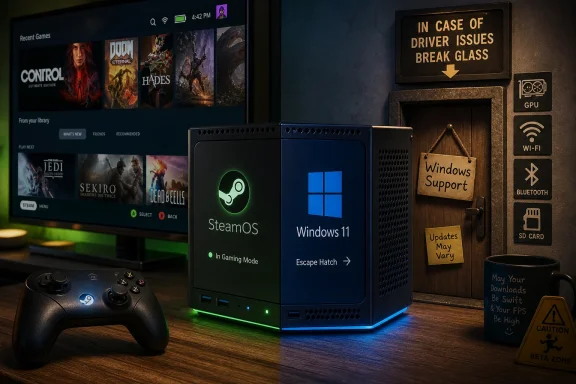 Valve Gives Windows a Door, Not the Keys to the House
The practical news is straightforward. Valve’s Windows resources now include Steam Machine drivers alongside the company’s existing Steam Deck Windows packages, according to GamesRadar+ and other outlets tracking the update. The driver set covers the hardware pieces Windows is least likely to handle gracefully on its own: the AMD graphics stack, wireless networking, Bluetooth, and removable storage.That is enough to make the Steam Machine function more like a normal small-form-factor gaming PC. It is not, however, the same as Valve blessing Windows as a first-class Steam Machine identity. Valve’s long-standing posture with Steam Deck Windows resources has been closer to “here are the parts you need, good luck” than to a fully supported OEM-style Windows deployment.
The most important limitation remains dual boot. GamesRadar+ notes that users cannot yet install Windows side-by-side with SteamOS through an official wizard, which means today’s path is closer to replacement than coexistence. If you want Windows on the Steam Machine right now, you are not just adding another launcher; you are taking the console-like appliance and turning it back into a PC.
That is the central tension of the Steam Machine project. Valve sells the fantasy of PC gaming without PC maintenance, but PC gaming’s messiness always returns through the side door. Windows drivers do not erase that tension. They formalize it.
The Anti-Cheat Problem Is Still Windows’ Strongest Argument
For all the progress Valve has made with Proton, the case for Windows remains brutally practical. Some games still refuse to run properly on Linux-based systems because anti-cheat vendors, publishers, or both have not enabled support. Competitive shooters and live-service games remain the obvious pressure points.GamesRadar+ points to the usual suspects: kernel-level anti-cheat, Easy Anti-Cheat, BattlEye, and the broader universe of games that either do not trust Linux or do not bother to support it. Proton is an extraordinary compatibility layer, but it cannot unilaterally change a publisher’s risk model. If a game’s business depends on policing cheating at the deepest layers of the operating system, Windows remains the safe commercial default.
That is why the Steam Machine’s Windows support is not merely a hobbyist feature. It is a compatibility insurance policy. A buyer who primarily lives in SteamOS may still want the option to boot Windows for Game Pass, a stubborn multiplayer title, or a launcher that behaves badly outside Microsoft’s ecosystem.
This is also where Microsoft’s advantage is less about elegance than inertia. Windows does not need to be beautiful on a TV to remain necessary. It only needs to be the place where the one game you care about works without ritual, forum archaeology, or launch-option incantations.
SteamOS Is Winning the Interface War Even When Windows Wins the Compatibility War
The reason Windows on Steam Machine feels like sacrilege is that SteamOS is not just another Linux distribution with a game launcher on top. On Valve’s hardware, it is the product. The suspend-and-resume behavior, controller-first shell, shader caching, update flow, performance overlays, and Steam library integration are the console tricks that make the device coherent.Windows can run games. SteamOS can make a PC feel like it belongs under a television. Those are not the same achievement.
Microsoft knows this, which is why the company has spent the last few years trying to make Windows more console-like for handhelds and living-room devices. The Xbox app, Game Bar, controller improvements, and newer full-screen experiences are all attempts to sand down the desktop. But Windows still carries the mental model of a general-purpose OS: accounts, pop-ups, background services, driver panels, update restarts, and the occasional reminder that your couch PC is still a computer with opinions.
Valve’s advantage is focus. SteamOS does not have to be the operating system for accountants, CAD users, enterprise fleets, point-of-sale terminals, and gaming handhelds at the same time. It can be tuned around the narrower question of what happens when someone presses the power button with a controller in hand.
That is why the driver release is so interesting. Valve is not pretending Windows has no role. It is betting that Windows’ role can be reduced to a fallback, while SteamOS owns the default emotional experience.
The Missing Dual-Boot Wizard Is Now the Product Gap
The absence of official dual boot is not a footnote. It is the feature that would turn this driver release from a recovery lane into a real strategy.Valve has talked for years around the idea of cleaner Windows-and-SteamOS coexistence on Steam Deck-class hardware, but the official experience has lagged behind community workarounds. On the Steam Machine, that gap is more visible because the device is explicitly pitched for the living room. A handheld owner may tolerate tinkering; a living-room box is judged by harsher console standards.
If Valve ships a polished dual-boot wizard, the Steam Machine becomes far more threatening to Microsoft’s living-room ambitions. SteamOS could remain the default for most play, while Windows becomes the compatibility compartment for Game Pass and problem titles. That would turn Microsoft’s operating system into an app-like utility inside Valve’s hardware story.
Without that wizard, the decision is too binary. Wipe SteamOS and gain compatibility, or keep SteamOS and accept some gaps. Enthusiasts will cross that bridge, but mainstream buyers do not buy a $1,049 living-room box because they want to partition drives and debug bootloaders.
The irony is that dual boot would probably make users less likely to abandon SteamOS permanently. When Windows is available as a safety valve, people can afford to keep Valve’s system as the daily driver. When Windows requires a wipe, the choice becomes ideological, and ideology is a poor substitute for convenience.
Microsoft’s Project Helix Problem Gets Sharper
GamesRadar+ invokes Xbox Project Helix for a reason. Microsoft’s next major gaming hardware push is widely expected to blur the line between console and PC, with Windows-derived software playing a central role. That creates an obvious opportunity and an equally obvious trap.The opportunity is compatibility. Microsoft can credibly argue that a Windows-based gaming device has native access to Game Pass, Xbox services, PC storefronts, anti-cheat-protected games, and decades of Windows software. That is a powerful pitch in a world where players increasingly expect libraries to follow them across screens.
The trap is user experience. If Microsoft ships something that feels like Windows with a console mask, Valve will have the cleaner story. SteamOS already behaves more like a purpose-built gaming environment because it is one. Microsoft has to make a sprawling desktop OS disappear without breaking the compatibility that makes it valuable.
Valve’s Windows driver release raises the stakes because it lets the Steam Machine borrow Microsoft’s biggest advantage while keeping Microsoft at arm’s length. If a user can eventually dual boot into Windows for the handful of things SteamOS cannot do, then a Windows-first Xbox PC hybrid has to justify itself on more than compatibility. It has to be better at being a console-like PC than Valve is.
That is a hard argument for Microsoft, because Valve’s incentives are simpler. Valve wants users in Steam. Microsoft wants users in Windows, Xbox, Game Pass, the Microsoft Store, and a broader platform strategy that has to serve hardware partners as well as its own devices. The messiness is structural.
The $1,049 Cube Is Not Trying to Be a Cheap Console
The Steam Machine’s reported $1,049 starting price makes this debate sharper. This is not a subsidized $499 console built to recoup losses through a locked-down software store. It is a premium living-room PC with console aspirations, sold into a market where expectations are already confused.At that price, buyers will reasonably expect flexibility. If the hardware is expensive enough to resemble a boutique mini PC, users will want the freedom of a PC. Valve’s driver drop is part of satisfying that expectation, even if the company would plainly prefer SteamOS to remain the main event.
But the same price also makes the SteamOS experience more important, not less. A $1,049 box that merely runs Windows is competing against every other small gaming PC, many of which can be upgraded, customized, or bought from vendors with traditional Windows support pipelines. The Steam Machine only makes sense if Valve’s software turns commodity PC ingredients into something more cohesive.
That is why wiping SteamOS for Windows feels like buying a nice espresso machine and using it to boil water. It works. It may even solve a specific problem. But it bypasses the thing you paid a premium to get.
Early Hardware Drama Shows Why Appliance Trust Matters
The recent “Red Line of Death” scare, reported by GamesRadar+, Tom’s Hardware, Windows Central, and others, is a reminder that Valve is asking users to trust a PC as if it were an appliance. Reports centered on at least one new Steam Machine showing red LED behavior associated with GPU failure, though GamesRadar+ later noted that leaving the system powered off for 24 hours appeared to resolve the issue in that case.The sensible read is not panic. Early hardware launches generate anecdotes, and a single dramatic failure does not establish a systemic defect. But perception matters, especially when a device borrows the language and placement of a console.
Console buyers expect failure states to be legible and rare. PC buyers expect some troubleshooting. The Steam Machine is trying to live between those worlds, which means every bug is judged twice: once as a PC issue and once as a console betrayal.
That is another reason Windows support cuts both ways. On one hand, it reassures buyers that the machine is not a locked box. On the other, it expands the support surface. The moment users install Windows, every driver quirk, sleep bug, controller oddity, and performance mismatch becomes part of the Steam Machine’s reputation, even if Valve would rather call it unsupported tinkering.
Valve’s Real Play Is Optionality Without Surrender
The mistake is to read the Windows drivers as a concession that SteamOS is not enough. The more accurate interpretation is that Valve understands platform wars are no longer won by purity. They are won by making your environment the most pleasant default while leaving enough exits that users do not feel trapped.That is a very different strategy from the old console model. Traditional consoles win by restricting what users can do. Modern PC-console hybrids may win by making the preferred path so good that users rarely bother to leave it.
Valve has been moving in this direction for years. Proton reduced the need for native Linux ports. Steam Deck proved that a Linux gaming handheld could feel normal. SteamOS 3.8’s broader PC ambitions suggest Valve wants the operating system to escape Valve hardware, not remain a boutique layer for one device family.
The Windows driver release fits that arc. Valve is not building a wall around SteamOS. It is building a bridge out of it, while hoping the view from inside remains better.
The Couch-PC Fight Is Now About Defaults, Not Possibility
The most concrete lesson from this update is that the Steam Machine is becoming more PC-like without giving up its console-like pitch. That is both its strength and its risk.- Valve’s Windows 11 driver package makes the Steam Machine more viable as a general-purpose gaming PC, but today’s path still appears to require replacing SteamOS rather than using an official dual-boot setup.
- The driver coverage addresses the essentials users would immediately notice, including graphics, Wi-Fi, Bluetooth, and SD card support.
- Windows remains the practical answer for Xbox Game Pass, stubborn third-party launchers, and games blocked by anti-cheat policies that do not fully support Linux.
- SteamOS remains the stronger living-room interface because it was designed around controller-first gaming rather than adapted from a desktop operating system.
- The missing dual-boot wizard is now the feature that could determine whether Windows becomes a fallback option or a full replacement for many tinkerers.
- Microsoft’s next Xbox-PC hybrid efforts will have to beat Valve not just on compatibility, but on the harder problem of making Windows disappear when the player only wants to play.
References
- Primary source: GamesRadar+
Published: Tue, 07 Jul 2026 15:51:29 GMT
Loading…
www.gamesradar.com - Related coverage: tomshardware.com
- Related coverage: techradar.com
Steam Machine hits 'Red Line of Death' issues — but there's no need to panic about bricked PCs yet | TechRadar
Let's not overreact to a couple of reports of GPU failureswww.techradar.com - Related coverage: windowscentral.com
Xbox's Red Ring of Death still haunts gamers as Steam Machine owners report a "Red Line of Death" after GPU failures | Windows Central
A Steam Machine owner reports a GPU failure, drawing comparisons to the Xbox 360's infamous Red Ring of Death.www.windowscentral.com - Related coverage: pcgamer.com
Valve's aim for a console-like experience with its Steam Machine lands a little too close for comfort as one of the first cases of 'Red Line of Death' comes to light | PC Gamer
Disappointing for the owner, but hopefully another software update can fix it.www.pcgamer.com - Related coverage: notebookcheck.net
Steam Machine can now run Windows with official Valve drivers - Notebookcheck News
Valve's new Steam Machine drivers for Windows are now made official. The set includes drivers for all major components, and their release is in line with Valve's PC-first approach to gaming hardware. www.notebookcheck.net
- Related coverage: tweakers.net
Loading…
tweakers.net - Related coverage: gamespot.com
Valve Releases SteamOS So Anyone Can Make A Steam Machine Now - GameSpot
With SteamOS 3.8 out now, you can turn your existing PC into a Steam Machine.www.gamespot.com - Related coverage: windowsforum.com
Steam Machine Gets Official Windows 11 Drivers—Dual-Boot Wizard Still Missing | Windows Forum
Valve has released official Windows 11 drivers for the new Steam Machine through Steam Support as units begin reaching customers in July 2026, but the...windowsforum.com - Related coverage: androidauthority.com
This Steam Machine user only got 20 minutes in before encountering the Red Line of Death
A Reddit user has posted a picture of their brand new Steam Machine encountering a Red Line of Death due to a GPU failure.www.androidauthority.com - Related coverage: overclock3d.net
Steam Machine gains official Windows support with Valve drivers - OC3D
Users of Valve's Steam Machine can now install Windows in their systems, with full driver support. Valve's Steam Machine is a PCoverclock3d.net - Related coverage: phoronix.com
Steam Machine Launches, Priced $1049 To $1428 USD - Phoronix
Valve today finally revealed pricing on their SteamOS Linux-powered Steam Machine living room PCwww.phoronix.com
- Related coverage: en.softonic.com
Valve releases Steam Machine Windows drivers: they wipe SteamOS - Softonic
Valve has finally put out official Windows drivers for the 2026 Steam Machine, which means supported Windows installs are now on the table for the firen.softonic.com - Related coverage: destructoid.com
Loading…
www.destructoid.com