

Valve’s new Steam Machine is a compact, SteamOS-based living-room PC, but NoobFeed’s July 17 testing reinforces the gap between its 4K marketing and the performance buyers should expect from current AAA games. The $1,049 base model is better treated as a 1080p-to-1440p machine, with 4K depending heavily on FSR upscaling and frame generation.
NoobFeed reported that Black Myth: Wukong averaged 68 fps at 1080p and 43 fps at 1440p at native settings, but only 22 fps at native 4K. Using FSR Performance mode lifted its reported 4K result to 57 fps, and frame generation pushed the displayed figure to 81 fps. Red Dead Redemption 2, a notably older and less demanding title, reportedly reached 43 fps at native 4K and 61 fps with FSR.
That outcome broadly matches PC Gamer’s review of the retail hardware. It found that demanding games need substantial compromises in settings, upscaling, or frame generation, while the hardware is more convincing at lower resolutions. Valve’s semi-custom AMD platform includes a six-core Zen 4 CPU, 16GB of DDR5 memory, an RDNA 3 GPU with 28 compute units, and 8GB of dedicated GDDR6 video memory. The latter is the practical constraint in newer games using high-resolution textures and effects.
Valve has presented the Steam Machine as suitable for 4K gaming, but reports from TechSpot and PC Gamer indicate that the realistic target is often 1440p, or a 4K output signal produced through upscaling rather than native rendering. That distinction matters on a large TV: frame generation can improve apparent smoothness, but it does not reduce the underlying GPU workload in the same way as native performance and can introduce visual artifacts or extra latency.
NoobFeed’s results illustrate the split clearly. Older titles such as Borderlands 3 reportedly scale well with FSR, while newer CPU- and GPU-heavy games such as Anno 117: Pax Romana remain difficult even at 1080p. Buyers should not assume that “4K” means a steady native 60 fps in current releases.
The hardware itself is unusually compact and quiet for a gaming PC. PC Gamer measured the design favorably, citing its large rear fan and substantial heatsink, while noting that its value is harder to justify at current pricing. The 512GB model starts at $1,049, while the 2TB version costs $1,349 before adding Valve’s optional controller.
For Windows users weighing a living-room upgrade, the Steam Machine is a tidy SteamOS appliance first and a high-end 4K gaming PC second.
NoobFeed reported that Black Myth: Wukong averaged 68 fps at 1080p and 43 fps at 1440p at native settings, but only 22 fps at native 4K. Using FSR Performance mode lifted its reported 4K result to 57 fps, and frame generation pushed the displayed figure to 81 fps. Red Dead Redemption 2, a notably older and less demanding title, reportedly reached 43 fps at native 4K and 61 fps with FSR.
That outcome broadly matches PC Gamer’s review of the retail hardware. It found that demanding games need substantial compromises in settings, upscaling, or frame generation, while the hardware is more convincing at lower resolutions. Valve’s semi-custom AMD platform includes a six-core Zen 4 CPU, 16GB of DDR5 memory, an RDNA 3 GPU with 28 compute units, and 8GB of dedicated GDDR6 video memory. The latter is the practical constraint in newer games using high-resolution textures and effects.
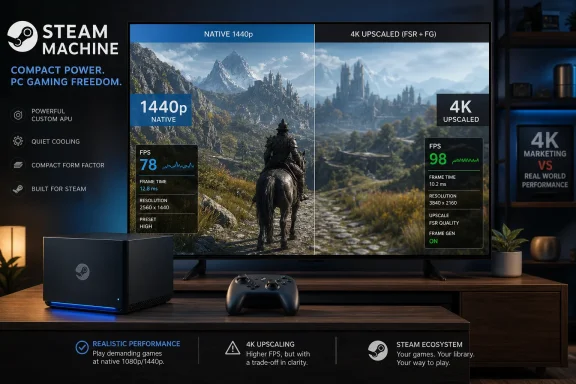 The 4K claim needs context
Valve has presented the Steam Machine as suitable for 4K gaming, but reports from TechSpot and PC Gamer indicate that the realistic target is often 1440p, or a 4K output signal produced through upscaling rather than native rendering. That distinction matters on a large TV: frame generation can improve apparent smoothness, but it does not reduce the underlying GPU workload in the same way as native performance and can introduce visual artifacts or extra latency.NoobFeed’s results illustrate the split clearly. Older titles such as Borderlands 3 reportedly scale well with FSR, while newer CPU- and GPU-heavy games such as Anno 117: Pax Romana remain difficult even at 1080p. Buyers should not assume that “4K” means a steady native 60 fps in current releases.
A polished alternative to Windows, not a Windows replacement
The machine’s core appeal is SteamOS 3: Valve’s Linux-based, console-style interface with Steam integration and Proton compatibility for many Windows games. Valve also positions the Steam Machine as a PC, meaning owners can install another operating system, including Windows, if they prefer conventional desktop software, Game Pass PC access, or games whose anti-cheat systems do not support Proton.The hardware itself is unusually compact and quiet for a gaming PC. PC Gamer measured the design favorably, citing its large rear fan and substantial heatsink, while noting that its value is harder to justify at current pricing. The 512GB model starts at $1,049, while the 2TB version costs $1,349 before adding Valve’s optional controller.
For Windows users weighing a living-room upgrade, the Steam Machine is a tidy SteamOS appliance first and a high-end 4K gaming PC second.
References
- Primary source: NoobFeed
Published: 2026-07-17T00:00:00+00:00
Loading…
www.noobfeed.com