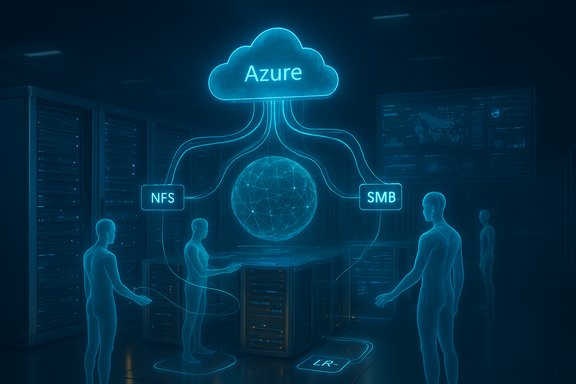
VAST Data’s announcement that its VAST AI Operating System will be available to Microsoft Azure customers signals a notable escalation in the race to provide purpose‑built infrastructure for agentic AI — the class of autonomous, goal‑oriented systems enterprises are now trying to operationalize at scale. The partnership promises to bring VAST’s unified data services — including the VAST DataStore, VAST DataBase, InsightEngine, and AgentEngine — into Azure’s global cloud fabric, with a focus on high-throughput data delivery for GPU‑heavy model training and inference, unified hybrid namespaces for effortless data mobility, and a set of data services designed explicitly to keep accelerators fed and agents reasoning over real‑time data.
VAST Data has, over the last two years, repositioned itself from a high‑performance storage vendor into what it now calls an AI Operating System: a software stack that conflates storage, data services, metadata management, and agent orchestration into a single platform for AI pipelines. That transition produced distinct product names — VAST DataStore, VAST DataBase, InsightEngine, AgentEngine, and a global namespace called DataSpace — all engineered to eliminate the traditional tradeoffs between scale, performance, and simplicity via VAST’s Disaggregated, Shared‑Everything (DASE) architecture. VAST’s own materials describe the AI OS as purpose‑built for real‑time agentic workloads and large‑scale vector search, with features like Similarity Reduction to lower storage footprint for high‑dimensional embeddings. Microsoft’s public roadmap over the same period has concentrated on three priorities relevant to any serious AI deployment: expanding global AI infrastructure (new VM families and datacenter designs), embedding agentic capabilities into platform tooling (Copilot Studio, Azure AI Foundry, agent identity and governance), and delivering enterprise controls for observability and policy. The timing of VAST’s Azure integration — announced alongside Ignite activity and Microsoft’s agentic messaging — aligns the two companies’ strategic narratives: Azure supplies the compute and global reach; VAST supplies the data and agent orchestration layer.
VAST’s aggressive multi‑cloud play — partnerships with Google Cloud and now Azure, service provider tie‑ups, and large commercial deals — indicates a strategy to become the neutral data plane for heterogeneous AI factories. That’s strategically sensible for customers who want multi‑vendor resilience, but it raises the stakes for interoperability standards (MCP, agent‑to‑agent protocols) and third‑party validation.
That said, the announcement is the beginning of a procurement conversation, not the end. Enterprises should treat Azure‑hosted VAST as a promising platform that requires rigorous proof points: verified SKU compatibility, reproducible performance on representative workloads, clear governance integrations with Azure Entra/Purview/Sentinel, and transparent TCO modelling. Specific phrases and SKU names in the press text should be validated with technical references and Azure documentation — any ambiguous terms (for example, references to a “Laos VM Series” or “Azure Boost”) should be treated as unverifiable until clarified by Microsoft or VAST. Ultimately, for organizations intent on operationalizing agentic AI at scale, the combination of VAST’s data services and Azure’s global compute fabric is a credible pathway — provided that buyers insist on pilot‑based validation, governance readiness, and contractual commitments that reflect measured, repeatable performance rather than marketing‑grade claims.
Source: The Manila Times VAST Data Partners with Microsoft to Power the Next Wave of Agentic AI
 Background / Overview
VAST Data has, over the last two years, repositioned itself from a high‑performance storage vendor into what it now calls an AI Operating System: a software stack that conflates storage, data services, metadata management, and agent orchestration into a single platform for AI pipelines. That transition produced distinct product names — VAST DataStore, VAST DataBase, InsightEngine, AgentEngine, and a global namespace called DataSpace — all engineered to eliminate the traditional tradeoffs between scale, performance, and simplicity via VAST’s Disaggregated, Shared‑Everything (DASE) architecture. VAST’s own materials describe the AI OS as purpose‑built for real‑time agentic workloads and large‑scale vector search, with features like Similarity Reduction to lower storage footprint for high‑dimensional embeddings. Microsoft’s public roadmap over the same period has concentrated on three priorities relevant to any serious AI deployment: expanding global AI infrastructure (new VM families and datacenter designs), embedding agentic capabilities into platform tooling (Copilot Studio, Azure AI Foundry, agent identity and governance), and delivering enterprise controls for observability and policy. The timing of VAST’s Azure integration — announced alongside Ignite activity and Microsoft’s agentic messaging — aligns the two companies’ strategic narratives: Azure supplies the compute and global reach; VAST supplies the data and agent orchestration layer. What the integration actually delivers (summary of claims)
- Unified data services on Azure: VAST says Azure customers will be able to deploy the VAST AI OS on Azure infrastructure and consume unified file (NFS, SMB), object (S3), and block protocols through the same platform. The VAST DataBase is presented as a hybrid that combines transactional performance with warehouse‑scale query speed and data‑lake economics.
- Agentic execution where data lives: InsightEngine (stateless high‑performance compute and vector/database services) plus AgentEngine (autonomous agent orchestration over real‑time streams) enable retrieval‑augmented generation (RAG), continuous reasoning agents, and event‑driven orchestration without moving datasets off their primary location.
- Scale and performance for GPU workloads: VAST claims the AI OS will keep Azure GPU and CPU clusters saturated by delivering high‑throughput data services, intelligent caching, and metadata‑optimized I/O, and will integrate with Azure’s latest infrastructure offerings. The vendor emphasizes predictable performance from pilot to multi‑region scale and points to techniques like intelligent caching and burstable DataSpace connectivity to minimize cold starts.
- Hybrid and multi‑cloud DataSpace: A single exabyte‑scale DataSpace provides a global namespace that eliminates silos and allows instant burst from on‑premises to Azure for GPU‑accelerated workloads without reconfiguration or full data migration. VAST positions this as a way to avoid egress and DR migration latencies while keeping one unified control plane.
- Cost and efficiency levers: The DASE architecture disaggregates compute and storage for independent scaling in Azure, and VAST highlights Similarity Reduction and other deduplication/compression techniques to lower storage footprints for embedding‑heavy pipelines.
Cross‑check: what independent sources confirm — and where claims need caution
Multiple vendor press materials from VAST outline the product architecture and exact feature names (InsightEngine, AgentEngine, DataSpace, DASE). VAST’s own announcements are the primary source for product capabilities and design assumptions. Third‑party reporting and vendor ecosystem coverage corroborate the general thrust — VAST has been integrating with NVIDIA DGX systems, partnering with cloud providers (Google Cloud, Voltage Park, and service providers), and positioning its AI OS to serve GPU‑heavy workflows. TahawulTech and other trade outlets reported the InsightEngine launch and the DGX collaboration; VAST also published detailed product PRs. Microsoft’s agentic and infrastructure narrative is independently documented by conference coverage and technical reporting: Azure’s move to purpose‑built AI datacenter designs, new VM families, and agent governance primitives is well covered in industry outlets. That context supports the logic of aligning a data‑first AI OS with Azure’s compute and governance fabric. Areas that require caution or further verification- “Laos VM Series using Azure Boost Accelerated Networking” — this specific VM family name and the phrase Azure Boost do not match commonly documented Azure VM families or public Azure networking products (e.g., Accelerated Networking is a known capability; Azure has VM families such as ND, NC, HB, and custom Maia/Cobalt silicon initiatives). The press text may contain a transcription error or an internal code name; this claim could not be verified against Microsoft public documentation at the time of writing and should be treated as unverified vendor wording. Enterprises should request precise Azure SKU names, VM specifications, and validated reference architectures before signing contracts.
- Performance headlines (e.g., “keeps Azure GPU clusters saturated” or “line‑rate model load times comparable to local NVMe”) are performance claims that vary by workload, model size, and cluster topology. VAST and partners publish benchmark snapshots, but independent third‑party benchmarks, customer case studies under NDA, or reproducible reference tests are needed to validate those numbers across broad customer environments. Treat vendor performance claims as directional until validated in your environment.
- Economic claims about TCO savings via Similarity Reduction and disaggregation are plausible but workload‑dependent. Cost modelling should be run with real dataset sizes and access patterns; common pitfalls include underestimating metadata costs, small‑file overhead, and network egress pricing when multi‑cloud traffic is non‑zero.
Why this matters to enterprises and model builders
- Data gravity is the blocker for agentic AI: Agents need fast, consistent access to high‑quality context. VAST’s pitch — unify data access across protocols and present it as a single namespace — directly addresses the “last mile” problem of discovery, feature extraction, and warm model access without wholesale migration. That capability simplifies RAG pipelines and multi‑agent orchestration where latency and freshness matter.
- Hybrid workflow continuity reduces operational complexity: Enterprises with existing on‑prem datasets (regulated data, large imaging/genomics stores, or legacy NAS) historically faced long migrations to cloud. A DataSpace that enables bursting to Azure for compute without reconfiguration lowers migration risk and shortens pilot timelines.
- Keeping accelerators busy is a real cost lever: GPU cycles are expensive and often underutilized due to I/O bottlenecks. A data layer engineered to minimize cold starts, deliver embeddings at scale, and stream training checkpoints can materially improve GPU utilization and reduce model‑training unit costs — if the platform performs as claimed.
- Multi‑protocol access simplifies developer experience: Support for NFS/SMB, S3, and block protocols from a single store reduces application rewrites and preserves existing tooling investments. This is an important pragmatic win for mixed workloads and varied engineering teams.
Technical deep dive: what to probe before you commit
When evaluating VAST AI OS on Azure, IT architects should ask for and test the following:- Deployment model and billing
- Is the VAST AI OS offered as an Azure Marketplace VM image, managed service, or customer‑managed software? What are licensing and consumption models for data services and metadata indexing?
- SKU validation and reference architecture
- Request a validated architecture for the specific Azure VM families, networking (RDMA, Accelerated Networking), and DPU/DPU‑offload requirements (if any). Confirm whether the press text’s VM names (e.g., “Laos VM Series”) correspond to public Azure SKUs and request an official Azure reference architecture.
- Performance reproducibility
- Ask for published, reproducible benchmarks (model load times, vector search throughput, training checkpoint streaming) and request to run those benchmarks in a pilot using a representative dataset and the same Azure region and VM SKUs you plan to use.
- Data residency, encryption, and compliance
- How are keys managed? Is encryption in transit and at rest using customer‑managed keys? How is audit logging integrated with Azure Monitor, Microsoft Purview, and Sentinel? Agentic AI requires provenance and audit trails to satisfy compliance teams.
- Agent lifecycle, identity, and governance
- How do AgentEngine agents map to Azure Entra identities? Are agents first‑class principals with RBAC, conditional access, and lifecycle controls? How is chain‑of‑thought, tool invocation, and data access recorded for E‑Discovery?
- Fault domains and resiliency
- How does the disaggregated architecture survive node, rack, or AZ failures in Azure? Request RTO/RPO expectations and a test plan for simulated failure scenarios.
- Storage economics
- Get a detailed TCO model that includes metadata store growth, index rebuild costs, cross‑region replication, and the expected deduplication/similarity reduction ratios for your dataset. Vendor averages can be misleading; run a short ingest to validate the dedupe profile on representative data.
Strengths and strategic benefits
- Enterprise‑grade feature list: VAST’s platform delivers a compelling set of features for agentic AI: global namespace, multi‑protocol access, vector search at exabyte scale, and agent orchestration. These are precisely the features enterprise AI teams have been asking for.
- Hybrid freedom with Azure governance: Running VAST on Azure allows teams to use native Azure billing, governance, and security tooling while leveraging VAST’s data services — a practical bridge between platform control and vendor capability.
- Vendor momentum and ecosystem reach: VAST’s recent deals and multi‑cloud partnerships (Google Cloud, service providers, and now Azure) suggest the company is intent on being the neutral data plane for AI, reducing lock‑in risk from any single hyperscaler. That strategic posture can be attractive to enterprises seeking multi‑cloud resilience.
Risks, gaps, and governance concerns
- Vendor hype vs. reproducible performance: Many storage and platform vendors publish bold claims; the only reliable way to evaluate is a controlled pilot using representative data and workloads. Without pilot metrics, cost and performance risk remain high.
- Agentic risk increases attack surface: Agent orchestration that can act on data across systems magnifies the need for identity‑bound agents, fine‑grained runtime policy enforcement, and robust observability. Enterprises must treat agent governance as an architectural requirement, not an optional add‑on.
- Potential for new operational complexity: Disaggregated systems remove some tradeoffs but introduce new ops patterns. Teams must be prepared for metadata management, catalog scaling, and network design that supports high‑fanout, high‑throughput streaming. Expect a learning curve.
- Unclear Azure SKU references and proprietary optimizations: Any mismatch between press‑release VM nomenclature and Azure’s public VM families needs clarification. Enterprises should insist on concrete Azure reference architectures and compatibility matrices. Do not assume a marketing‑term VM equals a published Azure SKU.
Recommendation: how to evaluate VAST on Azure in 90 days
- Run a short, targeted pilot (0–30 days)
- Deploy VAST AI OS in a single Azure region using the vendor‑recommended SKUs.
- Ingest a representative subset of your dataset (including worst‑case small files and largest binary objects).
- Run baseline RAG, embedding, and model‑load workloads and capture GPU utilization, model load times, and end‑to‑end latency.
- Validate governance and observability (30–60 days)
- Map agents to Entra identities, enable Azure Policy integration, and validate audit trail completeness with Sentinel and Purview.
- Test agent kill‑switches, quarantine flows, and human‑in‑the‑loop approval gates.
- Cost, scale, and resilience run (60–90 days)
- Scale to multi‑AZ or multi‑region pilot to test DataSpace burst behavior and cross‑region replication costs.
- Validate disaster scenarios and metadata-targeted failover plans.
- Produce a measured TCO projection and GPU utilization uplift report versus your baseline.
The bigger picture: what this partnership signals for the AI infrastructure market
Bringing an AI‑native data OS onto Azure marks an industry trend: storage and data layers are shifting from being passive repositories to active enablers of reasoning systems. Vendors that can provide metadata‑aware, protocol‑agnostic, and agent‑friendly services will be competitive, but the winning model is likely to be one that pairs strong technical performance with enterprise controls and clear economics.VAST’s aggressive multi‑cloud play — partnerships with Google Cloud and now Azure, service provider tie‑ups, and large commercial deals — indicates a strategy to become the neutral data plane for heterogeneous AI factories. That’s strategically sensible for customers who want multi‑vendor resilience, but it raises the stakes for interoperability standards (MCP, agent‑to‑agent protocols) and third‑party validation.
Conclusion
The VAST Data + Microsoft Azure collaboration promises a compelling value proposition: an AI‑native data operating system running on a hyperscaler that already provides the global compute, compliance tooling, and enterprise reach required for production agentic AI. The architectural vision — unify diverse data access, run agents where data lives, and keep accelerators busy — directly addresses real operational pain points that have slowed enterprise AI adoption.That said, the announcement is the beginning of a procurement conversation, not the end. Enterprises should treat Azure‑hosted VAST as a promising platform that requires rigorous proof points: verified SKU compatibility, reproducible performance on representative workloads, clear governance integrations with Azure Entra/Purview/Sentinel, and transparent TCO modelling. Specific phrases and SKU names in the press text should be validated with technical references and Azure documentation — any ambiguous terms (for example, references to a “Laos VM Series” or “Azure Boost”) should be treated as unverifiable until clarified by Microsoft or VAST. Ultimately, for organizations intent on operationalizing agentic AI at scale, the combination of VAST’s data services and Azure’s global compute fabric is a credible pathway — provided that buyers insist on pilot‑based validation, governance readiness, and contractual commitments that reflect measured, repeatable performance rather than marketing‑grade claims.
Source: The Manila Times VAST Data Partners with Microsoft to Power the Next Wave of Agentic AI