VAST Data’s decision to bring its VAST AI Operating System (AI OS) to Microsoft Azure marks a deliberate push to treat the cloud as more than just a compute utility — instead, a managed platform for agentic AI where data, fast retrieval, and autonomous agents operate together under unified governance and billing, promising simplified hybrid workflows and higher GPU utilization for model builders.
Background
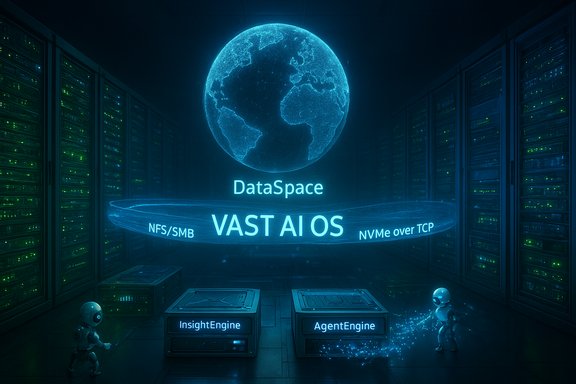
Over the past two years VAST Data has repositioned itself from a high‑performance flash‑storage vendor into what it now calls an AI Operating System: a software stack that collapses storage, database services, metadata indexing, and an in‑place, event‑driven compute fabric into one platform for large‑scale AI pipelines. The Azure collaboration was announced at Microsoft Ignite and makes those VAST components available to Azure customers under Azure’s tooling, identity, governance, and billing frameworks. VAST’s product vocabulary — DataStore, DataBase, DataSpace, InsightEngine, and AgentEngine — frames a single thesis: run vector search, retrieval‑augmented generation (RAG) pipelines, and autonomous agents where the data lives to avoid costly and slow data movement. VAST’s architecture, which it calls Disaggregated, Shared‑Everything (DASE), supports independent scaling of compute and storage and includes data‑reduction techniques like Similarity Reduction for embedding stores.What VAST AI OS on Azure actually delivers
Core components made Azure‑native
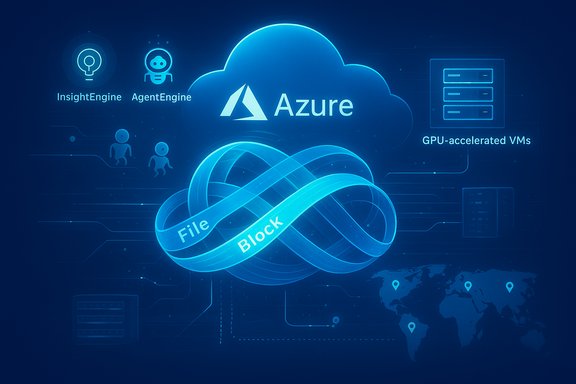
- DataStore: unified, multi‑protocol storage that supports file (NFS/SMB), object (S3), and block access so legacy apps and cloud services can access the same data without copying.
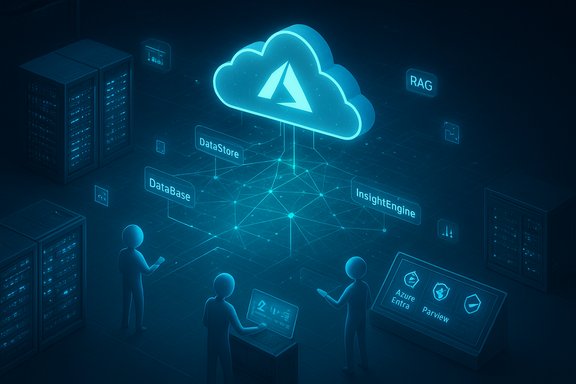
- DataBase: a transactional, indexable layer that ingests metadata and vector embeddings for low‑latency queries across very large datasets.
- DataSpace: a global namespace fabric that presents on‑prem and cloud storage as a single logical pool, enabling “burst to cloud” GPU workflows without full dataset rehydration.
- InsightEngine: stateless, in‑place compute for chunking, embedding, and high‑speed retrieval used in RAG and vector workloads.
- AgentEngine: an orchestration runtime for autonomous agents that can invoke data, run reasoning loops, and take actions in automated pipelines, integrated with the DataEngine eventing system.
Key vendor claims summarized
- Keep Azure GPU/CPU clusters saturated with high‑throughput data services, intelligent caching, and metadata‑optimized I/O for predictable scaling.
- Enable hybrid, multi‑region, and multi‑cloud agentic workflows through a single global namespace (DataSpace).
- Reduce storage footprint for massive embedding catalogs via built‑in Similarity Reduction.
- Provide first‑class tools for building RAG pipelines and agent orchestration without moving data, shortening model iteration cycles.
Why this matters: the practical value‑propositions
1) Data locality for model builders — less friction, faster cycles
AI workloads are dominated by data movement costs: preparing datasets, moving them into GPU fleets, and repeated I/O during training and inference. By enabling embedding, vector search, and pre‑processing in place — and by integrating that data plane with Azure compute — VAST promises to reduce latency, cloud egress, and time spent waiting for datasets to warm. The result for engineering teams should be shorter iteration cycles and higher GPU utilization.2) Multi‑protocol compatibility preserves legacy investments
Enterprises rarely rewrite every workload when moving to the cloud. The DataStore’s promise of NFS/SMB/S3 and block access from a single namespace means existing applications and analytics engines can access the same data without costly rewrites or copy pipelines. That reduces migration friction and helps maintain mixed workloads on the same fabric.3) Hybrid bursts and governance continuity
The Azure deployment emphasizes being an Azure‑native offering — you operate VAST with Azure governance, audit, and billing. For regulated workloads that must maintain residency or strict controls on movement, the ability to burst compute into Azure without changing governance policies is strategically powerful. It’s also attractive for customers who want to centralize billing and support under their Azure agreements.Critical analysis: strengths, limitations, and the procurement checklist
Strengths — where VAST + Azure is compelling
- Integrated stack for agentic AI: VAST moves beyond storage to orchestrated, event‑driven compute (DataEngine/AgentEngine), which is a natural fit for RAG and multi‑agent systems that need continuous access to fresh data.
- Realistic hybrid posture: The DataSpace concept addresses data gravity by enabling burst patterns rather than forcing migration. That’s a pragmatic answer for data‑heavy domains like genomics, video, and LiDAR.
- Enterprise management model: Running as an Azure‑native offering eases adoption for Microsoft enterprise customers by mapping to existing identity, policy, and support models.
Caveats and technical risks — what needs verification
- Unverified Azure SKU references: The announcement references a “Laos VM Series” and “Azure Boost” accelerated networking. Those specific product names are not present in Microsoft’s public VM family documentation and may be vendor shorthand or internal code names rather than published SKUs. Architects must obtain SKU‑level compatibility matrices from Microsoft and VAST. Treat these terms as unverified until clarified.
- Performance variability: Claims such as “keeping GPU clusters saturated” depend heavily on workload shape, dataset skew, concurrency, and network topology. Vendor benchmarks are directional; reproducible third‑party tests and representative pilot benchmarks are required for realistic sizing and TCO modeling.
- Operational complexity from metadata scale: Global namespaces and vector indexes add metadata growth and indexing costs that are often under‑estimated. Expect a non‑trivial operations and observability investment to manage index rebuilds, consistency, and metadata store growth at exabyte scale.
- Agent governance and security surface: Agentic systems that can act on data increase attack surface and regulatory exposure. Agent identities must be mapped to Azure Entra principals, audit trails must integrate with Sentinel and Purview, and runtime policy enforcement must be demonstrable before production rollout.
Technical verification: what to confirm before committing
- Confirm deployment model and contract mechanics. Is VAST AI OS offered via the Azure Marketplace as a managed service, an Azure‑hosted managed offering, or a customer‑managed image? Understand licensing, consumption metrics (per‑GB, per‑query, per‑CNode), and support SLAs.
- Insist on an Azure SKU compatibility matrix. Request a validated list of VM SKUs (exact names), GPU models, NIC capabilities (RDMA/InfiniBand, Accelerated Networking), and any DPU/DPU‑offload requirements. Do not accept marketing names in lieu of SKU numbers.
- Obtain reproducible benchmarks and run a pilot. Benchmarks should include model load times, embedding ingestion speed, vector search latency under sustained concurrency, and GPU utilization uplift on representative datasets. Compare vendor snapshots with in‑your‑environment runs.
- Validate governance and audit integrations. Map AgentEngine agents to Entra identities, verify audit logs and chain‑of‑action retention in Purview/Sentinel, and test policy enforcement such as kill switches and quarantines.
- Model TCO with metadata overhead. Include index rebuild costs, metadata database growth, cross‑region replication, and any expected egress or Inter‑Cloud transfer fees to produce realistic long‑term costing.
A practical 90‑day pilot plan (pragmatic, vendor‑agnostic)
To convert marketing claims into measurable results, follow a staged plan:0–30 days: Deployment & baseline
- Deploy VAST AI OS in one Azure region with the vendor‑recommended SKUs (validated in writing).
- Ingest a representative dataset (including small file worst‑cases and very large binary objects).
- Run baseline RAG and embedding workloads; capture GPU utilization, model load times, and end‑to‑end latency.
- Map AgentEngine agents to Entra principals; enable conditional access and RBAC scopes.
- Integrate logs with Azure Sentinel and Purview; validate that audit trails record agent actions, data access, and tool invocations.
- Test agent lifecycle controls: kill switches, quarantines, and human‑in‑the‑loop approvals.
- Scale across AZs or regions to test DataSpace bursting behavior and cross‑region replication costs.
- Run failure drills for metadata, node, and AZ failures to confirm RTO/RPO.
- Produce a measured TCO projection that incorporates observed dedupe/similarity ratios and GPU utilization uplift. If KPIs are met, negotiate staged commercial terms and SLAs.
Strategic risks and vendor lock‑in considerations
- Data plane consolidation risk: Adopting a single, provider‑specific AI OS can simplify operations but concentrates control and dependency. Enterprises should weigh the operational benefits against potential migration complexity later. Multi‑cloud deployments or exit plans should be validated up front.
- Agentic attack surface and regulatory exposure: Agents with autonomous enactment capabilities increase requirements for provenance, E‑Discovery, and human oversight. Regulatory teams should be engaged early to define acceptable agent behaviors and data access policies.
- Hidden TCO from metadata and small‑file overhead: Global namespaces and vector indexes can generate significant metadata growth, which is often the cost driver missed in initial estimates. Pilot the metadata growth model with representative ingest loads.
Where to be cautious about vendor language
Several publications and vendor analysis notes flag that phrases like “Laos VM Series” and “Azure Boost Accelerated Networking” appear in the announcement but do not map neatly to publicly documented Azure VM families or networking products. Microsoft does publish Accelerated Networking capabilities and numerous VM families (ND, NC, HB, etc., but the precise phraseology used in the VAST PR could be internal or marketing shorthand. Do not accept those names in contracts — require exact SKU names and NIC/driver requirements.Market context — why hyperscalers want data‑first partners
Hyperscalers are stacking richer, opinionated infrastructure to win enterprise AI workloads (specialized VM families, custom silicon, and platform agent tooling). For Microsoft, partnering with a data OS vendor like VAST tightens Azure’s ability to offer a turnkey path for large model training, RAG deployments, and agentic systems without forcing customers to rebuild their data pipelines from scratch. For VAST, being Azure‑native broadens its reach and embeds its control plane into enterprise procurement and governance flows. This partnership therefore reflects a broader trend: cloud providers want fewer integration headaches for customers; vendors want hyperscaler scale and operational simplicity.Final verdict for IT buyers
VAST AI OS on Azure is a strategically interesting and technically plausible proposition for organizations that:- run very large datasets (video, genomics, telemetry) that make data migration impractical;
- need high GPU utilization and fast RAG/agentic workflows; and
- are committed to Microsoft's governance, identity, and compliance tooling.
VAST’s public materials and the Azure collaboration together outline a coherent technical direction: unify data access, run compute in place, and operationalize agents at scale. The practical impact will depend on technical validation, SKU fidelity, and enterprise governance controls. For any organization considering VAST on Azure, the immediate next steps are (1) request SKU compatibility matrices and a validated reference architecture, (2) run a focused 90‑day pilot with representative workloads and governance tests, and (3) insist that any commercial commitment include measurable performance and compliance SLAs tied to those pilot results. CONTENTS: VAST press materials, independent reporting, and vendor analysis inform this assessment; ambiguous infrastructure references in the announcement should be verified directly with Microsoft and VAST before procurement.
Source: SourceSecurity.com VAST AI OS: Transforming AI with Microsoft Azure