

VAST Data this week positioned itself as a foundational AI infrastructure supplier by promoting expanded work with NVIDIA and Microsoft Azure, a zero-trust agentic AI security framework, and flagship deployments including the National Hockey League’s large-scale video archive. The message is not subtle: VAST wants to be seen less as a storage company and more as part of the operating substrate for industrial AI. That is an ambitious claim, but it also reflects a real shift in enterprise AI spending, where the bottleneck is increasingly not the model but the machinery around it. If AI factories are becoming the new data centers, VAST is arguing that the factory floor starts with data.
The past two years of AI infrastructure marketing have been dominated by GPUs, model weights, and spectacular claims about agentic systems. Storage, metadata, governance, and data movement were treated as plumbing — essential, expensive, and best discussed after the demo worked. VAST Data’s current campaign is an attempt to invert that hierarchy.
The company’s core argument is that large-scale AI has moved from experimentation into production, and production punishes fragmentation. Training data, inference context, retrieval pipelines, audit logs, video archives, genomics files, and enterprise records do not live neatly in one place. They sprawl across clouds, data centers, edge sites, and legacy systems, and the more ambitious the AI workload becomes, the more visible that sprawl gets.
That is why VAST’s language has shifted from storage to AI operating system. The term is grandiose, and IT buyers should always squint at vendor claims that turn nouns into platforms. But beneath the branding is a concrete bet: whoever controls the high-performance data layer may control a larger slice of the AI infrastructure stack than traditional storage vendors have historically captured.
For WindowsForum readers, the relevant comparison is not a new SSD benchmark or another NAS refresh. It is the familiar enterprise pattern where a seemingly peripheral layer becomes strategic because everything above it depends on it. Identity did that. Observability did that. Now data infrastructure is trying to do the same under the pressure of GPU economics.
VAST is leaning into that metaphor by tying its platform to NVIDIA DGX SuperPOD designs and the broader NVIDIA ecosystem. The pitch is that enterprises should not assemble AI infrastructure as a science project, stitching compute, storage, networking, retrieval, vector search, and governance together by hand. They should buy something closer to a validated plant design.
That is strategically useful for VAST because it moves the sales conversation away from storage procurement and toward infrastructure architecture. In a classic storage bake-off, the questions are cost per terabyte, IOPS, resilience, and support. In an AI factory conversation, the questions become GPU utilization, model throughput, data locality, metadata quality, and time to production.
This distinction matters because GPUs are the most visible cost center in modern AI deployments. If expensive accelerators sit idle waiting on data, the storage layer stops being a back-office commodity. It becomes part of the financial model for the entire AI initiative.
VAST’s most eye-catching performance framing addresses that point directly. The company has promoted scenarios where recomputation that might take more than a minute on GPUs can be replaced by a storage fetch measured in seconds. The details of workload, cache behavior, and architecture matter enormously, but the underlying theme is credible: as context windows grow and inference workloads become more stateful, where intermediate data lives can determine how efficiently the system runs.
BlueField has long been NVIDIA’s way of moving infrastructure work off the host CPU and into a data processing unit. In the AI context, that matters because the CPU path can become a choke point for data movement, security enforcement, and networking. The more work that can be handled close to the data plane, the more the GPU complex can focus on the thing buyers actually paid for.
VAST’s zero-trust AI data framework builds on that logic. By integrating VAST AI OS with NVIDIA Vera BlueField-4 STX and DOCA, the company is pitching hardware-isolated boundaries, inline policy enforcement, and real-time observability for AI workloads. This is not just about keeping a file share private. It is about managing access to data, agent memory, and context in systems that may operate continuously and semi-autonomously.
That is a timely concern. The security conversation around generative AI has moved beyond prompt injection as a parlor trick and toward the more serious problem of persistent agent state. If an AI agent can retrieve documents, remember prior interactions, invoke tools, and act across workflows, then the boundary between application security and data security gets blurry very quickly.
VAST’s framing is that the storage layer can become an enforcement point for that new risk model. It is a plausible argument, though not yet a universally proven one. Enterprises will want to see how policy definition, logging, identity integration, and incident response work in messy production environments before accepting any vendor’s claim that it has solved zero-trust AI.
VAST DataSpace is aimed at that problem. The idea is a high-throughput data layer and global namespace that can make distributed data feel more coherent to AI workloads. In plain English, VAST is trying to reduce the penalty organizations pay when their data does not sit conveniently beside their GPUs.
That aligns with Microsoft’s broader cloud strategy. Azure has spent years positioning itself as the enterprise-friendly AI cloud, especially for organizations already invested in Microsoft identity, security, productivity, and developer tooling. But Azure’s AI story still depends on moving data through pipelines that are often slower, more expensive, and more politically complicated than the model demo suggests.
If VAST can make hybrid AI data movement less painful, it gives Microsoft a cleaner answer to enterprises that are not ready to put everything in one cloud. It also gives VAST a way into accounts where Azure is already the strategic platform but where storage performance, file protocols, or data gravity remain limiting factors.
The catch is that hybrid data fabrics have been promised for decades under different names. Global namespaces, cloud bursting, tiering, caching, and distributed file access all sound simple in diagrams and become difficult under real latency, cost, consistency, and governance constraints. VAST’s opportunity is large precisely because the problem is hard.
Mistral is a particularly useful name because it represents the European frontier-model ecosystem rather than a generic enterprise AI pilot. If companies building or serving serious models are using a particular data architecture, that architecture earns a different kind of attention. It does not prove the platform is right for every enterprise, but it does establish that the vendor is playing in the relevant league.
HyperFRAME Research serves a different purpose. Analyst-style validation helps translate technical claims into market language, especially for executives who need external confirmation before funding infrastructure changes. This is the normal machinery of enterprise technology adoption: benchmarks, customer logos, partner programs, analyst reports, and eventually procurement frameworks.
Still, Windows and infrastructure professionals should separate the signal from the theater. The presence of major partners does not eliminate integration work, operational complexity, or vendor lock-in. It simply raises the probability that the architecture has been tested against real pressures rather than only against synthetic demos.
The more interesting point is that VAST is not presenting these deployments as storage wins. It is presenting them as evidence that a unified data architecture is becoming a prerequisite for AI at scale. That is the argument buyers will either validate or reject over the next few budget cycles.
Replacing or augmenting LTO tape workflows with a high-performance data platform is not simply a media modernization story. It reflects a broader change in how organizations value historical data. What was once cold storage can become active material for computer vision, highlight generation, officiating analysis, personalization, and archival search.
This is where VAST’s “storage as active infrastructure” argument lands most clearly. Tape remains excellent for durability and cost-effective long-term retention, and it is not going away. But tape is a poor fit for workflows that expect real-time or near-real-time interaction with massive datasets.
Sports leagues, film studios, broadcasters, hospitals, research labs, and public-sector agencies all have versions of the same problem. They own mountains of data accumulated before generative AI made that data newly valuable. The question is no longer whether the archive exists. The question is whether the archive can participate in modern computation without becoming an operational nightmare.
That shift creates a market opening for companies like VAST. The enterprise does not need every byte on the fastest possible storage, but it increasingly needs a way to make important historical data accessible, searchable, governed, and performant enough for AI-driven workflows.
That is an important contrast. The AI infrastructure market is often discussed as though it consists only of hyperscale clusters and enormous training runs. But many valuable AI workloads live in the awkward middle: too data-intensive for ordinary enterprise storage, too specialized for generic cloud services, and too distributed for a single centralized architecture.
Genomics is a classic example because the data is scientifically rich, operationally sensitive, and frequently subject to privacy or jurisdictional constraints. Moving everything into one cloud region may be slow, expensive, or unacceptable. Running analysis where the data is generated can be more practical, but only if the local infrastructure is powerful and manageable enough.
VAST’s story here is that a unified data architecture can serve both the giant AI factory and the specialized field deployment. That is a difficult balance. Platforms that work well at massive scale often become too complex or costly for edge-like environments, while lightweight systems often fail under central data-center pressure.
If VAST can span both, it gains a strong vertical-market argument. If it cannot, the genomics message risks becoming another example of AI infrastructure vendors stretching a platform narrative across every possible use case.
That makes the data layer a natural control point. If AI systems are constantly reading, indexing, embedding, caching, and reusing enterprise data, then access control cannot be bolted on at the application layer alone. It has to follow the data through the pipeline.
VAST’s zero-trust framing speaks to that requirement. Hardware isolation via BlueField, DOCA-enabled policy enforcement, and observability into agent behavior all suggest a future where AI infrastructure is monitored and constrained closer to the metal. That is likely where the market is heading, particularly for regulated industries.
But the phrase “zero trust” has been overused almost as badly as “AI.” Buyers should ask what identity source drives the policies, how exceptions are handled, how agent actions are attributed, what logs are produced, how tampering is detected, and how the system behaves when connectivity to a policy engine fails. Zero trust is not a badge. It is a set of operational disciplines.
The real value of the VAST-NVIDIA work may be less in any single security feature and more in the architectural acknowledgement that agentic AI changes the attack surface. A chatbot that answers questions is one thing. A system that remembers, retrieves, acts, and chains tools together is another. Infrastructure vendors are now racing to prove they understand the difference.
That does not make the announcements empty. Private infrastructure companies often disclose selectively, and customers may be more willing to discuss architecture than spending. But the lack of financial metrics means observers should treat the news as strategic positioning rather than proof of market dominance.
This matters because the AI infrastructure market is crowded. Dell, HPE, NetApp, IBM, Nutanix, WEKA, DDN, cloud providers, and hyperscale-adjacent specialists all want a role in the same budget pool. NVIDIA partnerships are valuable, but NVIDIA’s ecosystem is intentionally broad; being listed among partners does not confer exclusivity.
VAST’s differentiation rests on the claim that its architecture unifies storage, database-like access, metadata, global namespace, and AI workflow support in a way that reduces complexity. That is a compelling message for organizations drowning in fragmented data stacks. It is also a claim that must survive procurement scrutiny, operational testing, and years of lifecycle management.
The market will judge VAST not by whether it can sound like an AI platform, but by whether customers continue expanding after the first deployment. AI infrastructure is easy to overbuy and hard to operationalize. Repeat usage is the only benchmark that ultimately matters.
Enterprises running Windows Server, SMB shares, SQL Server estates, Microsoft 365 archives, Azure services, identity through Entra ID, and security tooling through Microsoft Defender are all confronting the same basic question: how does existing data become usable by AI without breaking governance? The answer will not come from a model endpoint alone. It will come from architecture.
VAST’s Azure alignment is especially relevant here because many Microsoft customers will approach AI through Azure AI Foundry, Copilot-related workflows, Azure Kubernetes Service, Fabric, or custom retrieval-augmented generation systems. Those tools still need data pipelines, permissions, indexing strategies, and performance envelopes. The Microsoft front end does not eliminate the back-end data problem.
There is also a practical procurement angle. IT teams that spent years consolidating storage, modernizing backup, and rationalizing cloud spend are now being asked to support AI workloads that behave differently from classic enterprise applications. They are bursty, data-hungry, metadata-sensitive, and expensive when poorly tuned.
That is why storage vendors are trying to re-enter strategic conversations. The AI boom has made infrastructure architecture newly visible to executives, and VAST is trying to ensure that the data layer is not treated as an afterthought once the GPU order is placed.
The company can credibly claim pieces of it. A high-performance data platform with global namespace, multi-protocol access, metadata services, and AI workflow integration is more than a disk array. If it participates in inference caching, retrieval, governance, and security enforcement, it becomes part of the runtime environment for AI applications.
But the term also raises expectations. Enterprises will want ecosystem maturity, developer interfaces, policy integration, observability, upgrade discipline, and predictable behavior across failure modes. The more central a platform becomes, the less tolerance customers have for black-box magic.
This is the paradox of VAST’s positioning. To win larger AI infrastructure budgets, it must argue that it is foundational. But the more foundational it becomes, the more buyers will examine it like critical infrastructure rather than like an accelerator for a single workload.
That scrutiny is healthy. The AI market has had too much narrative and not enough operational realism. VAST’s best chance is not to out-hype the industry, but to prove that the least glamorous parts of AI — data movement, access, caching, security, and lifecycle management — are where production success is won or lost.
There is evidence the market is moving in that direction. As enterprises shift from chatbots to agents, from pilots to workflows, and from static retrieval to continuously updated context, the data layer becomes harder to postpone. AI systems need clean access, reliable performance, fine-grained permissions, and governance that survives scale.
That does not mean every enterprise needs a VAST-scale deployment. Many organizations are still better served by simpler architectures, managed cloud services, or narrower retrieval systems. Not every AI project is an AI factory, and vendors have a financial incentive to make every customer feel as though it is building one.
But for organizations with petabytes of active data, regulated workflows, large media archives, genomics pipelines, or serious GPU clusters, the storage conversation is changing. The question is no longer “where do we put the data?” It is “how does the data participate in computation safely and fast enough to justify the AI spend?”
VAST’s week of announcements should be understood as an answer to that second question. Whether it is the best answer will depend on workload, scale, integration, and cost. But the question itself is becoming unavoidable.
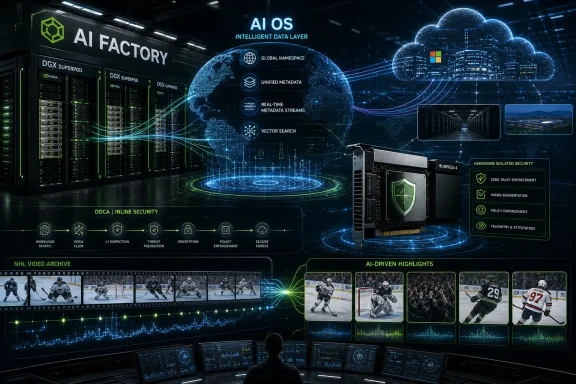 VAST Is Selling the Boring Layer That AI Suddenly Cannot Ignore
The past two years of AI infrastructure marketing have been dominated by GPUs, model weights, and spectacular claims about agentic systems. Storage, metadata, governance, and data movement were treated as plumbing — essential, expensive, and best discussed after the demo worked. VAST Data’s current campaign is an attempt to invert that hierarchy.The company’s core argument is that large-scale AI has moved from experimentation into production, and production punishes fragmentation. Training data, inference context, retrieval pipelines, audit logs, video archives, genomics files, and enterprise records do not live neatly in one place. They sprawl across clouds, data centers, edge sites, and legacy systems, and the more ambitious the AI workload becomes, the more visible that sprawl gets.
That is why VAST’s language has shifted from storage to AI operating system. The term is grandiose, and IT buyers should always squint at vendor claims that turn nouns into platforms. But beneath the branding is a concrete bet: whoever controls the high-performance data layer may control a larger slice of the AI infrastructure stack than traditional storage vendors have historically captured.
For WindowsForum readers, the relevant comparison is not a new SSD benchmark or another NAS refresh. It is the familiar enterprise pattern where a seemingly peripheral layer becomes strategic because everything above it depends on it. Identity did that. Observability did that. Now data infrastructure is trying to do the same under the pressure of GPU economics.
The AI Factory Pitch Turns Storage Into a Compute Problem
The phrase “AI factory” has become one of the industry’s favorite metaphors because it compresses a complex infrastructure problem into something executives can visualize. Data enters. Models train or reason. Outputs emerge. Capacity is measured not only in terabytes or FLOPS, but in throughput, utilization, and repeatability.VAST is leaning into that metaphor by tying its platform to NVIDIA DGX SuperPOD designs and the broader NVIDIA ecosystem. The pitch is that enterprises should not assemble AI infrastructure as a science project, stitching compute, storage, networking, retrieval, vector search, and governance together by hand. They should buy something closer to a validated plant design.
That is strategically useful for VAST because it moves the sales conversation away from storage procurement and toward infrastructure architecture. In a classic storage bake-off, the questions are cost per terabyte, IOPS, resilience, and support. In an AI factory conversation, the questions become GPU utilization, model throughput, data locality, metadata quality, and time to production.
This distinction matters because GPUs are the most visible cost center in modern AI deployments. If expensive accelerators sit idle waiting on data, the storage layer stops being a back-office commodity. It becomes part of the financial model for the entire AI initiative.
VAST’s most eye-catching performance framing addresses that point directly. The company has promoted scenarios where recomputation that might take more than a minute on GPUs can be replaced by a storage fetch measured in seconds. The details of workload, cache behavior, and architecture matter enormously, but the underlying theme is credible: as context windows grow and inference workloads become more stateful, where intermediate data lives can determine how efficiently the system runs.
NVIDIA Gives the Pitch Its Sharpest Edge
The most consequential part of VAST’s announcement cluster is its alignment with NVIDIA’s Vera BlueField-4 STX and DOCA security stack. NVIDIA is not merely the GPU vendor in this story; it is increasingly defining what the rest of the AI data center is supposed to look like. When NVIDIA says storage needs acceleration, isolation, and programmability, storage vendors have every reason to adapt their roadmaps accordingly.BlueField has long been NVIDIA’s way of moving infrastructure work off the host CPU and into a data processing unit. In the AI context, that matters because the CPU path can become a choke point for data movement, security enforcement, and networking. The more work that can be handled close to the data plane, the more the GPU complex can focus on the thing buyers actually paid for.
VAST’s zero-trust AI data framework builds on that logic. By integrating VAST AI OS with NVIDIA Vera BlueField-4 STX and DOCA, the company is pitching hardware-isolated boundaries, inline policy enforcement, and real-time observability for AI workloads. This is not just about keeping a file share private. It is about managing access to data, agent memory, and context in systems that may operate continuously and semi-autonomously.
That is a timely concern. The security conversation around generative AI has moved beyond prompt injection as a parlor trick and toward the more serious problem of persistent agent state. If an AI agent can retrieve documents, remember prior interactions, invoke tools, and act across workflows, then the boundary between application security and data security gets blurry very quickly.
VAST’s framing is that the storage layer can become an enforcement point for that new risk model. It is a plausible argument, though not yet a universally proven one. Enterprises will want to see how policy definition, logging, identity integration, and incident response work in messy production environments before accepting any vendor’s claim that it has solved zero-trust AI.
Azure Makes the Hybrid Story More Than a Footnote
The Microsoft Azure angle gives VAST’s pitch another kind of credibility. Most enterprises will not build AI infrastructure in a single pristine environment. They will train in one location, infer in another, retain regulated data in a third, and burst into cloud capacity when procurement or demand makes on-premises expansion impractical.VAST DataSpace is aimed at that problem. The idea is a high-throughput data layer and global namespace that can make distributed data feel more coherent to AI workloads. In plain English, VAST is trying to reduce the penalty organizations pay when their data does not sit conveniently beside their GPUs.
That aligns with Microsoft’s broader cloud strategy. Azure has spent years positioning itself as the enterprise-friendly AI cloud, especially for organizations already invested in Microsoft identity, security, productivity, and developer tooling. But Azure’s AI story still depends on moving data through pipelines that are often slower, more expensive, and more politically complicated than the model demo suggests.
If VAST can make hybrid AI data movement less painful, it gives Microsoft a cleaner answer to enterprises that are not ready to put everything in one cloud. It also gives VAST a way into accounts where Azure is already the strategic platform but where storage performance, file protocols, or data gravity remain limiting factors.
The catch is that hybrid data fabrics have been promised for decades under different names. Global namespaces, cloud bursting, tiering, caching, and distributed file access all sound simple in diagrams and become difficult under real latency, cost, consistency, and governance constraints. VAST’s opportunity is large precisely because the problem is hard.
Mistral, HyperFRAME, and the New Credibility Game
VAST’s mention of HyperFRAME Research and customers such as Mistral AI is part of a broader credibility campaign. In AI infrastructure, reference architectures and marquee names matter because buyers are trying to distinguish production-grade systems from PowerPoint ecosystems. Everyone claims to support AI. Fewer vendors can point to demanding workloads at meaningful scale.Mistral is a particularly useful name because it represents the European frontier-model ecosystem rather than a generic enterprise AI pilot. If companies building or serving serious models are using a particular data architecture, that architecture earns a different kind of attention. It does not prove the platform is right for every enterprise, but it does establish that the vendor is playing in the relevant league.
HyperFRAME Research serves a different purpose. Analyst-style validation helps translate technical claims into market language, especially for executives who need external confirmation before funding infrastructure changes. This is the normal machinery of enterprise technology adoption: benchmarks, customer logos, partner programs, analyst reports, and eventually procurement frameworks.
Still, Windows and infrastructure professionals should separate the signal from the theater. The presence of major partners does not eliminate integration work, operational complexity, or vendor lock-in. It simply raises the probability that the architecture has been tested against real pressures rather than only against synthetic demos.
The more interesting point is that VAST is not presenting these deployments as storage wins. It is presenting them as evidence that a unified data architecture is becoming a prerequisite for AI at scale. That is the argument buyers will either validate or reject over the next few budget cycles.
The NHL Reference Customer Shows Why Old Archives Are Becoming Live Assets
The National Hockey League example is effective because it is concrete. Roughly 20 petabytes of historical video is not an abstract AI workload. It is decades of footage that used to behave like an archive and now increasingly behaves like training data, retrieval material, broadcast fuel, and fan-experience substrate.Replacing or augmenting LTO tape workflows with a high-performance data platform is not simply a media modernization story. It reflects a broader change in how organizations value historical data. What was once cold storage can become active material for computer vision, highlight generation, officiating analysis, personalization, and archival search.
This is where VAST’s “storage as active infrastructure” argument lands most clearly. Tape remains excellent for durability and cost-effective long-term retention, and it is not going away. But tape is a poor fit for workflows that expect real-time or near-real-time interaction with massive datasets.
Sports leagues, film studios, broadcasters, hospitals, research labs, and public-sector agencies all have versions of the same problem. They own mountains of data accumulated before generative AI made that data newly valuable. The question is no longer whether the archive exists. The question is whether the archive can participate in modern computation without becoming an operational nightmare.
That shift creates a market opening for companies like VAST. The enterprise does not need every byte on the fastest possible storage, but it increasingly needs a way to make important historical data accessible, searchable, governed, and performant enough for AI-driven workflows.
Genomics Pushes the Platform Into Smaller, Stranger Places
VAST’s genomics messaging, including references to portable AI deployments and partners such as Oxford Nanopore Technologies, shows the other end of the spectrum. Instead of giant centralized video archives, genomics often involves specialized instruments, distributed sites, large raw datasets, and analysis pipelines that may need to operate close to where data is created.That is an important contrast. The AI infrastructure market is often discussed as though it consists only of hyperscale clusters and enormous training runs. But many valuable AI workloads live in the awkward middle: too data-intensive for ordinary enterprise storage, too specialized for generic cloud services, and too distributed for a single centralized architecture.
Genomics is a classic example because the data is scientifically rich, operationally sensitive, and frequently subject to privacy or jurisdictional constraints. Moving everything into one cloud region may be slow, expensive, or unacceptable. Running analysis where the data is generated can be more practical, but only if the local infrastructure is powerful and manageable enough.
VAST’s story here is that a unified data architecture can serve both the giant AI factory and the specialized field deployment. That is a difficult balance. Platforms that work well at massive scale often become too complex or costly for edge-like environments, while lightweight systems often fail under central data-center pressure.
If VAST can span both, it gains a strong vertical-market argument. If it cannot, the genomics message risks becoming another example of AI infrastructure vendors stretching a platform narrative across every possible use case.
Security Is Becoming the AI Infrastructure Buying Committee’s Veto
The security claims around VAST’s NVIDIA collaboration deserve special attention because they address the part of AI infrastructure that is most likely to slow deployments. Enterprises are not merely worried that models will hallucinate. They are worried that AI systems will mishandle sensitive data, retain poisoned context, execute unsafe tool calls, or expose regulated material through retrieval pipelines.That makes the data layer a natural control point. If AI systems are constantly reading, indexing, embedding, caching, and reusing enterprise data, then access control cannot be bolted on at the application layer alone. It has to follow the data through the pipeline.
VAST’s zero-trust framing speaks to that requirement. Hardware isolation via BlueField, DOCA-enabled policy enforcement, and observability into agent behavior all suggest a future where AI infrastructure is monitored and constrained closer to the metal. That is likely where the market is heading, particularly for regulated industries.
But the phrase “zero trust” has been overused almost as badly as “AI.” Buyers should ask what identity source drives the policies, how exceptions are handled, how agent actions are attributed, what logs are produced, how tampering is detected, and how the system behaves when connectivity to a policy engine fails. Zero trust is not a badge. It is a set of operational disciplines.
The real value of the VAST-NVIDIA work may be less in any single security feature and more in the architectural acknowledgement that agentic AI changes the attack surface. A chatbot that answers questions is one thing. A system that remembers, retrieves, acts, and chains tools together is another. Infrastructure vendors are now racing to prove they understand the difference.
The Missing Financials Keep the Story in the Realm of Strategic Momentum
The weakest part of VAST’s week of messaging is the absence of concrete financial detail. Customer names, partner alignments, and technical claims are useful, but they do not tell us how much revenue the company is generating from these AI infrastructure deployments, how margins look, or how quickly pilot projects are converting into durable platform commitments.That does not make the announcements empty. Private infrastructure companies often disclose selectively, and customers may be more willing to discuss architecture than spending. But the lack of financial metrics means observers should treat the news as strategic positioning rather than proof of market dominance.
This matters because the AI infrastructure market is crowded. Dell, HPE, NetApp, IBM, Nutanix, WEKA, DDN, cloud providers, and hyperscale-adjacent specialists all want a role in the same budget pool. NVIDIA partnerships are valuable, but NVIDIA’s ecosystem is intentionally broad; being listed among partners does not confer exclusivity.
VAST’s differentiation rests on the claim that its architecture unifies storage, database-like access, metadata, global namespace, and AI workflow support in a way that reduces complexity. That is a compelling message for organizations drowning in fragmented data stacks. It is also a claim that must survive procurement scrutiny, operational testing, and years of lifecycle management.
The market will judge VAST not by whether it can sound like an AI platform, but by whether customers continue expanding after the first deployment. AI infrastructure is easy to overbuy and hard to operationalize. Repeat usage is the only benchmark that ultimately matters.
Windows Shops Should Read This as a Data-Center Story, Not Just an AI Story
For Windows-heavy enterprises, the obvious temptation is to file VAST’s announcements under “AI infrastructure” and move on. That would be a mistake. The data-management pressures behind these announcements are the same ones already showing up in Microsoft-centric environments.Enterprises running Windows Server, SMB shares, SQL Server estates, Microsoft 365 archives, Azure services, identity through Entra ID, and security tooling through Microsoft Defender are all confronting the same basic question: how does existing data become usable by AI without breaking governance? The answer will not come from a model endpoint alone. It will come from architecture.
VAST’s Azure alignment is especially relevant here because many Microsoft customers will approach AI through Azure AI Foundry, Copilot-related workflows, Azure Kubernetes Service, Fabric, or custom retrieval-augmented generation systems. Those tools still need data pipelines, permissions, indexing strategies, and performance envelopes. The Microsoft front end does not eliminate the back-end data problem.
There is also a practical procurement angle. IT teams that spent years consolidating storage, modernizing backup, and rationalizing cloud spend are now being asked to support AI workloads that behave differently from classic enterprise applications. They are bursty, data-hungry, metadata-sensitive, and expensive when poorly tuned.
That is why storage vendors are trying to re-enter strategic conversations. The AI boom has made infrastructure architecture newly visible to executives, and VAST is trying to ensure that the data layer is not treated as an afterthought once the GPU order is placed.
The Fine Print Behind the AI OS Ambition
Calling a platform an AI OS is risky because it invites comparison to something far broader than storage. An operating system schedules resources, abstracts hardware, enforces security boundaries, manages state, exposes APIs, and becomes the layer developers and administrators build against. VAST clearly wants some of that conceptual territory.The company can credibly claim pieces of it. A high-performance data platform with global namespace, multi-protocol access, metadata services, and AI workflow integration is more than a disk array. If it participates in inference caching, retrieval, governance, and security enforcement, it becomes part of the runtime environment for AI applications.
But the term also raises expectations. Enterprises will want ecosystem maturity, developer interfaces, policy integration, observability, upgrade discipline, and predictable behavior across failure modes. The more central a platform becomes, the less tolerance customers have for black-box magic.
This is the paradox of VAST’s positioning. To win larger AI infrastructure budgets, it must argue that it is foundational. But the more foundational it becomes, the more buyers will examine it like critical infrastructure rather than like an accelerator for a single workload.
That scrutiny is healthy. The AI market has had too much narrative and not enough operational realism. VAST’s best chance is not to out-hype the industry, but to prove that the least glamorous parts of AI — data movement, access, caching, security, and lifecycle management — are where production success is won or lost.
The Real Test Is Whether AI Buyers Start Budgeting Around Data First
A useful way to read VAST’s announcements is as a campaign to change budget sequencing. In the first wave of generative AI adoption, many organizations started with models, then GPUs, then application prototypes, and only later confronted data architecture. VAST is arguing that this order is backwards.There is evidence the market is moving in that direction. As enterprises shift from chatbots to agents, from pilots to workflows, and from static retrieval to continuously updated context, the data layer becomes harder to postpone. AI systems need clean access, reliable performance, fine-grained permissions, and governance that survives scale.
That does not mean every enterprise needs a VAST-scale deployment. Many organizations are still better served by simpler architectures, managed cloud services, or narrower retrieval systems. Not every AI project is an AI factory, and vendors have a financial incentive to make every customer feel as though it is building one.
But for organizations with petabytes of active data, regulated workflows, large media archives, genomics pipelines, or serious GPU clusters, the storage conversation is changing. The question is no longer “where do we put the data?” It is “how does the data participate in computation safely and fast enough to justify the AI spend?”
VAST’s week of announcements should be understood as an answer to that second question. Whether it is the best answer will depend on workload, scale, integration, and cost. But the question itself is becoming unavoidable.
The Week’s Signal Beneath VAST’s Platform Noise
VAST’s announcements are best read as one coordinated argument: enterprise AI is becoming a data infrastructure problem before it becomes an application problem. The company’s NVIDIA, Azure, NHL, genomics, and AI factory messaging all point to that same conclusion, even when the marketing language stretches.- VAST is trying to move buyer perception from storage vendor to AI infrastructure platform, with its AI OS branding doing much of that repositioning work.
- The NVIDIA collaboration matters because BlueField-4 STX and DOCA put security, isolation, and data movement closer to the AI infrastructure layer.
- The Azure alignment gives VAST a stronger hybrid-cloud story for enterprises that need AI workloads to span on-premises and cloud environments.
- The NHL deployment is the clearest example of cold archives becoming active AI assets, especially for video-heavy organizations.
- The genomics messaging shows VAST chasing specialized, distributed AI use cases rather than only centralized hyperscale clusters.
- The absence of disclosed financial metrics means the news proves strategic momentum more than commercial dominance.
References
- Primary source: TipRanks
Published: 2026-06-06T14:49:11.196620
VAST Data Expands AI Infrastructure Footprint With NVIDIA, Azure and New Flagship Deployments - TipRanks.com
VAST Data entered the week emphasizing its role as a core infrastructure layer for large-scale AI, citing HyperFRAME Research and collaborations such as Mistral AI ...www.tipranks.com
- Related coverage: vastdata.com
VAST Data’s Zero Trust Framework for Agentic AI
VAST Data’s Zero Trust Framework for Agentic AI - Enhanced with NVIDIA STX and DOCA Securitywww.vastdata.com - Related coverage: nvidianews.nvidia.com
NVIDIA Vera BlueField-4 STX Brings Agentic AI Storage Processing With In-Silicon Security | NVIDIA Newsroom
NVIDIA today announced new NVIDIA DOCA™ security innovations for NVIDIA Vera BlueField-4 STX, defining a new class of secure-by-design storage for agentic AI factories.nvidianews.nvidia.com - Related coverage: nvidia.com
NVIDIA DOCA: Software Platform for Agentic AI Infrastructure
Accelerate your AI infrastructure with NVIDIA DOCA, the unified software platform for DPU software, AI-native storage, and runtime security on BlueField and ConnectX.www.nvidia.com - Related coverage: akamai.com
Akamai Brings Security Inside AI Factories with NVIDIA | Akamai
Akamai is collaborating with NVIDIA to bring an advanced security architecture into AI factories — the foundation of the agentic era.www.akamai.com - Related coverage: developer.nvidia.com
DOCA Software Framework | NVIDIA Developer | NVIDIA Developer
Create applications and services on top of NVIDIA BlueField DPUs to program future data center infrastructure.developer.nvidia.com
- Related coverage: tomshardware.com
Nvidia launches BlueField-4 STX storage architecture for agentic AI at GTC 2026 | Tom's Hardware
Eight cloud providers have committed to early adoption.www.tomshardware.com - Related coverage: vast.ai
Rent GPUs | Vast.ai
Rent high-performance cloud GPUs at low cost with Vast.ai. Instantly deploy GPU rentals for AI, machine learning, deep learning, and rendering. Flexible pricing, fast setup, and global availability vast.ai
- Official source: marketplace.microsoft.com
Microsoft Marketplace | cloud solutions, AI apps, and agents
marketplace.microsoft.com
- Related coverage: techtarget.com
Vast Data, Nvidia collaborate on new AI architecture | TechTarget
Vast Data utilizes Nvidia DPUs to more efficiently connect to its storage. It's also now partnering with Supermicro.www.techtarget.com - Related coverage: assets.ctfassets.net
- Official source: cdn-dynmedia-1.microsoft.com
The Next Wave of AI Innovation: Microsoft Introduces Azure AI Foundry, A New Unified AI, and GenAI Platform at Ignite 2024
PDF documentcdn-dynmedia-1.microsoft.com
