

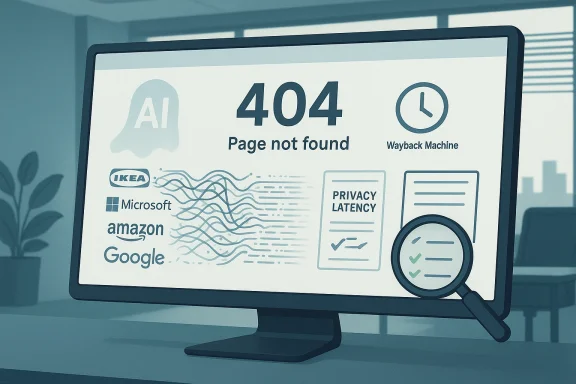
When a reader clicks a link and lands on a “We couldn’t find that page” message, it’s easy to shrug and move on—but every missing page is a small story about the way the web, vendors, and the fast-moving world of AI communicate (and sometimes fail to). The Goodcall page at /voice-ai/ai-like-chatgpt appears to be one of those missing pages, and its absence exposes wider issues about how voice‑AI claims are published, verified, and preserved—from vendor marketing and SEO strategies to technical claims that require cross‑checking with primary documentation and independent testing.
The rise of voice‑first AI features—voice chat, real‑time speech agents, and text‑to‑speech personalization—has grown into a crowded landscape where vendors race to publish how their products compare with GPT‑style chat systems. At the same time, the pace of product launches, iterative marketing, and content churn means vendor pages often change, move, or disappear entirely. That creates a gap between the claim (an attractive headline: “AI like ChatGPT”) and the verifiable technical truth readers need to evaluate it.
What’s important for Windows users, IT teams, and journalists is not just the promotional headline but the underlying technical claims, governance guarantees, and demonstrable performance. In several recent enterprise examples, vendors have combined managed realtime voice APIs, speech preprocessing, model selection, and TTS/voice customization to create production voice agents—but the details matter and are verifiable only when documentation or independent testing is available.
Because the page is not available, any specific technical or marketing claims that may have been on it must be treated as unverified unless they can be cross‑checked against separate vendor documentation, archived copies, or third‑party reviews. That is the baseline discipline for responsible reporting and decision‑making.
Why this matters: an honest vendor comparison with “ChatGPT‑style” systems should clarify whether the offering is:
In short, a missing Goodcall page is more than a broken link: it’s a reminder that fast‑moving AI marketing must be matched by durable documentation and independent verification. For readers and IT decision makers, the path forward is clear—demand technical evidence, cross‑check claims against developer docs and third‑party tests, and treat vanished pages as a signal to probe rather than an end of the inquiry. The voice‑AI era brings real possibilities for accessibility and productivity, but it requires correspondingly higher standards of technical transparency and governance before it can be trusted at scale.
Source: Goodcall https://www.goodcall.com/voice-ai/ai-like-chatgpt/
 Background / Overview
The rise of voice‑first AI features—voice chat, real‑time speech agents, and text‑to‑speech personalization—has grown into a crowded landscape where vendors race to publish how their products compare with GPT‑style chat systems. At the same time, the pace of product launches, iterative marketing, and content churn means vendor pages often change, move, or disappear entirely. That creates a gap between the claim (an attractive headline: “AI like ChatGPT”) and the verifiable technical truth readers need to evaluate it.What’s important for Windows users, IT teams, and journalists is not just the promotional headline but the underlying technical claims, governance guarantees, and demonstrable performance. In several recent enterprise examples, vendors have combined managed realtime voice APIs, speech preprocessing, model selection, and TTS/voice customization to create production voice agents—but the details matter and are verifiable only when documentation or independent testing is available.
What likely happened to the Goodcall page — and why it matters
There are four common reasons a vendor page like Goodcall’s “AI like ChatGPT” might vanish:- The content was moved or reorganized during a site redesign (common when marketing teams relabel product categories).
- The post was published prematurely and then pulled to avoid technical inaccuracies or legal exposure.
- SEO-driven content was deleted after it underperformed or after the vendor changed positioning.
- The page was intentionally removed because the product claim was no longer supportable (for example, a promised voice feature didn’t meet latency or privacy requirements).
Because the page is not available, any specific technical or marketing claims that may have been on it must be treated as unverified unless they can be cross‑checked against separate vendor documentation, archived copies, or third‑party reviews. That is the baseline discipline for responsible reporting and decision‑making.
What the missing Goodcall page might have covered — the current voice‑AI landscape
Even though the Goodcall page is offline, we can still place its implied premise—“AI like ChatGPT” for voice—into the current ecosystem to explain what such a claim would entail and how to verify it.Microsoft and enterprise realtime voice stacks
Modern enterprise voice assistants increasingly rely on managed realtime platforms that combine ASR, low‑latency generative models, and TTS. Microsoft’s Voice Live API is a representative example: it exposes bidirectional realtime audio (WebSocket/WebRTC friendly), audio preprocessing (noise suppression, echo cancellation, end‑of‑turn detection), selectable generative models (realtime‑optimized vs large models), and TTS/voice customization—all designed for production integrations where compliance and scale matter. These capabilities are not vague marketing copy; they’re the kinds of features documented in developer materials and customer case stories.Why this matters: an honest vendor comparison with “ChatGPT‑style” systems should clarify whether the offering is:
- A text‑first model with voice wrappers (text input/output converted to/from speech), or
- A true realtime speech‑to‑speech pipeline built on models optimized for conversational latency and interruption handling.
Consumer voice modes: ChatGPT, Gemini, Grok and others
On the consumer side, multiple players have introduced voice modes that turn their chat assistants into talkative partners. Differences show up in how these assistants manage clarifying questions, pacing, and turn management.- ChatGPT’s mobile and advanced voice modes offer polished voice synthesis and multiple named voices, but reviewers have noted a tendency toward long, self‑contained replies rather than continuous back‑and‑forth.
- Google’s Gemini Live is notable for asking clarifying questions and maintaining conversational drive—an experience some reviewers described as more “dialogue” than monologue.
- xAI’s Grok (and other entrants) emphasize rapid search integration or “deep search” features and plan voice modes that blend real‑time web grounding with conversation—yet these integrations vary in availability and capability across platforms.
New consumer tools and novelty voice apps
A parallel wave of consumer apps (voice changers, on‑device transformation tools) claim “no latency” or on‑device processing. Products like iTop Voicy position themselves for streamers and creators with free Windows‑only apps that promise low‑latency transformation and large voice libraries, but independent testing is often limited at launch, and vendor privacy practices need careful review. When a vendor page makes bold claims like “studio‑quality, instant voice transformation,” readers should ask for:- independent benchmarks,
- clear statements about on‑device vs cloud inference, and
- a privacy whitepaper describing telemetry and model training guarantees.
How to treat vendor claims that compare to “ChatGPT” (a verification checklist)
When a marketing page claims its voice product is “AI like ChatGPT” or “ChatGPT‑level conversational,” apply this structured verification approach:- Look for the technical architecture: is there an API reference showing realtime endpoints, model selection, or ASR/TTS pipelines? If not, flag it.
- Confirm model types and latency expectations: does the product use realtime‑optimized models or larger offline models? Are latency numbers documented?
- Check privacy and training guarantees: does the vendor commit to non‑training on customer transcripts, provide data residency options, or offer enterprise contractual terms? Enterprise-grade stacks often disclose these options.
- Seek independent testing or third‑party reviews: launch press kits are useful but insufficient. Independent reviews highlight conversational style (follow‑ups vs monologues), interruption handling, and transcript fidelity.
- Ask for usage metrics that matter: active user numbers are headline‑friendly, but what matters operationally are response time percentiles, error rates across accents, and cost per session. Vendor stories often provide engagement metrics; verify them where possible.
The technical and governance risks you should watch for
Voice AI blurs several operational risk lines that text chat does not, and these are precisely the areas where missing documentation or deleted pages are most dangerous.- Privacy and telemetry: voice sessions generate raw audio, transcripts, and metadata. Without clear contractual limits on retention and training, customer audio can become a training signal for models. Vendor claims of “on‑device processing” or “no training on customer data” must be evidenced by contractual terms or whitepapers.
- Bias and ASR robustness: voice interfaces can underperform for accents, dialects, or noisy environments. A product that glosses over this without benchmark data should be treated cautiously. Real‑world deployments highlight the importance of noise suppression, voice activity detection, and accent‑aware ASR.
- Regulatory and legal exposure: speech data in regulated sectors (health, finance) may be subject to stricter controls. Banking or fintech voice agents must embed confirmations, identity verification, and auditable flows; marketing claims that skip these details are red flags.
- Hallucination risk and grounding: spoken explanations that sound confident but are ungrounded are especially dangerous in voice. Tools that support function calling, retrieval‑augmented generation, and inline grounding lower hallucination risk—look for these features in technical docs.
Why link rot and content churn create systemic problems for trust and SEO
The disappearance of a vendor page doesn’t just inconvenience users; it affects evidence chains:- Journalists and researchers who cited the page must either retract or re‑verify the claims, a nontrivial editorial cost.
- Search engines will still index fragments or cached copies; those partial snapshots can propagate outdated or false claims.
- For enterprises performing vendor due diligence, the absence of documentation raises procurement speed bumps and compliance concerns.
- keep canonical redirects in place when moving content,
- archive important technical articles and whitepapers in static formats,
- and maintain backward‑compatible URLs or at least server redirects to avoid breaking external citation chains.
Practical steps readers and admins can take right now
If you encounter a missing vendor page that you need to evaluate:- Check archived sources (web archives) and cached search snapshots to recover the original wording.
- Ask the vendor for a product datasheet or API docs; insist on model names, latency metrics, and data handling guarantees.
- Cross‑reference claims with developer or partner messages (case studies often live on partner sites).
- Prioritize hands‑on testing focused on the features that matter for your scenario (latency, ASR accuracy across accents, integration with existing identity/graph services).
- Use the verification checklist above before any procurement or integration.
How journalists and technical writers should report on disappearing product pages
Missing pages demand transparency. Best practices include:- Mark any claims that rely on vanished pages as unable to verify unless corroborated by separate documents.
- Cite the remaining, verifiable sources (API docs, official blogs, partner case studies) and highlight where gaps remain.
- Preserve copies of vendor claims in your editorial archive when you publish, with timestamps and screenshots where allowed.
- When possible, obtain vendor comment about the content change and include that in your story to avoid one‑sided conclusions.
Final analysis: strengths, caveats, and the responsible posture for Windows users
Strengths to celebrate in the voice‑AI space:- Real‑time voice APIs and managed services have matured to the point where production voice agents are practical for high‑volume services. Features like realtime audio, model selection, and TTS customization can make voice assistants both inclusive and operationally efficient.
- Consumer voice modes are improving conversational dynamics: some assistants now ask clarifying questions and support voice‑first workflows that are genuinely useful on phones and desktops.
- Marketing language frequently compresses complex tradeoffs (latency vs capability, cloud vs on‑device) into simple slogans. A deleted or missing page removes the ability to interrogate those tradeoffs publicly.
- Privacy, regulatory, and hallucination risks are amplified with voice. Firms and users must insist on contractual protections and independent verification before deploying sensitive voice workflows.
- Treat a missing Goodcall page as a prompt to verify, not assume. Seek product docs, partner case studies, and independent tests before concluding a product is “ChatGPT‑like.” Use the verification checklist and insist on auditable, contractual guarantees where data sensitivity or regulatory risk is present.
In short, a missing Goodcall page is more than a broken link: it’s a reminder that fast‑moving AI marketing must be matched by durable documentation and independent verification. For readers and IT decision makers, the path forward is clear—demand technical evidence, cross‑check claims against developer docs and third‑party tests, and treat vanished pages as a signal to probe rather than an end of the inquiry. The voice‑AI era brings real possibilities for accessibility and productivity, but it requires correspondingly higher standards of technical transparency and governance before it can be trusted at scale.
Source: Goodcall https://www.goodcall.com/voice-ai/ai-like-chatgpt/
