

Vestel Elektronik Sanayi ve Ticaret A.Ş., the Turkish consumer electronics and white-goods manufacturer listed on Borsa Istanbul under VESTL with ISIN TREVEST00017, remains a strategically important regional producer in 2026 because its fortunes sit at the intersection of exports, currency pressure, European demand and manufacturing scale. The latest automatically generated market brief from Ad Hoc News captures the broad investor narrative: this is not merely a television maker, but a proxy for Turkey’s attempt to turn industrial capacity into durable export relevance. The harder question is whether scale still protects Vestel in a world where margins are squeezed from every direction. For investors and industry watchers, Vestel is a useful reminder that manufacturing heft is not the same thing as pricing power.
Vestel is often described in shorthand as an electronics company, but that undersells its role. Its business spans brown goods such as televisions and electronics, white goods through related manufacturing operations, and newer areas tied to mobility and connected products. The company’s official investor materials place its production facilities in Manisa and the İzmir Aegean Free Zone, tying the group closely to Turkey’s export-oriented industrial base.
That geography matters. Turkey sits close enough to Europe, the Middle East and North Africa to make delivery times and logistics flexibility part of the pitch. In a sector where shipping bulky appliances across oceans can erase cost advantages, proximity is not a footnote; it is one of Vestel’s core arguments.
The Ad Hoc News overview frames Vestel as a regional manufacturer shaped by demand cycles, currency movements and global supply-chain shifts. That is a fair starting point, but the phrase “regional manufacturer” can make the company sound smaller than its industrial footprint. Vestel is not a niche assembler waiting for orders; it is a large-scale producer whose model depends on running factories efficiently, filling capacity and keeping export channels open.
The company’s long-term narrative therefore lives in a tension familiar to many emerging-market manufacturers. A weaker domestic currency can help exports, but it can also raise the cost of imported components, foreign-currency debt and capital equipment. Domestic inflation can lift nominal revenue while clouding the real picture. Export growth can impress investors, but only if it converts into cash and margin rather than just volume.
That breadth gives Vestel options. Televisions, household appliances and related electronics move through different demand cycles, and a manufacturer with multiple categories can shift emphasis as markets change. In theory, that helps reduce dependence on any one product line.
But scale can also become a trap. Large factories need volume, and volume-driven businesses are vulnerable when demand softens. If retailers destock, if European consumers postpone appliance purchases, or if competitors cut prices, a company built for high throughput can quickly feel pressure on utilization.
This is why the company’s outlook cannot be judged only by whether it makes popular products. The more important question is whether Vestel can keep its production base loaded without sacrificing profitability. In consumer electronics, the distance between “efficient exporter” and “low-margin contract manufacturer” can be uncomfortably narrow.
This is a powerful position when Europe is growing or when supply-chain disruptions encourage buyers to diversify away from longer Asian routes. A Turkish supplier can offer proximity, shorter lead times and flexible manufacturing. That combination is attractive to retailers and brands that do not want every product decision exposed to transcontinental shipping delays.
But Europe is also a demanding market. Energy-efficiency rules, product-safety standards, sustainability expectations and price competition all raise the bar. A manufacturer selling into Europe must be compliant, reliable and cost-competitive at the same time.
The strategic irony is that Europe can validate Vestel’s industrial model while also exposing its weaknesses. If Vestel can win profitable business there, it proves its relevance. If it wins only by taking thin-margin volume, Europe becomes less a growth engine than a treadmill.
The TV market has changed. Screen size, panel quality and price still matter, but consumers increasingly expect smart interfaces, app compatibility, voice control, streaming integration and regular software support. A television is now a display, a computing device and a gateway to services.
That shift favors companies that can integrate hardware and software smoothly. It also raises the competitive bar for manufacturers that historically won on production cost and distribution partnerships. Reliability still matters, but user experience has become part of the product.
Vestel’s challenge is not merely to assemble televisions efficiently. It must participate in a value chain where operating systems, content platforms and semiconductor availability can shape customer perception. That makes partnerships and software capability more important than they once were.
Still, appliances are not immune to pressure. Housing markets, interest rates and consumer confidence influence purchases. Energy-efficiency regulation can force redesigns and capital spending. Input costs for steel, plastics, motors and electronics can move margins quickly.
The white-goods business also demands brand trust. Consumers may replace a television because a new feature looks attractive, but they replace a refrigerator because the old one fails, the household changes or energy savings justify the cost. That makes service networks and product durability part of the competitive equation.
Vestel’s opportunity is to use its manufacturing base to serve multiple brands, regions and price points. Its risk is that appliances, like TVs, can turn into a contest of scale and discounting if differentiation remains weak.
That creates a complicated margin picture. Revenue translated from exports can look stronger in lira terms, while imported inputs become more expensive. Inflation can distort year-on-year comparisons. Working capital can become more expensive as interest rates rise.
This is why investors should be careful with headline revenue growth. In a high-inflation and volatile-currency environment, nominal growth can hide real pressure. Cash generation, debt structure, financing costs and gross margin trends become more revealing than sales alone.
The company’s 2025 financial reporting, as summarized by financial data providers and investor sources, points to a tougher recent period than the generic sector story implies. StockAnalysis, using S&P Global Market Intelligence data, showed revenue falling in fiscal 2025 from the prior year, with Europe and Turkey both down in reported terms. That does not settle the long-term debate, but it does puncture any easy assumption that export exposure automatically means growth.
Vestel’s recent financial profile has drawn market attention for that reason. Ad Hoc News and market data sites have described volatility in the shares, while Turkish market commentary has focused on losses and financing pressure. Some social-media posts and forum chatter go further, but those should be treated as market sentiment rather than verified reporting.
The more reliable point is simpler: capital-intensive manufacturing is unforgiving when cash conversion weakens. A company can sell large volumes and still feel pressure if receivables stretch, inventories build or input costs rise before customers pay. That is especially true in export-heavy businesses where currency timing matters.
Investors looking at Vestel should therefore resist the temptation to treat the company as a pure “Turkey export play.” It is also a working-capital story, a credit story and a margin story. The factories are the visible asset; the financing cycle is the hidden machinery.
But private-label manufacturing has a ceiling. The customer relationship often belongs to the retailer or brand partner, not the factory. Pricing power may be limited, and a manufacturer can become interchangeable if competitors can match cost and quality.
This is the strategic crossroads for companies like Vestel. Scale manufacturing keeps the company in the game, but brand strength, product design, software capability and after-sales service determine how much value it can keep. The more Vestel can move from “efficient producer” to “trusted product platform,” the more durable its margins become.
That does not mean the company should abandon manufacturing partnerships. It means those partnerships need to be part of a broader portfolio, not the whole identity. In consumer electronics, being the factory behind someone else’s shelf presence is useful; being able to command attention under your own name is better.
Still, global giants shape the environment. Semiconductor roadmaps affect display performance and connected-device features. Software ecosystems change what consumers expect from smart TVs and appliances. Marketing by premium brands raises the standard for design, interface quality and sustainability claims.
Regional manufacturers then have to decide where to follow and where to differentiate. Trying to match every premium feature can be expensive and unrealistic. Ignoring technology shifts can make products look dated.
Vestel’s best strategic lane is likely not to out-innovate the biggest global technology companies. It is to convert selected innovations into affordable, compliant, regionally relevant products at scale. That is less glamorous than platform dominance, but it can be valuable if executed with discipline.
This matters commercially. A product that misses regulatory expectations does not simply suffer reputational damage; it may lose market access. A product that performs well on energy consumption can become easier to sell in markets where electricity costs are high and efficiency labels influence purchasing decisions.
For manufacturers, regulation can be a burden and a barrier to entry at the same time. Compliance requires investment, testing and documentation. But once a company has built those capabilities, they can become a competitive advantage against smaller or less sophisticated rivals.
Vestel’s export orientation makes this unavoidable. If Europe remains a key market, regulatory competence is not optional. It is part of the product.
For a company like Vestel, digital channels create both an opening and a threat. The opening is that brands can reach customers more directly and tell a more complete story about features, energy efficiency and service. The threat is that online comparison reduces products to price, star rating and availability.
Traditional retail partnerships still matter, especially for large appliances where installation and service are important. But digital visibility increasingly shapes the first impression. A manufacturer that cannot manage online product presentation risks losing the sale before a customer ever visits a store.
Vestel’s move toward broader European online presence, referenced in its corporate materials, fits this shift. The challenge is execution. Digital channels do not magically improve margins; they expose whether the brand proposition is strong enough to stand on its own.
The skeptical case is just as real. The company operates in competitive, margin-sensitive categories. It faces currency volatility, financing pressure, input-cost swings and demanding export markets. Its long-term role may be strategically important without being consistently lucrative for shareholders.
That distinction matters. A company can be industrially important and still be a difficult equity story. National manufacturing champions often carry strategic relevance, but public-market investors need earnings, cash flow and returns on capital.
Vestel’s outlook therefore depends less on whether televisions and appliances remain necessary. They will. It depends on whether Vestel can produce them profitably enough, finance the cycle safely enough and differentiate the product mix meaningfully enough to avoid being trapped in the low-margin middle.
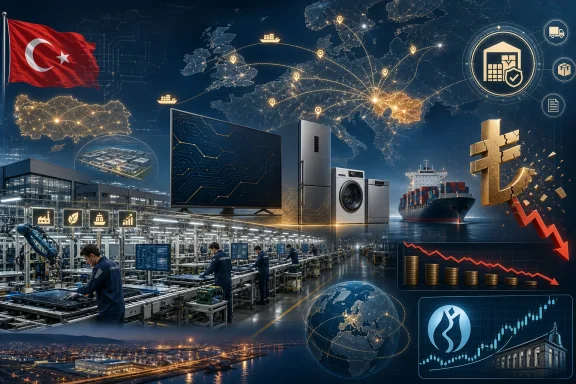 Vestel’s Story Is Really Turkey’s Industrial Bet in Miniature
Vestel is often described in shorthand as an electronics company, but that undersells its role. Its business spans brown goods such as televisions and electronics, white goods through related manufacturing operations, and newer areas tied to mobility and connected products. The company’s official investor materials place its production facilities in Manisa and the İzmir Aegean Free Zone, tying the group closely to Turkey’s export-oriented industrial base.That geography matters. Turkey sits close enough to Europe, the Middle East and North Africa to make delivery times and logistics flexibility part of the pitch. In a sector where shipping bulky appliances across oceans can erase cost advantages, proximity is not a footnote; it is one of Vestel’s core arguments.
The Ad Hoc News overview frames Vestel as a regional manufacturer shaped by demand cycles, currency movements and global supply-chain shifts. That is a fair starting point, but the phrase “regional manufacturer” can make the company sound smaller than its industrial footprint. Vestel is not a niche assembler waiting for orders; it is a large-scale producer whose model depends on running factories efficiently, filling capacity and keeping export channels open.
The company’s long-term narrative therefore lives in a tension familiar to many emerging-market manufacturers. A weaker domestic currency can help exports, but it can also raise the cost of imported components, foreign-currency debt and capital equipment. Domestic inflation can lift nominal revenue while clouding the real picture. Export growth can impress investors, but only if it converts into cash and margin rather than just volume.
Scale Buys Relevance, Not Immunity
Vestel’s scale is the reason investors pay attention. The group has long marketed itself around large manufacturing capacity, broad product coverage and the ability to supply both branded and partner products. Its annual reports and investor communications emphasize production, logistics, automation, design and export reach rather than a single blockbuster product.That breadth gives Vestel options. Televisions, household appliances and related electronics move through different demand cycles, and a manufacturer with multiple categories can shift emphasis as markets change. In theory, that helps reduce dependence on any one product line.
But scale can also become a trap. Large factories need volume, and volume-driven businesses are vulnerable when demand softens. If retailers destock, if European consumers postpone appliance purchases, or if competitors cut prices, a company built for high throughput can quickly feel pressure on utilization.
This is why the company’s outlook cannot be judged only by whether it makes popular products. The more important question is whether Vestel can keep its production base loaded without sacrificing profitability. In consumer electronics, the distance between “efficient exporter” and “low-margin contract manufacturer” can be uncomfortably narrow.
Europe Is the Opportunity and the Risk
Vestel’s export exposure is central to its identity. In its 2024 integrated annual report, the company reported an export ratio of 63 percent and showed Europe as its largest regional revenue contributor, ahead of Turkey and other markets. That tells us where the strategic center of gravity lies: Vestel’s future is tied not only to Turkish shoppers, but to the health of European retail channels and appliance demand.This is a powerful position when Europe is growing or when supply-chain disruptions encourage buyers to diversify away from longer Asian routes. A Turkish supplier can offer proximity, shorter lead times and flexible manufacturing. That combination is attractive to retailers and brands that do not want every product decision exposed to transcontinental shipping delays.
But Europe is also a demanding market. Energy-efficiency rules, product-safety standards, sustainability expectations and price competition all raise the bar. A manufacturer selling into Europe must be compliant, reliable and cost-competitive at the same time.
The strategic irony is that Europe can validate Vestel’s industrial model while also exposing its weaknesses. If Vestel can win profitable business there, it proves its relevance. If it wins only by taking thin-margin volume, Europe becomes less a growth engine than a treadmill.
The Television Business Is No Longer Just Hardware
Televisions remain the most intuitive way to understand Vestel. They combine panel sourcing, assembly scale, design, software integration and retail positioning in one visible product category. The Ad Hoc News article correctly treats televisions as representative of the company’s model, because TVs show both Vestel’s manufacturing strengths and the limits of manufacturing alone.The TV market has changed. Screen size, panel quality and price still matter, but consumers increasingly expect smart interfaces, app compatibility, voice control, streaming integration and regular software support. A television is now a display, a computing device and a gateway to services.
That shift favors companies that can integrate hardware and software smoothly. It also raises the competitive bar for manufacturers that historically won on production cost and distribution partnerships. Reliability still matters, but user experience has become part of the product.
Vestel’s challenge is not merely to assemble televisions efficiently. It must participate in a value chain where operating systems, content platforms and semiconductor availability can shape customer perception. That makes partnerships and software capability more important than they once were.
White Goods Offer Stability, but Not an Easy Escape
Household appliances can look more stable than consumer electronics. Refrigerators, washing machines, ovens and dishwashers are replacement-driven categories, and customers tend to care about reliability, energy efficiency and after-sales service. For a manufacturer like Vestel, white goods can provide a useful counterweight to the sharper price cycles of televisions.Still, appliances are not immune to pressure. Housing markets, interest rates and consumer confidence influence purchases. Energy-efficiency regulation can force redesigns and capital spending. Input costs for steel, plastics, motors and electronics can move margins quickly.
The white-goods business also demands brand trust. Consumers may replace a television because a new feature looks attractive, but they replace a refrigerator because the old one fails, the household changes or energy savings justify the cost. That makes service networks and product durability part of the competitive equation.
Vestel’s opportunity is to use its manufacturing base to serve multiple brands, regions and price points. Its risk is that appliances, like TVs, can turn into a contest of scale and discounting if differentiation remains weak.
Currency Can Help the Exporter and Hurt the Manufacturer
For a Turkish industrial company, currency is not background noise. It is part of the business model. A weaker lira can make Turkish-made goods more attractive to foreign buyers, especially when costs are locally denominated. But many key components, technologies and financing obligations are tied directly or indirectly to hard currencies.That creates a complicated margin picture. Revenue translated from exports can look stronger in lira terms, while imported inputs become more expensive. Inflation can distort year-on-year comparisons. Working capital can become more expensive as interest rates rise.
This is why investors should be careful with headline revenue growth. In a high-inflation and volatile-currency environment, nominal growth can hide real pressure. Cash generation, debt structure, financing costs and gross margin trends become more revealing than sales alone.
The company’s 2025 financial reporting, as summarized by financial data providers and investor sources, points to a tougher recent period than the generic sector story implies. StockAnalysis, using S&P Global Market Intelligence data, showed revenue falling in fiscal 2025 from the prior year, with Europe and Turkey both down in reported terms. That does not settle the long-term debate, but it does puncture any easy assumption that export exposure automatically means growth.
The Balance Sheet Is Where the Sector Story Gets Real
A manufacturer can have great products and still struggle if its balance sheet is stretched. Factories, inventories, receivables, supplier obligations and capital expenditure all require financing. When rates are high and demand is uneven, financial structure becomes as important as operational skill.Vestel’s recent financial profile has drawn market attention for that reason. Ad Hoc News and market data sites have described volatility in the shares, while Turkish market commentary has focused on losses and financing pressure. Some social-media posts and forum chatter go further, but those should be treated as market sentiment rather than verified reporting.
The more reliable point is simpler: capital-intensive manufacturing is unforgiving when cash conversion weakens. A company can sell large volumes and still feel pressure if receivables stretch, inventories build or input costs rise before customers pay. That is especially true in export-heavy businesses where currency timing matters.
Investors looking at Vestel should therefore resist the temptation to treat the company as a pure “Turkey export play.” It is also a working-capital story, a credit story and a margin story. The factories are the visible asset; the financing cycle is the hidden machinery.
Private Label Is a Strength Until It Becomes a Ceiling
Vestel’s business model has often been associated with supplying products across different brands, channels and markets. That can be a powerful strategy. Private-label and partner manufacturing can fill capacity, deepen relationships with retailers and reduce reliance on a single consumer-facing brand.But private-label manufacturing has a ceiling. The customer relationship often belongs to the retailer or brand partner, not the factory. Pricing power may be limited, and a manufacturer can become interchangeable if competitors can match cost and quality.
This is the strategic crossroads for companies like Vestel. Scale manufacturing keeps the company in the game, but brand strength, product design, software capability and after-sales service determine how much value it can keep. The more Vestel can move from “efficient producer” to “trusted product platform,” the more durable its margins become.
That does not mean the company should abandon manufacturing partnerships. It means those partnerships need to be part of a broader portfolio, not the whole identity. In consumer electronics, being the factory behind someone else’s shelf presence is useful; being able to command attention under your own name is better.
Global Giants Set the Pace Even When They Are Not Direct Peers
The Ad Hoc News article notes that large global peers listed in indices such as the S&P 500 or Nasdaq-100 can influence expectations for regional manufacturers. That observation is important, but the mechanism is indirect. Vestel is not competing with Apple or Nvidia in any straightforward sense, and it is not valued like a Silicon Valley platform company.Still, global giants shape the environment. Semiconductor roadmaps affect display performance and connected-device features. Software ecosystems change what consumers expect from smart TVs and appliances. Marketing by premium brands raises the standard for design, interface quality and sustainability claims.
Regional manufacturers then have to decide where to follow and where to differentiate. Trying to match every premium feature can be expensive and unrealistic. Ignoring technology shifts can make products look dated.
Vestel’s best strategic lane is likely not to out-innovate the biggest global technology companies. It is to convert selected innovations into affordable, compliant, regionally relevant products at scale. That is less glamorous than platform dominance, but it can be valuable if executed with discipline.
Regulation Is Becoming a Product Feature
Energy efficiency and sustainability are no longer soft corporate talking points in the appliance and electronics sector. In Europe especially, regulation increasingly shapes product design, labeling, repairability, recycling and material choices. Vestel’s own reporting has discussed product recovery, recycling and compliance with European waste electrical and electronic equipment frameworks.This matters commercially. A product that misses regulatory expectations does not simply suffer reputational damage; it may lose market access. A product that performs well on energy consumption can become easier to sell in markets where electricity costs are high and efficiency labels influence purchasing decisions.
For manufacturers, regulation can be a burden and a barrier to entry at the same time. Compliance requires investment, testing and documentation. But once a company has built those capabilities, they can become a competitive advantage against smaller or less sophisticated rivals.
Vestel’s export orientation makes this unavoidable. If Europe remains a key market, regulatory competence is not optional. It is part of the product.
The Digital Channel Changes the Manufacturer’s Bargain
E-commerce has changed how appliances and electronics are discovered, compared and bought. Consumers can compare specifications, reviews, prices and delivery options in minutes. That transparency rewards value but punishes weak differentiation.For a company like Vestel, digital channels create both an opening and a threat. The opening is that brands can reach customers more directly and tell a more complete story about features, energy efficiency and service. The threat is that online comparison reduces products to price, star rating and availability.
Traditional retail partnerships still matter, especially for large appliances where installation and service are important. But digital visibility increasingly shapes the first impression. A manufacturer that cannot manage online product presentation risks losing the sale before a customer ever visits a store.
Vestel’s move toward broader European online presence, referenced in its corporate materials, fits this shift. The challenge is execution. Digital channels do not magically improve margins; they expose whether the brand proposition is strong enough to stand on its own.
Investors Should Read the Outlook as Conditional, Not Assured
The optimistic case for Vestel is easy to articulate. It has scale, geography, export exposure, product breadth and proximity to major markets. It operates in categories that remain essential to modern households. It can benefit when buyers seek alternatives to longer Asian supply chains.The skeptical case is just as real. The company operates in competitive, margin-sensitive categories. It faces currency volatility, financing pressure, input-cost swings and demanding export markets. Its long-term role may be strategically important without being consistently lucrative for shareholders.
That distinction matters. A company can be industrially important and still be a difficult equity story. National manufacturing champions often carry strategic relevance, but public-market investors need earnings, cash flow and returns on capital.
Vestel’s outlook therefore depends less on whether televisions and appliances remain necessary. They will. It depends on whether Vestel can produce them profitably enough, finance the cycle safely enough and differentiate the product mix meaningfully enough to avoid being trapped in the low-margin middle.
The Vestel Case Comes Down to Five Practical Tests
The useful way to read Vestel is not as a simple buy-or-sell story, but as a checklist of operating proof points. The company’s strategic role is visible; the financial durability of that role must still be earned.- Vestel’s export base gives it relevance beyond Turkey, but European demand and regulatory requirements will continue to shape the company’s ceiling.
- The company’s manufacturing scale is a competitive asset only if capacity utilization supports margins rather than forcing discount-driven volume.
- Currency movements can flatter reported revenue while simultaneously raising the cost of imported components, financing and capital investment.
- Product differentiation in televisions and appliances increasingly depends on software, energy efficiency, service quality and brand trust, not assembly alone.
- Investors should watch cash generation, debt structure, working capital and operating margin more closely than broad claims about sector growth.
- Vestel’s regional role is strategically meaningful, but the shareholder case requires evidence that the company can convert industrial scale into sustainable returns.
References
- Primary source: AD HOC NEWS
Published: 2026-07-05T16:20:30.784750
Loading…
www.ad-hoc-news.de - Related coverage: financialreports.eu
Loading…
financialreports.eu - Related coverage: vestelinternational.com
Loading…
vestelinternational.com - Related coverage: dunya.com
Loading…
www.dunya.com - Related coverage: investing.com
Loading…
www.investing.com - Related coverage: ms.investing.com
Loading…
ms.investing.com