

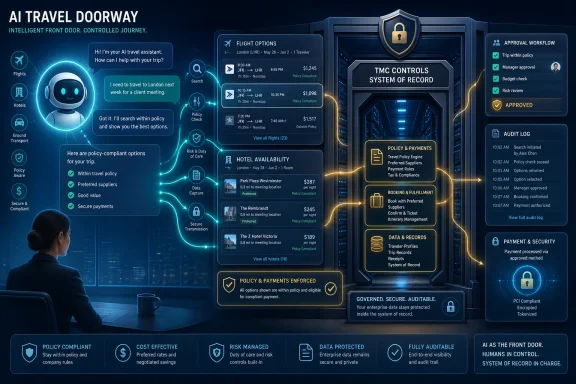
Vibe announced in July 2026 that its new Vibe MCP server connects travel management company booking platforms with AI assistants including ChatGPT, Claude and Microsoft Copilot, letting corporate travellers search, book, pay for and manage trips through conversational interfaces while keeping TMC controls in place. The claim, reported by The Business Travel Magazine and echoed by Business Travel News Europe, is that this is an industry first for managed travel rather than just another chatbot bolted onto a booking site. The more important point is narrower and more consequential: Vibe is trying to make the AI assistant a front door without letting it become the travel programme.
That distinction matters because corporate travel has always been an exercise in controlled choice. Employees want the fastest route, the better hotel, the easier interface and the fewest clicks. Finance, procurement, security and travel managers want policy compliance, negotiated rates, duty-of-care visibility, reporting, payment controls and a record of who approved what. Vibe’s bet is that the next fight in corporate travel will not be over whether employees use AI to plan trips, but whether that AI operates inside the managed programme or routes around it.
The headline feature is familiar enough: a traveller asks ChatGPT, Claude or Microsoft Copilot to find a flight, rail journey or hotel, then continues the process through natural language rather than clicking through a traditional online booking tool. Vibe says the same integration can show existing bookings, amend itineraries, take payments and surface relevant corporate travel policy information. That is the sort of experience every travel technology vendor has been sketching on conference slides since generative AI became boardroom shorthand for “we need a plan.”
The architecture is the more serious claim. Vibe says its implementation is built around a Model Context Protocol server designed for managed travel. MCP, introduced by Anthropic in November 2024 and since taken up widely across the AI tooling world, gives AI applications a more standardized way to connect to external systems, data and actions. In plain English, it is a way for an assistant to ask a business system what it can do, request information from it and call approved tools rather than guessing from stale training data.
That means Vibe is not merely placing a conversational layer on top of search results. The company is positioning its MCP server as a controlled bridge between consumer-style AI assistants and the messy plumbing of corporate travel: booking content, supplier relationships, policy rules, payments and reporting. If it works as described, the assistant becomes the interface, but the TMC platform remains the system of record.
That is a subtle but important inversion of the usual AI pitch. Many “AI travel” demos start with the assistant and treat booking systems as endpoints to be automated. Vibe is starting with the managed travel environment and allowing assistants to reach into it under rules. For TMCs, that is the difference between being displaced by a general-purpose agent and becoming the approved tool provider behind one.
That does not make Vibe’s claim meaningless. It does mean it needs to be read precisely. The strongest version of the claim is not that Vibe is the first travel company anywhere to use MCP, nor that it is the first business software vendor to connect ChatGPT or Claude to transactional systems. The stronger claim is that Vibe is offering a managed-travel MCP layer for TMCs that preserves the TMC’s programme controls while exposing search, booking and servicing to mainstream AI assistants.
That narrower interpretation is consistent with the reporting from Business Travel News Europe, which described the system as connecting TMC platforms directly with major AI platforms and noted that UK-based ITG Business Travel has gone live with the integration for testing with clients. The Business Travel Magazine also framed the announcement around TMC control, approved content and corporate-travel governance rather than consumer trip inspiration. Those details are what separate this from another travel-planning bot.
The caveat is that “live with the technology” and “testing with corporate clients” are not the same as broad deployment across large travel programmes. Early pilots can prove that an architecture is feasible; they do not yet prove reliability under the ugly conditions of business travel at scale. Flight disruptions, unused tickets, split payments, profile errors, policy exceptions, rail content, hotel rate leakage and after-hours servicing are where travel systems earn or lose trust.
So the industry-first claim should be treated as a marker of strategic intent, not a settled market verdict. Vibe has put a credible stake in the ground. The harder test is whether TMCs can operationalize conversational booking without turning their service desks into cleanup crews for overconfident AI decisions.
That is why Vibe CTO and co-founder Matthew Chapman’s framing lands. He told The Business Travel Magazine that AI is becoming the front door to digital commerce, and that the risk for TMCs is travellers using AI outside managed programmes. This is the central anxiety beneath the announcement: once a general assistant becomes the employee’s default interface for work, the old booking tool is no longer competing only with rival booking tools. It is competing with the way employees increasingly expect software to behave.
Managed travel has survived many waves of leakage because it could still claim control over the transaction. Employees might browse elsewhere, but the booking, ticketing, payment and reporting could be pulled back into the programme. AI threatens to blur that line. If an assistant can search the web, compare fares, fill forms and eventually transact, the unmanaged path becomes less of a rebellion and more of a convenience default.
Vibe’s answer is to meet the employee where the employee is going. Rather than forcing the user back into a separate interface, it lets the preferred assistant call into the approved travel environment. That is a pragmatic move because corporate IT rarely wins by banning convenient tools forever. It wins, when it wins, by making the governed path easier than the workaround.
For TMCs, the strategic appeal is obvious. They can tell clients that they are not blocking AI, not asking travellers to wait for a wholesale platform redesign and not surrendering commercial control to a consumer assistant. They are offering AI access as part of the managed programme itself. That is a cleaner boardroom story than “please keep using the booking tool because policy says so.”
For a travel platform, that pattern is powerful. The MCP server can expose specific capabilities: search approved flight content, check hotel availability, retrieve an itinerary, initiate an amendment, show policy guidance or submit payment through approved rails. The assistant does not need to know the full internal logic of the TMC platform. It needs permissioned tools with predictable inputs and outputs.
This is also where the security and governance arguments begin. A well-designed MCP server can limit what the assistant may see and do. It can require authentication, preserve audit trails, enforce policy checks and avoid dumping raw back-office access into a conversational window. The protocol is not the control model by itself; the control model is what the platform builds around it.
That distinction is crucial for Windows and Microsoft 365 shops watching Copilot become a more common workplace interface. Microsoft has been moving toward agent-based work in Copilot Studio and broader enterprise tooling, and Microsoft’s own security guidance has emphasized authentication, least privilege and approved connectors for agent integrations. If AI assistants are going to call business systems, those calls need the same identity, access and governance discipline IT already applies to SaaS applications.
The practical lesson for TMCs is that MCP should not be treated as a magic compliance wrapper. It is an integration standard, not a travel policy. The hard work remains in scoping permissions, logging actions, separating read-only lookups from transactional changes, and deciding where human confirmation is required before money moves or a ticket changes.
For a TMC, losing the interface is uncomfortable; losing the transaction path is existential. If a traveller uses a consumer AI assistant to discover options but still books through the TMC, the programme can survive. If the assistant begins booking outside preferred channels, the TMC loses visibility, servicing context, supplier leverage and sometimes the client’s confidence. The business value of the TMC shrinks from programme manager to emergency support line.
Vibe’s model is a way to defend that transaction path while conceding that the old interface may no longer be sacred. That is the right concession. Most corporate booking tools are not loved; they are tolerated because they encode the rules of the programme. If natural-language search can sit on top of those rules, the user experience can improve without dismantling the programme architecture.
This is also why ITG Business Travel’s involvement matters. Mat Cook, ITG’s managing director, said the MCP server gives the company a way to compete in the AI landscape without the investment and technical resources usually needed to build the capability in-house. That is the TMC market in miniature. Large global players may build their own AI layers, but smaller and mid-sized TMCs need platform vendors to turn AI into an adoptable product rather than a science project.
The risk is dependency. If TMCs rely on Vibe or similar providers for their AI gateway, the platform vendor gains more influence over the client experience. That may be perfectly acceptable if the technology works, but it changes the balance of power. The same TMCs trying not to be disintermediated by AI assistants may find themselves more tightly bound to the infrastructure companies that make those assistants usable.
That could be especially useful for infrequent travellers. Corporate booking tools often make perfect sense to travel managers and feel hostile to employees who use them three times a year. Natural language can reduce the learning curve, especially when policy questions arise mid-flow. If the assistant can explain why one hotel is out of policy or why a cheaper fare is not actually bookable under company rules, compliance becomes less adversarial.
But convenience introduces new failure modes. A conversational assistant may make a recommendation sound more certain than it is. It may compress trade-offs that deserve explicit review. It may hide fare restrictions, cancellation terms or policy exceptions inside a friendly summary. The better the interface becomes, the more careful vendors must be about confirmation steps.
That is not a theoretical concern. In travel, small misunderstandings become expensive quickly. A non-refundable fare, a hotel booked for the wrong night, a rail ticket tied to the wrong traveller profile or an itinerary change made without understanding downstream connections can create real costs. If an AI assistant is allowed to act, the system must be clear about when it is suggesting, when it is reserving and when it is committing funds.
The best version of Vibe’s approach would make the assistant conversational without making the process casual. It should let travellers move faster, but it should slow them down at the moments where business rules, money and personal safety intersect. In managed travel, a little friction is not always a defect. Sometimes it is the control surface.
That fits Microsoft’s broader direction. The company has been turning Copilot from a chat pane into a surface for agents, connectors and workflow automation. The promise is that users can act across business systems without learning each one separately. The risk is that each integration becomes another path where permissions, identity, data boundaries and auditability must be exactly right.
A travel MCP connector is a useful test case because it touches so many sensitive areas at once. It involves employee profile data, location data, payment data, supplier contracts, approval flows and sometimes travel to higher-risk destinations. If Copilot can help book a trip, IT and travel managers will want to know which tenant controls apply, what data leaves the travel platform, how prompts are retained, and whether the AI host can see more than it needs.
This is where enterprise buyers should resist demo intoxication. A smooth Copilot booking demo is not enough. The procurement questions should sound familiar: What identity provider is used? How are permissions scoped? Are actions logged in the TMC system, the AI assistant environment or both? Can admins disable payment or amendment actions while permitting search? How are policy exceptions handled? What happens when the assistant misunderstands?
The Windows enterprise story is not that Copilot should or should not book travel. It is that Copilot is becoming another front end for regulated business workflows, and travel is one of the first places where that shift will feel concrete to ordinary employees. The old desktop metaphor was applications. The new one is intent. IT still has to govern the consequences.
That is a more complicated risk. If an assistant can retrieve an itinerary, that is a privacy and access-control question. If it can amend a flight, make a payment or cancel a hotel, that is an operational integrity question. The blast radius expands from “who saw the data?” to “what did the system do?”
Microsoft’s security guidance around agents has been pointing in this direction, emphasizing authentication, least privilege and controlled connector onboarding. Those principles are not glamorous, but they are exactly what travel programmes need. A traveller should not gain access to another employee’s booking because the assistant has a broad tool token. A manager should not be able to approve a trip outside delegated authority because the agent runs under an overpowered author account. A prompt-injection attack embedded in travel content should not be able to trick the assistant into calling payment or cancellation tools.
The last scenario is particularly relevant to AI agents. Travel content is full of third-party text: hotel descriptions, supplier messages, disruption notices, emails, invoices and policy documents. If an assistant reads untrusted text and can also call tools, the system must separate instructions from content. Otherwise, a malicious or malformed message can become more than an annoyance.
Vibe has not publicly detailed every security control behind the MCP server, at least in the initial reporting. That is normal for a product announcement, but enterprise customers should demand the detail before broad rollout. AI integration is not inherently reckless. Unscoped AI integration is.
That is why the success of Vibe’s model will depend on experience as much as governance. If the AI-assisted path feels like a policy officer wearing a chatbot mask, employees will still leak. If it genuinely helps them find compliant options faster, it can make managed travel feel less punitive. The goal should be not merely to stop bad bookings, but to make good bookings the easiest ones.
There is a delicate balance here. Too much AI autonomy and the programme becomes risky. Too little autonomy and the assistant becomes a novelty search box. The sweet spot is likely staged: search and policy explanation first, itinerary retrieval next, amendments and payment only with explicit confirmations and clear audit trails.
The best systems will also know when to hand off. Travel is not just a transaction category; it is a disruption business. When weather hits, a conference overruns or a traveller is stranded at midnight, a conversational assistant may be useful, but escalation to human support remains essential. Vibe’s pitch is explicitly not about replacing the TMC, and that is wise. The TMC’s value is most visible when the happy path breaks.
Over time, however, the definition of human service may change. Agents may handle routine changes, refunds, document retrieval and policy questions, leaving human consultants for exceptions, VIP travel, complex international itineraries and crisis support. That could improve service economics, but only if the automation is reliable enough not to create more work than it removes.
Vibe is trying to ensure that the travel platform remains central in that repackaging. If its MCP server becomes the route through which assistants access travel content, then Vibe-powered TMCs keep their relevance even as the user interface fragments across ChatGPT, Claude, Copilot and whatever comes next. That is a defensive move, but also an ambitious one.
It also reflects a broader shift in enterprise software. The old SaaS model competed on dashboards and workflows. The emerging agentic model competes on who exposes the best tools to AI systems under the safest controls. The user may never open the dashboard, but the dashboard’s underlying permissions, data model and business logic still matter enormously.
For vendors, this creates a new kind of lock-in. If the assistant ecosystem learns to call a platform’s tools, and if enterprises trust that platform’s governance, the platform becomes infrastructure. That is stickier than a user interface. It is also harder for customers to evaluate because the most important product surface is no longer what the user sees, but what the agent is allowed to do.
For TMCs, the implication is blunt. They need to understand their technology stack at a deeper level than before. AI integration cannot be treated as a marketing feature outsourced entirely to a supplier. It touches commercial strategy, security posture, client retention and service design. The TMC that understands the policy layer will be in a stronger position than the one that simply adds “AI booking” to a sales deck.
That distinction matters because corporate travel has always been an exercise in controlled choice. Employees want the fastest route, the better hotel, the easier interface and the fewest clicks. Finance, procurement, security and travel managers want policy compliance, negotiated rates, duty-of-care visibility, reporting, payment controls and a record of who approved what. Vibe’s bet is that the next fight in corporate travel will not be over whether employees use AI to plan trips, but whether that AI operates inside the managed programme or routes around it.
 Vibe Is Selling a Gate, Not a Chatbot
The headline feature is familiar enough: a traveller asks ChatGPT, Claude or Microsoft Copilot to find a flight, rail journey or hotel, then continues the process through natural language rather than clicking through a traditional online booking tool. Vibe says the same integration can show existing bookings, amend itineraries, take payments and surface relevant corporate travel policy information. That is the sort of experience every travel technology vendor has been sketching on conference slides since generative AI became boardroom shorthand for “we need a plan.”The architecture is the more serious claim. Vibe says its implementation is built around a Model Context Protocol server designed for managed travel. MCP, introduced by Anthropic in November 2024 and since taken up widely across the AI tooling world, gives AI applications a more standardized way to connect to external systems, data and actions. In plain English, it is a way for an assistant to ask a business system what it can do, request information from it and call approved tools rather than guessing from stale training data.
That means Vibe is not merely placing a conversational layer on top of search results. The company is positioning its MCP server as a controlled bridge between consumer-style AI assistants and the messy plumbing of corporate travel: booking content, supplier relationships, policy rules, payments and reporting. If it works as described, the assistant becomes the interface, but the TMC platform remains the system of record.
That is a subtle but important inversion of the usual AI pitch. Many “AI travel” demos start with the assistant and treat booking systems as endpoints to be automated. Vibe is starting with the managed travel environment and allowing assistants to reach into it under rules. For TMCs, that is the difference between being displaced by a general-purpose agent and becoming the approved tool provider behind one.
The Industry-First Claim Needs a Narrow Lens
“Industry first” is one of those phrases that should make any editor reach for the brake pedal. The travel industry has no shortage of companies claiming firsts around AI assistants, agentic booking, itinerary management and MCP servers. Search the market and you will find adjacent claims from travel agencies, travel infrastructure firms, experience platforms, property-management vendors and expense companies connecting AI assistants to live commercial systems.That does not make Vibe’s claim meaningless. It does mean it needs to be read precisely. The strongest version of the claim is not that Vibe is the first travel company anywhere to use MCP, nor that it is the first business software vendor to connect ChatGPT or Claude to transactional systems. The stronger claim is that Vibe is offering a managed-travel MCP layer for TMCs that preserves the TMC’s programme controls while exposing search, booking and servicing to mainstream AI assistants.
That narrower interpretation is consistent with the reporting from Business Travel News Europe, which described the system as connecting TMC platforms directly with major AI platforms and noted that UK-based ITG Business Travel has gone live with the integration for testing with clients. The Business Travel Magazine also framed the announcement around TMC control, approved content and corporate-travel governance rather than consumer trip inspiration. Those details are what separate this from another travel-planning bot.
The caveat is that “live with the technology” and “testing with corporate clients” are not the same as broad deployment across large travel programmes. Early pilots can prove that an architecture is feasible; they do not yet prove reliability under the ugly conditions of business travel at scale. Flight disruptions, unused tickets, split payments, profile errors, policy exceptions, rail content, hotel rate leakage and after-hours servicing are where travel systems earn or lose trust.
So the industry-first claim should be treated as a marker of strategic intent, not a settled market verdict. Vibe has put a credible stake in the ground. The harder test is whether TMCs can operationalize conversational booking without turning their service desks into cleanup crews for overconfident AI decisions.
Corporate Travel Has Been Waiting for a Safer AI Doorway
The corporate travel sector has an obvious AI problem: employees already have access to powerful assistants, and those assistants are increasingly good at turning vague preferences into plausible itineraries. A traveller can ask for a three-day client visit, a hotel near the meeting site and a lower-cost return, then receive a polished answer in seconds. The risk is that the answer may ignore the corporate booking channel, negotiated rates, payment requirements or duty-of-care obligations.That is why Vibe CTO and co-founder Matthew Chapman’s framing lands. He told The Business Travel Magazine that AI is becoming the front door to digital commerce, and that the risk for TMCs is travellers using AI outside managed programmes. This is the central anxiety beneath the announcement: once a general assistant becomes the employee’s default interface for work, the old booking tool is no longer competing only with rival booking tools. It is competing with the way employees increasingly expect software to behave.
Managed travel has survived many waves of leakage because it could still claim control over the transaction. Employees might browse elsewhere, but the booking, ticketing, payment and reporting could be pulled back into the programme. AI threatens to blur that line. If an assistant can search the web, compare fares, fill forms and eventually transact, the unmanaged path becomes less of a rebellion and more of a convenience default.
Vibe’s answer is to meet the employee where the employee is going. Rather than forcing the user back into a separate interface, it lets the preferred assistant call into the approved travel environment. That is a pragmatic move because corporate IT rarely wins by banning convenient tools forever. It wins, when it wins, by making the governed path easier than the workaround.
For TMCs, the strategic appeal is obvious. They can tell clients that they are not blocking AI, not asking travellers to wait for a wholesale platform redesign and not surrendering commercial control to a consumer assistant. They are offering AI access as part of the managed programme itself. That is a cleaner boardroom story than “please keep using the booking tool because policy says so.”
MCP Turns the Assistant Into a Client of the Travel Platform
MCP has become fashionable because it promises to solve a real integration problem. Before a protocol layer, every AI assistant needed bespoke connectors, brittle plug-ins or custom API work to reach business systems. MCP standardizes the relationship between an AI host and the tools or data exposed by a server. It does not magically make integrations safe or useful, but it gives developers a common pattern.For a travel platform, that pattern is powerful. The MCP server can expose specific capabilities: search approved flight content, check hotel availability, retrieve an itinerary, initiate an amendment, show policy guidance or submit payment through approved rails. The assistant does not need to know the full internal logic of the TMC platform. It needs permissioned tools with predictable inputs and outputs.
This is also where the security and governance arguments begin. A well-designed MCP server can limit what the assistant may see and do. It can require authentication, preserve audit trails, enforce policy checks and avoid dumping raw back-office access into a conversational window. The protocol is not the control model by itself; the control model is what the platform builds around it.
That distinction is crucial for Windows and Microsoft 365 shops watching Copilot become a more common workplace interface. Microsoft has been moving toward agent-based work in Copilot Studio and broader enterprise tooling, and Microsoft’s own security guidance has emphasized authentication, least privilege and approved connectors for agent integrations. If AI assistants are going to call business systems, those calls need the same identity, access and governance discipline IT already applies to SaaS applications.
The practical lesson for TMCs is that MCP should not be treated as a magic compliance wrapper. It is an integration standard, not a travel policy. The hard work remains in scoping permissions, logging actions, separating read-only lookups from transactional changes, and deciding where human confirmation is required before money moves or a ticket changes.
The TMC Gets to Stay in the Transaction Path
The most commercially important sentence in Vibe’s pitch is that bookings remain connected to the TMC’s approved content, supplier relationships, payment processes, travel policies and reporting frameworks. That is the sentence aimed at travel managers, procurement teams and TMC executives. It says: the interface may change, but the economics and controls do not have to evaporate.For a TMC, losing the interface is uncomfortable; losing the transaction path is existential. If a traveller uses a consumer AI assistant to discover options but still books through the TMC, the programme can survive. If the assistant begins booking outside preferred channels, the TMC loses visibility, servicing context, supplier leverage and sometimes the client’s confidence. The business value of the TMC shrinks from programme manager to emergency support line.
Vibe’s model is a way to defend that transaction path while conceding that the old interface may no longer be sacred. That is the right concession. Most corporate booking tools are not loved; they are tolerated because they encode the rules of the programme. If natural-language search can sit on top of those rules, the user experience can improve without dismantling the programme architecture.
This is also why ITG Business Travel’s involvement matters. Mat Cook, ITG’s managing director, said the MCP server gives the company a way to compete in the AI landscape without the investment and technical resources usually needed to build the capability in-house. That is the TMC market in miniature. Large global players may build their own AI layers, but smaller and mid-sized TMCs need platform vendors to turn AI into an adoptable product rather than a science project.
The risk is dependency. If TMCs rely on Vibe or similar providers for their AI gateway, the platform vendor gains more influence over the client experience. That may be perfectly acceptable if the technology works, but it changes the balance of power. The same TMCs trying not to be disintermediated by AI assistants may find themselves more tightly bound to the infrastructure companies that make those assistants usable.
Travellers Get Convenience, But Not a Free Pass
From the traveller’s perspective, the appeal is obvious. Instead of remembering a booking tool’s filters, fare rules and menu structure, the employee can describe intent: “I need to be in Manchester by 10 a.m., avoid overnight connections, stay near the client office and keep within policy.” The assistant can translate that into structured searches and present options in a conversational flow.That could be especially useful for infrequent travellers. Corporate booking tools often make perfect sense to travel managers and feel hostile to employees who use them three times a year. Natural language can reduce the learning curve, especially when policy questions arise mid-flow. If the assistant can explain why one hotel is out of policy or why a cheaper fare is not actually bookable under company rules, compliance becomes less adversarial.
But convenience introduces new failure modes. A conversational assistant may make a recommendation sound more certain than it is. It may compress trade-offs that deserve explicit review. It may hide fare restrictions, cancellation terms or policy exceptions inside a friendly summary. The better the interface becomes, the more careful vendors must be about confirmation steps.
That is not a theoretical concern. In travel, small misunderstandings become expensive quickly. A non-refundable fare, a hotel booked for the wrong night, a rail ticket tied to the wrong traveller profile or an itinerary change made without understanding downstream connections can create real costs. If an AI assistant is allowed to act, the system must be clear about when it is suggesting, when it is reserving and when it is committing funds.
The best version of Vibe’s approach would make the assistant conversational without making the process casual. It should let travellers move faster, but it should slow them down at the moments where business rules, money and personal safety intersect. In managed travel, a little friction is not always a defect. Sometimes it is the control surface.
The Windows Angle Is Copilot as a Work Interface
For WindowsForum readers, Microsoft Copilot is the most interesting name in Vibe’s announcement. ChatGPT and Claude may lead many AI-native workflows, but Copilot is the assistant most likely to be pushed through enterprise Microsoft environments by policy, licensing and executive mandate. If travel booking becomes something employees can initiate from Copilot, it joins the growing list of business functions being pulled into conversational workspaces.That fits Microsoft’s broader direction. The company has been turning Copilot from a chat pane into a surface for agents, connectors and workflow automation. The promise is that users can act across business systems without learning each one separately. The risk is that each integration becomes another path where permissions, identity, data boundaries and auditability must be exactly right.
A travel MCP connector is a useful test case because it touches so many sensitive areas at once. It involves employee profile data, location data, payment data, supplier contracts, approval flows and sometimes travel to higher-risk destinations. If Copilot can help book a trip, IT and travel managers will want to know which tenant controls apply, what data leaves the travel platform, how prompts are retained, and whether the AI host can see more than it needs.
This is where enterprise buyers should resist demo intoxication. A smooth Copilot booking demo is not enough. The procurement questions should sound familiar: What identity provider is used? How are permissions scoped? Are actions logged in the TMC system, the AI assistant environment or both? Can admins disable payment or amendment actions while permitting search? How are policy exceptions handled? What happens when the assistant misunderstands?
The Windows enterprise story is not that Copilot should or should not book travel. It is that Copilot is becoming another front end for regulated business workflows, and travel is one of the first places where that shift will feel concrete to ordinary employees. The old desktop metaphor was applications. The new one is intent. IT still has to govern the consequences.
The Security Debate Moves From Data Leakage to Action Leakage
Much of the early enterprise AI conversation focused on data leakage: employees pasting confidential material into public chatbots, models retaining prompts, or sensitive documents being surfaced to the wrong user. MCP-style integrations add another dimension. The assistant is no longer merely reading or summarizing; it may be able to act.That is a more complicated risk. If an assistant can retrieve an itinerary, that is a privacy and access-control question. If it can amend a flight, make a payment or cancel a hotel, that is an operational integrity question. The blast radius expands from “who saw the data?” to “what did the system do?”
Microsoft’s security guidance around agents has been pointing in this direction, emphasizing authentication, least privilege and controlled connector onboarding. Those principles are not glamorous, but they are exactly what travel programmes need. A traveller should not gain access to another employee’s booking because the assistant has a broad tool token. A manager should not be able to approve a trip outside delegated authority because the agent runs under an overpowered author account. A prompt-injection attack embedded in travel content should not be able to trick the assistant into calling payment or cancellation tools.
The last scenario is particularly relevant to AI agents. Travel content is full of third-party text: hotel descriptions, supplier messages, disruption notices, emails, invoices and policy documents. If an assistant reads untrusted text and can also call tools, the system must separate instructions from content. Otherwise, a malicious or malformed message can become more than an annoyance.
Vibe has not publicly detailed every security control behind the MCP server, at least in the initial reporting. That is normal for a product announcement, but enterprise customers should demand the detail before broad rollout. AI integration is not inherently reckless. Unscoped AI integration is.
The User Experience Will Decide Whether Policy Survives
Corporate travel policy often fails at the point of annoyance. If the approved booking path is slower, worse or less flexible than the consumer alternative, employees find ways around it. Every travel manager knows the pattern: book elsewhere, expense later, apologize if challenged. AI assistants could intensify that behavior by making off-channel planning and booking easier.That is why the success of Vibe’s model will depend on experience as much as governance. If the AI-assisted path feels like a policy officer wearing a chatbot mask, employees will still leak. If it genuinely helps them find compliant options faster, it can make managed travel feel less punitive. The goal should be not merely to stop bad bookings, but to make good bookings the easiest ones.
There is a delicate balance here. Too much AI autonomy and the programme becomes risky. Too little autonomy and the assistant becomes a novelty search box. The sweet spot is likely staged: search and policy explanation first, itinerary retrieval next, amendments and payment only with explicit confirmations and clear audit trails.
The best systems will also know when to hand off. Travel is not just a transaction category; it is a disruption business. When weather hits, a conference overruns or a traveller is stranded at midnight, a conversational assistant may be useful, but escalation to human support remains essential. Vibe’s pitch is explicitly not about replacing the TMC, and that is wise. The TMC’s value is most visible when the happy path breaks.
Over time, however, the definition of human service may change. Agents may handle routine changes, refunds, document retrieval and policy questions, leaving human consultants for exceptions, VIP travel, complex international itineraries and crisis support. That could improve service economics, but only if the automation is reliable enough not to create more work than it removes.
The Platform Winners Will Own the Policy Layer
The most interesting long-term question is not which assistant travellers prefer. It is which system becomes the authoritative policy and transaction layer for AI-driven commerce. In corporate travel, that layer has historically been a combination of the online booking tool, the TMC, the expense platform and the client’s HR or finance systems. AI threatens to repackage that stack around the assistant interface.Vibe is trying to ensure that the travel platform remains central in that repackaging. If its MCP server becomes the route through which assistants access travel content, then Vibe-powered TMCs keep their relevance even as the user interface fragments across ChatGPT, Claude, Copilot and whatever comes next. That is a defensive move, but also an ambitious one.
It also reflects a broader shift in enterprise software. The old SaaS model competed on dashboards and workflows. The emerging agentic model competes on who exposes the best tools to AI systems under the safest controls. The user may never open the dashboard, but the dashboard’s underlying permissions, data model and business logic still matter enormously.
For vendors, this creates a new kind of lock-in. If the assistant ecosystem learns to call a platform’s tools, and if enterprises trust that platform’s governance, the platform becomes infrastructure. That is stickier than a user interface. It is also harder for customers to evaluate because the most important product surface is no longer what the user sees, but what the agent is allowed to do.
For TMCs, the implication is blunt. They need to understand their technology stack at a deeper level than before. AI integration cannot be treated as a marketing feature outsourced entirely to a supplier. It touches commercial strategy, security posture, client retention and service design. The TMC that understands the policy layer will be in a stronger position than the one that simply adds “AI booking” to a sales deck.
The Real Test Starts After the Demo Booking
The early facts are clear enough, but the practical consequences will depend on rollout discipline. Vibe has announced an MCP server for managed travel, ITG Business Travel is testing it with corporate clients, and the supported assistant environments named in the announcement include ChatGPT, Claude and Microsoft Copilot. The rest is execution.- Vibe’s announcement matters because it puts mainstream AI assistants inside the managed travel workflow rather than leaving them outside as unmanaged planning tools.
- The “industry first” claim is strongest when read narrowly as a TMC-controlled managed-travel MCP implementation, not as a claim that no travel company has ever used MCP before.
- The integration’s value depends on bookings remaining tied to approved content, policy rules, supplier relationships, payment processes and reporting systems.
- Copilot support makes the announcement especially relevant to Microsoft-centric enterprises, where AI assistants are increasingly becoming work interfaces rather than optional side tools.
- Security reviews should focus on action permissions, audit logs, identity controls, prompt-injection defenses and the difference between read-only access and transactional authority.
- The product will succeed only if travellers find the governed AI path easier than the unmanaged workaround.
References
- Primary source: The Business Travel Magazine
Published: 2026-07-07T11:50:08.327459
- Related coverage: businesstravelnewseurope.com
Vibe launches MCP server linking AI and TMC platforms
Vibe has launched an MCP server enabling TMC clients to integrate AI-assisted travel bookings while maintaining brand control and compliance with corporate policies. www.businesstravelnewseurope.com
- Related coverage: phocuswire.com
Vibe, Navan launch MCP servers
Navan initially is deploying its MCP as a "read-only experience" for travel data, letting travel and finance administrators use conversational prompts in Claude, ChatGPT and other MCP-compatible systems to query about their data. www.phocuswire.com
- Related coverage: windowsforum.com
Vibe MCP AI Integration Lets TMCs Book and Govern Travel in ChatGPT and Copilot | Windows Forum
Vibe has launched an MCP-based AI integration for travel management companies, announced July 2026 and already live in testing with ITG Business Travel...windowsforum.com - Related coverage: caribbeanmag.com
First U.S. AI Travel Booking MCP Server | Pixie Vacations
Pixie Vacations launches the first public AI travel booking server. Use Claude or ChatGPT to book Sandals, Beaches, and cruises with co-branded URLs.caribbeanmag.com - Related coverage: advancedcommunities.com
Advanced Communities Salesforce MCP Server - AI-Powered Salesforce Integration
PDF documentadvancedcommunities.com
- Related coverage: mckinsey.com
- Related coverage: idevnews.com
- Related coverage: tomshardware.com
Anthropic's Model Context Protocol includes a critical remote code execution vulnerability — newly discovered exploit puts 200,000 AI servers at risk | Tom's Hardware
A design choice in the MCP SDKs allows remote code execution across the AI supply chain.www.tomshardware.com