

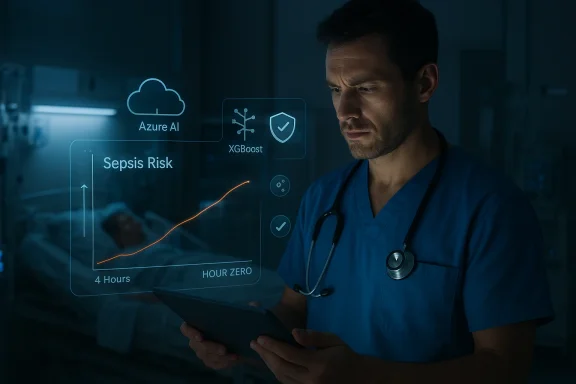
Virtua Health’s sepsis project is a useful case study in how Copilot and Azure AI are being positioned not just as productivity tools, but as the front end for serious clinical intelligence. The core idea is deceptively simple: let clinicians interact with AI in the same workflow where they already work, while pushing the predictive heavy lifting into the cloud and the model layer. In this instance, Virtua Health says its custom XGBoost model predicts sepsis up to four hours before hour zero, with materially lower false positives than commercial alternatives and workflow integration inside Epic, which is where the operational value really emerges. Microsoft’s healthcare agent service is explicitly designed for this kind of scenario, where healthcare organizations want conversational AI, connected data sources, safeguards, and integration into existing systems rather than a standalone chatbot
Sepsis has long been one of the hardest problems in acute care because speed matters, the signals are noisy, and the consequences of delay are severe. The condition can evolve quickly, and clinicians are often forced to balance vigilance against alert overload, especially in busy emergency and intensive care environments. Virtua Health’s pitch is that a better prediction layer can shift action earlier, giving staff a more usable window for intervention before a patient deteriorates.
That matters because predictive medicine is not just about accuracy in a lab setting. It is about whether a model can survive contact with real workflows, real EHR data, and real clinicians who already face too many alerts. Microsoft’s own healthcare documentation emphasizes that successful copilots must be grounded in customer data, connected to clinical systems, and wrapped in safeguards that support reliable use rather than novelty
Virtua’s approach also reflects a broader trend in healthcare AI: hospitals are increasingly building purpose-specific models instead of depending entirely on one-size-fits-all commercial products. The Microsoft customer story describes a custom model trained on EHR data and integrated into Epic’s workflow, which is notable because workflow integration is often the difference between an academic success and a practical tool. That is especially true in sepsis, where an alert that arrives too late, too often, or in the wrong place becomes a burden rather than a benefit.
The emergence of Copilot as a UI layer is significant because it changes where AI shows up. Instead of asking clinicians to open a separate analytics portal or navigate another dashboard, Microsoft’s healthcare direction is to embed the interface inside the clinical environment and let the model work in the background. In other words, Copilot becomes the conversational surface, while the model and data platform do the hard work behind the scenes.
This is also why the Virtua story resonates beyond one health system. It is a microcosm of the current enterprise AI strategy in regulated industries: combine cloud infrastructure, domain-specific machine learning, existing operational systems, and a natural-language interface that lowers friction. Microsoft is clearly trying to make Copilot the default interaction layer for that stack, not merely an assistant for office tasks
The Microsoft customer story says commercially available prediction models can have a false positive rate of around 36 percent, which is a serious problem in a high-stakes environment. Too many false alarms create alert fatigue, and alert fatigue can be deadly when staff begin to distrust the signal. In that sense, the problem is not merely whether AI can detect sepsis, but whether it can detect it usefully.
There is also a workflow truth here that AI enthusiasts sometimes overlook. Clinicians do not need more predictions in the abstract; they need predictions that arrive early enough to change treatment, and in a place where they can be acted on immediately. That is why integrating alerts into Epic matters so much. Without that operational layer, even a strong model risks becoming a PowerPoint success story rather than a bedside improvement.
The most important takeaway is that the value proposition is not "AI predicts sepsis." The value proposition is AI predicts sepsis early enough, accurately enough, and visibly enough to alter outcomes. That three-part requirement is what separates clinical utility from technical optimism.
XGBoost is not glamorous, but it is often very effective for structured healthcare data. In a domain where signals are tabular, sparse, and heterogeneous, tree-based gradient boosting can outperform more fashionable approaches if the features are engineered sensibly and the validation is rigorous. In other words, the choice of model suggests a focus on reliability and performance rather than hype.
The use of EHR data is also central. Clinical models live or die on the quality and relevance of the data they are trained on, and local data can capture a hospital’s own patient mix, care patterns, and documentation habits more accurately than a generic commercial model. That does not eliminate risk, but it can make predictions more context-aware and operationally credible.
This is where the story becomes strategically interesting for Microsoft. A hospital does not just buy a model; it buys a platform relationship. If Azure is where the model is trained, Copilot is where the clinician sees it, and Epic is where the action happens, then Microsoft has effectively positioned itself as the connective tissue across the AI stack.
For clinicians, the value of the UI layer is not decorative. It is about reducing cognitive and operational overhead. If an alert shows up in the exact place where decisions are made, and if it is supported by enough context to be credible, then the AI becomes a practical assistant rather than a separate system to manage.
Microsoft’s broader healthcare agent service is designed around this principle: it can connect customer-defined sources, support healthcare safeguards, and integrate into existing systems through orchestrated scenarios rather than one-off prompts. That makes it a fit for institutions that want AI embedded in operations, not bolted on top of them
The UI shift also matters for adoption. Clinicians are unlikely to tolerate yet another portal they must consult between tasks. But if AI surfaces in a familiar environment with enough precision to reduce noise, it can gradually earn trust. That trust is fragile, though, and once lost it is hard to recover.
This is why the phrase "UI to AI" should be interpreted carefully. It is not really about making AI prettier. It is about making AI usable, governable, and timed correctly inside clinical work.
A reduction like that can have multiple downstream benefits. It can preserve clinician attention, reduce unnecessary escalations, and create more confidence in the alerting system. It also helps the hospital preserve the social capital of AI within the care team, which is easy to underestimate and hard to rebuild once burned.
Commercial models often struggle here because they are deployed across many institutions with varying documentation practices and patient populations. A locally trained model can sometimes better reflect the realities of one health system, though it may sacrifice portability. That is the classic tradeoff between generalization and local fit.
The Virtua example suggests local fit may be worth the engineering effort if it meaningfully improves the signal-to-noise ratio. In healthcare AI, that ratio is often the real product. The algorithm is only part of the value; the other part is whether the human recipients believe it.
Microsoft’s healthcare platform strategy is explicitly built around this kind of embed-and-orchestrate model. The healthcare agent service documentation highlights integration with health data systems, customer sources, and other enterprise channels, which fits the broader pattern of making AI available where work already happens
If sepsis alerts are embedded into Epic, then the hospital can tie the model directly to existing escalation pathways. That is much more valuable than asking a nurse or physician to check a separate dashboard, because it preserves attention and reduces context switching. In healthcare, context switching is not just inconvenient; it is expensive and dangerous.
There is also a governance angle. Integrating into the EHR makes it easier to define who receives the alert, how it is logged, and what follow-up actions are expected. That means the AI can be audited and improved more readily, which is essential in regulated settings.
This is why successful clinical AI projects often look mundane from the outside. The exciting part is not the dashboard animation. The exciting part is that a nurse, resident, or attending can act faster because the signal appeared in the right place at the right time.
That matters because the company is not just selling infrastructure anymore. It is selling a layered model: Azure for compute and data, Copilot Studio for building experiences, and sector-specific services for compliance and orchestration. For healthcare buyers, that can be appealing because it reduces the number of vendors and integration points involved in moving from idea to deployment.
The Virtua story reinforces the appeal of that approach. It shows that Microsoft can support a hospital that is not simply using generative AI to draft emails, but applying AI to a serious clinical prediction problem with measurable operational impact. That broadens the narrative around Copilot from office productivity into clinical infrastructure.
It also creates competitive pressure. If Microsoft can make Copilot the default UI for healthcare intelligence, rivals will need to respond not just with better models but with better workflow integration. That is a harder and more expensive battle, because it involves ecosystem depth, EHR relationships, and trust.
At the enterprise level, the pitch is about lowering costs associated with preventable deterioration, reducing unnecessary escalations, and improving the effectiveness of clinical teams. That is a strong economic argument, particularly when hospitals face staffing pressure and high acuity. In that world, AI is not a novelty; it is capacity extension.
The consumer side also matters because it shapes public trust in healthcare AI. When patients hear about AI in hospitals, they often imagine chatbots or automation replacing clinicians. A use case like Virtua’s offers a different picture: AI as a supportive layer that helps humans notice danger sooner. That is a more credible and less threatening story.
Still, the consumer benefit depends on execution. If alerts are overconfident, undervalidated, or poorly explained, patients may experience more intervention without better outcomes. The value proposition only holds if the clinical team can rely on the model enough to act decisively but cautiously.
It also benefits from being aligned with Microsoft’s healthcare ecosystem, which is increasingly built around connected data, workflow integration, and governed AI experiences. That gives the project room to expand beyond sepsis into other predictive or conversational clinical scenarios.
There are also governance and accountability concerns. Hospitals need to know who is responsible when a model misses a case or generates a misleading alert. Technical success does not eliminate clinical liability, and the more deeply AI is embedded into workflows, the more important oversight becomes.
It will also be worth watching how Microsoft connects this kind of predictive intelligence to its wider Copilot strategy. The healthcare agent service, Copilot Studio, and Azure-based clinical workflows are clearly converging around a common idea: AI should be embedded, governed, and actionable. If that model keeps maturing, the company could make a stronger claim that Copilot is not just a productivity brand but a full interface layer for regulated enterprise intelligence
Ultimately, the most important lesson from Virtua Health’s work is that healthcare AI wins when it becomes infrastructure, not spectacle. If Microsoft can keep making Copilot the interface for reliable, clinically grounded, workflow-native intelligence, then the company’s role in healthcare may deepen well beyond productivity software and into the operational core of patient care.
Source: Microsoft Virtua Health innovates to improve patient care using Copilot as the UI to AI | Microsoft Customer Stories
 Background
Sepsis has long been one of the hardest problems in acute care because speed matters, the signals are noisy, and the consequences of delay are severe. The condition can evolve quickly, and clinicians are often forced to balance vigilance against alert overload, especially in busy emergency and intensive care environments. Virtua Health’s pitch is that a better prediction layer can shift action earlier, giving staff a more usable window for intervention before a patient deteriorates.That matters because predictive medicine is not just about accuracy in a lab setting. It is about whether a model can survive contact with real workflows, real EHR data, and real clinicians who already face too many alerts. Microsoft’s own healthcare documentation emphasizes that successful copilots must be grounded in customer data, connected to clinical systems, and wrapped in safeguards that support reliable use rather than novelty
Virtua’s approach also reflects a broader trend in healthcare AI: hospitals are increasingly building purpose-specific models instead of depending entirely on one-size-fits-all commercial products. The Microsoft customer story describes a custom model trained on EHR data and integrated into Epic’s workflow, which is notable because workflow integration is often the difference between an academic success and a practical tool. That is especially true in sepsis, where an alert that arrives too late, too often, or in the wrong place becomes a burden rather than a benefit.
The emergence of Copilot as a UI layer is significant because it changes where AI shows up. Instead of asking clinicians to open a separate analytics portal or navigate another dashboard, Microsoft’s healthcare direction is to embed the interface inside the clinical environment and let the model work in the background. In other words, Copilot becomes the conversational surface, while the model and data platform do the hard work behind the scenes.
This is also why the Virtua story resonates beyond one health system. It is a microcosm of the current enterprise AI strategy in regulated industries: combine cloud infrastructure, domain-specific machine learning, existing operational systems, and a natural-language interface that lowers friction. Microsoft is clearly trying to make Copilot the default interaction layer for that stack, not merely an assistant for office tasks
Why Sepsis Is Such a Difficult AI Problem
Sepsis prediction is difficult because the underlying clinical picture is fragmented. Vital signs, labs, medication orders, chart notes, and historical context can all matter, but no single marker tells the whole story. That makes this a classic machine-learning use case, yet also one that punishes models that are too eager to raise alarms.The Microsoft customer story says commercially available prediction models can have a false positive rate of around 36 percent, which is a serious problem in a high-stakes environment. Too many false alarms create alert fatigue, and alert fatigue can be deadly when staff begin to distrust the signal. In that sense, the problem is not merely whether AI can detect sepsis, but whether it can detect it usefully.
The Clinical Tradeoff
A good sepsis model has to manage the tension between sensitivity and precision. If sensitivity is too low, clinicians miss early deterioration. If precision is too low, they are flooded with noise and stop paying attention. Virtua Health’s reported result — sensitivity in the low 90s and more than an 80 percent reduction in false positives versus commercial models — suggests the team is trying to move both metrics in the right direction at once, which is exactly what a clinical organization wants to hear.There is also a workflow truth here that AI enthusiasts sometimes overlook. Clinicians do not need more predictions in the abstract; they need predictions that arrive early enough to change treatment, and in a place where they can be acted on immediately. That is why integrating alerts into Epic matters so much. Without that operational layer, even a strong model risks becoming a PowerPoint success story rather than a bedside improvement.
The most important takeaway is that the value proposition is not "AI predicts sepsis." The value proposition is AI predicts sepsis early enough, accurately enough, and visibly enough to alter outcomes. That three-part requirement is what separates clinical utility from technical optimism.
- Early detection only helps if it is early enough to act.
- High sensitivity only helps if the false-alarm burden stays manageable.
- Workflow integration only helps if it sits inside the clinician’s normal path.
- Model explainability matters, but so does operational trust.
- Predictions must be timed to the clinical reality, not just the dataset.
How Virtua Built the Model
Virtua Health’s reported architecture is a good example of modern healthcare ML done pragmatically rather than theatrically. The team built a custom XGBoost model in Azure, trained it on EHR data, and integrated the output into the Epic clinical workflow. That sequence matters because it shows a hospital using cloud machine learning as part of an end-to-end operational design, not as an isolated experiment.XGBoost is not glamorous, but it is often very effective for structured healthcare data. In a domain where signals are tabular, sparse, and heterogeneous, tree-based gradient boosting can outperform more fashionable approaches if the features are engineered sensibly and the validation is rigorous. In other words, the choice of model suggests a focus on reliability and performance rather than hype.
Why Azure Matters Here
Azure is not just hosting the model; it is providing the development and deployment environment that lets the health system iterate. In healthcare, that flexibility is important because model tuning, validation, governance, and integration all require careful control. Microsoft’s broader healthcare platform messaging emphasizes connected sources, safeguards, and extensibility, which fits the Virtua use case wellThe use of EHR data is also central. Clinical models live or die on the quality and relevance of the data they are trained on, and local data can capture a hospital’s own patient mix, care patterns, and documentation habits more accurately than a generic commercial model. That does not eliminate risk, but it can make predictions more context-aware and operationally credible.
This is where the story becomes strategically interesting for Microsoft. A hospital does not just buy a model; it buys a platform relationship. If Azure is where the model is trained, Copilot is where the clinician sees it, and Epic is where the action happens, then Microsoft has effectively positioned itself as the connective tissue across the AI stack.
- XGBoost fits structured clinical data well.
- Azure supports iteration, deployment, and scaling.
- Epic integration ensures the result reaches clinicians.
- EHR-trained models can reflect local patient populations.
- Platform alignment reduces friction for future AI projects.
Copilot as the UI to AI
The phrase "Copilot as the UI to AI" is more than marketing language. It reflects a product philosophy that the best AI interface for enterprise users may be the one that disappears into their existing workflow. Microsoft’s healthcare materials repeatedly stress connected sources, orchestration, and safe access to AI inside healthcare environments, which strongly aligns with the Virtua narrativeFor clinicians, the value of the UI layer is not decorative. It is about reducing cognitive and operational overhead. If an alert shows up in the exact place where decisions are made, and if it is supported by enough context to be credible, then the AI becomes a practical assistant rather than a separate system to manage.
From Chat Surface to Clinical Surface
There is a subtle but important distinction between a general-purpose chatbot and a clinical UI to AI. A chatbot is usually about conversation. A clinical surface is about decision support, situational awareness, and workflow timing. Virtua’s implementation appears to be closer to the latter, which is the more meaningful category in healthcare.Microsoft’s broader healthcare agent service is designed around this principle: it can connect customer-defined sources, support healthcare safeguards, and integrate into existing systems through orchestrated scenarios rather than one-off prompts. That makes it a fit for institutions that want AI embedded in operations, not bolted on top of them
The UI shift also matters for adoption. Clinicians are unlikely to tolerate yet another portal they must consult between tasks. But if AI surfaces in a familiar environment with enough precision to reduce noise, it can gradually earn trust. That trust is fragile, though, and once lost it is hard to recover.
This is why the phrase "UI to AI" should be interpreted carefully. It is not really about making AI prettier. It is about making AI usable, governable, and timed correctly inside clinical work.
The False Positive Problem and Alert Fatigue
False positives are not a minor annoyance in a hospital setting; they are an operational hazard. When a model produces too many warnings, staff begin to tune it out, and that creates the exact opposite of the intended effect. Virtua’s claim that its custom model reduces false positives by more than 80 percent is therefore one of the most important numbers in the story.A reduction like that can have multiple downstream benefits. It can preserve clinician attention, reduce unnecessary escalations, and create more confidence in the alerting system. It also helps the hospital preserve the social capital of AI within the care team, which is easy to underestimate and hard to rebuild once burned.
Why Precision Matters More Than Hype
Precision matters because every false alarm has a cost. That cost includes time, stress, extra checks, and the possibility of over-treatment. In a sepsis context, the ideal model is not the one that screams the loudest; it is the one that helps staff intervene just often enough to matter, and seldom enough to stay trusted.Commercial models often struggle here because they are deployed across many institutions with varying documentation practices and patient populations. A locally trained model can sometimes better reflect the realities of one health system, though it may sacrifice portability. That is the classic tradeoff between generalization and local fit.
The Virtua example suggests local fit may be worth the engineering effort if it meaningfully improves the signal-to-noise ratio. In healthcare AI, that ratio is often the real product. The algorithm is only part of the value; the other part is whether the human recipients believe it.
- False positives consume scarce clinical attention.
- Alert fatigue erodes trust over time.
- Local training can improve relevance.
- Better precision can reduce workflow disruption.
- Trust is a clinical asset, not just a UX outcome.
Integration Into Epic and the Care Team Workflow
The Epic integration is one of the strongest aspects of the Virtua story because it places the model inside the daily operating system of care. That matters far more than many vendors admit. A model that lives outside the EHR may be technically impressive, but a model that lives inside the workflow can change behavior.Microsoft’s healthcare platform strategy is explicitly built around this kind of embed-and-orchestrate model. The healthcare agent service documentation highlights integration with health data systems, customer sources, and other enterprise channels, which fits the broader pattern of making AI available where work already happens
Workflow Is the Real Product
In practice, clinician adoption often hinges on the smallest details. Who sees the alert? When does it appear? Is it actionable? Does it contain enough context? Is it too late to matter? Those questions are as important as model performance statistics because they determine whether the system changes behavior.If sepsis alerts are embedded into Epic, then the hospital can tie the model directly to existing escalation pathways. That is much more valuable than asking a nurse or physician to check a separate dashboard, because it preserves attention and reduces context switching. In healthcare, context switching is not just inconvenient; it is expensive and dangerous.
There is also a governance angle. Integrating into the EHR makes it easier to define who receives the alert, how it is logged, and what follow-up actions are expected. That means the AI can be audited and improved more readily, which is essential in regulated settings.
This is why successful clinical AI projects often look mundane from the outside. The exciting part is not the dashboard animation. The exciting part is that a nurse, resident, or attending can act faster because the signal appeared in the right place at the right time.
Microsoft’s Healthcare Platform Strategy
Virtua’s sepsis use case fits neatly into Microsoft’s broader healthcare story. Microsoft has been expanding Copilot, Copilot Studio, and healthcare-specific services to help organizations build AI experiences that are grounded in their own data and protected by healthcare safeguards. The company’s official materials describe healthcare agent service capabilities for connected sources, orchestrated workflows, and secure integration with systems such as EMR platformsThat matters because the company is not just selling infrastructure anymore. It is selling a layered model: Azure for compute and data, Copilot Studio for building experiences, and sector-specific services for compliance and orchestration. For healthcare buyers, that can be appealing because it reduces the number of vendors and integration points involved in moving from idea to deployment.
Why the Platform Message Resonates
Healthcare organizations do not want to stitch together a dozen AI components unless they absolutely must. They want something that feels cohesive, supportable, and compliant. Microsoft’s strategy is to present Copilot as the interactive layer that can front both administrative and clinical use cases, from documentation to decision support to patient-facing workflows.The Virtua story reinforces the appeal of that approach. It shows that Microsoft can support a hospital that is not simply using generative AI to draft emails, but applying AI to a serious clinical prediction problem with measurable operational impact. That broadens the narrative around Copilot from office productivity into clinical infrastructure.
It also creates competitive pressure. If Microsoft can make Copilot the default UI for healthcare intelligence, rivals will need to respond not just with better models but with better workflow integration. That is a harder and more expensive battle, because it involves ecosystem depth, EHR relationships, and trust.
- Azure provides scale and deployment flexibility.
- Copilot Studio helps create custom AI experiences.
- Healthcare agent service adds orchestration and safeguards.
- Epic integration gives the platform clinical relevance.
- The stack is designed to reduce vendor sprawl.
Enterprise vs. Consumer Impact
This kind of innovation has very different implications on the enterprise and consumer sides. For enterprises, especially hospitals, the main value lies in operational efficiency, clinical safety, and measurable outcomes. For consumers, the benefit is indirect but profound: fewer delays, earlier treatment, and potentially better survival and recovery chances.At the enterprise level, the pitch is about lowering costs associated with preventable deterioration, reducing unnecessary escalations, and improving the effectiveness of clinical teams. That is a strong economic argument, particularly when hospitals face staffing pressure and high acuity. In that world, AI is not a novelty; it is capacity extension.
What Patients Actually Experience
Patients may never see the model or know it exists, but they may feel the result through faster interventions and fewer missed warning signs. That is often the best kind of healthcare technology: invisible when it works, obvious when it fails. A sepsis model that helps clinicians intervene earlier can be life-changing even if it never becomes a consumer-facing product.The consumer side also matters because it shapes public trust in healthcare AI. When patients hear about AI in hospitals, they often imagine chatbots or automation replacing clinicians. A use case like Virtua’s offers a different picture: AI as a supportive layer that helps humans notice danger sooner. That is a more credible and less threatening story.
Still, the consumer benefit depends on execution. If alerts are overconfident, undervalidated, or poorly explained, patients may experience more intervention without better outcomes. The value proposition only holds if the clinical team can rely on the model enough to act decisively but cautiously.
Strengths and Opportunities
Virtua’s approach has several clear advantages, and it also points to broader opportunities for hospitals trying to modernize care without losing control of the clinical experience. The most important strength is that the project is tied to a concrete, high-value use case rather than a vague AI ambition. That makes it easier to measure and easier to defend.It also benefits from being aligned with Microsoft’s healthcare ecosystem, which is increasingly built around connected data, workflow integration, and governed AI experiences. That gives the project room to expand beyond sepsis into other predictive or conversational clinical scenarios.
- Clear clinical urgency gives the project immediate relevance.
- Lower false positives improve trust and reduce alert fatigue.
- Epic integration increases the odds of clinician adoption.
- Azure-based development supports iteration and scaling.
- Copilot UI lowers friction for users already living in Microsoft environments.
- Local EHR training can improve fit to the hospital’s patient population.
- Platform extensibility opens the door to other predictive models and copilots.
Risks and Concerns
The downside is that clinical AI can fail in subtle ways, and the stakes are high. A strong pilot does not guarantee durable performance when patient mix, documentation behavior, staffing, or care protocols change. There is always a risk that the model performs well in one setting and degrades as conditions evolve.There are also governance and accountability concerns. Hospitals need to know who is responsible when a model misses a case or generates a misleading alert. Technical success does not eliminate clinical liability, and the more deeply AI is embedded into workflows, the more important oversight becomes.
- Model drift can erode performance over time.
- Local success may not generalize to other hospitals.
- Over-reliance on AI can weaken human vigilance.
- Too much automation can obscure accountability.
- Integration complexity may slow expansion.
- Data quality issues can quietly distort predictions.
- Regulatory expectations may tighten as use cases expand.
What to Watch Next
The next stage of this story will be whether Virtua can show durable operational benefit over time, not just promising initial metrics. Hospitals often see good early results from well-targeted AI systems, but the real test is whether performance holds as clinical conditions shift and as teams become accustomed to the tool. That will determine whether the project becomes a reference case or remains a single-institution success.It will also be worth watching how Microsoft connects this kind of predictive intelligence to its wider Copilot strategy. The healthcare agent service, Copilot Studio, and Azure-based clinical workflows are clearly converging around a common idea: AI should be embedded, governed, and actionable. If that model keeps maturing, the company could make a stronger claim that Copilot is not just a productivity brand but a full interface layer for regulated enterprise intelligence
Key signals to monitor
- Whether Virtua publishes longer-term outcome data.
- Whether the model is adapted to other clinical pathways.
- How clinicians respond after the novelty wears off.
- Whether Microsoft adds more healthcare workflow integrations.
- Whether competitors match the combination of model quality and EHR embedding.
- Whether hospitals treat Copilot as a UI layer for multiple AI systems.
- Whether healthcare governance frameworks keep pace with deployment.
Ultimately, the most important lesson from Virtua Health’s work is that healthcare AI wins when it becomes infrastructure, not spectacle. If Microsoft can keep making Copilot the interface for reliable, clinically grounded, workflow-native intelligence, then the company’s role in healthcare may deepen well beyond productivity software and into the operational core of patient care.
Source: Microsoft Virtua Health innovates to improve patient care using Copilot as the UI to AI | Microsoft Customer Stories
Last edited:
