

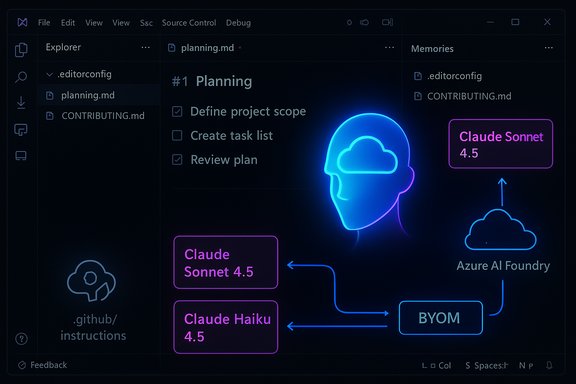
Microsoft’s October 2025 Visual Studio update (v17.14) moves Copilot from a contextual helper to a more autonomous, repository‑aware collaborator — adding Memories that persist project preferences, a built‑in Planning workflow for multi‑step tasks, instruction files for repo‑scoped rules, selectable Anthropic Claude models in Copilot chat, and Bring‑Your‑Own‑Model (BYOM) routing through Azure AI Foundry.
Visual Studio 2022 version 17.14’s October 2025 release is explicitly focused on expanding GitHub Copilot’s agentic capabilities inside the IDE: model choice, multi‑step orchestration, long‑term project preferences, and thread management for chat interactions. These features collectively aim to let Copilot reason, plan, and execute changes across files while keeping a transparent audit trail. The update was announced on the Visual Studio blog and documented in the official release notes and GitHub changelog. The release is notable for three threads that recur throughout Microsoft’s product messaging and independent coverage:
Source: The Tech Outlook Microsoft Releases the Visual Studio October 2025 Update: Copilot Memories, Claude Sonnet & Haiku in Chat, Instruction Files, and More - The Tech Outlook
 Background / Overview
Visual Studio 2022 version 17.14’s October 2025 release is explicitly focused on expanding GitHub Copilot’s agentic capabilities inside the IDE: model choice, multi‑step orchestration, long‑term project preferences, and thread management for chat interactions. These features collectively aim to let Copilot reason, plan, and execute changes across files while keeping a transparent audit trail. The update was announced on the Visual Studio blog and documented in the official release notes and GitHub changelog. The release is notable for three threads that recur throughout Microsoft’s product messaging and independent coverage:- Expanding the model catalog inside Copilot chat (now including Anthropic’s Claude variants) to support the “right model for the right task” approach.
- Introducing persistence of project preferences and conventions so Copilot’s behavior aligns with repository standards over time via Memories.
- Adding structured, auditable automation with Planning and instruction files, so agent edits are traceable and can be governed via standard repo workflows.
What’s new in this update — the facts
1) Claude Sonnet 4.5 and Claude Haiku 4.5 available in Copilot chat
Microsoft added Anthropic model options — specifically recent Claude variants — to the Copilot chat model picker in Visual Studio. The intention is to provide alternatives tuned to different workload profiles: higher‑throughput reasoning or lower‑latency pair‑programming scenarios depending on the variant chosen. Several independent outlets and Microsoft documents confirm the inclusion of Claude models in the October update.2) Copilot Memories — project‑aware, persistent guidance
The Memories feature allows Copilot to detect repeated corrections or explicit “remember this” prompts and to suggest saving the inferred preference into repository files (for example, .editorconfig, CONTRIBUTING.md, README.md, or specialized instruction files). The design writes guidance into version‑controlled artifacts so the team can review, audit, and revert these changes like any other commit. Microsoft documents this flow and independent reporting explains how it maps to repo governance.3) Built‑in Planning — multi‑step plans with execution traces
When Copilot determines a task requires multiple steps — such as a refactor, test additions, or architectural changes — it will generate a Markdown plan file listing objectives, files to edit, and a checklist of steps, then proceed to execute and update that plan as it works. The plan begins in a temporary location and can be committed into the repository to preserve auditable history. Microsoft calls this Planning and has published the UX details in the blog and product pages.4) Instruction files and repo‑scoped rules
Teams can add .instructions.md files under .github/instructions with glob patterns to target specific folders or file types. Instruction files provide a mechanism to codify rules (for example, “use internal logging-wrapper in /services/*”) so Copilot applies rules only where they make sense. This moves governance from ephemeral prompts into version‑controlled artifacts.5) Chat management and thread commands
Simple chat commands for thread hygiene are now available — for example,/clear resets the current thread and /clearall wipes all threads — to make conversational history management explicit and easier for developers. The GitHub changelog lists these commands as part of the update. 6) BYOM via Azure AI Foundry and model routing
Visual Studio’s Copilot chat can route requests to customer‑controlled or third‑party models through Azure AI Foundry (or equivalent private endpoints). Enterprises can thus plug in private, fine‑tuned models for sensitive workloads and avoid public hosted endpoints. Microsoft frames this as critical for regulated scenarios. Independent analysis emphasizes the operational and contractual implications of routing inference outside Microsoft’s own managed infrastructure.Why these changes matter — practical benefits for teams
- Consistency at scale: Writing conventions into repository files reduces style and architecture drift across contributors and AI‑generated output. When memories persist rules in .editorconfig or CONTRIBUTING.md, new contributors inherit the same guidance automatically.
- Auditability: Planning files and instruction artifacts become first‑class VCS objects, enabling code review and rollback of AI‑driven changes just like human edits. This is essential for enterprise acceptance of agentic automation.
- Operational flexibility through model choice: Different models excel at different tasks — using a smaller, faster model for pair programming versus a larger reasoning model for multi‑step refactors can reduce latency and control cost. Multi‑model orchestration also reduces dependence on a single vendor.
- Faster, auditable automation: Planning plus agent execution promises to automate repetitive and mechanical tasks (mass refactors, test scaffolding, dependency updates) while producing a traceable plan and execution log. That can significantly reduce cycle times for routine engineering work.
Critical analysis — strengths, tradeoffs, and areas of risk
Strengths and engineering upside
- The update thoughtfully binds AI behavior to version‑controlled artifacts rather than opaque user settings. By writing guidance into repo files, Copilot’s behavior becomes reviewable and reproducible, which is a major architectural win for integrating AI into team workflows.
- The Planning feature helps bridge a persistent gap in AI utility: complex, multi‑file engineering tasks. A living markdown plan that the agent updates as it executes makes automation auditable and interactive, enabling safer delegation.
- Model choice in Copilot gives teams the power to select a model optimized for the workload, enabling cost, latency, and quality tradeoffs. For enterprises this provides procurement leverage and resiliency.
Key risks and governance considerations
- Data residency and third‑party hosting: Anthropic’s Claude endpoints and many BYOM configurations may run on third‑party clouds outside Microsoft’s direct control. Routing repository content or tenant data to those endpoints raises legal, contractual, and regulatory concerns that administrators must evaluate before enabling.
- Accidental codification of poor practices: Memories are only as good as the pattern detection and human confirmation workflows. If Copilot misclassifies an accidental correction or a one‑off quirk as a canonical preference and persists it into shared files, the repository can inherit flawed conventions. Teams must require PR reviews and human‑in‑the‑loop validation for instruction artifacts.
- Over‑delegation and test gating: Allowing agents to make broad edits without tightly integrated CI gates or pre‑merge static analysis can introduce regressions that are hard to detect. Agentic edits should be gated by automated tests, linters, security scans, and human approval for production‑sensitive paths.
- Provenance and compliance: Committing agent‑generated instruction or plan files into a repo creates an audit trail, but it also raises questions about liability and intellectual property provenance — for example, third‑party model outputs mixed into production code. Organizations should codify policies about attribution, licensing, and external model usage.
Operational costs and complexity
Adopting multi‑model orchestration and BYOM adds administrative overhead: tenant‑level enablement, contract reviews with third‑party model providers, network routing configuration, and telemetry for per‑model performance. These are solvable but require investment in governance tooling and runbook development.Recommended rollout checklist for IT and engineering leaders
- Inventory and categorize codebases by sensitivity (public, internal, regulated).
- Pilot Memories and Planning on non‑production repos with strict PR review requirements.
- Require that any instruction or plan file committed to main branches pass through normal code review.
- Integrate agentic edits with CI: run full test suites, static analysis, and SCA scans before accepting agent‑generated PRs.
- For BYOM: validate model contracts, data handling agreements, and ensure endpoint residency meets compliance needs.
- Set admin controls to opt in to Anthropic or third‑party models only after legal review and technical gating.
- Train teams on how to detect and remediate accidental “memories” written into a repository.
Security and privacy deep dive
Where memories are stored and the risk surface
Copilot’s Memories intentionally persist guidance into repository artifacts (.editorconfig, CONTRIBUTING.md, README.md, or .github instruction files). That design gives transparency but also creates an exposure vector: if a memory includes sensitive operational details (for instance, credentials accidentally present in a prompt or comments describing internal secrets), committing that memory into a public repo could leak sensitive data. Teams must configure strict filtering, human confirmation, and guardrails before allowing automatic persistence.Third‑party model hosting and data routing
When Copilot routes requests to Anthropic or other third‑party models, data may traverse clouds outside Microsoft’s managed infrastructure. That has consequences:- Data residency constraints may be violated.
- Contracts and terms-of-service of third‑party providers determine permissible uses of customer content.
- Regulators may view cross‑cloud routing differently, particularly in privacy‑sensitive sectors.
Administrators should require opt‑in and perform legal reviews before enabling non‑Microsoft model endpoints.
Practical developer guidance — how to use the new features safely
- Use Memories for stylistic and formatting preferences (code style, logging wrappers, doc comments), not for secrets or process flows. Confirm every memory before accepting it into the repo.
- Treat Planning files as living runbooks: keep them in temp during iteration, but move plans to a feature branch and open a PR if the plan will affect multiple modules or production code.
- Use instruction files (.github/instructions/*.instructions.md) to express module‑scoped rules and require PR reviews for changes to those files. Keep instruction files minimal and well‑documented.
- Benchmark model choices for common tasks in your environment: measure latency, accuracy, and cost across OpenAI, Anthropic Sonnet/Haiku, and any private models you run through Azure Foundry. Use telemetry to route workloads dynamically.
Cross‑verification and what’s confirmed vs. cautionary notes
Confirmed facts (cross‑verified):- Visual Studio 17.14 October 2025 update adds Claude Sonnet and Claude Haiku models to Copilot chat and agent workflows.
- Copilot Memories can persist inferred project preferences into repository files such as .editorconfig and CONTRIBUTING.md.
- Planning creates Markdown plan files for multi‑step tasks and can update them as execution progresses; plans can be persisted into the repo.
- Instruction files live under .github/instructions and support glob patterns to scope rules.
- Specific internal performance numbers or vendor benchmark claims for Sonnet 4.5 and Haiku 4.5 (for example, exact token limits or numeric accuracy improvements) should be treated as vendor‑reported; independent benchmarking in the target environment is advised before relying on those claims for procurement or architecture decisions. Public reporting gives design intent and high‑level capabilities but not standardized, independent benchmark parity.
Related note: LinkedIn data and broader AI training policies (administrative action)
The October Visual Studio update was published alongside broader industry movements on data usage. Separately, LinkedIn — a Microsoft company — announced that starting November 3, 2025 it will use certain member profile and public activity data to train generative AI models by default in affected regions, with an opt‑out available under the “Data for Generative AI Improvement” setting. Organizations using LinkedIn for recruiting or talent data should remind staff and page admins to review their settings if they do not want profile content included in training datasets. This policy change is independently reported across multiple outlets and LinkedIn support documentation. If teams want to opt out of LinkedIn’s data‑for‑AI setting, practical steps commonly advised by coverage are:- Sign in to LinkedIn and go to Settings & Privacy.
- Select Data privacy → Data for Generative AI Improvement.
- Toggle off “Use my data for training content‑creation AI models.”
Perform this action for organizational accounts and instruct staff who manage company pages to do the same if you have a corporate policy against profile data being used for AI training.
Longer‑term implications and what to watch
- Expect increased emphasis on AI governance built into developer toolchains: PR gating, CI checks, and instruction‑file review processes will become standard practice for teams that adopt agentic automation.
- Model‑agnostic orchestration will become a procurement and legal discipline. Organizations will need to weight model cost, latency, and contractual protections, and to build routing policies that map workload classes to permitted endpoints.
- Security tooling will evolve to treat instruction and plan files as sensitive artifacts: static analysis and policy scanning will need to consider artifacts that encode AI guidance as part of the attack surface.
Conclusion
The Visual Studio October 2025 update (v17.14) materially advances the IDE’s AI capabilities by making Copilot more project‑aware, multi‑model, and autonomous — while explicitly trying to preserve auditability through persisted plan and instruction artifacts. These are practical, well‑measured steps toward agentic development workflows, but they also elevate governance, legal, and security responsibilities for teams. The new features are powerful tools when used with disciplined policies: require PR reviews for persisted memories and instruction files, gate agentic edits through CI, and carefully evaluate any routing of tenant data to third‑party model endpoints. The result can be a genuine productivity uplift — provided organizations treat policy, provenance, and telemetry as first‑class citizens in their AI toolchain.Source: The Tech Outlook Microsoft Releases the Visual Studio October 2025 Update: Copilot Memories, Claude Sonnet & Haiku in Chat, Instruction Files, and More - The Tech Outlook
