

Core Keeper’s underground keeps growing — and the next big expansion, Void & Voltage, arrives with a thump on January 28, 2026, bringing a new biome, heavy new weaponry, and a full suite of automation gear that reshapes late‑game goals and cooperative base design. The update also coincides with the debut of a Nintendo Switch 2 edition, meaning the game’s signature eight‑player co‑op and conveyor‑belt chaos are about to hit a wider, higher‑performance audience. This feature unpacks what’s coming, why it matters for Xbox and PC players, how the update shifts Core Keeper’s sandbox loop, and what risks and practical considerations players should weigh before they reboot their worlds for Breaker’s Reach.
Core Keeper launched out of Early Access into a full release on August 27, 2024, after a successful early period on Steam beginning in March 2022. The pixel‑art, top‑down mining‑sandbox mixes survival, farming, boss hunting, and factory‑style automation into a surprisingly deep multiplayer playground for up to eight players. The canonical store pages and publisher statements list Pugstorm as developer and Fireshine (Fireshine Games) and bilibili as partners on various platforms; the base price on storefronts sits at $19.99, though frequent sales lower that tag. Microsoft featured Core Keeper as a day‑one arrival on Xbox Game Pass at the 1.0 launch window — a move that helped the title scale quickly among console players — but the game later rotated out of Game Pass in October 2025, returning the title to standard storefront purchase windows and occasional platform sales. That Game Pass movement is a reminder of how discovery and long‑tail player counts can depend on subscription windows as much as on design merit. Meanwhile, Pugstorm’s team has not been idle: the studio is expanding Core Keeper with seasonal content and major free updates while also teasing a new title, KYORA, that reuses the studio’s co‑op sandbox DNA in a side‑scrolling direction. Those parallel moves — continued live support for Core Keeper and a new IP in the wings — set the context for Void & Voltage as both a content capstone and a live‑service growth vector.
Practical multiplayer tips:
Execution matters. Balance tuning, robust save infrastructure, and clear documentation will determine whether Void & Voltage elevates Core Keeper into a durable sandbox favorite or merely shuffles existing late‑game chores into new interfaces. If Pugstorm and Fireshine keep supporting the game with patches and community listening — and if players apply sane backup and hosting practices — January 28, 2026 should feel like both a fresh start and a step into a more engineered, collaborative underground world.
Core Keeper’s next chapter lands ready to rewire player workflows: expect fumes, gunfire, and conveyor‑belt symphonies under Breaker’s Reach.
Source: Windows Central https://www.windowscentral.com/gami...mbitious-survival-rpg-before-its-next-update/
 Background / Overview
Core Keeper launched out of Early Access into a full release on August 27, 2024, after a successful early period on Steam beginning in March 2022. The pixel‑art, top‑down mining‑sandbox mixes survival, farming, boss hunting, and factory‑style automation into a surprisingly deep multiplayer playground for up to eight players. The canonical store pages and publisher statements list Pugstorm as developer and Fireshine (Fireshine Games) and bilibili as partners on various platforms; the base price on storefronts sits at $19.99, though frequent sales lower that tag. Microsoft featured Core Keeper as a day‑one arrival on Xbox Game Pass at the 1.0 launch window — a move that helped the title scale quickly among console players — but the game later rotated out of Game Pass in October 2025, returning the title to standard storefront purchase windows and occasional platform sales. That Game Pass movement is a reminder of how discovery and long‑tail player counts can depend on subscription windows as much as on design merit. Meanwhile, Pugstorm’s team has not been idle: the studio is expanding Core Keeper with seasonal content and major free updates while also teasing a new title, KYORA, that reuses the studio’s co‑op sandbox DNA in a side‑scrolling direction. Those parallel moves — continued live support for Core Keeper and a new IP in the wings — set the context for Void & Voltage as both a content capstone and a live‑service growth vector. What Void & Voltage Brings — The Essentials
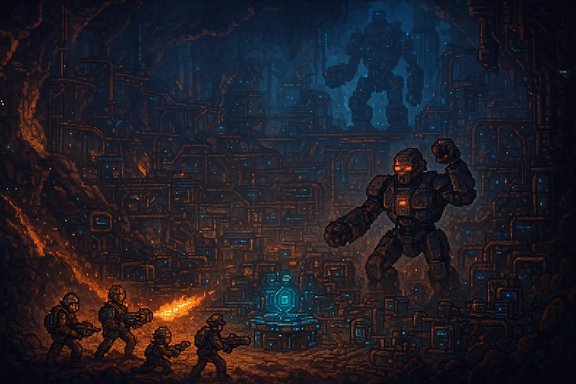
The Void & Voltage update is framed as a major, free content drop scheduled for January 28, 2026. It combines a destination biome, heavy automation upgrades, new weapons geared toward spectacle and crowd control, and a gargantuan robo‑boss meant to test coordinated groups.Breaker’s Reach — a biome focused on machines and risk
Breaker’s Reach is the update’s marquee map addition: a mechanically themed region that layers new traversal hazards, enemy types, and valuable nodes for late‑game factories. The biome promises environmental set‑pieces that reward scale — long corridors and vertical shafts ideal for conveyor systems, hazardous zones that encourage defensive engineering, and specific resource veins tied to late‑game recipes. Treat Breaker’s Reach as both a loot destination and a logistical design challenge: it’s built to be conquered by teams that can sustain prolonged automated extraction.New heavy weapons — Flamethrower and Minigun
The update explicitly adds two combat‑forward tools: a Flamethrower and a Minigun. These are not cosmetic toys; they change combat roles. The Flamethrower offers area denial and sustained damage against swarms and environmental hazards, while the Minigun trades accuracy for sustained suppressive fire and shredding of armored targets. Expect weapon balance to be tuned around co‑op scaling (the game increases difficulty with more players), which means these weapons will be valuable for both solo explorers and coordinated boss teams.Automation overhaul — advanced belts, collectors, and farm robotics
Void & Voltage doubles down on Core Keeper’s automation theme. The update introduces an Advanced Automation Table — a bench that unlocks mid‑to‑late‑game factory components — and a toolbox of machines aimed at cutting downtime:- Conveyor Belt Splitter: route resources more cleanly across sprawling bases.
- Item Collector / Item Collector Arm: automate pickup from mining lines and drop zones.
- Seed Extractor & Robot Farm Arm: turn farming into a production line.
- Critter Catcher: automate the capture and transfer of livestock.
- Shredder / Incinerator: deal with excess or contaminated output.
- Advanced drills, cranes, and feeders augment existing conveyor loops and cranes for raw throughput.
New boss: S.A.H.A.B.A.R. (and tougher encounters)
The update introduces a colossal robo‑boss, S.A.H.A.B.A.R., which functions as a culminating test of combined firepower and logistic design. Boss fights in Core Keeper have historically rewarded coordination (tanks, healers, crafters) and careful gear choice; adding a mechanically themed behemoth that can likely punish supply gaps encourages teams to design not just weapons but running production support — rescue ammo, emergency healing lines and repair tooling.Platform and Technical Notes
The Void & Voltage free update arrives across platforms on January 28, 2026, and Pugstorm and Fireshine announced a Core Keeper – Nintendo Switch 2 Edition on the same date. The Switch 2 edition promises enhanced fidelity, a target 60 FPS, and native eight‑player co‑op (doubling the prior Switch cap when connecting to a Switch 2 host). Current‑gen consoles and PC will receive the update as a free download. Steam store records and official platform pages confirm the August 27, 2024 1.0 release and list the game across PC, PlayStation, Xbox and Switch platforms. A historical note: some older console versions experienced staggered or delayed launches around 1.0 — the studio has a track record of patching console issues post‑launch — so expect a standard small patch cadence and some platform‑specific fixes in the days after January 28. The Steam and Xbox storefront entries indicate cloud saves and achievement support on Xbox platforms, which reduces friction for cross‑play continuity where store policies allow.Multiplayer, Saves, and the Practicalities of Co‑op
Core Keeper is an inherently social game, but its multiplayer architecture has practical constraints players must manage. The community has documented the multiplayer model as host‑based by default: the player who hosts a world owns the save and its online availability, and friends join that hosted session. Persistent, always‑online worlds require either a dedicated hosted server or save sharing workflows; community tools and third‑party hosts have filled that gap where desired. For groups that want a 24/7 persistent world, renting a dedicated server or employing a reliable save‑sync workflow is the most stable path. Character transfer and save slot behavior are important design points. Player characters can be moved between worlds in sessions, letting veteran characters help friends, but saves and home bases remain tied to the world file. That creates natural social dynamics: veteran players can guest into friend sessions for boss fights while keeping a separate “home” world safe from grief or accidental explosives. Windows Central’s coverage underlines this co‑op flexibility and the community playstyles that have emerged.Practical multiplayer tips:
- Back up world files regularly — manual backups are simple and lifesaving.
- For long‑term persistence, use a dedicated server host that supports Core Keeper saves or a community save‑sync tool vetted by your group.
- Assign roles (miner, farmer, defense, automation engineer) early — the automation additions reward specialization.
- Expect session difficulty scaling with player count; weapons like the Minigun and Flamethrower will change group composition strategies.
How Void & Voltage Changes Gameplay Loops (and Why That Matters)
Core Keeper’s original loop balanced short expeditions, base building, and incremental progression up skill trees and recipes. Void & Voltage reframes late game by turning automation into an objective equal to boss hunting.- Instead of walking dozens of tiles to empty a mining pocket, players can design dedicated collection rails and refine item sorting with splitters and incinerators.
- Farming becomes a production problem rather than a decorative hobby: seed extraction and robot harvesters turn fields into repeatable yield nodes feeding a conveyor backbone.
- Combat roles are more distinct: builders and engineers can now focus on throughput while combat specialists carry flamethrowers and miniguns into Breaker’s Reach.
Critical Analysis — Strengths, Risks, and Open Questions
Strengths
- Ambitious automation expansion: Void & Voltage answers a common late‑game gripe — travel and manual hauling — with a rich toolkit that encourages creative factory design.
- Platform momentum: Coordinating the Switch 2 edition with the update maximizes attention and should improve cross‑platform matchmaking and performance for Nintendo handheld ecosystems.
- Free, cross‑platform update: Shipping this content as a free update lowers the barrier for community return and replayability.
Risks and challenges
- Balance and difficulty drift: Adding powerful area weapons (Flamethrower, Minigun) and automation that accelerates resource flow risks destabilizing progression balance. Dev teams must monitor drop rates, boss HP, and weapon tuning post‑launch to avoid trivializing core fights.
- Technical debt in co‑op saves: Host‑based persistence and dedicated server rough edges historically caused save losses and connection troubles in the community. New features that reward large, always‑running factories increase the importance of robust dedicated server tooling and reliable save backups. Community guides and hosting providers can help, but the friction remains a barrier for some groups.
- Player expectation vs. reality: Marketing and press coverage highlight hundreds of hours of play potential; actual time‑to‑complete depends heavily on playstyle and whether groups choose to automate extensively. Any specific “100+ hours” framing should be read as possible for completionist automation, not a guaranteed runtime for every player.
Unverifiable or fluid claims
- Any precise sales totals, concurrent player counts, or long‑term engagement metrics released by third parties vary over time and were not independently confirmed for this article; those should be treated as provisional until consolidated studio or platform reports are published. Similarly, minor platform timing changes or patch rollouts after January 28 are likely and should be monitored on official channels. Treat such schedule details as firm at announcement but subject to short, practical patches.
Preparing For Void & Voltage — Practical Player Checklist
- Back up your current world and player saves to an external folder (Steam/PC: AppData path for Pugstorm/Core Keeper). Keep a copy before you apply the update.
- Inventory current automation and base blueprints: note what your current conveyor lines move and which resources would be safe to migrate to the new Advanced Automation Table.
- Allocate a small test world: experiment with a single automation chain and the new machines before attempting to refactor a sprawling base mid‑season.
- Coordinate with your group: assign a day to patch and test the update together, especially if you rely on a single host or rent a dedicated server.
- If using consoles, check platform store pages for any platform‑specific patches on launch day; some older consoles experienced staggered fixes during the 1.0 launch.
Final Take — Why Void & Voltage Is a Meaningful Evolution
Void & Voltage is not merely another biome drop; it’s an explicit pivot toward automation as a primary late‑game pleasure in Core Keeper. For groups that loved the mining and base‑building half of the loop, the update promises a long, mechanical endgame of production design and boss‑facing logistics. For more combat‑oriented players, new weapons and a massive robo‑boss offer fresh roles and more spectacle in expedition runs.Execution matters. Balance tuning, robust save infrastructure, and clear documentation will determine whether Void & Voltage elevates Core Keeper into a durable sandbox favorite or merely shuffles existing late‑game chores into new interfaces. If Pugstorm and Fireshine keep supporting the game with patches and community listening — and if players apply sane backup and hosting practices — January 28, 2026 should feel like both a fresh start and a step into a more engineered, collaborative underground world.
Core Keeper’s next chapter lands ready to rewire player workflows: expect fumes, gunfire, and conveyor‑belt symphonies under Breaker’s Reach.
Source: Windows Central https://www.windowscentral.com/gami...mbitious-survival-rpg-before-its-next-update/
