

Microsoft’s latest customer story on W1M is more than a routine digital-transformation case study. It is a clear example of how multi-tenant Microsoft 365 architecture is becoming a strategic enabler for regulated firms that need to merge operations without weakening control. In W1M’s case, the challenge was not just moving people onto common tools; it was unifying two long-established technology estates while preserving security, compliance, and business continuity. That combination makes the story relevant far beyond wealth management, because it reflects a broader pattern now visible across mergers, acquisitions, and complex multi-entity enterprises.
W1M Wealth and Investment Management Ltd was formed in 2025 through the merger of London & Capital and Waverton, combining more than £19 billion in assets, more than 325 employees, and offices across London, Edinburgh, Glasgow, Barcelona, and Barbados. The firm also operates under an unusually demanding regulatory mix, spanning the FCA, the SEC, and CNMV, which means the technology stack has to support governance, auditability, and secure data handling from the start. Microsoft’s customer story makes clear that the two legacy businesses began life as one company in commercial terms but remained separate in Microsoft 365 terms. That kind of split is common after mergers, but it becomes much harder to manage when compliance obligations are high and the business wants to move quickly.
The real issue was not merely duplication. Each firm had spent roughly two decades building its own processes, security configurations, and integrations, so the new organization inherited two distinct ways of working that needed to coexist, at least temporarily. In Microsoft’s telling, W1M’s IT leadership saw the fragmentation as a source of duplication, limited visibility, and operational drag, while business leaders worried about misalignment and version-control errors. That is the kind of problem that sounds mundane until you map it to regulated decision-making, where one wrong document version or one inconsistent approval trail can become a material risk.
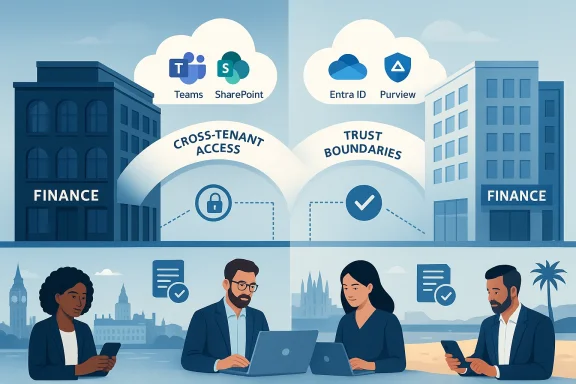
Microsoft’s broader multi-tenant work explains why this customer story matters. The company has spent years building secure collaboration features for cross-tenant and multi-tenant environments, including cross-tenant access settings, Teams Connect/shared channels, and the multi-tenant organization capabilities that became generally available in 2024. Microsoft’s own guidance explicitly frames mergers, acquisitions, divestitures, and regulatory compliance as common reasons organizations end up managing more than one tenant. In other words, W1M is not an edge case; it is a textbook use case for the architecture Microsoft has been refining.
The significance extends beyond W1M’s immediate cleanup project. Wealth and investment management firms often sit at the intersection of confidential client data, market-sensitive information, and strict retention and supervision requirements. When such firms modernize collaboration, the question is not whether they can make work easier; it is whether they can do so without creating new exposure. Microsoft’s pitch is that modern multi-tenant controls can reduce friction while keeping each tenant’s security and compliance boundary intact. That message is consistent across Microsoft’s security and collaboration documentation, which repeatedly emphasizes data staying within the tenant and policy controls following the organization’s governance model.
There is also a strategic dimension. As organizations scale through acquisition, they often face a choice between a quick but brittle merger and a slower but more governable one. Microsoft’s newer tenant-aware collaboration model is attractive because it offers a middle path: connect the environments first, then standardize the estate over time. That is a much more realistic approach for firms with multiple offices, multiple legal entities, and multiple oversight regimes. It acknowledges that identity and compliance architecture usually cannot be rewritten overnight.
Key points:
Victoria Carroll’s perspective adds another layer. Consistency in marketing and client-facing work is often the first casualty of siloed document systems, because teams are forced to reconcile multiple versions and sources of truth. In regulated financial services, that issue is amplified because every externally facing claim has to be accurate, current, and properly approved. A collaboration layer that reduces version drift can therefore help both productivity and compliance at the same time. That is a rare case where operational and regulatory goals genuinely align.
The leadership framing also matters. Michael Allen described the target state as one that would strengthen cyber security, improve IT risk posture, and provide a flexible user experience that could scale with future business needs. That language suggests the company was not just trying to unify tools; it was trying to future-proof the organization for more growth, including possible future acquisitions. In other words, the project was both remedial and architectural.
For W1M, this means collaboration does not have to imply administrative sameness. A firm can maintain distinct governance zones while giving employees a smoother experience when working across the combined organization. That is especially important where supervisory obligations, retention rules, and regional compliance requirements differ. The architecture becomes a mechanism for reconciling complexity rather than erasing it.
Microsoft’s security narrative is reinforced by its Teams and Microsoft 365 guidance, which emphasizes that advanced security and compliance controls are native to the platform. Features such as encryption in transit and at rest, single sign-on through Microsoft Entra ID, and Microsoft Purview DLP are not presented as optional extras but as standard layers in the collaboration stack. That is why the W1M story feels credible: the platform already has the control points that a regulated firm needs to unify collaboration safely.
Organizations considering similar projects should think in terms of sequence:
Teams matters here because it sits at the center of modern work. Microsoft’s own guidance says Teams is built on the Microsoft 365 cloud and that customer data stays within the tenant, with security and compliance policies extending across the service. For a company like W1M, that means collaboration can be centralized without losing the assurances that auditors and regulators care about. In practice, that is the difference between an IT convenience project and a true operating-model change.
The integration layer also helps explain why Microsoft has invested so heavily in cross-tenant collaboration features. If organizations are going to remain multi-tenant for structural reasons, then productivity services need to be tenant-aware rather than tenant-blind. That is the logic behind secure cross-organizational chat, shared channels, and multi-tenant organization controls. The platform is adapting to the way enterprises actually exist, instead of insisting they all behave like greenfield startups.
This is especially relevant in financial services, where security reviews often outlast product demos. Enterprise buyers want fewer moving parts, fewer vendors to govern, and fewer gaps between collaboration and compliance. Microsoft benefits when those preferences align with its own bundled architecture. The W1M example gives the company a concrete narrative for why its suite approach is not just convenient, but strategically safer.
At the same time, the story raises the bar for competitors. If Microsoft can show that multi-tenant governance works in a regulated merger context, then alternative vendors must prove not only that they can collaborate securely, but that they can do so across organizational boundaries without adding operational friction. That is a harder case to make, especially when the customer already lives in the Microsoft ecosystem.
In the near term, this also strengthens Microsoft’s partner ecosystem. Firms that specialize in identity, compliance, migration, and managed services will increasingly build around Microsoft’s tenant-aware model rather than trying to replace it. For customers, that is both a benefit and a constraint: the ecosystem becomes richer, but the center of gravity remains Microsoft 365. That is a tradeoff many organizations will accept if the result is easier governance.
The second lesson is that standardization does not have to mean sameness. A good multi-tenant design can preserve legal and operational distinctions while harmonizing user experience and policy enforcement. That is critical for regulated firms, international businesses, and organizations operating through acquired entities. It is also the main reason Microsoft’s 2024 multi-tenant organization launch was such an important milestone.
The third lesson is that collaboration and compliance should be designed together. If collaboration tooling is adopted first and compliance adjusted later, the organization usually inherits a mess of exceptions. If the control model comes first, the business can move faster with fewer surprises. W1M’s leadership seems to have understood that sequencing from the outset, and that is why the project is notable.
The next phase will be about maturity. Organizations will want better automation, more transparent controls, and clearer ways to extend the model across identity, data, and endpoint security without creating new operational overhead. The more Microsoft can prove that tenant-aware collaboration works at scale, the more it strengthens its position as the default enterprise collaboration platform for complex, regulated, and multi-entity businesses. That is the deeper lesson inside the W1M case: secure collaboration is no longer a nice-to-have feature, but a core ingredient of enterprise structure.
Source: Microsoft W1M enables secure, compliant collaboration across Microsoft 365 tenants | Microsoft Customer Stories
 Background
W1M Wealth and Investment Management Ltd was formed in 2025 through the merger of London & Capital and Waverton, combining more than £19 billion in assets, more than 325 employees, and offices across London, Edinburgh, Glasgow, Barcelona, and Barbados. The firm also operates under an unusually demanding regulatory mix, spanning the FCA, the SEC, and CNMV, which means the technology stack has to support governance, auditability, and secure data handling from the start. Microsoft’s customer story makes clear that the two legacy businesses began life as one company in commercial terms but remained separate in Microsoft 365 terms. That kind of split is common after mergers, but it becomes much harder to manage when compliance obligations are high and the business wants to move quickly.The real issue was not merely duplication. Each firm had spent roughly two decades building its own processes, security configurations, and integrations, so the new organization inherited two distinct ways of working that needed to coexist, at least temporarily. In Microsoft’s telling, W1M’s IT leadership saw the fragmentation as a source of duplication, limited visibility, and operational drag, while business leaders worried about misalignment and version-control errors. That is the kind of problem that sounds mundane until you map it to regulated decision-making, where one wrong document version or one inconsistent approval trail can become a material risk.
Microsoft’s broader multi-tenant work explains why this customer story matters. The company has spent years building secure collaboration features for cross-tenant and multi-tenant environments, including cross-tenant access settings, Teams Connect/shared channels, and the multi-tenant organization capabilities that became generally available in 2024. Microsoft’s own guidance explicitly frames mergers, acquisitions, divestitures, and regulatory compliance as common reasons organizations end up managing more than one tenant. In other words, W1M is not an edge case; it is a textbook use case for the architecture Microsoft has been refining.
The significance extends beyond W1M’s immediate cleanup project. Wealth and investment management firms often sit at the intersection of confidential client data, market-sensitive information, and strict retention and supervision requirements. When such firms modernize collaboration, the question is not whether they can make work easier; it is whether they can do so without creating new exposure. Microsoft’s pitch is that modern multi-tenant controls can reduce friction while keeping each tenant’s security and compliance boundary intact. That message is consistent across Microsoft’s security and collaboration documentation, which repeatedly emphasizes data staying within the tenant and policy controls following the organization’s governance model.
Why Multi-Tenant Collaboration Matters
The W1M case highlights a reality many enterprises are now confronting: one company does not always mean one tenant. Mergers, acquisitions, divestitures, regional regulation, and historical IT decisions can all leave organizations with a federated identity and collaboration landscape that is difficult to simplify quickly. Microsoft’s multi-tenant framework tries to make that reality less painful by letting organizations connect people and services across tenants while preserving autonomy and policy boundaries. That is especially valuable when the business cannot afford a long freeze while IT rationalizes everything.The business case for structure
In a regulated sector, collaboration is never just about convenience. A fragmented environment can slow approvals, complicate document governance, and make it harder to enforce consistent security settings across teams that need to act as one business. Microsoft’s customer story on W1M underscores exactly that tension: the firm needed a shared operating model, but it could not ignore the fact that each legacy estate had deep-rooted controls and integrations that had to be respected. That is why the value of multi-tenant collaboration is not simply “people can work together”; it is that they can do so with less administrative compromise.There is also a strategic dimension. As organizations scale through acquisition, they often face a choice between a quick but brittle merger and a slower but more governable one. Microsoft’s newer tenant-aware collaboration model is attractive because it offers a middle path: connect the environments first, then standardize the estate over time. That is a much more realistic approach for firms with multiple offices, multiple legal entities, and multiple oversight regimes. It acknowledges that identity and compliance architecture usually cannot be rewritten overnight.
What Microsoft is really selling
Microsoft is not only selling software features here; it is selling a governance strategy. The company’s messaging around multi-tenant organizations and cross-tenant access consistently emphasizes secure collaboration, controlled trust, and respect for compliance boundaries. In practice, that means enterprises can allow selective sharing and collaboration without flattening every tenant into a single administrative domain. For companies like W1M, that distinction matters because complete consolidation may be too disruptive, but permanent fragmentation may be too risky.Key points:
- Multi-tenant collaboration is now a mainstream enterprise requirement, not a niche feature.
- Mergers and acquisitions are a primary driver of tenant complexity.
- Microsoft’s model is designed to balance flexibility with security and compliance boundaries.
- The W1M story is a practical example of that architecture in action.
W1M’s Operational Challenge
W1M’s challenge was not a simple migration project. The firm had to align separate Microsoft 365 environments that had evolved independently for years, each with different processes, security choices, and custom integrations. That kind of divergence creates hidden complexity: duplicated workflows, inconsistent document handling, and different assumptions about who can access what. Adnan Uz-Zaman’s comments in the customer story make the core issue plain: fragmentation had become a drain on visibility and efficiency.Fragmentation is a control problem
The temptation in many post-merger environments is to think of fragmentation as an inconvenience first and a security issue second. In reality, it is both. When users do not have a unified collaboration environment, they tend to work around the gap with email forwarding, local copies, and ad hoc file sharing, which can quickly erode auditability. Microsoft’s story suggests W1M wanted to avoid exactly that outcome by making consolidation part of the security design, not an afterthought.Victoria Carroll’s perspective adds another layer. Consistency in marketing and client-facing work is often the first casualty of siloed document systems, because teams are forced to reconcile multiple versions and sources of truth. In regulated financial services, that issue is amplified because every externally facing claim has to be accurate, current, and properly approved. A collaboration layer that reduces version drift can therefore help both productivity and compliance at the same time. That is a rare case where operational and regulatory goals genuinely align.
The leadership framing also matters. Michael Allen described the target state as one that would strengthen cyber security, improve IT risk posture, and provide a flexible user experience that could scale with future business needs. That language suggests the company was not just trying to unify tools; it was trying to future-proof the organization for more growth, including possible future acquisitions. In other words, the project was both remedial and architectural.
Legacy systems and inherited risk
Two decades of independently developed systems usually means two decades of accumulated exception handling. That is fine when each business is separate, but after a merger those exceptions can become liabilities because they create different control surfaces, different admin patterns, and different levels of visibility. W1M’s need to consolidate under regulatory pressure made those differences more consequential than usual. It also made a rapid “rip and replace” approach less appealing than a controlled, tenant-aware transition.- Duplicate processes tend to hide duplicated risk.
- Separate integrations often mean separate audit assumptions.
- Version mismatch can turn into client-delivery risk.
- Security inconsistencies become more dangerous as the business scales.
- A phased consolidation is often safer than an abrupt one.
Security and Compliance by Design
The most important part of the W1M story is not the collaboration tooling itself. It is the idea that collaboration can be redesigned so that security and compliance are built in from the start rather than bolted on later. Microsoft’s documentation around Teams and multi-tenant organizations repeatedly stresses data residency within the tenant, encryption, identity controls, and policy-driven sharing. That matters because regulated firms need confidence that collaboration does not dilute their governance model.The compliance boundary is the product
Microsoft’s support for multi-tenant organizations is notable because it treats each tenant as a secure, autonomous unit that can still be connected to others under common policies. That is a strong fit for financial services, where legal entities may need their own controls even while they share an enterprise identity strategy. It also explains why Microsoft has invested in cross-tenant access and secure collaboration settings rather than pushing every customer toward a monolithic tenant.For W1M, this means collaboration does not have to imply administrative sameness. A firm can maintain distinct governance zones while giving employees a smoother experience when working across the combined organization. That is especially important where supervisory obligations, retention rules, and regional compliance requirements differ. The architecture becomes a mechanism for reconciling complexity rather than erasing it.
Microsoft’s security narrative is reinforced by its Teams and Microsoft 365 guidance, which emphasizes that advanced security and compliance controls are native to the platform. Features such as encryption in transit and at rest, single sign-on through Microsoft Entra ID, and Microsoft Purview DLP are not presented as optional extras but as standard layers in the collaboration stack. That is why the W1M story feels credible: the platform already has the control points that a regulated firm needs to unify collaboration safely.
Secure collaboration is a governance discipline
Secure collaboration is often misunderstood as a set of technical toggles. In reality, it is a governance discipline that spans identity, access, document control, monitoring, and user behavior. Microsoft’s tenant-aware model works best when administrators define who can collaborate, what can be shared, and which trust relationships are acceptable across the organization. That is more work than a casual “open everything up” approach, but it is far less risky.Organizations considering similar projects should think in terms of sequence:
- Define the legal and compliance boundaries.
- Map the collaboration scenarios that genuinely need cross-tenant access.
- Apply identity and trust settings before broad user enablement.
- Standardize document and workflow controls.
- Monitor usage and refine the model over time.
Microsoft 365 as an Integration Layer
The W1M story also illustrates a larger trend: Microsoft 365 is increasingly being used as an integration layer for enterprise operations, not just a productivity suite. When an organization merges, the challenge is rarely just email and files. It is the connected web of Teams, SharePoint, OneDrive, security policies, and custom workflows that determines whether employees can actually function as one company. Microsoft’s multi-tenant capabilities are designed to bring those layers into alignment without forcing a premature full migration.Collaboration is the visible surface
Employees experience the merger through the tools they use every day. If meetings, chats, files, and approvals remain split across environments, the business feels divided even if the legal structure says otherwise. Microsoft’s customer story suggests W1M wanted to reduce that cognitive burden by standardizing the user experience while preserving the back-end controls that different legal entities require. That is a subtle but important distinction: the goal is not just centralization, but coherence.Teams matters here because it sits at the center of modern work. Microsoft’s own guidance says Teams is built on the Microsoft 365 cloud and that customer data stays within the tenant, with security and compliance policies extending across the service. For a company like W1M, that means collaboration can be centralized without losing the assurances that auditors and regulators care about. In practice, that is the difference between an IT convenience project and a true operating-model change.
The integration layer also helps explain why Microsoft has invested so heavily in cross-tenant collaboration features. If organizations are going to remain multi-tenant for structural reasons, then productivity services need to be tenant-aware rather than tenant-blind. That is the logic behind secure cross-organizational chat, shared channels, and multi-tenant organization controls. The platform is adapting to the way enterprises actually exist, instead of insisting they all behave like greenfield startups.
Why this matters for regulated industries
Regulated firms often have to choose between flexibility and control, and historically that tradeoff has been painful. Microsoft’s approach suggests those two goals can coexist if the collaboration fabric is designed carefully enough. W1M’s use case is strong evidence of that shift because it combines merger complexity with financial-services oversight and still demands a modern employee experience. That is exactly the kind of scenario where Microsoft 365’s collaboration and governance stack has strategic value.- Teams is the collaboration front door.
- SharePoint and OneDrive are the controlled document backbone.
- Entra ID provides identity and trust logic.
- Purview and Defender add policy and protection.
- Multi-tenant organization controls connect the pieces without flattening them.
Competitive Implications
W1M’s story is also a quiet but meaningful competitive signal for Microsoft. The company is positioning Microsoft 365 as the preferred answer for enterprises that cannot afford a simplistic “one tenant, one team, one set of tools” model. That puts pressure on rivals offering standalone collaboration, identity, or compliance products, because Microsoft is arguing that the strongest solution is one where those capabilities are already integrated.Platform depth versus point solutions
The advantage of Microsoft’s approach is obvious: if collaboration, identity, and compliance are native to the same platform, the integration burden shrinks dramatically. That matters most in mergers, where IT teams are already busy reconciling data, users, access rights, and operational processes. A point solution can solve one problem well, but W1M’s situation required a set of linked controls that could operate consistently across the combined estate. Microsoft’s story is that the platform itself is the solution.This is especially relevant in financial services, where security reviews often outlast product demos. Enterprise buyers want fewer moving parts, fewer vendors to govern, and fewer gaps between collaboration and compliance. Microsoft benefits when those preferences align with its own bundled architecture. The W1M example gives the company a concrete narrative for why its suite approach is not just convenient, but strategically safer.
At the same time, the story raises the bar for competitors. If Microsoft can show that multi-tenant governance works in a regulated merger context, then alternative vendors must prove not only that they can collaborate securely, but that they can do so across organizational boundaries without adding operational friction. That is a harder case to make, especially when the customer already lives in the Microsoft ecosystem.
A stronger case for Microsoft-first modernization
Microsoft’s value proposition in cases like W1M is not merely “you already own the tools.” It is that the company is steadily filling in the exact gaps that used to make multi-tenant collaboration awkward. The more mature these capabilities become, the less incentive organizations have to assemble a patchwork of third-party systems to bridge mergers and multi-entity operations. That could have a long-term effect on procurement behavior, especially in regulated markets.In the near term, this also strengthens Microsoft’s partner ecosystem. Firms that specialize in identity, compliance, migration, and managed services will increasingly build around Microsoft’s tenant-aware model rather than trying to replace it. For customers, that is both a benefit and a constraint: the ecosystem becomes richer, but the center of gravity remains Microsoft 365. That is a tradeoff many organizations will accept if the result is easier governance.
What This Means for IT Leaders
For CIOs and IT leaders, the W1M story is a reminder that post-merger technology strategy should not start with “how do we merge everything?” but with “how do we make the business operate safely while the estates are still separate?” That is a more practical question, and often a more realistic one. Microsoft’s multi-tenant approach provides a way to reduce disruption first, then standardize at a pace the organization can absorb.Lessons from the W1M pattern
The first lesson is that visibility matters as much as consolidation. If leaders cannot see where work is happening, where data is stored, and which controls apply, they cannot safely unify the environment. W1M’s move toward a secure, compliant collaboration model shows that tenant-aware governance can create the visibility needed for later rationalization.The second lesson is that standardization does not have to mean sameness. A good multi-tenant design can preserve legal and operational distinctions while harmonizing user experience and policy enforcement. That is critical for regulated firms, international businesses, and organizations operating through acquired entities. It is also the main reason Microsoft’s 2024 multi-tenant organization launch was such an important milestone.
The third lesson is that collaboration and compliance should be designed together. If collaboration tooling is adopted first and compliance adjusted later, the organization usually inherits a mess of exceptions. If the control model comes first, the business can move faster with fewer surprises. W1M’s leadership seems to have understood that sequencing from the outset, and that is why the project is notable.
Enterprise and consumer impact are not the same
Enterprise users care about control, auditability, and continuity. Consumer-style simplicity is useful only if it does not erase the governance boundaries that a regulated company needs. Microsoft’s multi-tenant model is compelling because it does not force firms to choose between a seamless front end and a fragmented back end; instead, it tries to reconcile both. That is a more mature answer to enterprise collaboration than the old “one size fits all” model.- Design for coexistence before full consolidation.
- Treat identity trust as a first-order architecture decision.
- Keep compliance and collaboration in the same planning track.
- Avoid allowing user convenience to create shadow IT.
- Use multi-tenant capabilities to reduce merger friction.
Strengths and Opportunities
W1M’s approach showcases the practical value of Microsoft’s multi-tenant collaboration strategy, especially for regulated organizations that need to move fast without breaking governance. The broader opportunity is that this model can become a template for post-merger modernization across finance, professional services, and other industries where separate legal entities must still act like one business. Microsoft also gains a stronger proof point for the claim that collaboration, security, and compliance can be designed together rather than negotiated separately.- Reduced fragmentation across people, files, and workflows.
- Better visibility for IT and compliance teams.
- Stronger security posture through tenant-aware controls.
- Cleaner document governance with fewer versioning problems.
- More scalable merger integration for future acquisitions.
- Improved employee experience without sacrificing control.
- A stronger Microsoft ecosystem story for enterprise buyers.
Risks and Concerns
The main risk is that multi-tenant collaboration can be misunderstood as a substitute for real governance work. If organizations connect tenants without clearly defining trust boundaries, document rules, and operational ownership, they can create a false sense of unification while leaving the underlying complexity in place. Another concern is vendor dependency: the more an enterprise standardizes on Microsoft’s native controls, the harder it may be to pivot later if business needs change or licensing becomes more complicated.- Configuration sprawl if policies are not standardized.
- Overconfidence in platform defaults when business rules are more complex.
- Hidden integration debt from legacy custom systems.
- Incomplete user adoption if change management is weak.
- Vendor lock-in pressure as collaboration and security converge.
- Residual compliance gaps if regional requirements are not mapped carefully.
- Version-control errors if old habits persist alongside new tools.
Looking Ahead
The W1M story suggests that multi-tenant collaboration will become more important, not less, as enterprises continue to consolidate through acquisition and regional expansion. Microsoft is clearly betting that customers will prefer a model that lets them connect securely first and rationalize later, rather than endure a long and disruptive migration before any value appears. That is a sensible bet, especially in industries where governance is not optional and time-to-integration matters.The next phase will be about maturity. Organizations will want better automation, more transparent controls, and clearer ways to extend the model across identity, data, and endpoint security without creating new operational overhead. The more Microsoft can prove that tenant-aware collaboration works at scale, the more it strengthens its position as the default enterprise collaboration platform for complex, regulated, and multi-entity businesses. That is the deeper lesson inside the W1M case: secure collaboration is no longer a nice-to-have feature, but a core ingredient of enterprise structure.
- Expect more merger-driven adoption of multi-tenant Microsoft 365 controls.
- Watch for expanded use of cross-tenant trust and shared collaboration services.
- Monitor how regulated industries balance consolidation with autonomy.
- Look for stronger identity governance as the foundation for collaboration.
- Expect Microsoft to keep pushing tenant-aware security as a differentiator.
Source: Microsoft W1M enables secure, compliant collaboration across Microsoft 365 tenants | Microsoft Customer Stories
