

Wasatch County, Utah, has unanimously approved an AI-use policy that encourages employees to experiment with the technology while putting human review, privacy controls and accountability ahead of automation.
The policy, adopted by the County Council on July 15, does not treat generative AI as a tool to ban or a decision-maker to trust blindly. IT Director Don Wood told local outlet KPCW that staff can use approved, county-subscribed tools that meet government privacy standards, but employees remain responsible for checking the output and disclosing how AI was used in their work.
That is a notably practical position for a local government: permit controlled use, make the person using it accountable, and prevent staff from pasting government information into whatever free chatbot happens to be available.
According to The Park Record, Wood described the policy’s guiding principles as encouraging employees to learn and explore AI while protecting privacy, maintaining human accountability, and pursuing fairness and transparency.
The County’s line is clear: AI may assist with work, but it cannot make final decisions without a person in the loop. That applies not only to obvious high-risk tasks, but also to the more mundane risk of treating generated text, analysis or summaries as authoritative.
County Councilor Erik Rowland offered a useful example. He used AI to work through Utah Department of Transportation material spanning more than 450 pages and compare it with county ordinances, but did not use it to write the county’s final public comment. The tool supported research; officials owned the final analysis and submission.
For Windows and IT administrators, that distinction is familiar. Copilot, ChatGPT and similar services can speed up document triage, summaries, draft code and research, but they cannot inherit an employee’s legal, operational or records-management responsibilities.
The policy also assigns employees responsibility for recognizing possible bias and hallucinations in AI-generated output. Regular training is planned, according to KPCW.
That approach matters because an organization’s AI risk is often less about a formal deployment than routine staff use. A browser tab, personal account or unapproved plug-in can become a data-handling problem long before IT has visibility into it. County-managed accounts and stated limits on what may be entered into them provide a basic control point, though they do not remove the need for logging, data-classification rules and staff education.
Wasatch County’s immediate practical consequence is that employees can use approved AI tools, but must validate the results and remain accountable for every decision and document they produce.
The policy, adopted by the County Council on July 15, does not treat generative AI as a tool to ban or a decision-maker to trust blindly. IT Director Don Wood told local outlet KPCW that staff can use approved, county-subscribed tools that meet government privacy standards, but employees remain responsible for checking the output and disclosing how AI was used in their work.
That is a notably practical position for a local government: permit controlled use, make the person using it accountable, and prevent staff from pasting government information into whatever free chatbot happens to be available.
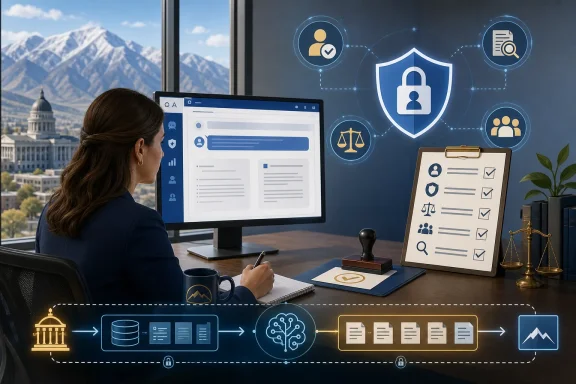 Human review is non-negotiable
According to The Park Record, Wood described the policy’s guiding principles as encouraging employees to learn and explore AI while protecting privacy, maintaining human accountability, and pursuing fairness and transparency.The County’s line is clear: AI may assist with work, but it cannot make final decisions without a person in the loop. That applies not only to obvious high-risk tasks, but also to the more mundane risk of treating generated text, analysis or summaries as authoritative.
County Councilor Erik Rowland offered a useful example. He used AI to work through Utah Department of Transportation material spanning more than 450 pages and compare it with county ordinances, but did not use it to write the county’s final public comment. The tool supported research; officials owned the final analysis and submission.
For Windows and IT administrators, that distinction is familiar. Copilot, ChatGPT and similar services can speed up document triage, summaries, draft code and research, but they cannot inherit an employee’s legal, operational or records-management responsibilities.
Approved tools, data boundaries
Wasatch County already has a dedicated Microsoft Copilot account, Wood told The Park Record. Per KPCW’s reporting, the county intends to avoid free AI services and products that store data outside the United States, while requiring employees to consider public-records obligations and privacy when using AI.The policy also assigns employees responsibility for recognizing possible bias and hallucinations in AI-generated output. Regular training is planned, according to KPCW.
That approach matters because an organization’s AI risk is often less about a formal deployment than routine staff use. A browser tab, personal account or unapproved plug-in can become a data-handling problem long before IT has visibility into it. County-managed accounts and stated limits on what may be entered into them provide a basic control point, though they do not remove the need for logging, data-classification rules and staff education.
A policy designed to change
Wood expects the policy may need revisions as products and practices evolve. Rowland made the same point, noting that AI capabilities and accepted safeguards are moving quickly.Wasatch County’s immediate practical consequence is that employees can use approved AI tools, but must validate the results and remain accountable for every decision and document they produce.
References
- Primary source: Park Record
Published: 2026-07-17T19:45:00+00:00
Wasatch County encourages responsible AI use in operations - Park Record
Wasatch County has approved parameters on artificial intelligence use, but IT Director Don Wood said he still wants employees to explore and utilize AI.www.parkrecord.com - Related coverage: kpcw.org
Wasatch County sets artificial intelligence use guardrails
Wasatch County will require people to verify work done by AI.www.kpcw.org - Related coverage: docs.wasatch.utah.gov
- Related coverage: wasatchcounty.gov