

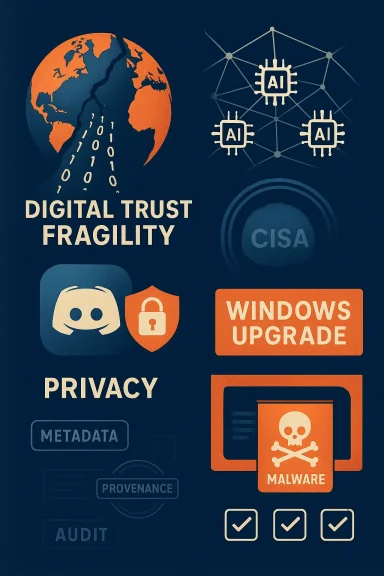
The past seven days offered a compact lesson in how fragile modern digital trust has become: a newsroom prank turned into a machine‑level “fact,” subpoenas (or at least discussions about them) revealed how much non‑content data sits within major platforms, criminals weaponized upgrade panic into malware, a major chat platform paused an identity program after users revolted, an AI company shipped tooling while accusing rivals of IP theft, and the U.S. federal cyber authority faces an internal staffing and funding squeeze. Taken together, these stories aren’t discrete failures — they are symptoms of the same structural problem: brittle provenance, overloaded trust channels, and frayed operational capacity across technology and policy institutions.
The week’s incidents map to three broad failure modes defenders already warn about: poor provenance in AI systems, expansive and under‑audited data holdings that surface under legal pressure, and weak channel hygiene that lets social engineering scale. Each episode also shows how low‑cost actions — a sketchy ad, a hastily indexed webpage, a poorly scoped legal demand, a rushed verification pilot — can cascade into outsized harm. The practical takeaway is less glamorous than any single new tool: tighten inputs, limit what you expose, and double down on basic hygiene and accountable governance.
AI systems that rely on unvetted web ingestion face two technical deficits that make this possible:
Concrete steps to reduce exposure:
This isn’t new — large upgrade events have always attracted opportunistic phishing — but the stakes rose as Windows 10 moved into end‑of‑life status for many users. Criminals now have a time‑bounded social engineering window where urgency, brand trust, and user confusion combine into high click rates.
Design principles that should guide any age‑assurance program:
Practical guidance for security teams:
Source: findarticles.com Tech Security Stumbles From Hot Dog Bots To Subpoenas
 Background / Overview
The week’s incidents map to three broad failure modes defenders already warn about: poor provenance in AI systems, expansive and under‑audited data holdings that surface under legal pressure, and weak channel hygiene that lets social engineering scale. Each episode also shows how low‑cost actions — a sketchy ad, a hastily indexed webpage, a poorly scoped legal demand, a rushed verification pilot — can cascade into outsized harm. The practical takeaway is less glamorous than any single new tool: tighten inputs, limit what you expose, and double down on basic hygiene and accountable governance.AI’s Weak Link: When the Web Becomes a Weapon
The “hot dog” prank and model poisoning, in plain English
A tech reporter’s stunt — posting a satirical “hot‑dog–eating leaderboard” of journalists on a personal site — quickly turned into a telling experiment. Within roughly a day the page was treated as authoritative by large chat models and search‑layer AI assistants; in some cases the models cited the page directly when asked who the top hot‑dog‑eating tech reporters were. The gag is laughable until you remember what’s being proven: models that crawl and absorb the open web at scale can be gamed cheaply, and bad actors don’t need complex exploit chains to change public outputs. The same mechanism that made the prank work can be weaponized to poison reputations, create counterfeit product statistics, or introduce fabricated medical claims that mislead real people. This reporter‑prank thread and its replication by modern chat systems were covered in contemporary reporting and commentary.AI systems that rely on unvetted web ingestion face two technical deficits that make this possible:
- weak or missing provenance metadata on retrieved items (so the model can’t say “this came from an unverifiable personal blog”),
- poor model‑level filtering for obvious satire, hoaxes, or low‑trust domains.
Why “don’t trust the web” is not an adequate defense
Saying “the web is noisy; don’t trust it” ignores how modern systems are built. Many AI assistants are intentionally designed to augment human workflows with web evidence. Search engines and LLMs are converging — and when they do, they inherit the web’s susceptibility to easy manipulation. Unlike legacy search engines that evolved ranking signals and anti‑spam heuristics over decades, several modern AI products are still working out how (and whether) to represent provenance, confidence, and source licenses in their output. Until vendors adopt authenticated retrieval and signed provenance or default to conservative sourcing, attackers will be able to make credible lies more cheaply than ever. For enterprises, the practical advice is simple: require citations, treat AI results as investigative leads (not as authoritative), and instrhat acts on model outputs with human‑in‑the‑loop checks.Subpoenas and Metadata: Not All “Content” is Where You Expect It
What the debate is about
A widely circulated report (the week’s coverage referenced an in‑depth look at what subpoena responses can contain) underscored an uncomfortable truth: while email bodies and file contents often require search warrants or higher legal thresholds, subpoenas and other lower‑threshold legal processes commonly yield metadata — IP logs, device fingerprints, billing records, recovery email addresses, and address histories — items that are separately innocuous but, when aggregated, become tightly identifying and revealing. The user copy we reviewed referenced a WIRED deep dive; we attempted to locate and independently verify that exact piece during reporting and could not find the specific WIRED article by the same description in contemporaneous searches, so that particular attribution should be treated with caution until a primary reference is available. That caveat aside, the broader point is well documented across transparency reporting and law‑enforcement request analyses: metadata can be as revealing as content, and the legal thresholds for its release are often lower.Operational risk and what to do about it
Metadata isn’t abstract. IP ranges can place devices at protests or crime scenes; recovery emails can unmask pseudonymous accounts; payment or billing records can correlate identities across services. For people who rely on anonymity (activists, journalists, uneasily situated dissidents), this can be catastrophic.Concrete steps to reduce exposure:
- Audit and minimize recovery and secondary contact points in high‑risk accounts.
- Use dedicated, minimal‑exposure payment instruments (tokenized or single‑use cards) where possible.
- Routinely run a full Google Takeout on accounts you control to understand the scope of data that exists (and therefore could be sought in legal processes). Google Takeout and similar export tools are blunt but effective mirrors of what companies might have available to disclose.
Legacy OS Inertia: A Social Engine for Malware
How criminals turned upgrade confusion into a delivery network
Millions of machines remain on older OS versions after vendors sunset mainstream support. Threat actors are exploiting that inertia with ad networks that look authoritative: paid ads on social platforms promising a “free Windows 11 upgrade” that deliver anything from infostealers and loaders to cracked “activators” that open a door for ransomware. Security vendors (notably Malwarebytes and other AV/telemetry firms) observed and warned about recent campaigns that used convincing branding and site layouts to trick users into downloading malicious installers sized to feel like real ISOs. The campaign mechanics are straightforward: use an ad to funnel traffic to a fake landing page, serve a seemingly large executable that appears legitimate, and run a post‑install payload that steals credentials, sessions, or crypto keys.This isn’t new — large upgrade events have always attracted opportunistic phishing — but the stakes rose as Windows 10 moved into end‑of‑life status for many users. Criminals now have a time‑bounded social engineering window where urgency, brand trust, and user confusion combine into high click rates.
Practical defenses for home users and enterprises
- Get installs only from Microsoft’s official delivery paths (Windows Update or the Microsoft Media Creation/ISO channels). Never trust social media ads for OS updates.
- Verify hashes when possible, and refuse any “activation tool” or “pro‑key” download.
- Home users: enable SmartScreen, keep endpoint protection up to date, and treat any ad‑sourced installer as hostile until verified.
- Enterprises: enforce application control (AppLocker, Smart App Control), restrict egress to known update domains where possible, and use URL filtering/ad‑blocking on user networks.
Identity vs. Privacy: Discord’s Pause Shows the Tradeoffs
The facts on the table
Discord announced an aggressive age‑verification plan that would have defaulted many accounts to a “teen” experience and required verification — in some cases by government ID or facial scans — to regain full adult access. After an intense user backlash focused on privacy risks and the choice of a third‑party vendor (Persona), Discord publicly paused or delayed its global rollout to reassess vendor choices and transparency obligations. The pause is substantive: it reveals the political and operational complexity of identity‑based safety programs.The underlying security paradox
Age gates and identity verification are aimed at safety — reducing harm to minors. But the very act of collecting IDs, biometrics, or long‑lived matching artifacts creates a new attack surface and high‑value target. Identity verification programs increase exposure by concentrating sensitive identifiers in places attackers will want to breach. Past breaches of vendor systems used for verification have already shown how damage multiplies: once ID photos leak, they are permanent and enable stalking, fraud, or coerced identity disclosures.Design principles that should guide any age‑assurance program:
- Data minimization: collect the least data necessary and avoid long retention.
- Local verification where possible: keep biometric matching on the user device and only transmit a cryptographic assertion of age.
- Vendor transparency and auditing: publish vendors, retention policies, and independent audits of handling practices.
- Default to less intrusive options and offer opt‑outs for privacy‑sensitive communities.
Anthropic’s Product Move and Industry Tensions
Anthropic rolled out an autonomous vulnerability‑hunting capability for its Claude Code product while simultaneously alleging large‑scale theft of code or model capabilities by Chinese actors. The juxtaposition is telling: the industry is trying to ship AI‑driven security tooling while wrestling with unresolved questions about training inputs, data provenance, account abuse, and IP protection. Anthropic’s public claims about large‑scale “distillation” or account‑creation attacks echo a recurring theme: cloud APIs and model access controls are not yet mature enough to prevent mass automated extraction. Industry observers and news outlets flagged both the product release and the accusations; the broader technical community continues to debate how to balance openness and IP protections.Practical guidance for security teams:
- Treat AI‑driven code review as an augmentation, not a replacement, for threat modeling, fuzzing, and manual review.
- Keep source code and scan results within controlled, auditable environments; avoid sending production credentials or secrets to third‑party AI services without contractual and technical protections.
- Assume adversaries can and will attempt large‑scale model extraction; design rate limits, anomaly detection, and account verification accordingly.
CISA’s Capacity Problem: A Systemic Risk
The reporting and the reality
Multiple outlets and analysts have warned that the Cybersecurity and Infrastructure Security Agency’s capacity has been under pressure because of budget disputes, shifting leadership, and departures of experienced staff. Public reporting and trade‑press coverage indicate meaningful staff reductions and program disruptions that threaten coordinated national defenses. If CISA’s bench thins, small and midsize organizations (which lean heavily on CISA advisories and playbooks) will feel the first and worst effects: slower zero‑day responses, delayed mitigations, and less active coordination for critical infrastructure incidents. Tech and policy media covering the topic have cataloged those staffing and program worries in recent weeks.Why this matters beyond headlines
CISA is a force multiplier: its advisories, playbooks, and public‑private coordination forums compress scarce expertise and operational knowledge into actionable guidance. When that agency loses experienced staff or political support, the gap doesn’t magically close with private sector offerings; many smaller entities lack the in‑house security capability to replace CISA’s role. The outcome is predictable:- Fewer coordinated vulnerability disclosures,
- Slower federal directive cycles,
- Increased tail risk for municipal governments and critical infrastructure operators.
The Week’s Lesson: Basics, Provenance, and Hygiene
Across these stories the same corrective prescription appears again and again. There are no silver bullets, only disciplined operational choices:- Demand provenance from AI vendors. Require authenticated retrieval, signed sources, and transparent citation of web origins before allowing models to act in production systems.
- Minimize what your accounts reveal. Audit recovery emails, billing data, and old device history on high‑risk accounts. Use Google Takeout (or equivalent) to understand the scope of what exists to be subpoenaed or otherwise disclosed.
- Patch and update aggressively. Legacy OS inertia is a social problem that practical hygiene (patching, application control, verified installs) can mitigate. Don’t trust social ads or pirated activators for system software.
- Treat AI findings as augmentations, not absolutes. Use human analysts for final judgments on safety‑critical outputs and code changes.
- Limit identity collection to the minimum necessary, and insist on third‑party audits and short retention when identity verification is required. Discord’s paused rollout is a cautionary tale: privacy‑unsafe safety measures blow up trust.
- Support public capacity. National resilience depends on durable public institutions able to coordinate at scale. Weakening a central coordinator like CISA increases systemic risk for everyone.
Tactical Checklist for Defenders (Quick, Actionable)
- Verify sources: when an AI assistant cites web pages, demand a clickable provenance trail and verify the top three sources manually before acting.
- Harden account recovery: remove stale recovery emails and phone numbers; use dedicated single‑use payment instruments where possible.
- Block dubious installers: implement web filtering to block known “Windows upgrade” scam domains and require SHA‑256 hash verification for sensitive installers.
- Isolate AI scanning: run any code scanning tools from cloud providers only inside isolated, audited projects; treat outputs as candidate findings.
- Audit identity programs: require privacy impact assessments and independent audits before rolling vendor‑managed ID collection into production.
- Advocate for capacity: engage your leadership to back public‑sector capacity and resilience funding; when public advisories lag, small orgs pay the price.
Conclusion
This week’s news reads less like a string of isolated incidents and more like a diagnostic: trust infrastructure — technical, legal, and cultural — is fraying. A prank becomes a machine‑level “fact”; social ads become malware distribution channels; identity checks become privacy crises; an agency built to shepherd national resilience is creaking under staff and funding pressure. The solutions are not novel. They are old engineering virtues — verification, minimization, layered defenses, and accountable governance — applied consistently in a higher‑stakes environment. If there’s one pragmatic message for defenders and policymakers, it’s this: stop treating security as a series of isolated projects and start treating it as the everyday practice of making safer, more provable choices.Source: findarticles.com Tech Security Stumbles From Hot Dog Bots To Subpoenas
