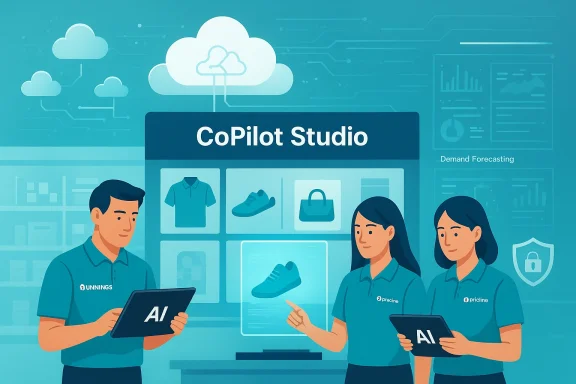
Wesfarmers’ new multi‑year strategic partnership with Microsoft is a striking example of how a large, diversified retail conglomerate intends to turn generative AI and cloud-first engineering into measurable competitive advantage across operations, stores and supply chains. The agreement — which expands Wesfarmers’ use of the Microsoft Cloud, Azure OpenAI Services, Microsoft 365 Copilot and Microsoft Copilot Studio — promises to push AI from pilot projects into production at scale across brands such as Bunnings, Kmart Group, Blackwoods and Priceline. The goals are familiar but ambitious: faster decision‑making, better product availability, improved team‑member productivity, new forms of customer engagement (including agentic commerce), and a sharper, more unified data foundation for long‑term value creation.
Wesfarmers is one of Australia’s largest listed companies and operates an unusually broad retail and industrial portfolio. That breadth — spanning home improvement, general merchandising, industrial supplies and healthcare retailing — brings both complexity and opportunity when it comes to digital transformation. Microsoft is the dominant global cloud vendor that has, in recent years, packaged generative AI capabilities into enterprise products such as Microsoft 365 Copilot, Azure OpenAI, and Copilot Studio. Together, the two companies are betting that a tightly governed, end‑to‑end Microsoft stack can unlock practical and measurable benefits across tens of thousands of employees and millions of customers.
This strategic deal builds on earlier collaboration: Wesfarmers divisions have already trialled and deployed Copilot licences, rolled out developer tools like GitHub Copilot, piloted conversational commerce experiments, and launched store‑level AI assistants. The new phase formalises a multi‑year engineering and skilling commitment with Microsoft, aiming to accelerate those initiatives and scale them across the group.
Microsoft’s product roadmap — integrating generative AI into productivity apps and producing a low‑code/no‑code agent platform — presents a pragmatic path for large organisations to move from proofs of concept to enterprise‑grade deployments. For Wesfarmers, the appeal is an end‑to‑end stack where connectors, security and governance are native to the platform and where Microsoft can provide embedded engineering resources and deployment frameworks for production scale.
From an industry timing perspective, the deal follows a wave of similar large‑scale Copilot and Azure partnerships across Australian institutions. Those deployments are moving beyond narrow pilots into broad employee adoption, and many organisations are pairing technical rollout with training and governance programs to manage risk while capturing productivity benefits.
But the technology also raises immediate questions: what level of autonomy is appropriate for customer transactions? How will agents handle payment authorisation and refunds? What human oversight is required when agents make promises about stock or delivery times? Wesfarmers’ approach — pairing Copilot agents with governance frameworks and controlled rollouts — is designed to mitigate these risks while enabling practical innovation.
Potential pitfalls include model drift as supplier behaviour or seasonality changes, brittle automation that doesn’t handle edge cases (e.g., supplier outages), and the cost of over‑optimisation on historical patterns that don’t account for structural shifts in demand. Operational teams must retain decision authority and the ability to override automated recommendations, and the AI pipelines must surface uncertainty, not just point forecasts.
On the corporate engineering side, developer productivity tools such as GitHub Copilot have been adopted by dozens or hundreds of engineers in many companies, and Microsoft‑led deployments report significant time savings in routine coding tasks. Similarly, Microsoft 365 Copilot aims to reduce administrative friction by summarising email threads, producing drafts for routine documents, and turning unstructured data into actionable summaries.
Key considerations for these productivity plays:
A responsible large‑scale program must include:
The human implications are substantial and not all negative. AI can free employees from repetitive tasks, enabling higher‑value work; but it also requires investment in role redesign, continuous learning programs, and transparent communication about how roles will evolve. A sustainable enterprise AI program invests in both technical training and change management.
Yet this is not a playbook for unbounded optimism. Technical complexity, security risks, governance demands and commercial discipline are what separate pilots from durable advantage. The most successful outcomes will come from an incremental, measurement‑driven program that balances autonomy with control, invests in people as much as technology, and treats data readiness as the first order of business.
If executed carefully, the deal can position Wesfarmers as a pragmatic leader in retail AI for Australia and New Zealand — not because it is the most aggressive adopter of the flashiest models, but because it moves responsibly and at scale, turning agentic possibilities into reliable, auditable improvements for team members and customers alike.
Source: Microsoft Source Wesfarmers and Microsoft announce multi-year strategic partnership to accelerate AI-powered innovation - Source Asia
 Background
Wesfarmers is one of Australia’s largest listed companies and operates an unusually broad retail and industrial portfolio. That breadth — spanning home improvement, general merchandising, industrial supplies and healthcare retailing — brings both complexity and opportunity when it comes to digital transformation. Microsoft is the dominant global cloud vendor that has, in recent years, packaged generative AI capabilities into enterprise products such as Microsoft 365 Copilot, Azure OpenAI, and Copilot Studio. Together, the two companies are betting that a tightly governed, end‑to‑end Microsoft stack can unlock practical and measurable benefits across tens of thousands of employees and millions of customers.This strategic deal builds on earlier collaboration: Wesfarmers divisions have already trialled and deployed Copilot licences, rolled out developer tools like GitHub Copilot, piloted conversational commerce experiments, and launched store‑level AI assistants. The new phase formalises a multi‑year engineering and skilling commitment with Microsoft, aiming to accelerate those initiatives and scale them across the group.
What the partnership covers: scope and stated goals
The public brief for the partnership names a set of clear technology pillars and business objectives:- Expand adoption of the Microsoft Cloud, Azure OpenAI Services, Microsoft 365 Copilot, and Microsoft Copilot Studio.
- Explore agentic commerce (Copilot digital storefronts) that could enable more conversational and automated buying journeys.
- Optimise supply chain processes such as demand forecasting, inventory management, and product availability using AI‑driven insights.
- Deploy AI agents to augment productivity in engineering, finance, marketing and frontline store operations.
- Improve access to organisational information and insights with searchable knowledge agents and out‑of‑the‑box analytic helpers.
- Accelerate skilling, capability development and governance to move AI initiatives from pilot to production.
Why this matters: scale, context and industry timing
Few retail groups are so widely exposed to customer‑facing, logistics and warehouse operations as Wesfarmers. The group’s scale means that even modest percentage improvements in inventory accuracy, forecast precision or staff time saved can translate into significant dollar outcomes. At the same time, retail has become an agility race: speed to market, personalised customer experiences, and supply chain resilience are competitive differentiators.Microsoft’s product roadmap — integrating generative AI into productivity apps and producing a low‑code/no‑code agent platform — presents a pragmatic path for large organisations to move from proofs of concept to enterprise‑grade deployments. For Wesfarmers, the appeal is an end‑to‑end stack where connectors, security and governance are native to the platform and where Microsoft can provide embedded engineering resources and deployment frameworks for production scale.
From an industry timing perspective, the deal follows a wave of similar large‑scale Copilot and Azure partnerships across Australian institutions. Those deployments are moving beyond narrow pilots into broad employee adoption, and many organisations are pairing technical rollout with training and governance programs to manage risk while capturing productivity benefits.
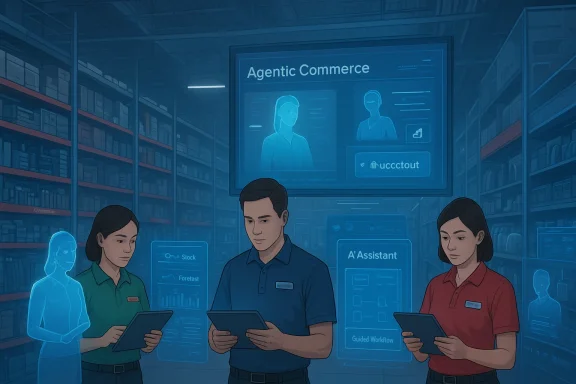
Agentic commerce: what it is and why Wesfarmers is exploring it
Agentic commerce refers to a new class of customer interactions where autonomous, contextual AI agents conduct commerce tasks on behalf of customers or retailers. In practice, this can look like:- Conversational storefronts where an AI agent guides a customer to the right product, bundles items, checks stock, and places an order.
- Interactive assistants embedded into product pages that provide personalised recommendations and answer technical questions.
- Agents proactively reconnecting with customers about replenishment, cross‑sells or order updates.
But the technology also raises immediate questions: what level of autonomy is appropriate for customer transactions? How will agents handle payment authorisation and refunds? What human oversight is required when agents make promises about stock or delivery times? Wesfarmers’ approach — pairing Copilot agents with governance frameworks and controlled rollouts — is designed to mitigate these risks while enabling practical innovation.
Supply chain and inventory use cases: realistic gains, hidden complexity
Supply chain optimisation is one of the most concrete, high‑value domains for AI in retail. The partnership highlights three areas:- Demand forecasting: richer models that combine point‑of‑sale, promotions, weather, local events and supplier constraints to better predict demand.
- Inventory management: intelligent replenishment that reduces both stockouts and excess inventories by using forecast uncertainty and lead‑time awareness.
- Product availability: dynamic allocations across stores, warehouses and digital channels to improve the customer experience.
Potential pitfalls include model drift as supplier behaviour or seasonality changes, brittle automation that doesn’t handle edge cases (e.g., supplier outages), and the cost of over‑optimisation on historical patterns that don’t account for structural shifts in demand. Operational teams must retain decision authority and the ability to override automated recommendations, and the AI pipelines must surface uncertainty, not just point forecasts.
Productivity and the frontline: Ask Lionel and the case for AI team assistants
Wesfarmers divisions have already trialled frontline AI tools. The most commonly cited example is a store‑level assistant (branded internally in trials as an information service) that gives team members instant answers to product questions and operating guidance. Early internal reports indicate positive feedback: staff spend less time searching for information and more time in customer conversations.On the corporate engineering side, developer productivity tools such as GitHub Copilot have been adopted by dozens or hundreds of engineers in many companies, and Microsoft‑led deployments report significant time savings in routine coding tasks. Similarly, Microsoft 365 Copilot aims to reduce administrative friction by summarising email threads, producing drafts for routine documents, and turning unstructured data into actionable summaries.
Key considerations for these productivity plays:
- Guardrails and access controls: Staff must not share confidential or regulated data in prompts without safeguards.
- Auditability: Automated outputs used in customer interactions or financial reporting require traceability back to sources and models.
- Human oversight: AI assistants should augment — not replace — critical judgment, with clear escalation paths for complex or high‑risk decisions.
Copilot Studio, agent features and technical enablers
Microsoft Copilot Studio is central to the technical delivery model the partnership references. The platform provides:- A low‑code/no‑code environment for building agents, connecting knowledge sources and publishing agents across channels.
- Out‑of‑the‑box connectors to enterprise data sources and Microsoft 365 content.
- Automation capabilities that can perform UI‑level actions (sometimes called computer use) when APIs are unavailable.
- Governance controls, monitoring and analytics to observe agent behaviour.
Security, privacy and governance — real risks that demand real controls
Large‑scale Copilot and agent deployments bring both security and privacy risks. Recent security research has demonstrated practical attacks that can abuse agent configuration to obtain OAuth tokens or escalate privileges. Social engineering that leverages legitimate platforms can be particularly effective because attackers use trusted Microsoft domains and flows to extract consent.A responsible large‑scale program must include:
- Least privilege and admin consent policies for any application or agent requesting tenant or user access.
- Conditional access and multi‑factor authentication enforced for high‑risk operations and token issuance.
- Threat monitoring and anomaly detection for suspicious agent behaviour or unexpected patterns of API calls.
- Data loss prevention (DLP) and content filtering to prevent sensitive corporate data from leaking into model prompts or external model caches.
- Strong change management around agent configuration — only approved and audited agents should be allowed to interact with critical systems.
Upskilling and organisational change: more than technology
Wesfarmers’ strategy includes a heavy skilling component. Large enterprise AI programs fail more often from lack of capability than from lack of technology. The partnership emphasises training on Microsoft AI products, internal programs, and the creation of maker communities so teams can build, share and govern agents responsibly.The human implications are substantial and not all negative. AI can free employees from repetitive tasks, enabling higher‑value work; but it also requires investment in role redesign, continuous learning programs, and transparent communication about how roles will evolve. A sustainable enterprise AI program invests in both technical training and change management.
Commercial and vendor considerations
There is strategic benefit in a single‑vendor stack: integrated security, faster integrations and a unified governance model. But vendor concentration also carries negotiating and operational risks:- Contract terms and cost management: licensing for Copilot, Azure compute and data egress can become substantial at scale. Organisations must model ongoing cost and secure predictable commercial terms.
- Vendor lock‑in: deep ties to platform features — connectors, proprietary agent formats and managed services — increase switching costs over time.
- Multi‑cloud and sovereign requirements: for some workloads, regulatory or resilience needs may demand hybrid or multi‑cloud architectures.
Early wins, measured outcomes and where to look for ROI
To justify the scale of this partnership, Wesfarmers will need measurable outcomes. The most promising ROI vectors include:- Reduced store‑level handling time for routine questions and processes (time saved per team member, converted to labour cost reductions or redeployment into higher‑value tasks).
- Improved product availability and fewer stockouts through AI‑driven replenishment and demand forecasting (measured by uplift in on‑shelf availability and retail sales).
- Productivity gains in corporate functions via Microsoft 365 Copilot (measured in hours saved per employee and process cycle time reductions).
- Reduction in customer service costs and higher NPS through conversational commerce and faster self‑service.
Potential regulatory and reputational headwinds
AI deployments at scale attract regulatory attention, particularly where sensitive customer data or automated decision‑making are involved. Potential headwinds include:- Data residency and cross‑border transfer scrutiny if personal data moves between regions.
- Consumer protection obligations where automated agents make promises about delivery or refunds.
- Employment and industrial relations discussions if AI materially changes workforce structure or roles.
Practical checklist for enterprises considering similar partnerships
For CIOs and digital leaders evaluating a large AI partnership, these steps provide a pragmatic path:- Establish a cross‑functional AI steering committee (legal, security, ops, analytics, business leaders).
- Prioritise use cases with clear KPIs and measurable baselines.
- Harden data foundations: master data, event telemetry and API‑driven integrations.
- Start with narrow, auditable agents before expanding autonomy.
- Implement DLP, conditional access, and admin policies for agent governance.
- Build a continuous monitoring program: model performance, drift, downstream business impact.
- Invest in skilling and change management across every affected team.
- Negotiate commercial terms with visibility into long‑term costs and potential expansions.
What to watch next
Over the next 12–24 months, the partnership’s success will be visible in several concrete ways:- The pace and breadth of Microsoft 365 Copilot seat expansion across Wesfarmers divisions.
- Live customer‑facing agent launches (for example, Copilot‑powered storefront pilots or WhatsApp‑based assistants).
- Verified improvements in product availability metrics or reductions in operational costs tied to AI supply chain initiatives.
- The maturity of governance patterns — how quickly the group adopts secure deployment frameworks and how it responds to newly discovered security threats.
- The establishment of in‑house skills academies and the number of trained makers and engineers using Copilot Studio to ship agents.
Conclusion
Wesfarmers’ multi‑year partnership with Microsoft is an important case study in enterprise AI adoption: a large, multi‑brand retailer committing to embed generative AI across customer experiences, supply chains and internal productivity. The partnership maps directly to tangible business levers — forecasting accuracy, store productivity, developer efficiency and customer engagement — and benefits from Microsoft’s integrated product set and global engineering resources.Yet this is not a playbook for unbounded optimism. Technical complexity, security risks, governance demands and commercial discipline are what separate pilots from durable advantage. The most successful outcomes will come from an incremental, measurement‑driven program that balances autonomy with control, invests in people as much as technology, and treats data readiness as the first order of business.
If executed carefully, the deal can position Wesfarmers as a pragmatic leader in retail AI for Australia and New Zealand — not because it is the most aggressive adopter of the flashiest models, but because it moves responsibly and at scale, turning agentic possibilities into reliable, auditable improvements for team members and customers alike.
Source: Microsoft Source Wesfarmers and Microsoft announce multi-year strategic partnership to accelerate AI-powered innovation - Source Asia