

Amid a broader debate over urban mobility, inclusion, and volunteer-led community support, Westwind Hamburg e.V. is quietly proving that a refurbished bicycle can be more than transportation. It can be a job ticket, a school run, a link to a doctor, or simply the first reliable way to participate in city life. The organization’s model is simple, but its social impact is not: take donated bikes, make them roadworthy, and place them with people who need mobility most. In Hamburg, that has become a small but durable example of practical solidarity.
Westwind Hamburg e.V. traces its roots to 2015, when Hamburg, like many German cities, was confronting the arrival of large numbers of people fleeing war, terror, and displacement. The central insight behind the initiative was almost disarmingly straightforward: if refugee housing is far from workplaces, schools, and public services, then a bicycle becomes an instrument of access, not a luxury. That idea remains embedded in the organization’s identity, and it still shapes how the group describes its mission today. (westwind-hamburg.de)
The group’s premise also reflects a broader truth about cities. Mobility is not merely about speed or convenience; it is about participation. A person who can reach a language class, a part-time job, a clinic, or a supermarket without depending on someone else gains a measure of autonomy that public transport alone may not always provide, especially when schedules, distances, and costs collide. Westwind’s work sits right at that intersection of transportation policy and human dignity. (westwind-hamburg.de)
What started as a response to urgent humanitarian need has matured into a more structured local institution. Westwind says it has made more than 3,500 donated bicycles roadworthy and handed them out at social prices to people with and without a migration background. The organization also describes a volunteer base of around 30 helpers from across Hamburg, which suggests the project is not only charitable but also deeply civic in character. (westwind-hamburg.de)
That scale matters because it places Westwind in a category beyond a neighborhood repair shop. It is part workshop, part distribution network, part social bridge. It is also a reminder that many of the best inclusion projects are not top-down policy initiatives but low-friction systems built by volunteers, donations, and repeatable routines. In a city the size of Hamburg, that combination can have surprisingly durable reach.
At the same time, Westwind’s public-facing story has evolved. The organization now highlights not just bike handouts, but also workshops, children’s learning activities, and upcycling work through its “Kettenküche” project. That evolution is telling: once a volunteer effort becomes trusted, it often expands from immediate aid into wider forms of education, environmental reuse, and community building.
The organization’s own language emphasizes access to “work, events, school, authorities, or shopping,” and that list is revealing because it spans both necessity and social participation. It is not just about solving transport problems. It is about making sure people are not socially stranded by geography, price, or circumstance. (westwind-hamburg.de)
There is also a psychological component that should not be underestimated. Mobility can restore routine, and routine can restore confidence. For someone adapting to a new country, recovering from hardship, or trying to get back on their feet financially, the ability to move independently can be a small but meaningful step toward a fuller life. (westwind-hamburg.de)
That process matters because it gives the project a repeatable structure. Rather than depending on one-off charity events, Westwind has built a cycle of donation, repair, and redistribution. In practice, that makes the organization less fragile and more scalable, even if it remains volunteer-driven. (westwind-hamburg.de)
The practical result is a layered organization. At one level, it repairs bicycles. At another, it produces belonging, training, and reuse. And at yet another, it demonstrates how small civic groups can tie together environmental goals and social inclusion without needing a large bureaucracy.
The model also fits Hamburg’s broader cycling culture. In a city where bikes are already part of everyday mobility, there is an existing social understanding of what a bike can do. Westwind turns that cultural familiarity into a tool for equity, which is an elegant and efficient move. (westwind-hamburg.de)
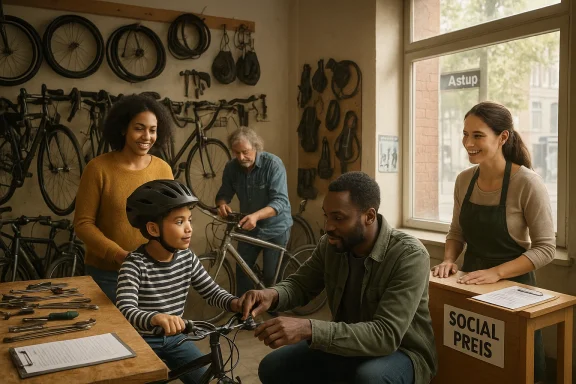
The organization’s public reporting on sale days underscores this local logic. One recent account described families arriving, children test-riding bikes, and volunteers helping people choose the right fit. Those scenes matter because they show the project is not an abstract distribution mechanism but a human-scale service shaped by interaction and trust. (westwind-hamburg.de)
Westwind is also notable because it does not frame itself as an NGO replacing public policy. Instead, it occupies the space where volunteer action can solve a narrow but meaningful problem efficiently. That distinction matters. It suggests the group is best understood as a complement to state systems rather than a substitute for them. (hamburg.de)
There is a reason this model resonates. It is easy to explain, visibly useful, and hard to cynically dismiss. A repaired bike that helps a parent get to work or a child get to school is a concrete outcome, not a slogan. In the social economy of cities, concrete outcomes are what sustain public trust. (westwind-hamburg.de)
Volunteer work also produces a subtle but important secondary benefit: skills transfer. People who learn to repair bikes, organize inventories, or support newcomers gain practical competence that can be used elsewhere. In that sense, Westwind is not only redistributing bicycles; it is redistributing confidence and know-how.
The organization’s public storytelling also reinforces the sense of belonging. Recent reports and examples on its website show families, children, and helpers interacting in ways that make the workshop feel welcoming rather than bureaucratic. That matters because inclusion is not only about access to objects; it is about access to spaces where people feel seen and respected. (westwind-hamburg.de)
This broader framing also helps reduce stigma. A person does not have to be labeled “refugee” to receive help, and that matters in a city where financial hardship can affect many different households. By widening access while retaining a needs-based approach, Westwind avoids making assistance feel like a fixed identity category. (westwind-hamburg.de)
A second inclusion layer comes through the workshops and learning activities. The “Schraublabor” is described as a place where local and refugee volunteers meet, and that kind of shared labor is a powerful integration tool because it reduces abstraction. People do not just talk about coexistence; they work side by side on a common task.
There is also a generational element. Children’s cycling courses and sale days involving family members help make mobility a family-level capability rather than a one-person privilege. That is important because transport inequality often accumulates across households, not just individuals. If a parent cannot get a bike, a child may also lose access to after-school opportunities or independent movement.
Westwind therefore sits at the intersection of integration policy, youth support, and everyday mobility. That is a rare position for a bicycle charity, and it helps explain why the group has remained relevant beyond its founding moment. (hamburg.de)
The “Kettenküche” project is especially interesting because it moves beyond bike repair into material upcycling. By turning discarded inner tubes into bags through a partner organization, Westwind is showing how repair culture can evolve into a more complete reuse ecosystem. That kind of extension often signals a maturing social enterprise mindset, even when the legal form remains nonprofit.
Still, the environmental argument should not eclipse the social one. Westwind’s real value lies in the fact that it gives mobility to people who need it most. The sustainability gains are significant, but they are best understood as a welcome co-benefit, not the primary reason the organization exists. (westwind-hamburg.de)
Media coverage matters because many volunteer groups remain invisible until someone tells their story well. A workshop full of donated bikes and volunteer labor can function effectively for years without much publicity, but public recognition can unlock donations, volunteers, and partnerships. That is especially relevant for an organization that depends on community goodwill rather than commercial revenue. (westwind-hamburg.de)
The timing is also notable. Spring and early summer are naturally active periods for cycling, and Westwind’s own site says it works at full speed as the bike season begins. That seasonal rhythm makes media attention more likely, because a bicycle charity is easier to understand when readers are already thinking about riding. (westwind-hamburg.de)
There is, however, an editorial caution here. The romantic image of a workshop, grease, and coffee should not obscure the underlying labor model. This is a service built on donation streams, volunteer energy, and logistical discipline. The human warmth is real, but so is the operational seriousness required to keep hundreds of bikes moving toward people who need them. (westwind-hamburg.de)
The organization also benefits from a clear social narrative: mobility equals inclusion. That message resonates across refugee support, family assistance, youth work, and sustainability circles. In an era when practical impact often matters more than lofty branding, Westwind’s model has unusually broad appeal. (westwind-hamburg.de)
Funding and supply are the second concern. Donation-based organizations can experience seasonal fluctuations in both bike donations and financial support, and that can make planning difficult. Even when a nonprofit has strong public goodwill, it still needs predictable resources for tools, workshop space, accessories, and administrative work. (westwind-hamburg.de)
Finally, the social-price model itself must be handled carefully. It works because it preserves dignity while keeping access affordable, but it depends on fair eligibility criteria and transparent process. Any perception of inconsistency, however minor, could undermine the trust that makes the whole system function.
The next phase may depend less on reinvention than on consolidation. If Westwind can preserve its workshop culture, maintain a steady stream of donations, and deepen partnerships with schools, sponsors, and local institutions, it can remain both practical and adaptable. That combination is rare, and in community work it is often the difference between a good idea and a lasting institution.
Source: openPR.com Establishing a secure connection ...
 Background
Westwind Hamburg e.V. traces its roots to 2015, when Hamburg, like many German cities, was confronting the arrival of large numbers of people fleeing war, terror, and displacement. The central insight behind the initiative was almost disarmingly straightforward: if refugee housing is far from workplaces, schools, and public services, then a bicycle becomes an instrument of access, not a luxury. That idea remains embedded in the organization’s identity, and it still shapes how the group describes its mission today. (westwind-hamburg.de)The group’s premise also reflects a broader truth about cities. Mobility is not merely about speed or convenience; it is about participation. A person who can reach a language class, a part-time job, a clinic, or a supermarket without depending on someone else gains a measure of autonomy that public transport alone may not always provide, especially when schedules, distances, and costs collide. Westwind’s work sits right at that intersection of transportation policy and human dignity. (westwind-hamburg.de)
What started as a response to urgent humanitarian need has matured into a more structured local institution. Westwind says it has made more than 3,500 donated bicycles roadworthy and handed them out at social prices to people with and without a migration background. The organization also describes a volunteer base of around 30 helpers from across Hamburg, which suggests the project is not only charitable but also deeply civic in character. (westwind-hamburg.de)
That scale matters because it places Westwind in a category beyond a neighborhood repair shop. It is part workshop, part distribution network, part social bridge. It is also a reminder that many of the best inclusion projects are not top-down policy initiatives but low-friction systems built by volunteers, donations, and repeatable routines. In a city the size of Hamburg, that combination can have surprisingly durable reach.
At the same time, Westwind’s public-facing story has evolved. The organization now highlights not just bike handouts, but also workshops, children’s learning activities, and upcycling work through its “Kettenküche” project. That evolution is telling: once a volunteer effort becomes trusted, it often expands from immediate aid into wider forms of education, environmental reuse, and community building.
The Human Meaning of Mobility
For many middle-class commuters, a bicycle is a choice among several transport options. For people on tight budgets, it can be the only practical way to move across the city with dignity and consistency. That difference is not cosmetic; it changes whether a person can keep an appointment, arrive on time for work, or simply say yes to opportunities that appear far from home. Westwind’s messaging understands this functional reality better than most institutional campaigns do. (westwind-hamburg.de)The organization’s own language emphasizes access to “work, events, school, authorities, or shopping,” and that list is revealing because it spans both necessity and social participation. It is not just about solving transport problems. It is about making sure people are not socially stranded by geography, price, or circumstance. (westwind-hamburg.de)
Why a bike matters more than it looks
A bicycle is low-tech, but its social value is high. It bypasses the friction of paperwork, fares, and fixed timetables, and for some users it provides a level of flexibility that even well-run bus systems cannot match. In that sense, Westwind is addressing a mobility gap that is often invisible in urban statistics but obvious in daily life. (westwind-hamburg.de)- It reduces dependence on costly, time-sensitive transport.
- It can shorten the path to work and education.
- It offers independence in areas poorly served by transit.
- It gives children and families a shared, practical asset.
- It can improve confidence by making the city feel less fragmented.
There is also a psychological component that should not be underestimated. Mobility can restore routine, and routine can restore confidence. For someone adapting to a new country, recovering from hardship, or trying to get back on their feet financially, the ability to move independently can be a small but meaningful step toward a fuller life. (westwind-hamburg.de)
How Westwind Operates
Westwind’s operating model is modest, but it is far from improvised. Donations are accepted in Bahrenfeld at Schnackenburgallee 11, where volunteers work in the “Schraublabor” workshop. The organization says bikes are checked for roadworthiness, repaired, and then sold at social prices during scheduled sale days, with proof of need required. (westwind-hamburg.de)That process matters because it gives the project a repeatable structure. Rather than depending on one-off charity events, Westwind has built a cycle of donation, repair, and redistribution. In practice, that makes the organization less fragile and more scalable, even if it remains volunteer-driven. (westwind-hamburg.de)
The workshop as a social system
The repair space is more than a technical area. According to Westwind, local and refugee volunteers come together there, supported by mechanics who guide them and help with workshops. That combination of skill-building and community exchange is important because it turns the workshop into a learning environment, not just a production line.- Donations are accepted midweek at the workshop.
- Sale days are scheduled and targeted to people in need.
- Children’s accessories are often provided alongside bikes.
- Volunteers handle both technical work and organizational support.
- The model depends on both material donations and time donations.
The practical result is a layered organization. At one level, it repairs bicycles. At another, it produces belonging, training, and reuse. And at yet another, it demonstrates how small civic groups can tie together environmental goals and social inclusion without needing a large bureaucracy.
Why the Model Works in Hamburg
Hamburg is a city where geography matters. Even in a well-connected metropolitan area, not every household lives close to school, work, or social infrastructure, and not every newcomer arrives with resources to bridge those distances. Westwind’s original decision to offer bikes to refugees in isolated housing therefore addressed a very specific urban problem, not an abstract charitable need. (westwind-hamburg.de)The model also fits Hamburg’s broader cycling culture. In a city where bikes are already part of everyday mobility, there is an existing social understanding of what a bike can do. Westwind turns that cultural familiarity into a tool for equity, which is an elegant and efficient move. (westwind-hamburg.de)
A local answer to a city-scale problem
What Westwind has built is essentially a bridge between excess and need. In many households, old bikes sit unused in basements and garages. In Westwind’s workshop, those same bikes become mobility assets for people who would otherwise go without. That is resource matching at its most community-oriented.The organization’s public reporting on sale days underscores this local logic. One recent account described families arriving, children test-riding bikes, and volunteers helping people choose the right fit. Those scenes matter because they show the project is not an abstract distribution mechanism but a human-scale service shaped by interaction and trust. (westwind-hamburg.de)
Westwind is also notable because it does not frame itself as an NGO replacing public policy. Instead, it occupies the space where volunteer action can solve a narrow but meaningful problem efficiently. That distinction matters. It suggests the group is best understood as a complement to state systems rather than a substitute for them. (hamburg.de)
There is a reason this model resonates. It is easy to explain, visibly useful, and hard to cynically dismiss. A repaired bike that helps a parent get to work or a child get to school is a concrete outcome, not a slogan. In the social economy of cities, concrete outcomes are what sustain public trust. (westwind-hamburg.de)
Volunteers, Skills, and Community
Westwind’s strength is not simply that it has volunteers; it is that it has a productive volunteer culture. The organization describes around 30 people contributing time from across Hamburg, which is enough to keep a regular rhythm of repairs, sales, and support tasks moving. That indicates a level of organizational maturity that many grassroots projects struggle to reach. (westwind-hamburg.de)Volunteer work also produces a subtle but important secondary benefit: skills transfer. People who learn to repair bikes, organize inventories, or support newcomers gain practical competence that can be used elsewhere. In that sense, Westwind is not only redistributing bicycles; it is redistributing confidence and know-how.
More than wrench work
The public material around the organization suggests that volunteering at Westwind is not limited to turning bolts. There is coordination, customer-facing work, donation management, workshop support, and educational activity, including kids’ riding courses and mobility-related events. That broader task mix helps explain why a volunteer group can remain active over many years without becoming too narrow or repetitive.- Technical repair work keeps the bikes usable.
- Organizing sale days keeps distribution fair.
- Workshops support learning and integration.
- Children’s activities widen the social mission.
- Upcycling adds an environmental dimension.
The organization’s public storytelling also reinforces the sense of belonging. Recent reports and examples on its website show families, children, and helpers interacting in ways that make the workshop feel welcoming rather than bureaucratic. That matters because inclusion is not only about access to objects; it is about access to spaces where people feel seen and respected. (westwind-hamburg.de)
The Inclusion Dimension
Westwind’s earliest mission centered on refugees, but its current description is broader: it now says bikes are sold at social prices to people with and without a migration background. That shift is important because it reflects a common evolution in successful social projects, where an emergency response expands into a broader anti-exclusion service. (westwind-hamburg.de)This broader framing also helps reduce stigma. A person does not have to be labeled “refugee” to receive help, and that matters in a city where financial hardship can affect many different households. By widening access while retaining a needs-based approach, Westwind avoids making assistance feel like a fixed identity category. (westwind-hamburg.de)
From targeted aid to shared support
That evolution is not accidental. Many community organizations begin with one clearly defined group and then discover that related groups face similar barriers. Westwind’s later emphasis on people with general need suggests the project is responding to real demand rather than sticking rigidly to its original label. That makes the model more resilient and arguably more socially honest. (westwind-hamburg.de)A second inclusion layer comes through the workshops and learning activities. The “Schraublabor” is described as a place where local and refugee volunteers meet, and that kind of shared labor is a powerful integration tool because it reduces abstraction. People do not just talk about coexistence; they work side by side on a common task.
There is also a generational element. Children’s cycling courses and sale days involving family members help make mobility a family-level capability rather than a one-person privilege. That is important because transport inequality often accumulates across households, not just individuals. If a parent cannot get a bike, a child may also lose access to after-school opportunities or independent movement.
Westwind therefore sits at the intersection of integration policy, youth support, and everyday mobility. That is a rare position for a bicycle charity, and it helps explain why the group has remained relevant beyond its founding moment. (hamburg.de)
Environmental and Circular Economy Value
There is an environmental story here as well, and it should not be treated as a side note. Reusing donated bicycles avoids waste, extends product life, and keeps durable goods in circulation longer. In a city and region increasingly attentive to sustainable transport, that makes Westwind’s work relevant to both social policy and climate-conscious consumption. (westwind-hamburg.de)The “Kettenküche” project is especially interesting because it moves beyond bike repair into material upcycling. By turning discarded inner tubes into bags through a partner organization, Westwind is showing how repair culture can evolve into a more complete reuse ecosystem. That kind of extension often signals a maturing social enterprise mindset, even when the legal form remains nonprofit.
Repair as climate action
A repaired bicycle is a small climate victory, but a repeatable one. Each bike that stays in service avoids the need for a new manufactured item and delays disposal. On its own, that may seem modest; at scale, it becomes a meaningful local contribution to circularity. (westwind-hamburg.de)- Repair extends the life of durable goods.
- Donation reduces waste and supports reuse.
- Upcycling captures value from otherwise discarded parts.
- Cycling supports low-emission urban mobility.
- Volunteer repair builds local repair literacy.
Still, the environmental argument should not eclipse the social one. Westwind’s real value lies in the fact that it gives mobility to people who need it most. The sustainability gains are significant, but they are best understood as a welcome co-benefit, not the primary reason the organization exists. (westwind-hamburg.de)
The Media Moment and Public Awareness
The recent openPR item and the accompanying broadcast notice suggest that Westwind is also benefiting from broader media interest in community mobility stories. The mention of a radio feature on April 6, 2026, across TIDE.radio, Lübeck FM, and Westküste FM indicates an effort to tell the organization’s story beyond Hamburg itself. In local media terms, that is an important amplification step.Media coverage matters because many volunteer groups remain invisible until someone tells their story well. A workshop full of donated bikes and volunteer labor can function effectively for years without much publicity, but public recognition can unlock donations, volunteers, and partnerships. That is especially relevant for an organization that depends on community goodwill rather than commercial revenue. (westwind-hamburg.de)
Why storytelling changes outcomes
The framing of mobility as “a matter of the heart” may sound sentimental, but in this case the sentiment is doing useful work. It translates policy-adjacent ideas into human terms, which is exactly what local civil society projects need if they want to broaden their supporter base. Empathy can be a fundraising tool, but it can also be a civic organizing principle.The timing is also notable. Spring and early summer are naturally active periods for cycling, and Westwind’s own site says it works at full speed as the bike season begins. That seasonal rhythm makes media attention more likely, because a bicycle charity is easier to understand when readers are already thinking about riding. (westwind-hamburg.de)
There is, however, an editorial caution here. The romantic image of a workshop, grease, and coffee should not obscure the underlying labor model. This is a service built on donation streams, volunteer energy, and logistical discipline. The human warmth is real, but so is the operational seriousness required to keep hundreds of bikes moving toward people who need them. (westwind-hamburg.de)
Strengths and Opportunities
Westwind’s strongest advantage is that its mission is easy to understand and immediately useful, which makes it attractive to donors, volunteers, and partner organizations alike. Because the group combines repair, redistribution, training, and upcycling, it can create multiple forms of value from a single donated bike. That versatility is a major asset in a city where many civic efforts compete for attention. (westwind-hamburg.de)The organization also benefits from a clear social narrative: mobility equals inclusion. That message resonates across refugee support, family assistance, youth work, and sustainability circles. In an era when practical impact often matters more than lofty branding, Westwind’s model has unusually broad appeal. (westwind-hamburg.de)
- Clear, concrete mission with visible outcomes.
- Strong volunteer identity and community trust.
- Multiple program lanes beyond basic repair.
- Environmental credibility through reuse and upcycling.
- Potential for partnerships with schools and local sponsors.
- Scalable social pricing model.
- Strong fit with Hamburg’s cycling culture.
Risks and Concerns
The biggest structural risk is dependence on volunteer capacity. A project like Westwind is resilient in one sense because it is decentralized, but it is also vulnerable to burnout, leadership turnover, and uneven availability of skilled mechanics. If the repair pipeline slows, the whole distribution chain can tighten quickly. (westwind-hamburg.de)Funding and supply are the second concern. Donation-based organizations can experience seasonal fluctuations in both bike donations and financial support, and that can make planning difficult. Even when a nonprofit has strong public goodwill, it still needs predictable resources for tools, workshop space, accessories, and administrative work. (westwind-hamburg.de)
- Volunteer fatigue can reduce repair capacity.
- Demand may outpace available refurbished bikes.
- Workshop logistics require consistent funding.
- Documentation and eligibility checks add administrative load.
- Safety standards must remain high to avoid accidents.
- Growth can strain informal organizational structures.
- Broadening the mission can dilute focus if not managed carefully.
Finally, the social-price model itself must be handled carefully. It works because it preserves dignity while keeping access affordable, but it depends on fair eligibility criteria and transparent process. Any perception of inconsistency, however minor, could undermine the trust that makes the whole system function.
Looking Ahead
Westwind Hamburg e.V. appears well positioned for continued relevance because its mission addresses a problem that is not going away: the need for inexpensive, reliable, and dignified mobility. As Hamburg continues to grow and diversify, that need may become even more important, especially for households living with economic pressure or new arrivals navigating the city for the first time. The organization’s challenge will be to protect the clarity of its core mission while expanding its reach carefully. (westwind-hamburg.de)The next phase may depend less on reinvention than on consolidation. If Westwind can preserve its workshop culture, maintain a steady stream of donations, and deepen partnerships with schools, sponsors, and local institutions, it can remain both practical and adaptable. That combination is rare, and in community work it is often the difference between a good idea and a lasting institution.
- Expand volunteer recruitment without overloading existing helpers.
- Strengthen partnerships with schools and neighborhood initiatives.
- Keep social-price access transparent and easy to navigate.
- Grow upcycling and circular-economy projects where feasible.
- Document outcomes to improve fundraising and public awareness.
Source: openPR.com Establishing a secure connection ...
Last edited:
