

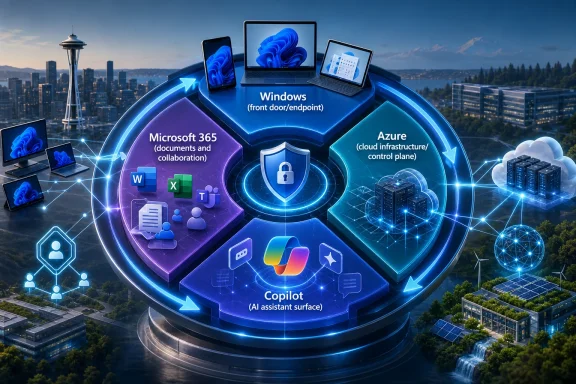
Microsoft is the Redmond, Washington technology company founded by Bill Gates and Paul Allen in 1975 that now sells Windows, Microsoft 365, Azure cloud services, Xbox, LinkedIn, Surface devices, security software, developer tools, and Copilot-branded artificial intelligence across consumer and enterprise markets. Its modern shape is less a collection of famous products than a flywheel: Windows creates reach, Office creates habit, Azure creates infrastructure, and Copilot tries to turn all of that installed base into an AI distribution channel. That is why a seemingly simple “what is Microsoft?” question now has three answers: it is a software company, a cloud utility, and increasingly an AI platform company. The tension is that each answer depends on the others, and none of them is optional anymore.
Microsoft began as a software supplier in the personal-computing boom, but its defining move was never merely writing code. It was making its code the layer other people had to assume. MS-DOS and then Windows turned the PC from a hobbyist object into a standardized business machine, and Microsoft Office turned clerical work into a file-format economy.
That history matters because Microsoft’s power has always been strongest when it becomes invisible. Windows was not just an operating system; it was the default expectation for hardware vendors, software developers, IT departments, and office workers. Word and Excel were not just applications; they became the grammar of corporate documents and spreadsheets.
The company’s recurring controversies follow from the same pattern. Microsoft’s ambition is rarely to participate in a market politely. It wants to define the layer on which the market runs, then charge rent, sell tools, and shape the upgrade cycle.
That is why the modern Microsoft cannot be understood by treating Windows, Azure, Office, Xbox, LinkedIn, GitHub, and Copilot as separate islands. They are different fronts in the same campaign: keep Microsoft present wherever work is created, stored, secured, analyzed, automated, and billed.
Productivity and Business Processes contains the obvious office stack: Microsoft 365, Office commercial subscriptions, Teams, Exchange, SharePoint, OneDrive, Dynamics, and LinkedIn. This is the subscription engine that turned Office from boxed software into a steady enterprise annuity. It is also where Microsoft has the deepest behavioral data about how organizations actually communicate and produce work.
Intelligent Cloud is the Azure-centered business that made Microsoft a first-tier cloud provider rather than a legacy software vendor watching Amazon define the future. It includes server products, cloud services, developer platforms, databases, analytics, AI infrastructure, and hybrid-cloud management. Azure is not simply “Microsoft’s AWS competitor”; it is the place Microsoft tries to make its old enterprise credibility useful in a cloud-native world.
More Personal Computing is the oddest bucket because it holds both Microsoft’s past and its consumer ambitions. Windows, Surface, search advertising, devices, and gaming live here, alongside Xbox content and services. It can look like the legacy drawer, but it remains strategically important because Windows still gives Microsoft a privileged place on hundreds of millions of PCs.
The segments matter financially. Strategically, though, Microsoft’s advantage is that a customer rarely buys only one thing. A company running Windows endpoints, Microsoft 365 identities, Teams meetings, Defender security, Azure workloads, GitHub development, and Power Platform automation is not merely a customer. It is inside a Microsoft operating environment.
The renaming from Windows Azure to Microsoft Azure in 2014 was more than branding hygiene. It signaled that Azure could not be trapped inside Windows. If Microsoft wanted to be the cloud for the enterprise, it had to support Linux, open-source tools, containers, Kubernetes, PostgreSQL, Java, Python, and whatever else customers were actually using.
That shift was one of the most important strategic course corrections in Microsoft history. The company that once treated cross-platform computing as a threat learned to treat it as a sales channel. Azure’s promise became less “run Microsoft software in Microsoft’s cloud” and more “bring your messy enterprise reality here, and Microsoft will manage, secure, meter, and extend it.”
Azure’s strength is not only raw compute. It is hybrid computing, identity, compliance, security integration, developer tooling, and procurement familiarity. For a bank, hospital, manufacturer, retailer, or government agency, the hardest cloud problem is often not spinning up virtual machines. It is connecting old systems, new applications, auditors, employees, contractors, and security policies without creating chaos.
That is where Microsoft’s old enterprise DNA became useful again. Azure Arc, Entra ID, Defender, Sentinel, SQL services, Visual Studio, GitHub, and Microsoft’s management tools turn Azure into a control plane for organizations that cannot simply abandon the past. In that sense, Azure is not just a cloud platform. It is Microsoft’s bridge between legacy IT and AI-era infrastructure.
The genius of Microsoft 365 was not inventing these categories. It was converting them into a subscription bundle tied to identity, storage, collaboration, compliance, device management, and security. Once Office became Microsoft 365, it stopped being a suite of desktop apps and became a managed workplace platform.
That change gave Microsoft a stronger position against both Google Workspace and the sprawling universe of SaaS tools. Google challenged Microsoft on browser-native collaboration and simplicity. Slack challenged email and meetings culture. Zoom challenged enterprise video. Notion, Airtable, Asana, Monday.com, and countless others challenged pieces of the workflow. Microsoft’s answer was not always to build the best individual tool. It was to bundle, integrate, and make switching costly.
Teams is the clearest example. It grew from collaboration app into meeting room, chat client, file surface, app shell, and administrative object. Its rise was aided by Microsoft 365 distribution, and its controversies reflected the same fact. Microsoft can place a product in front of users at enormous scale because the enterprise desktop is already rented by Microsoft.
LinkedIn gives the productivity segment another kind of data and reach. It is not an office app, but it is a professional graph: identities, employers, hiring signals, advertising audiences, sales prospects, and learning content. Microsoft bought LinkedIn in 2016, and the acquisition now looks less like a social-media bet than an extension of enterprise software into professional identity.
For Windows enthusiasts and administrators, this creates a strange reality. Windows is no longer the sun around which every Microsoft decision orbits, but it is still where many of those decisions land. Microsoft account prompts, OneDrive integration, Edge promotion, Teams hooks, Copilot buttons, security defaults, telemetry settings, and update policies all show how Windows has become a delivery surface for broader company priorities.
That is not automatically bad. A modern operating system needs cloud identity, device security, backup, recovery, app distribution, and AI features. The problem is that Microsoft’s product integration often feels indistinguishable from upsell pressure. Windows users are asked to trust that the same company selling the operating system, the browser, the cloud storage, the productivity suite, the ads, and the AI assistant is also making neutral design choices.
Surface, meanwhile, plays a smaller but symbolic role. Microsoft’s hardware line exists partly to sell devices and partly to define what a premium Windows machine can be. It has produced some genuinely influential designs, especially around 2-in-1 PCs, even if it has never displaced the broader OEM ecosystem.
Xbox gives Microsoft a different kind of consumer footprint. With Xbox hardware, Game Pass, cloud gaming, and major studios including Mojang, Bethesda, and Activision Blizzard, Microsoft has tried to turn gaming into another subscription-and-platform business. The strategic logic resembles Microsoft 365 more than old console economics: own content, build services, keep users inside the ecosystem, and make the hardware only one piece of the relationship.
The branding began to crystallize in 2023, after the public shockwave created by ChatGPT and Microsoft’s deepening partnership with OpenAI. Microsoft introduced Copilot across Bing, Microsoft 365, Dynamics, GitHub, Windows, security products, and developer tools. The word quickly became less a product name than a doctrine.
That doctrine is simple: AI becomes more valuable when it has context. Microsoft has context in abundance. It knows the document, the meeting, the inbox, the spreadsheet, the directory, the code repository, the CRM record, the device, the access policy, and the cloud workload. Copilot is Microsoft’s attempt to turn that context into assistance — and eventually into action.
But this is also where the skepticism is most justified. An assistant that can summarize a meeting is convenient. An assistant that can act across mail, files, calendars, business systems, and cloud resources raises sharper questions about permissions, auditability, hallucinations, data boundaries, and user consent. For enterprises, the issue is not whether generative AI is impressive. It is whether it can be governed.
Microsoft’s pitch is that Copilot inherits existing security, compliance, and identity controls. That is the right pitch to make to CIOs, and it is more credible coming from Microsoft than from many AI startups. Still, inherited permissions are only as good as the data hygiene beneath them. If a company’s SharePoint, Teams, and file permissions are already a mess, Copilot may not create the problem, but it can make the problem easier to see — and easier to exploit accidentally.
The upside was obvious. Azure became the infrastructure behind some of the most visible AI workloads in the world. Microsoft 365 gained a new premium upsell. Bing briefly became interesting again. GitHub Copilot gave developers a practical AI tool before many knowledge workers had one. The company’s market narrative shifted from “mature cloud incumbent” to “AI platform leader.”
The risk is just as obvious. Microsoft does not fully control the research frontier, the economics of model training, or the public perception of AI quality. It must manage a partnership that is strategically critical, capital intensive, and politically sensitive. When AI models improve, Microsoft benefits. When AI disappoints, costs too much, creates legal exposure, or fails to justify subscription premiums, Microsoft owns much of the customer-facing backlash.
There is also a product-design risk. Microsoft has a habit of inserting strategic features before users have clearly asked for them. Copilot buttons, prompts, sidebars, and rebrands can make AI feel less like a breakthrough and more like another layer of Microsoft insistence. The company’s challenge is to make Copilot useful enough that users invite it in, rather than merely tolerate it because IT deployed it.
For developers, GitHub Copilot remains one of the strongest demonstrations of the model. Code completion, explanation, test generation, and boilerplate assistance fit naturally into software development. For general office work, the return on investment is more uneven. Summarizing, drafting, and rewriting are valuable, but the value depends heavily on role, data access, workflow maturity, and whether users trust the output.
Microsoft has pledged to be carbon negative, water positive, and zero waste by 2030, and to remove by 2050 the carbon it has emitted directly or through electricity use since its founding. Those are ambitious targets, and they carry reputational weight precisely because Microsoft is building and leasing data centers at global scale. The company’s sustainability story is therefore both a commitment and a stress test.
AI makes the stress test harder. Larger models and higher usage can increase power demand even as chips, cooling systems, and software become more efficient. Microsoft has invested in renewable energy, carbon-free power arrangements, data-center efficiency, circular hardware practices, and carbon-removal projects, but the direction of travel is not frictionless. Growth in cloud and AI can push emissions upward before mitigation catches up.
This is where corporate language often gets too smooth. “Carbon negative by 2030” sounds like a finish line, but it is really a race between infrastructure expansion and decarbonization. If Azure and Copilot are central to Microsoft’s growth, sustainability cannot live in a separate annual report. It has to be measured against the actual energy appetite of the business Microsoft is building.
For IT buyers, that matters more than it once did. Large customers increasingly have their own emissions targets, procurement rules, and reporting obligations. Microsoft’s data-center footprint becomes part of their footprint. The sustainability promise is therefore not merely moral branding; it is becoming a feature of enterprise cloud competition.
That is why Microsoft’s bundling power remains formidable. A CIO does not evaluate Teams, Defender, OneDrive, SharePoint, Exchange, Intune, and Entra as isolated consumer apps. They arrive as parts of a licensing and governance structure. The question becomes not “is this the best app?” but “is this good enough, integrated enough, secure enough, and already paid for?”
Competitors can beat Microsoft feature by feature. Many do. Slack may be loved more by some teams than Teams. Google Docs may feel cleaner for live collaboration. Zoom may remain the preferred meeting experience in some environments. AWS may be the default cloud for many developers. Specialized security vendors may outperform Microsoft in particular categories.
But Microsoft’s advantage is cumulative. It wins by reducing procurement complexity, centralizing identity, bundling security, integrating admin controls, and making “one more Microsoft service” feel easier than “one more vendor.” That is powerful for IT departments under pressure to cut costs, reduce risk, and support hybrid work.
The downside is that integration can become dependence. Outages ripple widely. Licensing changes become budget events. Interface changes become training burdens. Security incidents become existential because the same identity plane may touch email, files, devices, applications, and cloud resources. Microsoft’s value proposition is convenience at scale; its risk profile is concentration at scale.
That dual role explains much of the community’s mixed feeling toward Microsoft. The company builds tools people depend on and often admire. It also makes decisions that feel imposed: forced account flows, aggressive Edge promotion, confusing branding, telemetry anxiety, shifting admin portals, and AI features that arrive before organizations have policies for them.
The Copilot era intensifies that tension. If AI becomes a standard layer in Windows and Microsoft 365, administrators will have to think about it the way they think about identity, endpoint security, data loss prevention, and update rings. It will not be enough to ask whether Copilot is clever. The practical questions are where it appears, what it can access, how it is licensed, how it is logged, how it can be disabled, and whether users understand its limits.
For home users, the stakes are different but still real. Microsoft wants Windows PCs to feel modern in an AI-first market, especially as Apple, Google, and chip vendors push their own on-device intelligence stories. But if the experience feels like advertising wrapped in assistance, users will resist. The PC remains personal enough that unwanted intelligence can feel more intrusive than helpful.
Microsoft’s best version of this future is compelling. A Windows PC that can explain settings, recover documents, summarize notifications, help troubleshoot errors, and automate repetitive work could be genuinely useful. The worst version is familiar: more prompts, more cloud dependency, more branding churn, and more features that serve Microsoft’s strategy before they serve the user.
 Microsoft’s Oldest Trick Is Turning Software Into Infrastructure
Microsoft began as a software supplier in the personal-computing boom, but its defining move was never merely writing code. It was making its code the layer other people had to assume. MS-DOS and then Windows turned the PC from a hobbyist object into a standardized business machine, and Microsoft Office turned clerical work into a file-format economy.That history matters because Microsoft’s power has always been strongest when it becomes invisible. Windows was not just an operating system; it was the default expectation for hardware vendors, software developers, IT departments, and office workers. Word and Excel were not just applications; they became the grammar of corporate documents and spreadsheets.
The company’s recurring controversies follow from the same pattern. Microsoft’s ambition is rarely to participate in a market politely. It wants to define the layer on which the market runs, then charge rent, sell tools, and shape the upgrade cycle.
That is why the modern Microsoft cannot be understood by treating Windows, Azure, Office, Xbox, LinkedIn, GitHub, and Copilot as separate islands. They are different fronts in the same campaign: keep Microsoft present wherever work is created, stored, secured, analyzed, automated, and billed.
The Three-Segment Map Hides a Much More Integrated Machine
On paper, Microsoft reports its business through three large segments: Productivity and Business Processes, Intelligent Cloud, and More Personal Computing. The categories are useful, but they can also make the company look tidier than it is. The real story is how aggressively Microsoft stitches those categories together.Productivity and Business Processes contains the obvious office stack: Microsoft 365, Office commercial subscriptions, Teams, Exchange, SharePoint, OneDrive, Dynamics, and LinkedIn. This is the subscription engine that turned Office from boxed software into a steady enterprise annuity. It is also where Microsoft has the deepest behavioral data about how organizations actually communicate and produce work.
Intelligent Cloud is the Azure-centered business that made Microsoft a first-tier cloud provider rather than a legacy software vendor watching Amazon define the future. It includes server products, cloud services, developer platforms, databases, analytics, AI infrastructure, and hybrid-cloud management. Azure is not simply “Microsoft’s AWS competitor”; it is the place Microsoft tries to make its old enterprise credibility useful in a cloud-native world.
More Personal Computing is the oddest bucket because it holds both Microsoft’s past and its consumer ambitions. Windows, Surface, search advertising, devices, and gaming live here, alongside Xbox content and services. It can look like the legacy drawer, but it remains strategically important because Windows still gives Microsoft a privileged place on hundreds of millions of PCs.
The segments matter financially. Strategically, though, Microsoft’s advantage is that a customer rarely buys only one thing. A company running Windows endpoints, Microsoft 365 identities, Teams meetings, Defender security, Azure workloads, GitHub development, and Power Platform automation is not merely a customer. It is inside a Microsoft operating environment.
Azure Is the Pivot That Saved Microsoft From Becoming Yesterday’s Platform
Azure launched publicly as Windows Azure in 2010, at a time when Microsoft still looked culturally and technically tied to the client-server era. Amazon Web Services had already shown that infrastructure could be rented by API, not purchased as hardware and installed in a corporate data center. Microsoft’s initial cloud story was awkward, but the company had one advantage Amazon lacked: decades of trust, contracts, and dependencies inside enterprise IT.The renaming from Windows Azure to Microsoft Azure in 2014 was more than branding hygiene. It signaled that Azure could not be trapped inside Windows. If Microsoft wanted to be the cloud for the enterprise, it had to support Linux, open-source tools, containers, Kubernetes, PostgreSQL, Java, Python, and whatever else customers were actually using.
That shift was one of the most important strategic course corrections in Microsoft history. The company that once treated cross-platform computing as a threat learned to treat it as a sales channel. Azure’s promise became less “run Microsoft software in Microsoft’s cloud” and more “bring your messy enterprise reality here, and Microsoft will manage, secure, meter, and extend it.”
Azure’s strength is not only raw compute. It is hybrid computing, identity, compliance, security integration, developer tooling, and procurement familiarity. For a bank, hospital, manufacturer, retailer, or government agency, the hardest cloud problem is often not spinning up virtual machines. It is connecting old systems, new applications, auditors, employees, contractors, and security policies without creating chaos.
That is where Microsoft’s old enterprise DNA became useful again. Azure Arc, Entra ID, Defender, Sentinel, SQL services, Visual Studio, GitHub, and Microsoft’s management tools turn Azure into a control plane for organizations that cannot simply abandon the past. In that sense, Azure is not just a cloud platform. It is Microsoft’s bridge between legacy IT and AI-era infrastructure.
Microsoft 365 Is the Subscription Version of Office’s Cultural Monopoly
If Azure is Microsoft’s infrastructure engine, Microsoft 365 is its behavioral engine. Word, Excel, PowerPoint, Outlook, Teams, OneDrive, and SharePoint are not glamorous in the way consumer gadgets are glamorous, but they sit at the center of daily work. The world still runs on documents, spreadsheets, calendars, inboxes, meetings, and slide decks.The genius of Microsoft 365 was not inventing these categories. It was converting them into a subscription bundle tied to identity, storage, collaboration, compliance, device management, and security. Once Office became Microsoft 365, it stopped being a suite of desktop apps and became a managed workplace platform.
That change gave Microsoft a stronger position against both Google Workspace and the sprawling universe of SaaS tools. Google challenged Microsoft on browser-native collaboration and simplicity. Slack challenged email and meetings culture. Zoom challenged enterprise video. Notion, Airtable, Asana, Monday.com, and countless others challenged pieces of the workflow. Microsoft’s answer was not always to build the best individual tool. It was to bundle, integrate, and make switching costly.
Teams is the clearest example. It grew from collaboration app into meeting room, chat client, file surface, app shell, and administrative object. Its rise was aided by Microsoft 365 distribution, and its controversies reflected the same fact. Microsoft can place a product in front of users at enormous scale because the enterprise desktop is already rented by Microsoft.
LinkedIn gives the productivity segment another kind of data and reach. It is not an office app, but it is a professional graph: identities, employers, hiring signals, advertising audiences, sales prospects, and learning content. Microsoft bought LinkedIn in 2016, and the acquisition now looks less like a social-media bet than an extension of enterprise software into professional identity.
Windows Is No Longer the Center of Microsoft, but It Is Still the Front Door
The modern Microsoft is not as dependent on Windows as the Microsoft of the 1990s or 2000s, but Windows remains strategically irreplaceable. It is the front door for many users, the default endpoint for many businesses, and the compatibility layer for decades of software. Even when revenue growth comes from cloud and subscriptions, Windows shapes how Microsoft reaches people.For Windows enthusiasts and administrators, this creates a strange reality. Windows is no longer the sun around which every Microsoft decision orbits, but it is still where many of those decisions land. Microsoft account prompts, OneDrive integration, Edge promotion, Teams hooks, Copilot buttons, security defaults, telemetry settings, and update policies all show how Windows has become a delivery surface for broader company priorities.
That is not automatically bad. A modern operating system needs cloud identity, device security, backup, recovery, app distribution, and AI features. The problem is that Microsoft’s product integration often feels indistinguishable from upsell pressure. Windows users are asked to trust that the same company selling the operating system, the browser, the cloud storage, the productivity suite, the ads, and the AI assistant is also making neutral design choices.
Surface, meanwhile, plays a smaller but symbolic role. Microsoft’s hardware line exists partly to sell devices and partly to define what a premium Windows machine can be. It has produced some genuinely influential designs, especially around 2-in-1 PCs, even if it has never displaced the broader OEM ecosystem.
Xbox gives Microsoft a different kind of consumer footprint. With Xbox hardware, Game Pass, cloud gaming, and major studios including Mojang, Bethesda, and Activision Blizzard, Microsoft has tried to turn gaming into another subscription-and-platform business. The strategic logic resembles Microsoft 365 more than old console economics: own content, build services, keep users inside the ecosystem, and make the hardware only one piece of the relationship.
Copilot Is Microsoft’s Attempt to Make AI Feel Like an Operating Layer
Copilot is the newest name attached to an old Microsoft instinct. The company does not want AI to be a separate destination users occasionally visit. It wants AI embedded into the tools people already use: Word drafts, Excel analysis, Outlook summaries, Teams recaps, Windows settings, GitHub coding, Dynamics workflows, Power Platform automation, and Azure services.The branding began to crystallize in 2023, after the public shockwave created by ChatGPT and Microsoft’s deepening partnership with OpenAI. Microsoft introduced Copilot across Bing, Microsoft 365, Dynamics, GitHub, Windows, security products, and developer tools. The word quickly became less a product name than a doctrine.
That doctrine is simple: AI becomes more valuable when it has context. Microsoft has context in abundance. It knows the document, the meeting, the inbox, the spreadsheet, the directory, the code repository, the CRM record, the device, the access policy, and the cloud workload. Copilot is Microsoft’s attempt to turn that context into assistance — and eventually into action.
But this is also where the skepticism is most justified. An assistant that can summarize a meeting is convenient. An assistant that can act across mail, files, calendars, business systems, and cloud resources raises sharper questions about permissions, auditability, hallucinations, data boundaries, and user consent. For enterprises, the issue is not whether generative AI is impressive. It is whether it can be governed.
Microsoft’s pitch is that Copilot inherits existing security, compliance, and identity controls. That is the right pitch to make to CIOs, and it is more credible coming from Microsoft than from many AI startups. Still, inherited permissions are only as good as the data hygiene beneath them. If a company’s SharePoint, Teams, and file permissions are already a mess, Copilot may not create the problem, but it can make the problem easier to see — and easier to exploit accidentally.
The OpenAI Bet Made Microsoft Look Early, but It Also Made It Dependent
Microsoft’s AI resurgence is inseparable from OpenAI. The company invested heavily, supplied cloud infrastructure, and integrated OpenAI models into products at a speed that made rivals look flat-footed. For a time, Microsoft appeared to have executed the cleanest platform coup of the generative AI era: fund the lab, host the models, productize the capabilities, and sell the result to existing customers.The upside was obvious. Azure became the infrastructure behind some of the most visible AI workloads in the world. Microsoft 365 gained a new premium upsell. Bing briefly became interesting again. GitHub Copilot gave developers a practical AI tool before many knowledge workers had one. The company’s market narrative shifted from “mature cloud incumbent” to “AI platform leader.”
The risk is just as obvious. Microsoft does not fully control the research frontier, the economics of model training, or the public perception of AI quality. It must manage a partnership that is strategically critical, capital intensive, and politically sensitive. When AI models improve, Microsoft benefits. When AI disappoints, costs too much, creates legal exposure, or fails to justify subscription premiums, Microsoft owns much of the customer-facing backlash.
There is also a product-design risk. Microsoft has a habit of inserting strategic features before users have clearly asked for them. Copilot buttons, prompts, sidebars, and rebrands can make AI feel less like a breakthrough and more like another layer of Microsoft insistence. The company’s challenge is to make Copilot useful enough that users invite it in, rather than merely tolerate it because IT deployed it.
For developers, GitHub Copilot remains one of the strongest demonstrations of the model. Code completion, explanation, test generation, and boilerplate assistance fit naturally into software development. For general office work, the return on investment is more uneven. Summarizing, drafting, and rewriting are valuable, but the value depends heavily on role, data access, workflow maturity, and whether users trust the output.
Sustainability Is Now Part of Microsoft’s Infrastructure Story, Not Corporate Decoration
Microsoft’s sustainability commitments are not a side note to its cloud and AI ambitions. They are part of the same story, because cloud infrastructure and AI training demand enormous amounts of electricity, land, water, hardware, and supply-chain coordination. A company selling the future as cloud-based intelligence must answer what that future consumes.Microsoft has pledged to be carbon negative, water positive, and zero waste by 2030, and to remove by 2050 the carbon it has emitted directly or through electricity use since its founding. Those are ambitious targets, and they carry reputational weight precisely because Microsoft is building and leasing data centers at global scale. The company’s sustainability story is therefore both a commitment and a stress test.
AI makes the stress test harder. Larger models and higher usage can increase power demand even as chips, cooling systems, and software become more efficient. Microsoft has invested in renewable energy, carbon-free power arrangements, data-center efficiency, circular hardware practices, and carbon-removal projects, but the direction of travel is not frictionless. Growth in cloud and AI can push emissions upward before mitigation catches up.
This is where corporate language often gets too smooth. “Carbon negative by 2030” sounds like a finish line, but it is really a race between infrastructure expansion and decarbonization. If Azure and Copilot are central to Microsoft’s growth, sustainability cannot live in a separate annual report. It has to be measured against the actual energy appetite of the business Microsoft is building.
For IT buyers, that matters more than it once did. Large customers increasingly have their own emissions targets, procurement rules, and reporting obligations. Microsoft’s data-center footprint becomes part of their footprint. The sustainability promise is therefore not merely moral branding; it is becoming a feature of enterprise cloud competition.
The Real Product Is the Microsoft Account, the Directory, and the Contract
The familiar products make Microsoft easy to describe, but the deeper lock-in lives in identity and administration. Entra ID, Microsoft accounts, Active Directory heritage, licensing portals, tenant settings, compliance dashboards, device management, security baselines, and enterprise agreements are the connective tissue. They are not as visible as Windows or Word, but they decide how deeply Microsoft sits inside an organization.That is why Microsoft’s bundling power remains formidable. A CIO does not evaluate Teams, Defender, OneDrive, SharePoint, Exchange, Intune, and Entra as isolated consumer apps. They arrive as parts of a licensing and governance structure. The question becomes not “is this the best app?” but “is this good enough, integrated enough, secure enough, and already paid for?”
Competitors can beat Microsoft feature by feature. Many do. Slack may be loved more by some teams than Teams. Google Docs may feel cleaner for live collaboration. Zoom may remain the preferred meeting experience in some environments. AWS may be the default cloud for many developers. Specialized security vendors may outperform Microsoft in particular categories.
But Microsoft’s advantage is cumulative. It wins by reducing procurement complexity, centralizing identity, bundling security, integrating admin controls, and making “one more Microsoft service” feel easier than “one more vendor.” That is powerful for IT departments under pressure to cut costs, reduce risk, and support hybrid work.
The downside is that integration can become dependence. Outages ripple widely. Licensing changes become budget events. Interface changes become training burdens. Security incidents become existential because the same identity plane may touch email, files, devices, applications, and cloud resources. Microsoft’s value proposition is convenience at scale; its risk profile is concentration at scale.
For WindowsForum Readers, Microsoft Is Both Platform and Weather System
For enthusiasts, sysadmins, and IT pros, Microsoft is not an abstract market-cap story. It is the company that changes defaults on Patch Tuesday, retires control panels, moves settings, renames products, adjusts licensing, adds requirements, and decides which hardware gets the next version of Windows. It is both a vendor and an environment.That dual role explains much of the community’s mixed feeling toward Microsoft. The company builds tools people depend on and often admire. It also makes decisions that feel imposed: forced account flows, aggressive Edge promotion, confusing branding, telemetry anxiety, shifting admin portals, and AI features that arrive before organizations have policies for them.
The Copilot era intensifies that tension. If AI becomes a standard layer in Windows and Microsoft 365, administrators will have to think about it the way they think about identity, endpoint security, data loss prevention, and update rings. It will not be enough to ask whether Copilot is clever. The practical questions are where it appears, what it can access, how it is licensed, how it is logged, how it can be disabled, and whether users understand its limits.
For home users, the stakes are different but still real. Microsoft wants Windows PCs to feel modern in an AI-first market, especially as Apple, Google, and chip vendors push their own on-device intelligence stories. But if the experience feels like advertising wrapped in assistance, users will resist. The PC remains personal enough that unwanted intelligence can feel more intrusive than helpful.
Microsoft’s best version of this future is compelling. A Windows PC that can explain settings, recover documents, summarize notifications, help troubleshoot errors, and automate repetitive work could be genuinely useful. The worst version is familiar: more prompts, more cloud dependency, more branding churn, and more features that serve Microsoft’s strategy before they serve the user.
The Microsoft Story Now Runs Through Six Concrete Realities
The easiest mistake is to describe Microsoft as if it were still primarily the Windows-and-Office company of memory. The harder, more useful view is that Microsoft has become a vertically integrated enterprise technology state: productivity at the top, cloud underneath, identity through the middle, AI across the surface, and Windows still anchoring the endpoint.- Microsoft’s modern business is organized around Productivity and Business Processes, Intelligent Cloud, and More Personal Computing, but customers experience those segments as one increasingly integrated ecosystem.
- Azure is the strategic pivot that transformed Microsoft from a packaged-software incumbent into one of the central infrastructure providers of the cloud era.
- Microsoft 365 turned Office into a subscription workplace platform where identity, storage, meetings, documents, compliance, and security reinforce one another.
- Copilot is Microsoft’s attempt to make generative AI a standard layer across work, development, Windows, business applications, and cloud operations.
- Xbox, Surface, Windows, LinkedIn, GitHub, and Dynamics matter because they extend Microsoft’s reach into consumers, creators, developers, professionals, and business processes.
- Microsoft’s sustainability promises will be judged against the energy and resource demands of the same cloud and AI expansion driving its growth.
References
- Primary source: TradingKey
Published: 2026-05-23T17:04:08.116663
What is Microsoft? Everything You Need to Know About Its History, Azure, and Copilot AI
Microsoft commands global tech through its Intelligent Cloud (Azure), productivity software (Microsoft 365), and Xbox gaming, with growth now driven by extensive OpenAI and Copilot AI integrations.www.tradingkey.com - Related coverage: windowscentral.com
Ex-Microsoft exec says the company blew it with AI, as it did with mobile — "Not even 3% of paying Copilot users use it even when it's pre-deployed right in their faces." | Windows Central
Microsoft might have missed the AI wave, with Copilot adoption stuck at just 3%.www.windowscentral.com - Official source: microsoft.com
Announcing Copilot for Microsoft 365 general availability and Microsoft 365 Chat | Microsoft 365 Blog
Discover the latest AI innovations across Microsoft 365 Copilot, Bing Chat Enterprise, and Windows.www.microsoft.com - Official source: blogs.microsoft.com
Introducing Microsoft Dynamics 365 Copilot, the world’s first copilot in both CRM and ERP, that brings next-generation AI to every line of business - The Official Microsoft Blog
Today, we’re announcing the next generation of AI product updates across our business applications portfolio, including the launch of the new Microsoft Dynamics 365 Copilot – providing interactive, AI-powered assistance across business functions. According to our recent survey on business...blogs.microsoft.com - Related coverage: techtarget.com
What is Microsoft Copilot? In-Depth Guide to Versions and Uses | TechTarget
Learn about Microsoft Copilot, an AI tool that integrates with a wide range of Microsoft's software and services.www.techtarget.com - Official source: datacenters.microsoft.com
Sustainability - Microsoft Datacenters
datacenters.microsoft.com
- Official source: azure.microsoft.com
What is Azure? | Microsoft Azure
Learn how Azure works, its benefits and use cases, and how it supports innovation with industry-leading AI services and tools.azure.microsoft.com
- Official source: learn.microsoft.com
What is Microsoft 365 Copilot? | Microsoft Learn
Learn about what Microsoft 365 Copilot is and common Copilot features in Microsoft 365 apps, like Word, Excel, PowerPoint, and Teams. This article answers common questions about Copilot, including what is Copilot, how Copilot works, and the benefits of using Copilot.learn.microsoft.com - Related coverage: tomshardware.com
Microsoft follows Nvidia's lead, surpasses $4 trillion market capitalization on soaring demand for cloud services, multi-front AI endeavors | Tom's Hardware
AI and Azure drive Microsoft's market cap.www.tomshardware.com - Related coverage: axios.com
Microsoft pledges to power data centers with zero-carbon energy by 2030
Data centers suck up lots of power, and the company acknowledges the limits of its current efforts.www.axios.com
- Related coverage: pcgamer.com
In a truly galaxy-brained rebrand, Microsoft Office is now the 'Microsoft 365 Copilot app,' but Copilot is also still the name of the AI assistant | PC Gamer
Copilot is the app for launching the other apps, but it's also a chatbot inside the apps. Any questions?www.pcgamer.com - Related coverage: techradar.com
Microsoft 365 confirms new premium tier focused on AI and productivity | TechRadar
Microsoft adds new E7 plan to cope with AI usagewww.techradar.com - Official source: news.microsoft.com
- Related coverage: annualreports.ai
- Official source: download.microsoft.com
Slide 1: Windows 365 Link The simple, secure, purpose-built device for Windows 365
PDF documentdownload.microsoft.com
