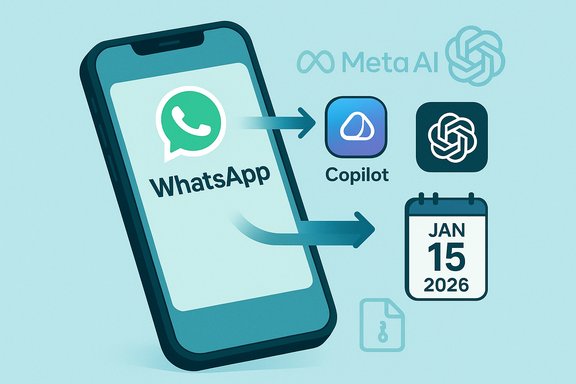
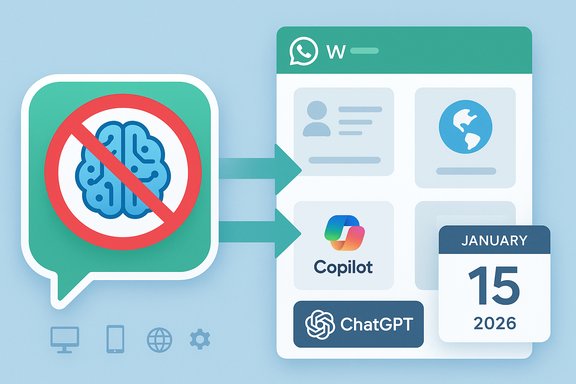
Microsoft’s Copilot will stop responding inside WhatsApp on January 15, 2026, after WhatsApp’s owner rewrote its Business Solution (Business API) terms to explicitly forbid general-purpose AI assistants from operating as primary services through the platform — a policy change that forces Microsoft, OpenAI and other vendors to migrate users to first‑party apps, web portals, or alternative messaging channels.
WhatsApp’s Business Solution was designed as an enterprise channel for verified notifications, customer support threads, and structured commerce messages. Over the past year this API became a low‑friction distribution surface for general‑purpose AI assistants: vendors could expose a bot as a WhatsApp contact and let millions of users message it without installing a separate app or signing in. That experiment—convenient for users and powerful for growth—collided with WhatsApp’s operational model and commercial intent, prompting Meta to add a new “AI Providers” clause to Business Solution terms in October 2025 that takes effect January 15, 2026. The practical consequence is simple and immediate: Copilot on WhatsApp will work through January 15, 2026 and then be disabled; Microsoft is directing users to its Copilot mobile apps, copilot.microsoft.com on the web, and Copilot integrations on Windows for continued access. Because the WhatsApp integration used an unauthenticated contact model, Microsoft warns that chat histories on WhatsApp cannot be automatically migrated into Copilot account histories — users must export any chats they want to keep before the cutoff.
Two strategic forces will shape the next 12–24 months:
Practical steps are clear: export any WhatsApp Copilot chats you care about, sign in to Copilot on Microsoft’s native surfaces for continuity and features, and for developers, rebuild identity, portability, and compliant automation into the core of product strategies. Where ambiguity remains — especially around enforcement thresholds and the undisclosed operational metrics cited by Meta — stakeholders should demand clearer public guidance and migration tools to reduce friction and preserve user choice.
Source: AI Insider Microsoft to Remove Copilot from WhatsApp Following Platform Policy Changes
 Background / Overview
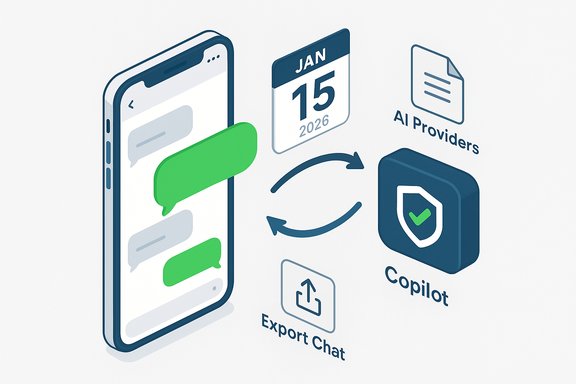
WhatsApp’s Business Solution was designed as an enterprise channel for verified notifications, customer support threads, and structured commerce messages. Over the past year this API became a low‑friction distribution surface for general‑purpose AI assistants: vendors could expose a bot as a WhatsApp contact and let millions of users message it without installing a separate app or signing in. That experiment—convenient for users and powerful for growth—collided with WhatsApp’s operational model and commercial intent, prompting Meta to add a new “AI Providers” clause to Business Solution terms in October 2025 that takes effect January 15, 2026. The practical consequence is simple and immediate: Copilot on WhatsApp will work through January 15, 2026 and then be disabled; Microsoft is directing users to its Copilot mobile apps, copilot.microsoft.com on the web, and Copilot integrations on Windows for continued access. Because the WhatsApp integration used an unauthenticated contact model, Microsoft warns that chat histories on WhatsApp cannot be automatically migrated into Copilot account histories — users must export any chats they want to keep before the cutoff. What WhatsApp changed — the policy, in plain English
The new “AI Providers” clause
WhatsApp’s revised Business Solution terms add a dedicated restriction aimed at third‑party AI vendors. In effect, the policy:- Labels a broad category of “AI Providers” to include creators or operators of large language models (LLMs), generative AI platforms, and general‑purpose AI assistants.
- Prohibits those AI Providers from using the Business Solution when the assistant itself is the primary functionality offered to end users.
- Retains a carve‑out for business‑incidental AI — e.g., a retailer using AI to triage tickets or generate transactional messages remains allowed.
Why Meta gives this reason
Meta frames the change as a product‑fit and capacity decision: Business Solution was built for predictable, transactional traffic (notifications, support workflows), not for high‑volume, open‑ended LLM conversations that can spike message volume, increase moderation burden, and require different infrastructure. Independent reporting and vendor notices confirm the operational rationale while also noting the strategic effect of re‑consolidating conversational AI inside first‑party Meta offerings.What this means for users and admins
Immediate user impact (short checklist)
- Export any WhatsApp Copilot chats you want to keep before January 15, 2026. The WhatsApp app provides an Export Chat feature that writes a text archive (and optionally media) you can save or email; exported chats are not importable into Copilot and may be limited in size.
- Install and sign into the Copilot mobile app (iOS/Android) or use copilot.microsoft.com to retain an authenticated, account‑backed history and richer features.
- Expect the WhatsApp contact to stop responding on the enforcement date; any in‑chat automations or workflows relying on Copilot must be reworked.
Exporting chats — practical notes and caveats
WhatsApp’s Export Chat tool is the canonical way to preserve a readable copy of a conversation:- Open the chat you want to export.
- On Android: tap the three‑dot menu → More → Export chat. On iPhone: open contact info → Export Chat.
- Choose “Include Media” or “Without Media” (including media increases archive size and may be limited).
- Use the share sheet to save the .txt (and zipped media) to cloud storage, email, or local files.
Why Microsoft and other vendors are complying (and what they’re offering)
Microsoft and other major AI providers acknowledged the policy and announced migration plans rather than continuing to fight access. That response reflects three pragmatic considerations:- Authentication and features: First‑party Copilot surfaces provide authenticated accounts, cross‑device history, and multimodal features (voice, vision) that the WhatsApp contact could not support reliably. Microsoft frames the shift as an opportunity to move users to richer experiences where privacy, identity, and controls are clearer.
- Compliance and predictability: The effective date is firm; turning off the integration avoids the risk of punitive enforcement actions or account terminations by WhatsApp partners or BSPs (Business Solution Providers).
- Business tradeoffs: WhatsApp’s Business Solution was intended for enterprise messaging; vendors that built products on top of that free distribution layer face an immediate go‑to‑market and retention challenge if they have to migrate users to authenticated apps or web portals.
Technical and privacy implications
Authentication, portability, and account continuity
The WhatsApp Copilot model deliberately prioritized low friction: anyone could send the Copilot contact a message without creating a Copilot account. That convenience is the tradeoff: no server‑side record tied to a Microsoft identity meant no reliable path to move conversations into account‑linked history. Vendors that want portability must build authenticated integrations from the start. This policy action highlights a structural tension in consumer AI: open distribution vs. accountable identity:- Open distribution (WhatsApp contact model) lowers onboarding friction but reduces control over data, personalization, and safety controls.
- Authenticated distribution (apps, web) increases friction but enables audit trails, consented storage, provenance, and enterprise controls.
Data handling and retention risks
Exporting chats creates static archives, not live, searchable memories inside Copilot. That presents concrete risks:- Loss of continuity: users lose conversational memory in the assistant unless they manually re‑feed context into Copilot’s authenticated surfaces.
- Security of exported archives: exported chats are plain text and may include sensitive content; storing them in email or cloud services shifts risk exposure. Users should treat exports like any sensitive document and protect them with encryption or secure storage practices.
Moderation and abuse surface
Meta’s official rationale cites moderation burden and unpredictable message volumes from open‑ended LLM traffic. Whether that operational claim is the sole driver or partly strategic (protecting Meta’s own AI offerings) is a matter of analysis — both explanations are plausible and supported by reporting. The new terms give Meta broad discretion, which will likely be exercised unevenly across edge cases; this creates compliance unpredictability for developers building hybrid or borderline bots.Impact on developers and businesses
For startups relying on WhatsApp distribution
Startups that used WhatsApp as a primary acquisition and usage channel face a sharp migration cost: rebuild onboarding inside a native app or web client, rebuild authentication and account systems, or pivot to allowed business‑incidental uses (support flows, notifications). The policy shortens migration windows and raises customer‑support and retention costs.For enterprises and BSPs
Enterprise customers using AI internally (for ticket triage, booking confirmation, etc. largely remain unaffected — the Business Solution continues to support business‑incidental AI when it sits inside a broader workflow. BSPs should update their contract language and compliance tooling to reflect the new terms and to advise clients about what constitutes permitted AI usage.Tactical steps for affected teams
- Inventory: Map every WhatsApp flow that touches an LLM or generative AI.
- Categorize: Identify whether each flow is business‑incidental (allowed) or general‑purpose (disallowed).
- Migrate: For disallowed flows, build authenticated mobile/web surfaces and provide clear user migration paths.
- Communicate: Notify users about the shutdown date, provide export instructions, and explain the benefits of the new, authenticated experience.
- Audit: Review privacy, retention, and security policies for exported chat archives.
Strategic analysis — strengths and risks of the policy change
Notable strengths
- Operational clarity for WhatsApp: preserving the Business API’s original design and resource allocation reduces unforeseen infrastructure strain and helps WhatsApp prioritize enterprise messaging reliability.
- Better safety and governance prospects: pushing vendors toward authenticated surfaces enables improved moderation, provenance, and accountability over model behavior, usage, and data handling.
- Opportunity for richer product experiences: vendors moving users to native clients can provide better multimodal features, account‑backed memories, and enterprise compliance controls.
Potential risks and downsides
- Concentration of distribution power: Meta’s change effectively removes a high‑reach, low‑friction channel for third‑party assistants, advantaging Meta’s own AI or other first‑party experiences and raising competition concerns.
- Portability and consumer choice erosion: users lose seamless, installation‑free options to access different assistants inside a single app, which can stifle competition and user choice.
- Short migration windows and developer burden: the January 15, 2026 deadline is a tight runway for startups and SMBs that built critical flows on WhatsApp; rebuilding identity‑linking and re‑engagement is costly.
Practical migration guide for Windows users and administrators
For end users who used Copilot on WhatsApp
- Export chats now: Open the Copilot chat in WhatsApp and use Export Chat (include media only if you have enough storage and accept the size limits). Back up exported archives to an encrypted cloud folder or a secure local drive.
- Install Copilot on Windows: Copilot is available on Windows and via copilot.microsoft.com. Sign in with a Microsoft account to gain access to authenticated history and cross‑device sync.
- Rebuild important context: If you relied on previous conversations for continuity (projects, drafts), copy or summarize them into a secure note in your Copilot account or into a document so you can reintroduce context in the new surface.
For IT admins and enterprise teams
- Evaluate integrations: Identify any workflows that used third‑party in‑chat assistants as a user touchpoint and decide whether they can be reclassed as business‑incidental or must be migrated off WhatsApp.
- Update compliance and training: Draft user communications and helpdesk scripts to explain the migration, ensure exported archives are handled according to corporate retention and privacy policies, and retrain agents on new channels.
- Consider alternatives: If in‑app chat remains a strategic requirement, evaluate other messaging platforms with permissive integration policies or build a bespoke in‑app assistant with authentication and enterprise-grade controls.
Broader implications for the AI and messaging landscape
This policy change is a watershed: it signals how platform rules — not just technology capabilities — will shape where conversational AIs flourish. The distribution model is shifting from passive, frictionless channels toward authenticated, first‑party experiences where platforms and vendors can control identity, moderation, and monetization.Two strategic forces will shape the next 12–24 months:
- Platform consolidation vs. interoperability: platform owners will have incentives to limit third‑party AI access, while startups and regulators will push for portability, neutral APIs, or alternative standards to preserve competition.
- Product design tradeoffs: firms must choose between frictionless reach (messaging contacts) and accountable experiences (authenticated apps) — a choice that will affect user adoption curves and business models.
Conclusion
WhatsApp’s Business Solution policy rewrite and Microsoft’s consequent decision to remove Copilot from WhatsApp by January 15, 2026 mark a turning point in how conversational AI will be distributed and governed. The decision prioritizes authenticated, first‑party surfaces and sharper alignment of platform resources with enterprise messaging use cases — but it also concentrates distribution power and imposes real migration costs on users, startups, and businesses.Practical steps are clear: export any WhatsApp Copilot chats you care about, sign in to Copilot on Microsoft’s native surfaces for continuity and features, and for developers, rebuild identity, portability, and compliant automation into the core of product strategies. Where ambiguity remains — especially around enforcement thresholds and the undisclosed operational metrics cited by Meta — stakeholders should demand clearer public guidance and migration tools to reduce friction and preserve user choice.
Source: AI Insider Microsoft to Remove Copilot from WhatsApp Following Platform Policy Changes