WhatsApp Bans General Purpose Chatbots in Business API by Jan 2026

  • Thread Author
Illustration showing migration to first-party apps and web portals on a smartphone.
WhatsApp’s recent rewrite of its Business Solution terms is triggering a dramatic redistribution of where conversational AI lives: starting January 15, 2026, third‑party, general‑purpose chatbots such as OpenAI’s ChatGPT and Microsoft’s Copilot will be removed from WhatsApp’s Business API, forcing millions of users and dozens of startups to migrate to vendor‑owned apps, web portals, or alternative messaging surfaces.

Background​

WhatsApp’s Business Solution — commonly called the WhatsApp Business API — was created to let companies run predictable, enterprise‑grade customer communications: order confirmations, appointment reminders, and structured support workflows. In October 2025 Meta added a new “AI Providers” clause to those terms that explicitly bars creators of large language models, generative AI platforms, and general‑purpose AI assistants from using the Business Solution when the AI is the primary functionality being provided. The restriction carries a firm enforcement date of January 15, 2026. The change was not hypothetical: OpenAI publicly warned users that ChatGPT on WhatsApp would cease to function after that date and invited more than 50 million people who had interacted with ChatGPT on WhatsApp to link their accounts to preserve history. Microsoft issued its own advisory confirming that Copilot on WhatsApp will also stop working on January 15, 2026, and urged users to export chat history because the WhatsApp integration was unauthenticated and cannot be migrated into Copilot accounts automatically.

What changed — the policy in plain language​

The new restriction​

WhatsApp’s revised Business Solution terms introduce a clear line: the Business API is for business‑to‑customer automation and transactional messaging, not a distribution platform for consumer‑facing AI chat assistants. The terms define “AI Providers” broadly and state that Meta may determine, at its sole discretion, whether a given use counts as the AI being the primary functionality. In practice, that gives WhatsApp wide latitude to block general‑purpose assistants that were being offered as a product through the API.

Carve‑outs and boundaries​

The policy is not an absolute ban on AI inside WhatsApp. Businesses that use AI incidentally — for example, airline ticketing bots, order‑status automations, or support triage systems where AI is embedded within a wider customer‑service workflow — remain permitted. The ban targets consumer chat assistants and other open‑ended LLM deployments that used the Business API as a low‑friction distribution channel.

Timeline and immediate impact​

  • October 2025: Meta publishes the Business Solution terms update introducing the “AI Providers” section.
  • October 21, 2025: OpenAI confirms ChatGPT will no longer be available on WhatsApp after January 15, 2026 and instructs users how to link accounts to preserve chats.
  • November 24–25, 2025: Microsoft posts formal guidance that Copilot on WhatsApp will be discontinued on January 15, 2026 and recommends exporting conversations.
  • January 15, 2026: Enforcement date — third‑party, general‑purpose chatbots using the Business API must stop operating.
The window between the policy publication and enforcement is short, and that compresses the migration burden on both consumers and businesses that adopted chatbots on WhatsApp as a primary access point.

Who’s affected — scale and scope​

Consumers​

Many everyday users discovered and adopted LLM assistants via WhatsApp because it’s already their daily messaging surface. OpenAI reported that more than 50 million people used ChatGPT on WhatsApp, a user base that must now be redirected to the ChatGPT app, website, or other first‑party surfaces. Microsoft says Copilot reached “millions” of users through its WhatsApp integration since late 2024. These numbers demonstrate the scale of the disruption.

AI vendors and startups​

Startups that built quick, low‑friction experiences on WhatsApp — including Perplexity, Luzia, Poke and others — face the loss of a high‑reach discovery channel. Many of these services relied on a simple contact‑based model that bypassed formal account linking; losing WhatsApp means they must drive users to native apps, web flows, or alternate messengers like Telegram.

Enterprises and developers​

Businesses that mixed general‑purpose assistants into customer interactions will need to audit their use of the Business Solution and either re‑architect flows to make AI ancillary or migrate to other channels that permit open assistants. The policy places a premium on authenticated, account‑backed integrations rather than anonymous, contact‑based distribution.

Data portability and privacy — the user pain points​

Exports, unauthenticated sessions, and continuity​

Both OpenAI and Microsoft explicitly urged users to take action to keep their WhatsApp conversations: OpenAI suggested linking to ChatGPT accounts, while Microsoft said users should use WhatsApp’s export features because Copilot chat history could not be imported into its native Copilot surfaces. The technical reason is simple: the WhatsApp contact model operated largely without authentication tied to a vendor account, so vendors lack an identity link necessary to migrate chat transcripts into a persistent, account‑backed history. Users exporting chats should note two important caveats:
  • Exported chat files leave WhatsApp’s end‑to‑end encryption protections once extracted; how you store those exports matters for privacy.
  • Migration is manual and imperfect: exported text may lack metadata, embedded references, or attachments that vendors’ own apps use to reconstitute conversational context.

Practical steps users must take now​

  1. Open the WhatsApp chat with the AI contact (ChatGPT, Copilot, or other).
  2. Use WhatsApp’s Export Chat feature and choose whether to include media.
  3. Store the exported file in a secure, encrypted location if it contains sensitive material.
  4. Sign up for the vendor’s native app or web surface, link your accounts where supported (OpenAI offers a link‑through via the chatbot’s contact profile), and recreate any critical prompts or files.

Why Meta did this — operational reasons, monetization, and strategic control​

Meta frames the change as a reaffirmation of the Business Solution’s original purpose: enterprise messaging, not a distribution layer for consumer AI assistants. The company also points to operational burdens: open‑ended assistants can generate large, unpredictable message volumes, multimedia payloads, and moderation workloads that don’t fit the Business API’s capacity and billing model. Tech reporting and Meta’s statements consistently emphasize those operational and product intent rationales. But the policy also has clear strategic consequences: by narrowing third‑party access to its high‑reach messaging surface, Meta implicitly funnels general‑purpose conversational experiences toward Meta AI — the assistant Meta controls inside WhatsApp — while preserving the Business API for merchants and enterprises. Several observers see this as a competitive move that shifts distribution power back to platform owners.

Regulatory and competition implications​

The policy change has attracted regulatory attention. Italy’s competition authority recently broadened an antitrust probe into Meta over the integration of AI tools in WhatsApp and the new Business Solution terms, questioning whether the update could unfairly disadvantage rivals and restrict market access. That probe underscores that platform policy changes with competitive effects will soon be scrutinized by regulators across jurisdictions. Expect further inquiries and possibly follow‑on enforcement in regions where WhatsApp holds significant market power. The core tension for regulators will be whether WhatsApp is exercising legitimate product stewardship or leveraging platform control to privilege its own AI services.

Winners, losers, and strategic reorientation​

Early winners​

  • Meta / WhatsApp / Meta AI: The policy clears space for Meta’s own assistant to be the primary general‑purpose chatbot inside WhatsApp, improving retention metrics and increasing the appeal of Meta’s AI surfaces.
  • Vendors with strong native surfaces: Companies that already invested in authenticated apps and web experiences (e.g., those with robust account systems) will likely retain most users, because they can offer a smoother sign‑in migration path.

Early losers​

  • Startups relying on low‑effort WhatsApp discovery: Small vendors and experimenters lose an inexpensive acquisition channel that exposed products to billions of users. Many will need fresh marketing budgets to regain reach.
  • Users who prioritized convenience over account setup: These users face friction — a separate app install, account creation, or a manual export/backup step — and some fraction will not follow through, resulting in lost usage and potentially lost revenue for vendors.

Broader industry effects​

The policy accelerates a migration trend toward authenticated, vendor‑owned experiences where providers control the user identity, monetization, and feature set. That favors companies with existing ecosystems and weakens the “ambient assistant” model that relied on piggybacking inside dominant messaging apps. The result will likely be more first‑party investments (native apps, PWAs, Windows and macOS clients) and renewed interest in alternative messaging platforms that remain open to third‑party bots.

Security, moderation, and technical reasoning — how plausible is Meta’s argument?​

Meta’s operational argument is credible in certain respects: open‑ended LLM assistants produce unpredictable context lengths, a high volume of back‑and‑forth messages, and increased content moderation burdens. Those patterns differ from the predictable templates and one‑to‑many notifications the Business API was built to accommodate. However, the actual technical necessity of a global prohibition — rather than a tiered or quota‑based approach — is debatable. Some alternatives Meta could have adopted include:
  • Rate limiting or throttling LLM‑style traffic on Business API endpoints.
  • Requiring authentication and verified vendor accounts for high‑volume LLM traffic.
  • Introducing cost‑based controls to reflect the higher compute and moderation costs.
The chosen approach — an effective ban on general‑purpose LLMs via the Business API — prioritizes product clarity and enforcement simplicity but raises questions about whether it’s the least‑restrictive path to preserve platform health.

Practical guidance for Windows users and IT admins​

For individual users​

  • Export any important ChatGPT or Copilot conversations from WhatsApp immediately and store them in an encrypted location.
  • Install the vendor’s native app (ChatGPT on iOS/Android/macOS, Copilot mobile app, or the vendor web portal) and link accounts where the vendor offers a migration link.
  • Recreate essential prompts or saved templates inside the vendor’s native interface; expect some formatting and metadata loss during export/import.

For IT administrators and product teams​

  1. Audit any flows that relied on general‑purpose LLMs via WhatsApp Business Solution.
  2. Reclassify chatbot use cases as either “business‑incidental” or primary‑product assistants; only continue using the Business Solution for the former.
  3. Design for portability: require authenticated accounts and implement export/import hooks before any single platform change can sever access.
  4. Communicate deadlines and migration instructions clearly to customers; provide secure transfer options and document retention policies.

Risks and caveats — what to watch for​

  • User attrition and lost AI continuity: Many users adopted assistants inside WhatsApp because of convenience; some will not migrate, and that attrition could be material for services that monetize via subscriptions or in‑chat transactions.
  • Data security after export: Exported transcripts often leave the protection envelope of end‑to‑end encryption. Vendors and users must treat exported files as sensitive.
  • Regulatory scrutiny: Antitrust investigators will pay attention to whether platform rules are applied in a non‑discriminatory manner, especially where a platform concurrently offers its own competing assistant. Italy’s expanded probe into Meta’s WhatsApp AI moves is an early example.
  • Fragmentation and vendor lock‑in: The move increases the effort required to switch assistants and could push the market toward vertical integration, reducing interoperability and consumer choice.
Where claims rely on vendor statements (for example, user counts or internal load metrics), those should be read as the companies’ disclosures rather than independently verified telemetry; some operational details remain proprietary and unverifiable in public reporting.

Strategic recommendations for vendors​

  • Prioritize authenticated experiences and user account linking to ensure portability and reduce risk from sudden platform policy changes.
  • Invest in first‑party apps (mobile, web, Windows/Mac) with compelling onboarding flows that make account creation frictionless.
  • Consider multi‑channel strategies (email, web, alternative messengers) to diversify discovery and distribution.
  • Build export/import and backup tooling into the product roadmap so users retain control over their data.

Conclusion​

WhatsApp’s Business Solution rewrite and the January 15, 2026 enforcement date mark a watershed moment in the distribution of conversational AI. The change halts a recent experiment where AI vendors used WhatsApp as a low‑friction storefront and forces a strategic pivot to authenticated, vendor‑owned surfaces. For users, the near‑term imperative is practical: export conversations and migrate to first‑party apps if continued access matters. For startups and developers, the lesson is structural: do not rely on a single platform for scale; invest in identity, portability, and multi‑channel reach. For regulators and competition watchers, the situation will be a live test of how platform policy intersects with market power when a dominant messenger shifts the rules that govern access to billions of users.

Source: Thurrott.com WhatsApp is Losing its ChatGPT and Copilot Chatbots
 

The abrupt removal of OpenAI’s ChatGPT and Microsoft’s Copilot from WhatsApp—set to take effect on January 15, 2026—is the clearest sign yet that platform owners are moving to tightly control how third‑party AI reaches users inside instant‑messaging ecosystems.

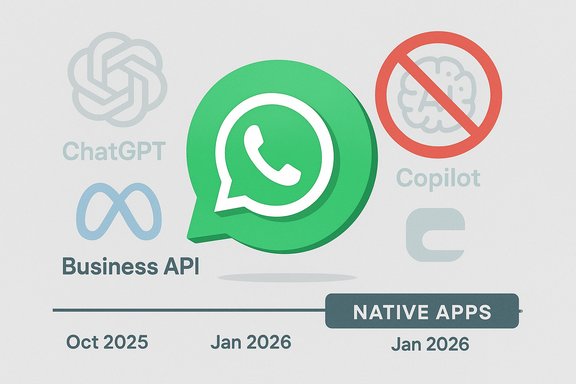
WhatsApp center-stage with ChatGPT, Copilot, and Business API icons on a timeline to Jan 2026.Background / Overview​

WhatsApp’s quietly updated Business API terms, introduced in October 2025, add a new “AI Providers” clause that prohibits providers of large language models, generative AI platforms, and general‑purpose conversational AI assistants from using the WhatsApp Business Solution when those AI capabilities are the primary functionality being offered. The rule takes effect January 15, 2026 and is explicitly scoped to the Business API (WhatsApp’s business messaging surface), while still permitting traditional, business‑oriented automation such as transactional notifications and customer‑service bots. Meta frames the change as restoring the original design of the Business API—a channel for enterprise‑to‑customer communications—and says the surge of consumer‑facing assistants was an unanticipated use that imposed technical and moderation burdens on WhatsApp’s infrastructure. Independent reporting confirms Meta cited system strain and support costs as part of its rationale. At the same time, Meta has been heavily promoting its own assistant, Meta AI, across Facebook, Instagram, Messenger and WhatsApp. The new policy change leaves Meta’s first‑party assistant as the dominant general‑purpose bot that can operate at scale on WhatsApp, while effectively closing the door on most third‑party consumer chat assistants distributed via the Business API. Regulatory scrutiny followed: Italy’s competition watchdog broadened an inquiry into Meta’s AI strategy and the WhatsApp policy change, flagging potential competition concerns.

What exactly is changing (in plain terms)​

The new rule, summarized​

  • WhatsApp added an “AI Providers” section to its Business Solution terms that explicitly names creators of large language models and general‑purpose AI assistants.
  • These providers are prohibited from using the Business API to make consumer‑facing conversational AI available if that AI is the primary functionality being provided.
  • The ban does not target AI used incidentally inside business workflows (booking confirmations, order updates, customer support triage)—those uses remain allowed.

Enforcement timeline​

  • New enforcement and block on new general‑purpose approvals: policy introduced October 2025.
  • Effective enforcement date for existing integrations: January 15, 2026 — by then, affected third‑party assistants must cease Business API usage.

Who is affected, and how severe is the impact?​

Immediate victims​

  • OpenAI’s ChatGPT and Microsoft’s Copilot have announced they will wind down their WhatsApp presences by the January deadline. Vendors such as Perplexity and several startups that used WhatsApp as a frictionless consumer channel are also impacted.

Practical effects for users​

  • ChatGPT users were advised to link their WhatsApp numbers to an OpenAI account to preserve chat history where platform support exists; OpenAI encouraged migration to native ChatGPT apps and the web. Microsoft warned that Copilot’s WhatsApp integration used unauthenticated sessions and therefore chat histories cannot be migrated into Microsoft’s account‑backed Copilot surfaces; users must export chats manually. If users don’t act before the cutoff, chat threads with these assistants will be lost on WhatsApp.

Practical effects for businesses and developers​

  • Companies that used WhatsApp to reach customers with business‑incidental AI workflows remain able to do so, but any product that treats WhatsApp as the primary delivery channel for a consumer AI assistant must be re‑architected. Startups that relied on WhatsApp to reach millions with minimal friction face short windows to rebuild authentication, onboarding, and retention into standalone apps or alternative messaging platforms.

Why Meta says the change was necessary — and what to believe​

Meta’s stated reasons fall into three broad categories:
  • Platform strain: Open‑ended AI assistants generated high volumes of automated messages that created message spikes and support burdens not anticipated by WhatsApp’s human‑to‑human messaging architecture. Meta argues this created systemic load and customer‑support overhead.
  • Product boundaries: The Business API was designed for enterprise transactional and support uses, not as an app distribution layer for consumer AI products. Meta says the policy aligns the API with its intended purpose.
  • Ecosystem consistency and moderation: Allowing dozens of free‑roaming assistants complicates content moderation, metadata handling, and the predictability of user experiences on a platform used by billions. The new rule gives Meta discretionary authority to determine what counts as “general‑purpose” AI.
Those explanations are plausible and are grounded in technical and operational realities. But they also dovetail neatly with a strategic motive: ensuring Meta’s own assistant is the dominant general‑purpose AI inside its apps. Several industry analysts and outlets read the policy as an exclusionary move that advantages Meta AI by reducing friction for its distribution, a concern heightened by ongoing antitrust scrutiny in Europe. The convergence of infrastructure rationales and competitive benefit is the core of the regulatory worry. Flag for readers: Meta’s technical explanations are credible, but the policy’s language grants broad discretion and can be enforced selectively. The competitive effect—channel control for Meta AI—is real and is the primary basis for regulators’ and analysts’ concern.

The user‑experience fallout: data portability, exports, and friction​

WhatsApp’s ubiquity made it the ideal low‑friction distribution channel for AI assistants: no installs, no account creation, just text messages. Losing that convenience has several concrete user‑facing implications:
  • Loss of frictionless continuity: Many users treated a WhatsApp contact as the simplest way to keep AI in their daily flow. That convenience disappears and will likely reduce casual usage of assistants that don’t migrate successfully.
  • Data portability headaches: Because several integrations (notably Copilot on WhatsApp) ran unauthenticated contact models, there is no server‑side mapping back to vendor accounts. That makes automated migration of conversation history infeasible; the only practical option is exporting chat transcripts via WhatsApp’s export tool and preserving them as files. Users should export before January 15, 2026 if they want a copy. Exported material loses WhatsApp’s end‑to‑end encryption protections and requires careful handling.
  • Shift to vendor apps and web: Vendors are directing users to their native apps, web interfaces, or other platforms where authentication, persistent history, and richer multimodal features are available. These surfaces will offer more features but also require installs and sign‑ins, raising churn risk among casual users accustomed to WhatsApp.

Strategic and competitive analysis​

Meta consolidates a premium channel​

Messaging apps are the new battleground for consumer AI distribution. Control of a messaging surface that reaches billions is a direct competitive lever. By removing third‑party general‑purpose assistants from its Business API, Meta effectively reserves WhatsApp as a safer, lower‑friction route for Meta AI to capture users, collect signals, and monetize features across its ad and product stack. Meta has been rolling out Meta AI widely and positioning it as a cross‑product assistant, which aligns with the timing of this policy.

Developer ecosystem fragmentation​

Startups and companies that built products reliant on WhatsApp as a primary distribution channel face an abrupt platform risk. That erosion of channel predictability will:
  • Increase go‑to‑market costs (app building, onboarding flows, authentication).
  • Raise customer acquisition costs as vendors shift to less ubiquitous or more frictional channels.
  • Concentrate power in platforms that can offer in‑app assistants without the same third‑party restrictions.

Regulatory and competition risk for Meta​

The Italian antitrust authority broadened its probe into Meta’s AI tactics and WhatsApp policy, signaling active scrutiny in Europe. That reflects a real legal risk: platform owners that use private API changes to exclude rivals can draw antitrust attention, especially when consumer choice and interoperability are affected. Other regulators may follow. Meta’s defensive legal and PR posture will be consequential if antitrust agencies reach a different view about whether the policy is a legitimate product design change or a deliberate gatekeeping tactic.

Security, privacy, and moderation considerations​

  • The policy reduces the proliferation of unknown third‑party assistants that could introduce malicious or low‑quality models into private chats. From a moderation standpoint, this makes content governance simpler for Meta. However, centralizing control also concentrates risk: a single dominant assistant will carry more influence and will be a bigger target for misuse or data‑handling scrutiny.
  • For exported chats, note that end‑to‑end encryption protection ends once content is exported to a file; users must secure exported transcripts appropriately and be mindful of the personal data they include. Vendors advising exports should highlight this privacy risk.
  • Third‑party vendors moving to other messaging platforms may face different policy regimes. Platforms like Telegram and Signal have different moderation and API constraints; vendors should perform threat modeling for each channel they adopt.

Practical guidance: what users, businesses and developers should do now​

For users who relied on ChatGPT or Copilot inside WhatsApp​

  • Export important chat threads now using WhatsApp’s Export Chat function and store them securely. Files containing sensitive information should be encrypted at rest.
  • Link your phone number to the vendor account where supported (OpenAI provided account‑linking guidance) or sign up for the vendor’s native app to preserve ongoing history and access advanced features.
  • Install and sign into vendors’ official apps (ChatGPT, Copilot) or use the web portals they recommend to rebuild continuity and benefit from authenticated features like synced history and personalization.

For businesses that used WhatsApp as a customer‑facing distribution channel for AI assistants​

  • Audit your WhatsApp Business API flows to confirm whether your usage is incidental to a business workflow (allowed) or a consumer‑facing general‑purpose assistant (disallowed).
  • If disallowed, plan a migration strategy: build first‑party mobile/web apps, integrate authentication and account linking, or shift to permitted messaging partners.
  • Reassess SLAs and infrastructure expectations: if your assistant used WhatsApp for scale, model capacity planning and support staffing for a standalone channel.

For developers and startups that built on WhatsApp​

  • Prioritize account‑based onboarding and a cross‑platform identity model that avoids unauthenticated, contact‑only integrations.
  • Consider multi‑channel deployment earlier (web, mobile SDKs, alternate messengers) to avoid single‑point platform dependency.
  • Monitor regulatory developments—particularly in Europe—where antitrust and privacy regulators are scrutinizing platform behaviors.

Risks and open questions​

  • Regulatory reversal risk: Antitrust authorities may challenge the restriction as exclusionary conduct. If regulators force changes, the competitive landscape could shift again; companies should plan for both sustained enforcement and a scenario where access is restored under conditions.
  • Policy discretionary scope: The Business API language gives Meta wide leeway to determine what counts as “general‑purpose.” That legal vagueness raises compliance uncertainty: vendors may spend development resources to meet rules that are later interpreted inconsistently.
  • User retention and churn: For assistants that relied on WhatsApp’s frictionless reach, user loss is a near‑term risk. It is unclear how well casual users will adopt dedicated apps or web portals when convenience is reduced.
  • Data and privacy trade‑offs: Exporting chat history is a workaround but is imperfect. Exports may lack the richness of structured conversational context and can leak personal data if mishandled. Vendors and users must weigh the privacy trade‑offs of migration paths.
Unverifiable claim flagged: Some reporting interprets the policy as a deliberate attempt to favor Meta AI over rivals. While this interpretation is supported by the effect of the rule and Meta’s simultaneous Meta AI push, intent is ultimately a matter for regulators and internal records; that aspect cannot be fully verified from public statements alone. Readers should treat competitive motive as plausible but legally unsettled.

The bigger picture: messaging apps as AI’s primary interface​

Messaging apps have become the preferred entry point for many AI experiences because they meet users where they already communicate. That trend makes control over a major messaging platform a strategic chokepoint in the broader AI economy. Meta’s action to cordon off WhatsApp’s Business API for third‑party general‑purpose assistants is the clearest demonstration to date that platform owners view messaging channels as a form of distribution power worth defending. For developers, the lesson is straightforward: design for platform diversity and authenticated continuity, because platform rules can change quickly.

Conclusion​

Meta’s WhatsApp Business API update—and the resulting exit of ChatGPT and Copilot from WhatsApp—reshapes how conversational AI is delivered to billions of users. The move reduces operational complexity for WhatsApp and gives Meta greater control over the in‑app assistant experience, but it also concentrates market power, creates short‑term disruption for users and startups, and triggered regulatory scrutiny in Europe. For users, the immediate priorities are straightforward: export what matters, migrate to authenticated vendor apps or web portals, and treat WhatsApp as a platform that may no longer host general‑purpose assistants. For companies and developers, the episode is a stark reminder that distribution channels matter—and that overreliance on a single, third‑party owned channel is a strategic vulnerability in an era of rapid platform policy change.
Source: The Eastleigh Voice ChatGPT, Copilot forced off WhatsApp as Meta enforces new AI restrictions
 

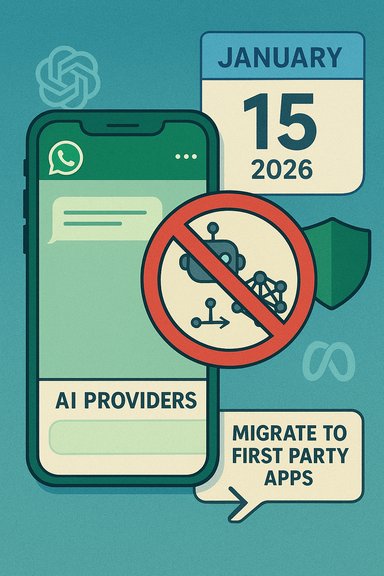
Illustration urging migration from external AI providers to first-party apps (January 15, 2026).
Meta’s quiet rewrite of WhatsApp’s Business API terms has delivered a blunt, consequential deadline: OpenAI’s ChatGPT, Microsoft’s Copilot and a raft of third‑party, general‑purpose AI assistants must stop operating through WhatsApp’s business channel on January 15, 2026 — a move that reshapes who controls conversational AI’s most ubiquitous distribution surface and forces millions of users and businesses to migrate, export, or rebuild their workflows.

Background / Overview​

WhatsApp’s Business Solution — commonly called the WhatsApp Business API — was built to let companies send transactional messages, manage customer support and automate structured workflows at scale. Over the past year, a wave of AI vendors repurposed that same surface to deliver general‑purpose conversational assistants (LLM‑backed chatbots) directly into users’ existing chats, providing zero‑install access and massive reach. In mid‑October 2025 Meta added a new “AI Providers” clause to the Business Solution terms, effective January 15, 2026, that bars providers of large language models and general‑purpose assistants from using the API when those technologies are the primary functionality being offered. Meta frames the change as a return to the Business API’s original purpose — support and transactional workflows — and points to message volume, moderation complexity and engineering overhead as core operational drivers. Independent coverage and vendor confirmations show the practical effect is clear: popular assistants that used WhatsApp as a distribution channel — notably OpenAI’s ChatGPT and Microsoft’s Copilot — will wind down their WhatsApp presences by the January deadline.

What exactly changed in the Business API terms​

The new “AI Providers” clause (plain English)​

  • The updated terms define “AI Providers” broadly to include developers and providers of large language models, generative AI platforms and general‑purpose AI assistants.
  • The prohibition states that such providers are not allowed to access or use the WhatsApp Business Solution “when such technologies are the primary (rather than incidental or ancillary) functionality being made available,” with Meta retaining sole discretion to interpret that clause.
This wording draws a sharp line between permitted business‑incidental automation (customer support bots, booking assistants, transactional notifications) and standalone chat assistants that treat WhatsApp as a distribution platform. TechCrunch first published the refreshed language and Meta’s explanation when the change was introduced.

Effective date and scope​

  • Enforcement date: January 15, 2026.
  • Scope: The prohibition applies to the WhatsApp Business Solution (the Business API) and does not purport to ban all AI within the consumer app; rather, it blocks third‑party conversational assistants that rely on the Business API as their primary delivery channel.

Who’s affected and what vendors have said​

Major vendors: OpenAI and Microsoft​

  • OpenAI: Confirmed ChatGPT’s WhatsApp contact will be removed after the January 15, 2026 deadline and advised users to link phone numbers to ChatGPT accounts where supported to preserve history. The company’s guidance advised migration to ChatGPT’s native apps and web experience for continuity. This user‑linking option is vendor‑specific and may not be available to all users.
  • Microsoft: Announced that Copilot on WhatsApp will cease to operate on January 15, 2026 and directed users to the Copilot mobile apps, copilot.microsoft.com, and Copilot integrations on Windows. Microsoft explicitly warned that WhatsApp sessions with Copilot were often unauthenticated and therefore cannot be migrated server‑side into Microsoft accounts, meaning users must export any important chat history manually before the cutoff.

Smaller startups and regional players​

A wide range of smaller assistants — from Perplexity to newer startups that used WhatsApp to reach users in mobile‑first markets — are equally affected. Many do not offer account linking and will need to either shut down the WhatsApp channel or redesign their products to use authenticated, first‑party surfaces or alternative messaging platforms.

Why Meta says these bots had to go — product and technical rationale​

Meta has given three public rationales for the policy rewrite. Each is plausible on its face, though some aspects are unverifiable from outside the company.
  • Platform strain and operational mismatch: Meta argues that large‑scale, free‑roaming AI chat agents generate unpredictable message volumes and require continuous automated replies — a traffic pattern the Business API was not architected to carry. That created elevated load and new moderation and support requirements. This technical rationale is credible and consistent with how enterprise messaging platforms are typically instrumented.
  • Product boundaries and monetization fit: WhatsApp intends the Business API to support enterprises — notifications, support workflows, transactional messages — not to become a distribution storefront for consumer assistants. General‑purpose assistants blur that boundary and can undermine the platform’s billing and template model.
  • Ecosystem consistency and competitive control: By narrowing permitted AI to business‑incidental cases, Meta reduces the fragmentation and curation costs of allowing dozens of third‑party assistants. The side effect — intentional or not — is to limit rival assistants’ reach inside WhatsApp while Meta pushes its own Meta AI assistant across Facebook, Instagram and WhatsApp. Observers and regulators have flagged this competitive angle for scrutiny.
Caveat: when Meta cites specific load figures or moderation costs, those are company assertions that are not independently verifiable from public telemetry. Treat operational numbers mentioned in vendor statements as claims, and weigh them alongside marketplace effects and vendor reactions.

Immediate user impact and concrete migration steps​

For the millions who have used ChatGPT or Copilot inside WhatsApp, the shutdown is material. The differences in migration options depend on how the vendor implemented the WhatsApp contact.
Key practical points:
  • After January 15, 2026, affected WhatsApp contacts will stop responding and the bot numbers will go dark.
  • ChatGPT: OpenAI offers an account‑linking workflow for some users that can preserve chat history when phone numbers are linked to a ChatGPT account. This option is not universal and depends on whether the WhatsApp session was associated with an account.
  • Copilot: Microsoft’s WhatsApp implementation was commonly unauthenticated — meaning there was no underlying Microsoft account tied to the chat thread — so Microsoft cannot perform server‑side transfers of history; users must export chats manually using WhatsApp’s export tool.
Recommended short checklist for affected users
  1. Export any important WhatsApp chat threads with the AI contact now (use WhatsApp → chat → More → Export chat).
  2. If available, follow vendor guidance to link your phone number to an account (OpenAI’s option where supported).
  3. Install and sign into the vendor’s first‑party app (ChatGPT, Copilot) or bookmark/access the web client for continuity.
  4. Save exported chat archives in a secure backup (local encrypted storage or a trusted cloud vault).
  5. Reconfigure any workflows or automations that routed through WhatsApp and migrate to authenticated API integrations or native apps.

Technical and product implications for developers and enterprises​

This policy shift is an immediate operational headache for companies that relied on WhatsApp’s ubiquity as a zero‑friction distribution channel, especially in mobile‑first markets where WhatsApp functions as a de facto OS layer.
  • Authentication becomes essential. Vendors must design authenticated, account‑backed experiences to preserve history, personalization and user trust. Relying on unauthenticated phone‑number sessions is brittle and nonportable.
  • Diversify distribution. Dependence on a single messaging platform is now a brittle business model. Firms should build cross‑platform clients (web, native apps), leverage alternative messaging channels (Telegram, Signal, RCS where available), or adopt open messaging protocols that reduce single‑vendor dependency.
  • Rework support and moderation models. If the business case requires running open‑ended assistants, vendors will need infrastructure and moderation pipelines suited to high‑volume conversational traffic rather than enterprise notification patterns.
  • Architect for portability. Export mechanisms, data portability APIs and standards for authenticated migration will be valuable differentiators and compliance features in a fragmented landscape.

Competitive and regulatory fallout — why regulators are watching​

Meta’s move has obvious competitive implications: controlling access to a dominant messaging surface gives any platform owner leverage over which AI experiences reach billions of users. That dynamic has already attracted regulatory scrutiny.
  • Italy’s competition authority (AGCM) broadened an investigation into Meta’s integrations and Business Solution updates, investigating whether these changes could be an abuse of dominance that limits competition in the AI‑chatbot ecosystem. That probe underscores how policy and product decisions can trigger antitrust interest when they reshape distribution channels.
  • Antitrust concerns are likely to surface in other jurisdictions if regulators conclude that Meta’s terms unduly favor its own assistant or foreclose competitors from a critical platform. The ban — even if justified on product grounds — concentrates gatekeeper power over a key communications surface.

Strategic reading: what Meta gains and what the market loses​

Meta’s potential gains
  • Control over distribution: By closing a high‑reach channel to third parties, Meta makes it easier for Meta AI to be the default, in‑app assistant users encounter. That reduces friction for Meta’s monetization and product strategies.
  • Operational simplicity: Fewer unvetted, high‑volume chatbot integrations lowers moderation, compliance and engineering overhead for the Business API.
  • Monetization clarity: Keeping the Business API focused on enterprise‑grade usage preserves existing template and billing models.
Market and user costs
  • Reduced consumer choice: Users lose zero‑install, in‑chat access to rival assistants without installing separate apps.
  • Portability friction: Unauthenticated threads and the lack of standard migration paths mean many users will permanently lose conversational history unless they export it.
  • Developer fragility: Startups that scaled through WhatsApp now face higher user‑acquisition costs and slower growth paths.

Practical advice for Windows users and IT pros​

For Windows enthusiasts and IT administrators, the story has an immediate, practical dimension: Microsoft is steering Copilot users to Windows‑native integrations and the Copilot desktop experience.
  • If you used Copilot on WhatsApp for productivity, install Copilot on Windows (or access the web client) and sign into a Microsoft account to preserve history and use richer multimodal features such as Voice and Vision. Microsoft highlights parity plus extra features on its native surfaces.
  • Corporate deployments that routed customer‑facing workflows through third‑party assistants on WhatsApp should:
    1. Audit any business processes that rely on open‑ended chatbot responses.
    2. Migrate critical workflows to authenticated channels (Microsoft Graph, vendor APIs, or dedicated web portals).
    3. Ensure compliance and audit logging remain intact — WhatsApp’s Business API enforcement accentuates the importance of enterprise‑grade telemetry.
  • For personal users, export important chats now and adopt authenticated apps to preserve continuity.

Longer‑term industry consequences: winners, losers, and alternatives​

Likely short‑term outcomes​

  • Rapid migration of mainstream users to vendor‑owned apps and web experiences.
  • Fragmentation as startups pursue alternative messaging integrations or native apps.
  • Increased developer emphasis on portable authentication and server‑side history to avoid future cutoffs.

Potential medium‑term shifts​

  • A market bifurcation where big vendors keep rich, authenticated assistants inside their own apps (and on OS integrations), while smaller players opt for open protocols or niche integrations to retain reach.
  • Pressure on standards bodies and regulators to define portability expectations for conversational AI and to require transparent enforcement criteria for platform APIs.

Possible longer‑term consequences​

  • New consortiums or open protocols for assistant discovery and authentication may emerge if the industry values cross‑platform portability.
  • Alternatively, a handful of platform owners could control how users access assistants in messaging surfaces, increasing vertical consolidation.

What can be done to reduce the harm?​

  • Vendors should build authenticated onboarding paths and offer a standard history export/import format so users aren’t locked out when a channel changes.
  • Platforms should publish clear enforcement thresholds (message volumes, rate limits, detection heuristics) to reduce interpretive uncertainty for developers.
  • Regulators should evaluate whether platform term changes create anti‑competitive barriers, and whether interim portability protections are needed for consumer data.
Practical developer checklist
  • Instrument authenticated APIs for persistent conversation state.
  • Provide an exportable conversation format (timestamped JSON + media manifest).
  • Use multi‑surface delivery (web + native) and reduce dependence on a single messaging API.
  • Monitor policy channels for platform changes and maintain migration playbooks.

Caveats, uncertainties, and unverifiable claims​

  • Public coverage attributes large user counts to vendor statements (for example, OpenAI’s claim that 50 million people used ChatGPT via WhatsApp). Such numbers are vendor‑reported and should be treated as claims unless independently verified by third‑party telemetry. The enforcement rationale Meta cites (exact message‑volume figures and moderation costs) is likewise an internal assertion that external observers cannot fully validate without access to Meta’s operations data. These points are material to understanding the debate but should be presented as company claims rather than independently confirmed facts.
  • The January 15, 2026 deadline is firm in vendor communications; however, enforcement mechanics — how Meta will detect violations and whether any transitional allowances will be made — remain underdefined publicly. Vendors and developers should plan for the date as a hard cutoff while watching for enforcement guidance.

Final assessment: product governance or gatekeeping?​

Meta’s policy rewrite is simultaneously a product governance decision and a strategic consolidation of distribution control. The company has plausible product design reasons to keep the Business API focused on enterprise workflows, and restricting general‑purpose assistants reduces technical and moderation friction. Yet the policy’s competitive effect — reducing rivals’ ability to reach users inside WhatsApp and favoring Meta’s own assistant — is unmistakable and draws legitimate regulatory scrutiny.
For users and IT professionals, the immediate action is operational: export important chat histories, install and sign into vendor first‑party apps, and re‑architect critical workflows to avoid single‑channel failure. For policymakers and industry stakeholders, this episode spotlights the urgent need for clearer portability standards, transparent enforcement signals from platforms, and a public conversation about fair access to the channels where people actually use AI.

This shift marks a meaningful pivot in how conversational AI will be distributed and regulated. The January 15, 2026 enforcement date is the hard pivot point: after that day, the convenience of messaging ChatGPT or Copilot inside WhatsApp will be gone and the market will move toward authenticated, vendor‑controlled surfaces or alternative distribution strategies. Act now to preserve data and plan migration paths; expect the legal and competitive debate over platform gatekeeping to intensify in response.
Source: The Eastleigh Voice ChatGPT, Copilot forced off WhatsApp as Meta enforces new AI restrictions
 

Back
Top