

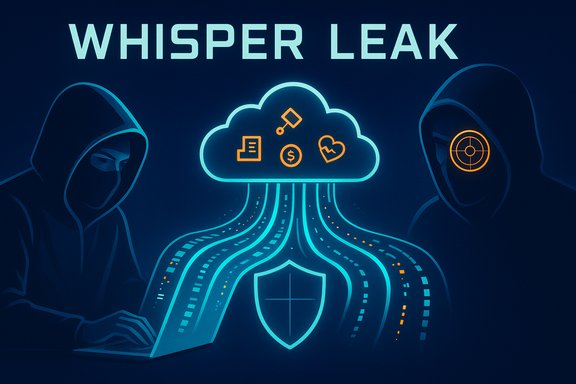
Microsoft’s security team has disclosed “Whisper Leak,” a novel side‑channel attack showing that encrypted AI chat traffic can betray conversation topics to a passive network observer by analyzing packet sizes and timing — and the implications for privacy, enterprise risk, and product design are substantial.
Modern chat-based large language models (LLMs) frequently stream responses token‑by‑token to deliver low perceived latency. That streaming behavior — the rhythm, size, and ordering of encrypted network packets sent while a model streams output — remains visible to any observer on the network path even when TLS (HTTPS) protects the content. Whisper Leak demonstrates that those metadata signals carry structured information that machine‑learning classifiers can exploit to determine whether a conversation concerns a specific sensitive topic. This is not a cryptographic failure of TLS itself: encryption keeps plaintext unreadable. The vulnerability exploits side channels that TLS and current streaming transports leave exposed by design — chiefly record/packet length and inter‑arrival times. The researchers describe an adversary who only needs passive visibility (ISP, transit operator, compromised router, or malicious public Wi‑Fi) and the ability to profile a target model or provider by generating labeled traces. The result is a reconnaissance primitive: identify sessions of interest at scale without decrypting content.
Source: Security Affairs AI chat privacy at risk: Microsoft details Whisper Leak side-channel attack
 Background / Overview
Modern chat-based large language models (LLMs) frequently stream responses token‑by‑token to deliver low perceived latency. That streaming behavior — the rhythm, size, and ordering of encrypted network packets sent while a model streams output — remains visible to any observer on the network path even when TLS (HTTPS) protects the content. Whisper Leak demonstrates that those metadata signals carry structured information that machine‑learning classifiers can exploit to determine whether a conversation concerns a specific sensitive topic. This is not a cryptographic failure of TLS itself: encryption keeps plaintext unreadable. The vulnerability exploits side channels that TLS and current streaming transports leave exposed by design — chiefly record/packet length and inter‑arrival times. The researchers describe an adversary who only needs passive visibility (ISP, transit operator, compromised router, or malicious public Wi‑Fi) and the ability to profile a target model or provider by generating labeled traces. The result is a reconnaissance primitive: identify sessions of interest at scale without decrypting content. How Whisper Leak works — technical breakdown
The observable signal: sizes and timings
When a model streams, the application writes output chunks (often correlated with tokens or small token batches) to the socket. Those writes translate to TLS records and network packets whose ciphertext lengths closely match plaintext lengths plus a small AEAD tag overhead. Observers can record:- The sequence of TLS record / packet sizes in a session.
- The inter‑arrival times between those packets.
- Directional context (client→server vs server→client) and session boundaries.
Data collection and modeling
Microsoft’s team collected labeled traces by programmatically issuing prompt variants for a target topic (their illustrative example: “legality of money laundering”) and mixing them with a large corpus of background questions (over 11,000 unrelated prompts in their setup). They captured packet traces (tcpdump) while randomizing sampling to avoid caching bias, and trained multiple binary classifiers — LightGBM (gradient‑boosted trees), Bi‑LSTM (recurrent), and BERT‑style sequence classifiers — using size only, time only, and size+time feature sets. The main metric reported is Area Under the Precision‑Recall Curve (AUPRC), appropriate for highly imbalanced detection tasks.Results at a glance
- Across 28 commercial LLMs, many attacker models reached AUPRC > 98% in controlled experiments, demonstrating strong discrimination between sensitive-topic and non-sensitive sessions.
- In a simulated large‑scale surveillance scenario (10,000 background conversations with one target), several classifiers achieved 100% precision at operationally useful recall (detecting 5–50% of target sessions) — meaning flagged sessions were almost always true positives.
- Attack effectiveness improves with more profiling data and repeated observations of the same model or user; the team observed accuracy gains as dataset size increased.
Vendor response and mitigations
Microsoft coordinated responsible disclosure with major providers; several vendors have rolled out mitigations or flags to reduce immediate risk. Reported defensive patterns include:- Randomized obfuscation/padding: inserting a random‑length filler field or additional data into streaming events (Microsoft’s blog notes an “obfuscation” field introduced in streaming responses). This breaks the tight one‑to‑one mapping between token length and observed ciphertext length.
- Token batching: server‑side grouping of multiple tokens into larger writes, reducing per‑packet granularity of the signal and masking per‑token length patterns.
- Packet injection / dummy traffic: interleaving synthetic packets to blur timing and size sequences; effective but bandwidth‑heavy (reported overheads in prototypes often approach 2–3×).
- Configurable privacy streaming modes: tenant‑ or API‑level toggles that prioritize obfuscation over latency for sensitive workloads.
Why this matters: practical threats and use cases
Whisper Leak elevates metadata analysis from an academic curiosity to a concrete operational threat. Key scenarios:- Authoritarian surveillance: a state ISP or transit operator could flag users seeking instructions about protests, banned materials, or political organization by applying topical classifiers to encrypted LLM traffic.
- Targeted persecution or repression: high‑precision detection with extremely low false positives is especially useful to an adversary aiming to single out individuals without triggering widespread alerts.
- Corporate exposure: enterprises routing prompts to third‑party LLMs risk leaking the topics of internal investigations, legal strategy, or M&A activity to passive observers on compromised links.
- Phishing and reconnaissance: cybercriminals can prioritize targets identified via topic fingerprints and tailor social engineering or extortion campaigns accordingly.
Strengths of the research
- Breadth — testing across dozens of commercial models and providers demonstrates that this is an industry‑level phenomenon, not an isolated implementation bug.
- Realistic adversary model — passive observation assumptions (ISP, local network) match realistic surveillance capabilities and make the threat credible to defenders and policy makers.
- Robust evaluation metrics — use of AUPRC and extreme class imbalance simulations (10,000:1) focuses on operationally meaningful outcomes (precision-first surveillance scenarios).
- Responsible disclosure and vendor engagement — the research team coordinated fixes and validated mitigations with providers, which accelerated practical countermeasures.
Limitations, uncertainties, and residual risks
- Controlled vs. wild traffic: high AUPRC values were achieved under controlled trace collection and labeled prompt sets. Real-world networks introduce noise: proxies, CDNs, variable MTU fragmentation, multi‑turn dialogs, client batching, and client‑side SDK differences. These factors may degrade classifier performance in the wild. The researchers acknowledge this caveat.
- Model and deployment heterogeneity: vendors use diverse streaming behaviors. Some models (or specific deployments) apply batching or other buffering techniques that materially reduce leakage. Attack success therefore varies by model and endpoint.
- Mitigation arms‑race: obfuscation and batching complicate attacks but do not guarantee permanent safety. Adversaries can gather more profiling samples, exploit residual timing signals, or correlate across sessions and services to recover signal. This is a likely cat‑and‑mouse dynamic.
- Scope of detection vs. reconstruction: current experiments demonstrate topic detection (binary classification), not full prompt reconstruction. Detecting that a conversation is about “money laundering” is serious; reconstructing full prompts would be far harder. The distinction matters for threat modeling.
What enterprises and product teams should do now
Whisper Leak forces changes at multiple levels — architecture, procurement, incident response, and user education. Actionable steps:- Inventory LLM usage: identify which business processes and user groups send prompts to external LLM endpoints. Prioritize sensitive domains (legal, HR, security, health).
- Ask vendors specific questions: is a privacy streaming mode available? Are obfuscation/padding features enabled by default for your account and for all model versions? What are the measured reductions in classifier performance?
- Prefer non‑streaming or on‑prem inference for high‑sensitivity workflows: receiving the full response in a single encrypted transfer or keeping models in a private network removes or greatly reduces token‑level streaming fingerprints.
- Implement tenant controls: require or enable server‑side token batching and random padding for regulated workloads; provide opt‑in* privacy modes that sacrifice a little latency for substantially reduced metadata leakage.
- Network controls and segmentation: route highly sensitive LLM traffic through controlled, encrypted tunnels (e.g., enterprise VPNs or private peering) to reduce exposure to third‑party ISPs; note that tunnels shift trust to the tunnel endpoint/operator.
- Update procurement and SLAs: contract language that promises “encryption” must be explicit about metadata protections, streaming defaults, and guarantees about mitigation rollouts and testing.
- Logging and incident response: correlate prompts and responses with telemetry so that if an adversary leverages metadata signals, incident teams can investigate and trace exposures.
- Benefits of these steps:
- Reduces reconnaissance surface and prioritizes remediation for truly sensitive use cases.
- Provides documented, auditable controls to demonstrate due diligence during compliance assessments.
Engineering trade‑offs and product design choices
Mitigations require hard product decisions:- Token batching reduces leakage but increases latency and can degrade real‑time UX.
- Randomized padding increases bandwidth and slightly complicates billing and telemetry.
- Packet injection offers stronger obfuscation at the cost of significant bandwidth overhead (2–3× in prototypes).
- Fixed‑record framing or multiplexed tunnels can remove variable-size leakage but are complex to implement at internet scale.
Practical advice for individual users
- Avoid discussing extremely sensitive topics on public or untrusted networks with streaming LLMs.
- Prefer providers that document and enable streaming obfuscation or offer non‑streaming modes.
- Use a reputable VPN on public Wi‑Fi, understanding that it moves the observer out but does not eliminate the tunnel endpoint’s visibility.
- For highly sensitive personal or professional conversations, prefer on‑premise models or enterprise isolation.
Regulatory and ethical implications
Whisper Leak reframes what “end‑to‑end encryption” means in the AI era. Privacy regulators, procurement officers, and legal teams must recognize that metadata can be as revealing as content. Contracts that blindly assert “TLS encryption” without stipulating metadata protections may provide a false sense of security for regulated workloads. Procurement requirements and standards bodies should consider adding metadata leakage mitigation as part of privacy and security baselines for AI services.Conclusion — an industry wake‑up call
Whisper Leak is not a single bug to be patched and forgotten. It exposes a systemic interaction between autoregressive LLM streaming semantics and transport‑level metadata that can enable high‑precision topical surveillance even when encryption is correctly implemented. Microsoft’s disclosure, the accompanying technical report, and vendor mitigations illustrate both the problem’s seriousness and the practical levers to reduce risk. But the work is not done: mitigating metadata side channels requires careful product design, transparent defaults, contractual safeguards, and ongoing research into low‑latency, low‑bandwidth obfuscation techniques. The bottom line for IT leaders and security teams: treat LLM metadata leakage as a first‑class privacy threat. Update threat models, demand clear mitigation guarantees from vendors, and isolate the most sensitive workflows from public streaming endpoints until defenses and standards mature.Source: Security Affairs AI chat privacy at risk: Microsoft details Whisper Leak side-channel attack
