

Apple sells fewer smartphones than the Android ecosystem because it competes as one premium hardware-and-services company, while Android is a many-manufacturer platform spanning everything from sub-$100 handsets to foldables and flagships. That difference, highlighted in a recent WION explainer and reflected in market data from StatCounter, Counterpoint Research, and Apple’s own financial filings, is the whole story hiding in plain sight. Android wins the population count; Apple wins the profit pool. The iPhone is not merely a phone business — it is the front door to a high-margin, tightly controlled commercial system.
The most common mistake in the Apple-versus-Android debate is treating operating-system share as if it were business performance. Android’s roughly 70 percent global mobile operating-system share tells us something important: Google’s platform is the default smartphone infrastructure for most of the planet. It does not tell us who captures the value created by that infrastructure.
That distinction matters because Android is not a single hardware business. It is Samsung, Xiaomi, Oppo, Vivo, Transsion, Motorola, Google, Honor, Realme, and many others, all selling into different markets, price bands, carrier channels, and consumer budgets. A $90 Android phone sold in an emerging market and a $1,300 Galaxy Ultra both count as Android units, but they do not produce anything like the same economics.
Apple’s iPhone business is narrower by design. The company does not chase every buyer, every price point, or every regional affordability tier. It largely concentrates on the premium end of the market, where consumers are willing to pay more upfront and where margins are structurally healthier.
That is why the headline comparison can feel paradoxical. Android has more devices in the world. Apple has more control over the part of the market where profit is richest.
Android’s success is distributional. Google built an operating system that could be adopted by almost every manufacturer, customized for different regions, and pushed into every corner of the price spectrum. That strategy made Android the global smartphone default, especially in countries where the median phone buyer cannot or will not spend flagship money.
Apple’s success is extractive in the clean business sense of the word. It controls the hardware, the operating system, the app marketplace, the services layer, the silicon roadmap, the retail experience, and much of the accessory attachment story. Each of those control points gives Apple a chance to preserve margin, deepen loyalty, or collect recurring revenue.
Android manufacturers, by contrast, often live in a more brutal world. Many compete on specifications, discounts, carrier promotions, camera megapixels, charging speed, and razor-thin hardware margins. Even successful Android vendors may move enormous volume while earning far less per device than Apple does from the iPhone.
That is not failure. It is the economics of an open-ish platform with many hardware sellers. Android made smartphones universal; Apple made the premium smartphone unusually profitable.
The iPhone lineup has broadened over time, but Apple’s center of gravity remains premium. Even its “standard” models sit far above the budget Android market, and its Pro models anchor consumer expectations around four-figure pricing. That is a very different business from selling high-volume entry-level handsets where every dollar of bill-of-materials cost matters.
Counterpoint Research has repeatedly reported that Apple captures a disproportionate share of global smartphone revenue and operating profit relative to shipments. That pattern is more important than any single quarter. Apple does not have to dominate unit volume because it dominates the part of the market where customers spend more and where competitors have fewer ways to undercut without damaging their own margins.
This is why Apple can lose the global share chart and still make the industry look financially lopsided. A budget Android phone expands connectivity. A premium iPhone expands Apple’s gross profit, services base, accessory opportunity, and future upgrade pipeline.
There is also an uncomfortable truth for Android vendors: the premium smartphone market behaves differently from the mass market. Brand trust, software longevity, camera consistency, resale value, retail support, and ecosystem compatibility carry more weight than raw specifications. Apple has spent nearly two decades turning those softer attributes into pricing power.
Apple’s financial filings show the scale. In fiscal 2025, Apple reported more than $200 billion in iPhone net sales and more than $100 billion in services net sales. Services are not a side hustle anymore. They are one of the company’s defining profit engines.
Those services include iCloud+, Apple Music, Apple TV+, Apple Arcade, AppleCare, payment services, advertising, licensing, and App Store economics. Some of these are visible monthly subscriptions. Others are less visible tolls on activity that happens inside Apple’s controlled environment.
The strategic effect is powerful. Once a user buys an iPhone, Apple has years of opportunities to earn more from that user without selling another phone immediately. Storage fills up, so iCloud becomes useful. Devices get expensive, so AppleCare becomes attractive. Family members want shared photos, location features, subscriptions, and purchases. Apps and games create transactions. Accessories add convenience.
This is where Android’s scale becomes less decisive. Google can monetize Android users through search, ads, Play services, subscriptions, cloud storage, and app distribution, but Android handset makers do not all share equally in that stream. Samsung may sell the phone, Google may operate the app and search layer, Qualcomm may provide the modem or system-on-chip, and carriers may own the customer relationship. Apple collapses more of that value chain into itself.
But from a business perspective, the ecosystem is also a switching-cost machine. Every additional Apple device makes the next Apple purchase more likely. Every family iCloud plan, shared subscription, Apple Watch band collection, AirTag, HomePod, MagSafe charger, and app purchase adds another thread tying the user to the platform.
This is not unique to Apple. Microsoft built Windows and Office into enterprise defaults through network effects. Google built search and Gmail into daily habits. Adobe turned creative workflows into subscription gravity. But Apple’s version is unusually potent because it sits at the intersection of identity, communication, health, payments, media, and hardware.
The result is a customer base that is not merely buying phones. It is maintaining a personal computing environment. That is why iPhone loyalty remains so valuable even when annual hardware upgrades slow down.
For Android vendors, loyalty is more fragmented. A Samsung user may remain loyal to Samsung, but Android makes it comparatively easier to move to another Android manufacturer. That flexibility is good for consumers and good for platform reach. It is less good for manufacturer-level pricing power.
It is also why profit is scattered. When multiple vendors sell similar Android slabs with similar chips, similar screens, similar app catalogs, and similar access to Google services, price competition becomes intense. One manufacturer’s premium feature quickly becomes another manufacturer’s midrange bullet point.
This is visible in the way Android brands compete. Faster charging becomes a race. Camera sensors become a race. Foldables become a race. RAM and storage configurations become a race. The pace of hardware experimentation is exciting, and Android users often benefit first from new form factors and aggressive specifications.
But speed does not always equal margin. If a feature becomes a commodity within a product cycle or two, it may drive sales without creating durable pricing power. Apple is often slower to adopt certain hardware features, but when it does, it packages them inside a brand and ecosystem that can preserve margin longer.
That is why Android can be more innovative in visible hardware terms while Apple remains more profitable in business terms. The market rewards novelty. The income statement rewards control.
That resale value is not magic. It comes from long software support, predictable hardware quality, brand demand, and a large refurbishing ecosystem. Carriers and retailers can structure trade-in deals around iPhones because they know used devices remain liquid.
This reinforces premium pricing. A consumer may not think of resale value as part of Apple’s business model, but Apple benefits when the secondary market validates the primary market. The more valuable old iPhones remain, the easier it is to sell new iPhones at high prices.
Many Android flagships have improved dramatically on update support and build quality, especially Samsung and Google’s Pixel line. But the Android market as a whole still includes a vast number of low-cost devices with weaker resale value, shorter support windows, and less predictable long-term demand. That pulls down the platform-wide comparison.
When Apple sells an iPhone, it gains a hardware customer. When that customer pays for iCloud storage, subscribes to Apple Music, buys apps, purchases AppleCare, uses Apple Pay, or watches Apple TV+, Apple gains an annuity-like relationship. The company no longer depends solely on the next hardware upgrade to deepen revenue.
This shift also gives Apple more resilience. Smartphone markets mature. Replacement cycles lengthen. Hardware innovation becomes incremental. But services revenue can continue growing if the installed base is large, loyal, and willing to pay.
The installed base is the critical phrase. Apple does not need every smartphone user on Earth. It needs enough affluent, engaged users who spend money inside its environment. The company’s business is optimized around that audience.
Regulators understand this, which is why Apple’s App Store policies, default settings, payment rules, browser restrictions, and platform fees have drawn scrutiny in the United States, Europe, and elsewhere. The very mechanisms that make Apple so profitable are also the ones that make governments ask whether the company has too much control over digital commerce on its devices.
But Google’s win is not the same as Samsung’s win, Xiaomi’s win, or Motorola’s win. Android’s profits are divided among many players and business models. Google monetizes attention and services. Manufacturers monetize hardware. Chipmakers monetize components. Carriers monetize connectivity. Retailers monetize distribution.
Apple, meanwhile, operates a more integrated cash register. It earns from the device, then from the services, then from the accessories, then from the next device. That is why Apple’s business can look disproportionately strong even when Android is the larger platform.
This distinction matters for how we read market-share stories. A chart showing Android at around 70 percent and iOS at around 30 percent is not wrong. It is just incomplete. Market share tells us who is present. Profit share tells us who is extracting value.
The two measures answer different questions. Android answers: what operating system do most people use? Apple answers: who makes the most money from the premium smartphone customer?
Developers want access to iPhone users because those users tend to spend more. Apple then charges commissions on many digital transactions and subscriptions, subject to rules that have been repeatedly challenged by developers and regulators. The circular logic is obvious: Apple’s affluent user base attracts developers, developer activity increases platform value, and platform value reinforces iPhone loyalty.
This is brilliant business architecture. It is also politically vulnerable. The European Union’s Digital Markets Act and related regulatory fights have already forced Apple to make changes in some markets, including around alternative app distribution and payment options. In the United States, litigation and antitrust scrutiny continue to pressure Apple’s control over iOS commerce.
The risk for Apple is not that the iPhone suddenly stops being profitable. The risk is that regulators gradually chip away at the most toll-like parts of the model. Even modest changes to app distribution, default services, browser engines, or payment steering can matter when applied to a business of Apple’s scale.
Still, regulation has not yet destroyed Apple’s core advantage. Consumers buy iPhones because they like them, because the ecosystem works, because the brand is trusted, and because switching is inconvenient. The App Store adds profit, but the moat is broader than one commission structure.
Apple has tried to address that problem through older models, trade-ins, financing, carrier subsidies, and the iPhone SE line. But it has not truly become a low-end phone company, and doing so would risk weakening the economics that make the iPhone so valuable. Apple’s restraint is strategic: it would rather miss some unit sales than dilute the business.
There is also pressure at the high end. Samsung’s foldables, Google’s Pixel AI features, Chinese flagship hardware, and Android’s rapid experimentation all challenge the perception that Apple is the only serious premium choice. If Apple’s hardware roadmap feels too conservative, the company risks leaning too heavily on loyalty rather than excitement.
The services business has its own tension. The more Apple monetizes the installed base, the more users may notice the bill. iCloud storage prompts, subscription bundles, App Store fees passed through by developers, and accessory pricing all contribute to a sense that Apple’s convenience has a meter attached.
That does not mean customers will leave. It does mean Apple must keep proving that the premium is worth paying.
The mature smartphone market is different. Most people already have a smartphone. Replacement cycles are longer. The obvious hardware leaps are fewer. In that environment, the most valuable companies are not necessarily the ones adding the most first-time users. They are the ones monetizing the most profitable installed bases.
Apple is built for that world. It has affluent customers, high retention, a strong services layer, powerful retail and carrier relationships, premium accessories, and a brand that still carries cultural weight. It does not need to outsell all Android vendors combined to out-earn many of them.
Android’s strength remains enormous. It is the global default, the volume leader, the experimentation layer, and the platform that keeps smartphones accessible. But Android’s success is spread across an ecosystem, while Apple’s success accrues to Apple.
That is the answer to the original paradox. Apple sells fewer phones because it refuses to be the phone company for everyone. It makes more money because the people it does serve are more profitable, more loyal, and more likely to keep spending.
For WindowsForum readers, the analogy is familiar. The PC market has long separated volume from value: low-cost Windows laptops can dominate unit sales while premium ultrabooks, workstations, enterprise licensing, cloud services, and software subscriptions capture disproportionate profit. Apple has applied a similar value-over-volume logic to the smartphone business, only with tighter control over the whole stack.
The concrete takeaways are straightforward:
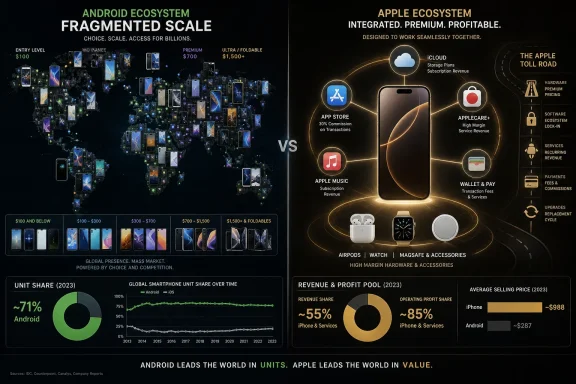 Apple Does Not Need to Win the Unit Race to Win the Money Race
The most common mistake in the Apple-versus-Android debate is treating operating-system share as if it were business performance. Android’s roughly 70 percent global mobile operating-system share tells us something important: Google’s platform is the default smartphone infrastructure for most of the planet. It does not tell us who captures the value created by that infrastructure.That distinction matters because Android is not a single hardware business. It is Samsung, Xiaomi, Oppo, Vivo, Transsion, Motorola, Google, Honor, Realme, and many others, all selling into different markets, price bands, carrier channels, and consumer budgets. A $90 Android phone sold in an emerging market and a $1,300 Galaxy Ultra both count as Android units, but they do not produce anything like the same economics.
Apple’s iPhone business is narrower by design. The company does not chase every buyer, every price point, or every regional affordability tier. It largely concentrates on the premium end of the market, where consumers are willing to pay more upfront and where margins are structurally healthier.
That is why the headline comparison can feel paradoxical. Android has more devices in the world. Apple has more control over the part of the market where profit is richest.
Android Is a Platform; Apple Is a Toll Road
WION’s explanation gets the basic mechanism right: Apple’s smaller share of shipments masks a much larger share of industry profit because Apple sells expensive phones, keeps customers inside its ecosystem, and monetizes them after the device sale. But the deeper point is that Apple and Android are not symmetrical competitors.Android’s success is distributional. Google built an operating system that could be adopted by almost every manufacturer, customized for different regions, and pushed into every corner of the price spectrum. That strategy made Android the global smartphone default, especially in countries where the median phone buyer cannot or will not spend flagship money.
Apple’s success is extractive in the clean business sense of the word. It controls the hardware, the operating system, the app marketplace, the services layer, the silicon roadmap, the retail experience, and much of the accessory attachment story. Each of those control points gives Apple a chance to preserve margin, deepen loyalty, or collect recurring revenue.
Android manufacturers, by contrast, often live in a more brutal world. Many compete on specifications, discounts, carrier promotions, camera megapixels, charging speed, and razor-thin hardware margins. Even successful Android vendors may move enormous volume while earning far less per device than Apple does from the iPhone.
That is not failure. It is the economics of an open-ish platform with many hardware sellers. Android made smartphones universal; Apple made the premium smartphone unusually profitable.
The Premium Segment Is Where the Margin Lives
Apple’s central trick is not mysterious. It sells expensive products to people who can afford expensive products, then persuades them those products are worth replacing on a predictable cycle.The iPhone lineup has broadened over time, but Apple’s center of gravity remains premium. Even its “standard” models sit far above the budget Android market, and its Pro models anchor consumer expectations around four-figure pricing. That is a very different business from selling high-volume entry-level handsets where every dollar of bill-of-materials cost matters.
Counterpoint Research has repeatedly reported that Apple captures a disproportionate share of global smartphone revenue and operating profit relative to shipments. That pattern is more important than any single quarter. Apple does not have to dominate unit volume because it dominates the part of the market where customers spend more and where competitors have fewer ways to undercut without damaging their own margins.
This is why Apple can lose the global share chart and still make the industry look financially lopsided. A budget Android phone expands connectivity. A premium iPhone expands Apple’s gross profit, services base, accessory opportunity, and future upgrade pipeline.
There is also an uncomfortable truth for Android vendors: the premium smartphone market behaves differently from the mass market. Brand trust, software longevity, camera consistency, resale value, retail support, and ecosystem compatibility carry more weight than raw specifications. Apple has spent nearly two decades turning those softer attributes into pricing power.
The iPhone Is the Sale That Starts the Meter Running
The old version of Apple’s business was easy to understand: sell hardware at a premium, repeat every few years. The modern version is more durable. Apple still makes a vast amount of money from hardware, but the iPhone increasingly functions as the enrollment device for a recurring-revenue machine.Apple’s financial filings show the scale. In fiscal 2025, Apple reported more than $200 billion in iPhone net sales and more than $100 billion in services net sales. Services are not a side hustle anymore. They are one of the company’s defining profit engines.
Those services include iCloud+, Apple Music, Apple TV+, Apple Arcade, AppleCare, payment services, advertising, licensing, and App Store economics. Some of these are visible monthly subscriptions. Others are less visible tolls on activity that happens inside Apple’s controlled environment.
The strategic effect is powerful. Once a user buys an iPhone, Apple has years of opportunities to earn more from that user without selling another phone immediately. Storage fills up, so iCloud becomes useful. Devices get expensive, so AppleCare becomes attractive. Family members want shared photos, location features, subscriptions, and purchases. Apps and games create transactions. Accessories add convenience.
This is where Android’s scale becomes less decisive. Google can monetize Android users through search, ads, Play services, subscriptions, cloud storage, and app distribution, but Android handset makers do not all share equally in that stream. Samsung may sell the phone, Google may operate the app and search layer, Qualcomm may provide the modem or system-on-chip, and carriers may own the customer relationship. Apple collapses more of that value chain into itself.
Ecosystem Lock-In Is Not an Accident; It Is the Product
Apple prefers the friendlier term ecosystem, and consumers often experience it that way. AirPods pair smoothly. Apple Watch unlocks things, tracks health, and extends notifications. A Mac can receive iMessages. AirDrop remains one of the company’s most effective invisible retention tools. iCloud makes device replacement feel less like migration and more like continuation.But from a business perspective, the ecosystem is also a switching-cost machine. Every additional Apple device makes the next Apple purchase more likely. Every family iCloud plan, shared subscription, Apple Watch band collection, AirTag, HomePod, MagSafe charger, and app purchase adds another thread tying the user to the platform.
This is not unique to Apple. Microsoft built Windows and Office into enterprise defaults through network effects. Google built search and Gmail into daily habits. Adobe turned creative workflows into subscription gravity. But Apple’s version is unusually potent because it sits at the intersection of identity, communication, health, payments, media, and hardware.
The result is a customer base that is not merely buying phones. It is maintaining a personal computing environment. That is why iPhone loyalty remains so valuable even when annual hardware upgrades slow down.
For Android vendors, loyalty is more fragmented. A Samsung user may remain loyal to Samsung, but Android makes it comparatively easier to move to another Android manufacturer. That flexibility is good for consumers and good for platform reach. It is less good for manufacturer-level pricing power.
Android’s Strength Is Also Its Margin Problem
Android’s openness is the reason it won the global unit race. Manufacturers can adapt it to local markets, build devices at nearly every price point, and differentiate with hardware features Apple would never ship at scale across its main lineup. That variety is Android’s superpower.It is also why profit is scattered. When multiple vendors sell similar Android slabs with similar chips, similar screens, similar app catalogs, and similar access to Google services, price competition becomes intense. One manufacturer’s premium feature quickly becomes another manufacturer’s midrange bullet point.
This is visible in the way Android brands compete. Faster charging becomes a race. Camera sensors become a race. Foldables become a race. RAM and storage configurations become a race. The pace of hardware experimentation is exciting, and Android users often benefit first from new form factors and aggressive specifications.
But speed does not always equal margin. If a feature becomes a commodity within a product cycle or two, it may drive sales without creating durable pricing power. Apple is often slower to adopt certain hardware features, but when it does, it packages them inside a brand and ecosystem that can preserve margin longer.
That is why Android can be more innovative in visible hardware terms while Apple remains more profitable in business terms. The market rewards novelty. The income statement rewards control.
Apple’s Resale Value Quietly Supports New-Phone Pricing
One underappreciated part of Apple’s profit machine is the used iPhone market. High resale values make expensive new iPhones feel less expensive on a net-cost basis. If a buyer believes today’s $1,099 iPhone will retain meaningful value in two or three years, the purchase becomes easier to justify.That resale value is not magic. It comes from long software support, predictable hardware quality, brand demand, and a large refurbishing ecosystem. Carriers and retailers can structure trade-in deals around iPhones because they know used devices remain liquid.
This reinforces premium pricing. A consumer may not think of resale value as part of Apple’s business model, but Apple benefits when the secondary market validates the primary market. The more valuable old iPhones remain, the easier it is to sell new iPhones at high prices.
Many Android flagships have improved dramatically on update support and build quality, especially Samsung and Google’s Pixel line. But the Android market as a whole still includes a vast number of low-cost devices with weaker resale value, shorter support windows, and less predictable long-term demand. That pulls down the platform-wide comparison.
Services Turn Loyalty Into an Income Statement
Apple’s services business is sometimes described as a bonus attached to the iPhone. That understates its importance. Services are the financial expression of Apple’s ecosystem strategy.When Apple sells an iPhone, it gains a hardware customer. When that customer pays for iCloud storage, subscribes to Apple Music, buys apps, purchases AppleCare, uses Apple Pay, or watches Apple TV+, Apple gains an annuity-like relationship. The company no longer depends solely on the next hardware upgrade to deepen revenue.
This shift also gives Apple more resilience. Smartphone markets mature. Replacement cycles lengthen. Hardware innovation becomes incremental. But services revenue can continue growing if the installed base is large, loyal, and willing to pay.
The installed base is the critical phrase. Apple does not need every smartphone user on Earth. It needs enough affluent, engaged users who spend money inside its environment. The company’s business is optimized around that audience.
Regulators understand this, which is why Apple’s App Store policies, default settings, payment rules, browser restrictions, and platform fees have drawn scrutiny in the United States, Europe, and elsewhere. The very mechanisms that make Apple so profitable are also the ones that make governments ask whether the company has too much control over digital commerce on its devices.
Google Wins Reach, but Not the Same Cash Register
Google’s Android strategy has produced one of the most successful software platforms in history. It ensured that mobile computing did not become an Apple-only future, and it gave Google’s services worldwide reach. Search, Maps, YouTube, Gmail, Chrome, Play, and Google’s advertising stack all benefit from Android’s massive footprint.But Google’s win is not the same as Samsung’s win, Xiaomi’s win, or Motorola’s win. Android’s profits are divided among many players and business models. Google monetizes attention and services. Manufacturers monetize hardware. Chipmakers monetize components. Carriers monetize connectivity. Retailers monetize distribution.
Apple, meanwhile, operates a more integrated cash register. It earns from the device, then from the services, then from the accessories, then from the next device. That is why Apple’s business can look disproportionately strong even when Android is the larger platform.
This distinction matters for how we read market-share stories. A chart showing Android at around 70 percent and iOS at around 30 percent is not wrong. It is just incomplete. Market share tells us who is present. Profit share tells us who is extracting value.
The two measures answer different questions. Android answers: what operating system do most people use? Apple answers: who makes the most money from the premium smartphone customer?
The App Store Is Both Moat and Flashpoint
No discussion of Apple’s profitability can ignore the App Store. It is one of the most lucrative control points in consumer technology, and it exists because the iPhone is both a device and a governed marketplace.Developers want access to iPhone users because those users tend to spend more. Apple then charges commissions on many digital transactions and subscriptions, subject to rules that have been repeatedly challenged by developers and regulators. The circular logic is obvious: Apple’s affluent user base attracts developers, developer activity increases platform value, and platform value reinforces iPhone loyalty.
This is brilliant business architecture. It is also politically vulnerable. The European Union’s Digital Markets Act and related regulatory fights have already forced Apple to make changes in some markets, including around alternative app distribution and payment options. In the United States, litigation and antitrust scrutiny continue to pressure Apple’s control over iOS commerce.
The risk for Apple is not that the iPhone suddenly stops being profitable. The risk is that regulators gradually chip away at the most toll-like parts of the model. Even modest changes to app distribution, default services, browser engines, or payment steering can matter when applied to a business of Apple’s scale.
Still, regulation has not yet destroyed Apple’s core advantage. Consumers buy iPhones because they like them, because the ecosystem works, because the brand is trusted, and because switching is inconvenient. The App Store adds profit, but the moat is broader than one commission structure.
The Premium Strategy Has Limits
Apple’s model is powerful, but it is not invincible. Premium positioning can become a constraint when growth shifts to lower-income markets. In countries where device affordability dominates the purchase decision, Android’s range is hard to beat. A consumer who needs a capable phone at the lowest possible price is not Apple’s natural customer.Apple has tried to address that problem through older models, trade-ins, financing, carrier subsidies, and the iPhone SE line. But it has not truly become a low-end phone company, and doing so would risk weakening the economics that make the iPhone so valuable. Apple’s restraint is strategic: it would rather miss some unit sales than dilute the business.
There is also pressure at the high end. Samsung’s foldables, Google’s Pixel AI features, Chinese flagship hardware, and Android’s rapid experimentation all challenge the perception that Apple is the only serious premium choice. If Apple’s hardware roadmap feels too conservative, the company risks leaning too heavily on loyalty rather than excitement.
The services business has its own tension. The more Apple monetizes the installed base, the more users may notice the bill. iCloud storage prompts, subscription bundles, App Store fees passed through by developers, and accessory pricing all contribute to a sense that Apple’s convenience has a meter attached.
That does not mean customers will leave. It does mean Apple must keep proving that the premium is worth paying.
The Real Contest Is Over the Best Customers, Not the Most Customers
The smartphone war used to be framed as a battle for global dominance. That made sense when smartphones were new and the basic question was who would get a computer into everyone’s pocket. Android won that phase by being everywhere.The mature smartphone market is different. Most people already have a smartphone. Replacement cycles are longer. The obvious hardware leaps are fewer. In that environment, the most valuable companies are not necessarily the ones adding the most first-time users. They are the ones monetizing the most profitable installed bases.
Apple is built for that world. It has affluent customers, high retention, a strong services layer, powerful retail and carrier relationships, premium accessories, and a brand that still carries cultural weight. It does not need to outsell all Android vendors combined to out-earn many of them.
Android’s strength remains enormous. It is the global default, the volume leader, the experimentation layer, and the platform that keeps smartphones accessible. But Android’s success is spread across an ecosystem, while Apple’s success accrues to Apple.
That is the answer to the original paradox. Apple sells fewer phones because it refuses to be the phone company for everyone. It makes more money because the people it does serve are more profitable, more loyal, and more likely to keep spending.
The Scoreboard That Actually Explains the Fight
The cleanest way to understand Apple’s advantage is to stop treating shipment share as the final scoreboard. Shipments show reach. Revenue shows pricing power. Profit shows business quality. Services growth shows whether the customer relationship survives after the sale.For WindowsForum readers, the analogy is familiar. The PC market has long separated volume from value: low-cost Windows laptops can dominate unit sales while premium ultrabooks, workstations, enterprise licensing, cloud services, and software subscriptions capture disproportionate profit. Apple has applied a similar value-over-volume logic to the smartphone business, only with tighter control over the whole stack.
The concrete takeaways are straightforward:
- Android leads global smartphone operating-system share because many manufacturers use it across nearly every price band and region.
- Apple earns more per device because the iPhone is concentrated in the premium segment, where margins are much healthier.
- Apple’s services business turns the iPhone from a one-time hardware sale into a recurring revenue relationship.
- The Apple ecosystem increases retention by making watches, earbuds, tablets, Macs, cloud services, apps, and family purchases work better together.
- Android’s openness produces scale and variety, but it also spreads profit among manufacturers, Google, chipmakers, carriers, and retailers.
- Apple’s biggest long-term risk is not losing the unit-share race, but regulators or competitors weakening the control points that make each iPhone customer so valuable.
References
- Primary source: WION
Published: 2026-07-03T21:50:12.510798
- Related coverage: digitalapplied.com
Mobile OS Market Share 2026: iOS vs Android Statistics
Mobile OS market share for 2026: iOS vs Android data by region, version distribution, device pricing tiers, and the strategic impact for app teams.www.digitalapplied.com - Related coverage: technetbooks.com
Android 16 Market Share Surpasses Android 15 as Most Used Mobile OS According to StatCounter Data | Technetbook
Android 16 hits 21.61 percent market share to become the leading version, overtaking Android 15 as the industry prepares for Android 17 release.www.technetbooks.com
- Related coverage: articsledge.com
What Is Android OS? The Complete 2026 Guide
Android OS powers 3.9 billion devices and holds 72%+ of the global mobile market. Learn what it is, how it works, its history, versions, and what makes it dominate in 2026. www.articsledge.com
- Related coverage: mobiloud.com
Android vs iOS Market Share: Most Popular Mobile OS in 2026
Discover the latest trends in Android vs iOS market share and how it impacts your mobile app development strategy. Get the insights you need to succeed.www.mobiloud.com - Related coverage: notebookcheck.net
Apple accounts for almost half of smartphone sales in 2024 thanks to overpriced iPhones - Notebookcheck News
On average, an Apple iPhone costs more than three times as much as a Samsung or Vivo smartphone, and even almost six times as much as a Xiaomi smartphone. Such prices allowed Apple to claim almost half of the global smartphone market revenue in 2024. www.notebookcheck.net
- Related coverage: androidcentral.com
Google's Pixel had a good 2025, but it still trails the big phone makers | Android Central
Despite solid year-over-year growth, the Google Pixel brand still trails Apple and Samsung globally.www.androidcentral.com - Related coverage: digitalcameraworld.com
Apple led global smartphone market in 2025, overtaking Samsung at the post | Digital Camera World
Market report puts Apple on top with a two-percent year-on-year growth for worldwide smartphone shipmentswww.digitalcameraworld.com - Related coverage: axios.com
Apple earnings top estimates on strong iPhone sales
Its results are closely tied to the fortunes of a host of other companies, including component suppliers and wireless carriers.www.axios.com
- Official source: apple.com
