

Apple’s first foldable iPhone, widely rumored as the iPhone Ultra, is reportedly moving toward late-July 2026 mass production at Foxconn ahead of a possible September 2026 unveiling alongside the iPhone 18 Pro lineup. The important part is not merely that Apple may finally ship a foldable. It is that the company appears ready to treat a category Android vendors spent seven years normalizing as a mainstream flagship tier. If the reports hold, September will not be Apple discovering foldables; it will be Apple deciding they are finally safe enough to sell at Apple scale.
The foldable iPhone story has always been less about invention than timing. Samsung, Huawei, Oppo, Honor, Google, and others have already done the messy work: fragile first-generation panels, visible creases, hinge anxiety, awkward app layouts, and prices that could make even a workstation buyer blink. Apple’s reported entry comes after the category has become technically credible, if still commercially narrow.
That is very Apple. The company rarely wins by being first to a hardware category. It wins when it decides the rough edges have been sanded down enough that its version can be presented not as an experiment, but as the obvious mature form of the product.
The latest reporting suggests that hinge issues, long treated as one of the remaining blockers, are no longer the same existential obstacle. That does not mean the phone is finished, cheap, plentiful, or immune to delay. It means Apple may have crossed the internal line between prototype anxiety and production planning.
For WindowsForum readers, the parallel is familiar. Microsoft did not invent tablets, convertibles, or ARM PCs, but it spent years trying to make the seams disappear between device modes. Apple’s rumored foldable iPhone is chasing the same psychological trick: not a phone that becomes a tablet, but a device that makes the distinction feel less important.
That would be very different from how many foldables entered the market. Android vendors often treated early foldables as halo devices: expensive showcases for engineering capability, sold in modest volumes to enthusiasts and status buyers. Apple may still sell the iPhone Ultra in limited quantities at first, but attaching it to the main iPhone cycle gives it a different kind of legitimacy.
The reported late-July mass production start also fits the rhythm of a product that could be announced in September but constrained at launch. Apple can unveil a product before broad availability, and it has done so before when supply, regulatory, or manufacturing realities demanded it. The danger is that a high-priced foldable with limited stock becomes more symbol than product.
Still, symbols matter in consumer technology. If Apple says the foldable belongs in the iPhone family’s top tier, carriers, accessory makers, app developers, and enterprise mobility managers will behave accordingly. A category that Android vendors fought to justify may suddenly inherit the weight of Apple’s installed base.
A bad hinge does not merely break. It creaks, loosens, traps debris, changes the crease profile, and makes a $2,000-class device feel temporary. Apple, more than most companies, cannot afford for its first foldable iPhone to feel temporary.
That is why the long delay was not simply conservatism. Apple had to wait for a foldable design that could survive the company’s brand promise: open it, close it, pocket it, drop it, use it for years, and expect support long after the novelty has faded. The first-generation foldable iPhone does not need to be indestructible, but it cannot feel like a lab sample sold at retail.
This is where Samsung’s years of public iteration helped the entire industry. Every Galaxy Z Fold generation taught consumers what to expect and taught suppliers what could be manufactured at scale. Apple is now reportedly stepping into a supply chain that is more experienced, more disciplined, and less surprised by the demands of folding glass and complex hinges.
Apple has long relied on competitors as suppliers. The iPhone has always been an ecosystem of uneasy dependencies: Samsung displays, Sony camera sensors, TSMC chips, memory from companies that also serve Android OEMs, assembly partners that build for everyone. Apple’s power lies not in making every component itself, but in turning the component stack into a tightly controlled product narrative.
That narrative is where Samsung faces risk. Samsung can say, fairly, that it pioneered the modern foldable phone. It can point to years of engineering, customer feedback, durability improvements, and software refinements. But Apple can arrive late and still define the category for millions of buyers who never considered a Galaxy Z Fold because it was an Android device first and a foldable second.
That is the old iPod lesson, the old iPhone lesson, and to some extent the old Apple Watch lesson. The winning product is not always the first technically credible one. It is often the one that makes the buying public feel the category has finally been translated into a language they already speak.
For Samsung, the answer cannot be simply “we were here first.” It has to be better multitasking, better stylus integration, better displays, better pricing, and a stronger argument for Android flexibility. If Apple enters foldables with even a competent first attempt, Samsung’s foldable line has to stop selling against other Android phones and start selling against the gravitational pull of the iPhone ecosystem.
That matters because Apple’s developer ecosystem is unusually responsive to new device classes when the incentives are clear. A foldable iPhone could create a new layout target between iPhone and iPad, especially for productivity, messaging, reading, photo editing, finance, health, and creative apps. If Apple provides strong APIs and design guidance, developers will follow the money.
The risk is that the first wave of apps merely stretches. Android foldables have suffered from this for years: big screens that sometimes display phone apps with more whitespace rather than more capability. Apple has the advantage of a mature iPad app ecosystem, but the foldable iPhone will not simply be an iPad mini with a hinge.
The device needs continuity that feels natural. A user should start a task closed, open the device, and feel the interface become more useful rather than merely larger. That is a software design challenge as much as a hardware one.
This is where Apple’s rumored timing intersects with WWDC-era developer signals. If Apple has already begun nudging developers toward adaptable layouts, dynamic aspect ratios, and fold-aware interface thinking, the hardware launch becomes the payoff rather than the starting gun. The best version of the iPhone Ultra is not a surprise device that leaves developers scrambling; it is a device whose arrival makes recent software guidance suddenly make sense.
Apple is comfortable cannibalizing itself when the replacement is more profitable or more strategically useful. A foldable iPhone Ultra would almost certainly be expensive, potentially more expensive than many iPads and some Macs. If it pulls high-end users away from a separate small tablet purchase, Apple may accept that trade.
For Windows users, the more interesting question is whether a foldable iPhone becomes a better companion device for PC workflows. Apple and Microsoft have gradually made iPhone-Windows coexistence less hostile, though still nowhere near the integration between iPhone and Mac. A larger folding display could make Microsoft 365, Teams, Outlook, OneNote, Remote Desktop, Windows 365, and cloud PC sessions more practical on an iPhone-class device.
That does not mean Apple is building a Windows companion. It means Microsoft’s services are likely to benefit if the iPhone gains a credible small-tablet mode. The modern Microsoft is less concerned with whether the glass says iPadOS, iOS, Android, or Windows, so long as the user is inside Microsoft’s cloud, identity, security, and productivity stack.
In that sense, the foldable iPhone could become one more endpoint in the post-PC sprawl that IT departments already manage. The device may be Apple’s hardware story, but the work done on it will often belong to Microsoft, Google, Salesforce, Adobe, Slack, Zoom, and the rest of the enterprise app constellation.
The management side should be familiar. If it runs iOS and supports Apple’s current MDM model, the device should fit into existing enrollment, compliance, app distribution, and remote wipe workflows. The harder questions will be physical durability, repair cost, accessory compatibility, and whether apps behave predictably across folded and unfolded states.
Security teams will also care about the larger display. Shoulder surfing becomes easier when a device opens into a mini-tablet in an airport lounge or client site. More usable multitasking can also mean more visible sensitive information. These are not reasons to reject the device, but they are reasons to update acceptable-use guidance.
There is also the matter of lifecycle predictability. Enterprises buy iPhones partly because Apple supports them for a long time and keeps the fleet relatively coherent. A first-generation foldable introduces mechanical uncertainty into that equation. A slab phone may age mostly through battery wear and accidental damage; a foldable adds hinge wear, crease behavior, and panel stress to the risk model.
This is where Apple’s reputation cuts both ways. Buyers will expect the company to have solved the obvious problems before launch. If Apple has not, the backlash will be harsher precisely because the company waited so long.
That shift is uncomfortable because Android foldables have often relied on hardware differentiation to justify themselves. They had larger screens, more adventurous form factors, faster charging, stylus support, multitasking tricks, and early access to folding designs. Apple can neutralize part of that advantage simply by making a foldable that feels polished and works smoothly with iMessage, FaceTime, AirDrop, Apple Watch, AirPods, iCloud, and the App Store.
The Android counterargument remains strong. Samsung and others can still offer more aggressive multitasking, more open file handling, USB-C flexibility, desktop-style modes, stylus ecosystems, and broader form-factor experimentation. Android vendors can also move faster on price tiers once Apple defines the top of the market.
But they will need discipline. If Apple’s iPhone Ultra launches at the ultra-premium end, Android vendors should resist the temptation to answer only with thinner, flashier, more expensive devices. The larger opportunity may be the foldable that becomes affordable enough for mainstream buyers while Apple’s version remains aspirational.
Google has a special stake here. Android’s foldable story is only as strong as the platform’s large-screen app behavior, and Google has spent years trying to improve tablet and foldable support. Apple’s entry could force Android developers to care more, but it could also expose inconsistencies if iOS apps adapt more gracefully.
That creates a positioning problem. A foldable iPhone cannot merely be “an iPhone that opens.” At a very high price, it has to replace something: a small tablet, a second travel device, a paper notebook, a portable monitor, or enough friction in daily work to justify the premium. Novelty will sell the first batch; utility has to sell the second.
Apple’s best chance is to make the device feel less like a foldable phone and more like the most capable iPhone. That means excellent cameras, uncompromised performance, strong battery life, durable construction, and software that uses the inner display without making the outer display feel secondary. If the outside experience feels cramped or compromised, the device becomes annoying during the hundreds of moments when users do not want to unfold it.
Early supply limits could also distort the story. Scarcity can create hype, but it can also keep a product from building normal momentum. If the iPhone Ultra launches with long shipping delays, limited regional availability, or carrier allocation games, it may look more successful than it is while also preventing developers and accessory makers from seeing real-world scale.
The first year, then, may be less about unit volume than proof. Apple needs to prove the form factor belongs in the iPhone family. Consumers need to prove they will pay for it. Developers need to prove they can make the extra screen matter. Everyone else needs to prove they can respond without panic.
Microsoft has already accepted this reality. Its strategy is not to make Windows the only screen, but to make Microsoft identity, files, meetings, cloud PCs, and AI assistants available everywhere. A foldable iPhone gives those services more room to operate on Apple hardware, particularly for users who live in Outlook, Teams, Word, Excel, OneDrive, and Copilot.
The second current is app design. Windows developers have spent years dealing with responsive layouts, touch targets, window resizing, high-DPI scaling, tablet posture, and multi-monitor assumptions. Foldables bring similar problems to mobile, except with more abrupt physical state changes. A device can transform in the user’s hands, and software has to keep up.
The third current is endpoint management. Modern organizations already manage Windows laptops, iPhones, Android phones, iPads, Macs, virtual desktops, and browser-only devices. A premium foldable iPhone adds another shape to the fleet, but not necessarily another management philosophy. The practical questions will be policy, support cost, and whether the form factor improves productivity enough to justify its fragility and price.
The fourth current is the slow erosion of device categories. A Windows laptop is still the center of gravity for many serious workflows, but the edges keep moving. Phones became cameras, wallets, keys, scanners, hotspots, authentication devices, and meeting terminals. A foldable iPhone would push the phone further into tablet territory, and that should interest anyone who cares about the future of personal computing.
Apple’s challenge is to make that compromise feel worth it. The company does not need to eliminate the crease entirely, but it needs to keep it from becoming the first thing reviewers and users talk about. It does not need infinite battery life, but it needs enough endurance that opening the device does not feel like a luxury reserved for moments near a charger.
The more subtle challenge is habit. Most people are trained by years of slab phones to do quick tasks one-handed and longer tasks on a laptop or tablet. A foldable asks them to create a middle behavior: unfold for reading, comparing, editing, planning, navigating, or working. That habit will not form unless the payoff is immediate.
This is where Apple’s ecosystem could be decisive. If unfolding the iPhone makes Photos better, Mail better, Messages better, Safari better, Maps better, Notes better, and third-party apps better, the behavior will stick. If only a handful of apps shine, the hinge becomes a party trick.
A first-generation Apple foldable can survive being expensive. It can survive being supply constrained. It can even survive a visible crease. It cannot survive feeling like a device whose best use cases belong in a keynote rather than a Tuesday afternoon.
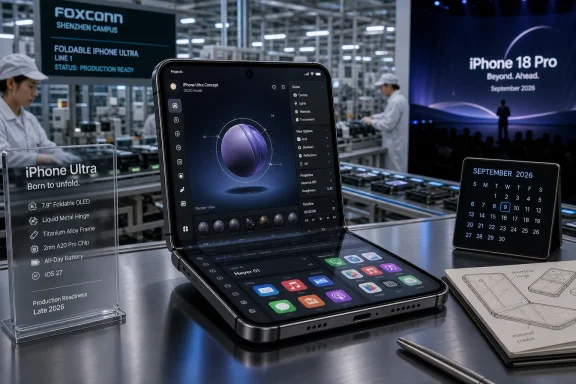 Apple Waited Until the Foldable Stopped Looking Like a Science Project
The foldable iPhone story has always been less about invention than timing. Samsung, Huawei, Oppo, Honor, Google, and others have already done the messy work: fragile first-generation panels, visible creases, hinge anxiety, awkward app layouts, and prices that could make even a workstation buyer blink. Apple’s reported entry comes after the category has become technically credible, if still commercially narrow.That is very Apple. The company rarely wins by being first to a hardware category. It wins when it decides the rough edges have been sanded down enough that its version can be presented not as an experiment, but as the obvious mature form of the product.
The latest reporting suggests that hinge issues, long treated as one of the remaining blockers, are no longer the same existential obstacle. That does not mean the phone is finished, cheap, plentiful, or immune to delay. It means Apple may have crossed the internal line between prototype anxiety and production planning.
For WindowsForum readers, the parallel is familiar. Microsoft did not invent tablets, convertibles, or ARM PCs, but it spent years trying to make the seams disappear between device modes. Apple’s rumored foldable iPhone is chasing the same psychological trick: not a phone that becomes a tablet, but a device that makes the distinction feel less important.
The September Target Is a Statement, Not Just a Date
A September launch window matters because Apple’s fall iPhone event is the industry’s metronome. If the foldable iPhone Ultra appears there, Apple is not positioning it as a curiosity or a developer preview. It is placing it on the same stage as the iPhone 18 Pro and Pro Max, which would make the foldable part of the flagship conversation from day one.That would be very different from how many foldables entered the market. Android vendors often treated early foldables as halo devices: expensive showcases for engineering capability, sold in modest volumes to enthusiasts and status buyers. Apple may still sell the iPhone Ultra in limited quantities at first, but attaching it to the main iPhone cycle gives it a different kind of legitimacy.
The reported late-July mass production start also fits the rhythm of a product that could be announced in September but constrained at launch. Apple can unveil a product before broad availability, and it has done so before when supply, regulatory, or manufacturing realities demanded it. The danger is that a high-priced foldable with limited stock becomes more symbol than product.
Still, symbols matter in consumer technology. If Apple says the foldable belongs in the iPhone family’s top tier, carriers, accessory makers, app developers, and enterprise mobility managers will behave accordingly. A category that Android vendors fought to justify may suddenly inherit the weight of Apple’s installed base.
The Hinge Was Never Just a Mechanical Problem
The reported resolution of “most” hinge problems is easy to read as a manufacturing milestone, but hinge reliability is only the visible part of a deeper issue. A foldable device succeeds or fails at the intersection of materials science, software adaptation, battery packaging, thermal management, and user trust. The hinge is where all of those compromises become tactile.A bad hinge does not merely break. It creaks, loosens, traps debris, changes the crease profile, and makes a $2,000-class device feel temporary. Apple, more than most companies, cannot afford for its first foldable iPhone to feel temporary.
That is why the long delay was not simply conservatism. Apple had to wait for a foldable design that could survive the company’s brand promise: open it, close it, pocket it, drop it, use it for years, and expect support long after the novelty has faded. The first-generation foldable iPhone does not need to be indestructible, but it cannot feel like a lab sample sold at retail.
This is where Samsung’s years of public iteration helped the entire industry. Every Galaxy Z Fold generation taught consumers what to expect and taught suppliers what could be manufactured at scale. Apple is now reportedly stepping into a supply chain that is more experienced, more disciplined, and less surprised by the demands of folding glass and complex hinges.
Samsung May Supply the Screen and Still Lose the Story
One of the more interesting threads in the reporting is Samsung Display’s expected role as a major supplier of foldable OLED panels for Apple. If that holds, Apple’s first foldable iPhone will owe some of its feasibility to the same corporate empire that defined the Android foldable market. The irony is sharp but not unusual.Apple has long relied on competitors as suppliers. The iPhone has always been an ecosystem of uneasy dependencies: Samsung displays, Sony camera sensors, TSMC chips, memory from companies that also serve Android OEMs, assembly partners that build for everyone. Apple’s power lies not in making every component itself, but in turning the component stack into a tightly controlled product narrative.
That narrative is where Samsung faces risk. Samsung can say, fairly, that it pioneered the modern foldable phone. It can point to years of engineering, customer feedback, durability improvements, and software refinements. But Apple can arrive late and still define the category for millions of buyers who never considered a Galaxy Z Fold because it was an Android device first and a foldable second.
That is the old iPod lesson, the old iPhone lesson, and to some extent the old Apple Watch lesson. The winning product is not always the first technically credible one. It is often the one that makes the buying public feel the category has finally been translated into a language they already speak.
For Samsung, the answer cannot be simply “we were here first.” It has to be better multitasking, better stylus integration, better displays, better pricing, and a stronger argument for Android flexibility. If Apple enters foldables with even a competent first attempt, Samsung’s foldable line has to stop selling against other Android phones and start selling against the gravitational pull of the iPhone ecosystem.
Apple Is Really Selling a New App Canvas
The foldable iPhone’s most important feature may not be the hinge, the panel, or the chassis thickness. It may be the app canvas. A folding iPhone forces developers to think beyond the traditional slab-phone rectangle without asking users to carry a full iPad.That matters because Apple’s developer ecosystem is unusually responsive to new device classes when the incentives are clear. A foldable iPhone could create a new layout target between iPhone and iPad, especially for productivity, messaging, reading, photo editing, finance, health, and creative apps. If Apple provides strong APIs and design guidance, developers will follow the money.
The risk is that the first wave of apps merely stretches. Android foldables have suffered from this for years: big screens that sometimes display phone apps with more whitespace rather than more capability. Apple has the advantage of a mature iPad app ecosystem, but the foldable iPhone will not simply be an iPad mini with a hinge.
The device needs continuity that feels natural. A user should start a task closed, open the device, and feel the interface become more useful rather than merely larger. That is a software design challenge as much as a hardware one.
This is where Apple’s rumored timing intersects with WWDC-era developer signals. If Apple has already begun nudging developers toward adaptable layouts, dynamic aspect ratios, and fold-aware interface thinking, the hardware launch becomes the payoff rather than the starting gun. The best version of the iPhone Ultra is not a surprise device that leaves developers scrambling; it is a device whose arrival makes recent software guidance suddenly make sense.
The Foldable iPhone Is a Threat to the Small Tablet
A successful foldable iPhone would not only challenge Android foldables. It would also pressure Apple’s own product map. The iPad mini, compact tablets, and even some lightweight laptop use cases all sit near the same behavioral territory: reading, note-taking, travel entertainment, email triage, remote desktop sessions, dashboards, and document review.Apple is comfortable cannibalizing itself when the replacement is more profitable or more strategically useful. A foldable iPhone Ultra would almost certainly be expensive, potentially more expensive than many iPads and some Macs. If it pulls high-end users away from a separate small tablet purchase, Apple may accept that trade.
For Windows users, the more interesting question is whether a foldable iPhone becomes a better companion device for PC workflows. Apple and Microsoft have gradually made iPhone-Windows coexistence less hostile, though still nowhere near the integration between iPhone and Mac. A larger folding display could make Microsoft 365, Teams, Outlook, OneNote, Remote Desktop, Windows 365, and cloud PC sessions more practical on an iPhone-class device.
That does not mean Apple is building a Windows companion. It means Microsoft’s services are likely to benefit if the iPhone gains a credible small-tablet mode. The modern Microsoft is less concerned with whether the glass says iPadOS, iOS, Android, or Windows, so long as the user is inside Microsoft’s cloud, identity, security, and productivity stack.
In that sense, the foldable iPhone could become one more endpoint in the post-PC sprawl that IT departments already manage. The device may be Apple’s hardware story, but the work done on it will often belong to Microsoft, Google, Salesforce, Adobe, Slack, Zoom, and the rest of the enterprise app constellation.
Enterprise IT Will See a Premium Phone and a New Risk Surface
Corporate buyers are unlikely to rush into foldable iPhones on day one, especially if pricing and availability are constrained. But executives, developers, sales teams, consultants, and field staff have a way of turning luxury devices into enterprise support requests. If the iPhone Ultra ships, IT departments will be asked whether it is allowed, supported, insured, enrolled, and replaceable.The management side should be familiar. If it runs iOS and supports Apple’s current MDM model, the device should fit into existing enrollment, compliance, app distribution, and remote wipe workflows. The harder questions will be physical durability, repair cost, accessory compatibility, and whether apps behave predictably across folded and unfolded states.
Security teams will also care about the larger display. Shoulder surfing becomes easier when a device opens into a mini-tablet in an airport lounge or client site. More usable multitasking can also mean more visible sensitive information. These are not reasons to reject the device, but they are reasons to update acceptable-use guidance.
There is also the matter of lifecycle predictability. Enterprises buy iPhones partly because Apple supports them for a long time and keeps the fleet relatively coherent. A first-generation foldable introduces mechanical uncertainty into that equation. A slab phone may age mostly through battery wear and accidental damage; a foldable adds hinge wear, crease behavior, and panel stress to the risk model.
This is where Apple’s reputation cuts both ways. Buyers will expect the company to have solved the obvious problems before launch. If Apple has not, the backlash will be harsher precisely because the company waited so long.
Android Vendors Now Face the Problem They Created
Android manufacturers spent years arguing that foldables are the future. Apple may be about to agree with them, which is both validation and nightmare. Once Apple enters, the category’s benchmark shifts from “better than last year’s Fold” to “better than the foldable iPhone.”That shift is uncomfortable because Android foldables have often relied on hardware differentiation to justify themselves. They had larger screens, more adventurous form factors, faster charging, stylus support, multitasking tricks, and early access to folding designs. Apple can neutralize part of that advantage simply by making a foldable that feels polished and works smoothly with iMessage, FaceTime, AirDrop, Apple Watch, AirPods, iCloud, and the App Store.
The Android counterargument remains strong. Samsung and others can still offer more aggressive multitasking, more open file handling, USB-C flexibility, desktop-style modes, stylus ecosystems, and broader form-factor experimentation. Android vendors can also move faster on price tiers once Apple defines the top of the market.
But they will need discipline. If Apple’s iPhone Ultra launches at the ultra-premium end, Android vendors should resist the temptation to answer only with thinner, flashier, more expensive devices. The larger opportunity may be the foldable that becomes affordable enough for mainstream buyers while Apple’s version remains aspirational.
Google has a special stake here. Android’s foldable story is only as strong as the platform’s large-screen app behavior, and Google has spent years trying to improve tablet and foldable support. Apple’s entry could force Android developers to care more, but it could also expose inconsistencies if iOS apps adapt more gracefully.
Price Will Decide Whether This Is a Product or a Trophy
The rumored iPhone Ultra name says the quiet part out loud. This will not be a budget experiment. Every signal points to a device sitting above the Pro Max tier, possibly at a price where buyers compare it not only to phones, but to laptops and tablets.That creates a positioning problem. A foldable iPhone cannot merely be “an iPhone that opens.” At a very high price, it has to replace something: a small tablet, a second travel device, a paper notebook, a portable monitor, or enough friction in daily work to justify the premium. Novelty will sell the first batch; utility has to sell the second.
Apple’s best chance is to make the device feel less like a foldable phone and more like the most capable iPhone. That means excellent cameras, uncompromised performance, strong battery life, durable construction, and software that uses the inner display without making the outer display feel secondary. If the outside experience feels cramped or compromised, the device becomes annoying during the hundreds of moments when users do not want to unfold it.
Early supply limits could also distort the story. Scarcity can create hype, but it can also keep a product from building normal momentum. If the iPhone Ultra launches with long shipping delays, limited regional availability, or carrier allocation games, it may look more successful than it is while also preventing developers and accessory makers from seeing real-world scale.
The first year, then, may be less about unit volume than proof. Apple needs to prove the form factor belongs in the iPhone family. Consumers need to prove they will pay for it. Developers need to prove they can make the extra screen matter. Everyone else needs to prove they can respond without panic.
The Windows Angle Is Bigger Than Phone Link
A foldable iPhone story may look peripheral to a Windows audience, but it touches several currents that matter deeply to PC users. The first is cross-device work. The more capable phones become, the more Windows PCs must justify when and why users move tasks back to the desktop.Microsoft has already accepted this reality. Its strategy is not to make Windows the only screen, but to make Microsoft identity, files, meetings, cloud PCs, and AI assistants available everywhere. A foldable iPhone gives those services more room to operate on Apple hardware, particularly for users who live in Outlook, Teams, Word, Excel, OneDrive, and Copilot.
The second current is app design. Windows developers have spent years dealing with responsive layouts, touch targets, window resizing, high-DPI scaling, tablet posture, and multi-monitor assumptions. Foldables bring similar problems to mobile, except with more abrupt physical state changes. A device can transform in the user’s hands, and software has to keep up.
The third current is endpoint management. Modern organizations already manage Windows laptops, iPhones, Android phones, iPads, Macs, virtual desktops, and browser-only devices. A premium foldable iPhone adds another shape to the fleet, but not necessarily another management philosophy. The practical questions will be policy, support cost, and whether the form factor improves productivity enough to justify its fragility and price.
The fourth current is the slow erosion of device categories. A Windows laptop is still the center of gravity for many serious workflows, but the edges keep moving. Phones became cameras, wallets, keys, scanners, hotspots, authentication devices, and meeting terminals. A foldable iPhone would push the phone further into tablet territory, and that should interest anyone who cares about the future of personal computing.
Apple’s Real Competitor Is the User’s Patience
Foldables have improved, but they have not become invisible. Users still notice creases. They still worry about drops. They still wonder whether dust, sand, keys, toddlers, or bad luck will turn an expensive device into an insurance claim. The category asks buyers to accept a mechanical compromise in exchange for a larger screen.Apple’s challenge is to make that compromise feel worth it. The company does not need to eliminate the crease entirely, but it needs to keep it from becoming the first thing reviewers and users talk about. It does not need infinite battery life, but it needs enough endurance that opening the device does not feel like a luxury reserved for moments near a charger.
The more subtle challenge is habit. Most people are trained by years of slab phones to do quick tasks one-handed and longer tasks on a laptop or tablet. A foldable asks them to create a middle behavior: unfold for reading, comparing, editing, planning, navigating, or working. That habit will not form unless the payoff is immediate.
This is where Apple’s ecosystem could be decisive. If unfolding the iPhone makes Photos better, Mail better, Messages better, Safari better, Maps better, Notes better, and third-party apps better, the behavior will stick. If only a handful of apps shine, the hinge becomes a party trick.
A first-generation Apple foldable can survive being expensive. It can survive being supply constrained. It can even survive a visible crease. It cannot survive feeling like a device whose best use cases belong in a keynote rather than a Tuesday afternoon.
Cupertino’s Foldable Bet Leaves a Paper Trail
The clearest reading of the current reports is that Apple’s foldable iPhone has moved from rumor fog into production-watch territory. That still leaves room for delay, renaming, limited availability, and specification surprises, but the direction of travel is now unusually concrete.- Apple is reportedly targeting late July 2026 for mass production of its first foldable iPhone through Foxconn.
- The device is widely rumored to launch in September 2026, likely alongside the iPhone 18 Pro and iPhone 18 Pro Max rather than the full standard iPhone lineup.
- Recent reporting suggests hinge-related problems have been largely resolved, though first-generation foldable durability remains the central risk.
- Samsung Display is expected to play a major role in supplying foldable OLED panels, making Apple’s rival an important enabler of the product.
- The real test will be software, because a foldable iPhone needs apps that adapt intelligently rather than simply stretch.
- Enterprise buyers should treat the device as both a premium endpoint and a new physical-risk category, not merely another iPhone SKU.
References
- Primary source: gsmarena.com
Published: Wed, 24 Jun 2026 19:00:03 GMT
Here's when Apple is starting mass production of the iPhone Ultra - GSMArena.com news
Everything seems to be back on schedule. Recently there's been some controversy about the iPhone Ultra's release window, with a report claiming it was...www.gsmarena.com
- Independent coverage: Android Authority
Published: Wed, 24 Jun 2026 17:31:01 GMT
Apple's foldable iPhone Ultra looks on track for a September launch
According to a new report, Apple will start mass production of the iPhone Ultra in July and the phone is on track for a September launch.www.androidauthority.com - Independent coverage: Android Headlines
Published: Wed, 24 Jun 2026 13:39:36 GMT
Apple Just Cleared the Last Big Hurdle for the iPhone Ultra
The iPhone Ultra is apparently ready to enter mass production next month. While we had already reported that Samsung had begun mass-producing the M16 www.androidheadlines.com
- Related coverage: t3.com
Hold on, we've been looking at the iPhone Ultra all wrong – it's not a foldable iPhone after all | T3
Apple might have pulled the wool over our eyeswww.t3.com - Related coverage: techradar.com
Apple tipped to launch 6 new iPhones, 2 new wearables, and more in 'biggest product year’ ever — here's the full list | TechRadar
New phones, AirPods, glasses, and morewww.techradar.com - Related coverage: macrumors.com
Foldable iPhone 'Ultra' Still on Track for September Debut
Apple's first foldable iPhone remains on track for a September debut, despite rumors to the contrary, based on a new report by China Securities Journal (via DigiTimes). According to the report, which cites a source at an Apple supplier, the company recently started delivering components in...www.macrumors.com
- Related coverage: macworld.com
Folding iPhone is reportedly on track with 'most' hinge issues resolved | Macworld
Defect rates are higher than expected, but officials are optimistic about September launch.www.macworld.com - Related coverage: notebookcheck.net
Good news: Foldable iPhone Ultra launching with iPhone 18 Pro; mass production on track, says latest leak - Notebookcheck News
The latest iPhone leak suggests the foldable iPhone Ultra (iPhone Fold) is on track for its September launch. Despite mechanical setbacks, Apple aims for a July mass production start at Foxconn, so the iPhone Ultra can be announced alongside the iPhone 18 Pro by CEO John Ternus. www.notebookcheck.net
- Related coverage: tomsguide.com
iPhone Fold delay rumors debunked — here's why a September release window seems likely after all | Tom's Guide
iPhone Fold should still be on track for a September release, according to a new report.www.tomsguide.com - Related coverage: frandroid.com
iPhone pliable : sortie confirmée en septembre 2026 après quelques semaines de doutes— Frandroid
Plus de report prévu pour l'iPhone pliable. Le calendrier est fixé pour une sortie en septembre. Les soucis de charnière rencontrés par Apple auraient étéwww.frandroid.com - Related coverage: apple.gadgethacks.com
iPhone Ultra Leak Shows Apple May Be Learning From Samsung's Foldables << Apple :: Gadget Hacks
New leaks around Apple's rumored foldable iPhone point to a wide, book-style device that could feel like a standard iPhone when closed and open into... apple.gadgethacks.com
- Related coverage: androidcentral.com
The foldable phone ‘failure’ is over: Why 2026 is set to change everything | Android Central
Fold once, fold twice: Stronger return of the foldables!www.androidcentral.com - Related coverage: whathifi.com
iPhone Fold: design rumours, price leaks and everything we know so far | What Hi-Fi?
Looks likely to launch in Septemberwww.whathifi.com
