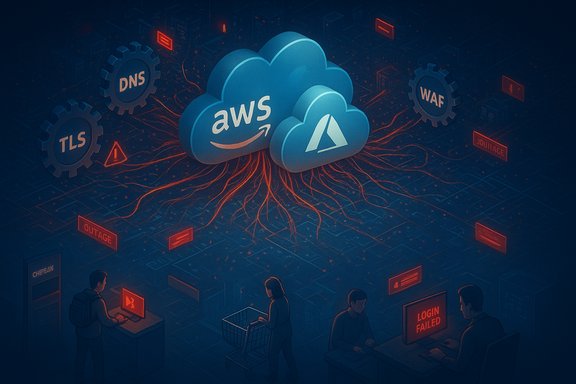
The internet’s plumbing is creaking louder: in the space of a few weeks a trio of high‑profile outages knocked huge swaths of services offline, and the pattern exposes a deeper fault line in how the modern web is built, operated and regulated.
The past two months have produced a string of outages that were not only large in scope but instructive in how they happened: Amazon Web Services suffered a DynamoDB-related DNS failure on October 20 that cascaded across services; Microsoft experienced a global Azure Front Door configuration incident on October 29 that disrupted identity and routing; and Cloudflare suffered a November outage tied to its anti-bot/edge systems. These events—all caused or amplified by relatively small configuration or software errors—demonstrate a recurring mode of failure where control‑plane mistakes become systemic outages for millions of users and thousands of businesses. Independent technical analyses and vendor post‑mortems consistently point to DNS, global control‑plane fabrics and automated change processes as the proximate failure modes. At the same time, historic incidents—most notably a faulty CrowdStrike update in July 2024 that caused mass Windows crashes and ripple effects across airlines and critical infrastructure—remain in the memory of operators and regulators as proof that a single software misstep can cause national‑scale disruption. Reporting and legal actions arising from that 2024 incident underscore the financial and systemic stakes. WindowsForum’s incident archives and community analyses mirror this timeline and technical framing, showing a common conclusion: convenience and scale have outpaced systemic resilience in key parts of the internet stack.
For Windows system administrators, enterprise architects and everyday users, the imperative is clear: assume failure, map dependencies, create escape hatches and test degraded modes regularly. For vendors and regulators, the work is to reduce blast radii, increase operational transparency and codify the minimum resilience obligations for services that underpin commerce and public safety.
The internet can be reliably resilient, but only if the industry treats control‑plane safety, staged change governance and contractual accountability as first‑class priorities instead of afterthoughts. The near‑term path to fewer and less severe outages runs through multidisciplinary improvements—engineering, procurement, legal and policy—and through a sober recognition that scale without contingency is brittle.
WindowsForum’s technical community has already begun cataloguing mitigation patterns, incident runbooks and admin checklists that implement these lessons; those practical guides remain critical reading for anyone responsible for continuity in a cloud‑dependent organization.
Key recent reporting and technical analyses referenced above include vendor incident posts and independent reconstructions of the AWS, Azure and Cloudflare incidents, as well as reporting and legal filings tied to the CrowdStrike 2024 update — these public materials informed the technical timelines, verified reported causes and shaped the resilience recommendations provided here.
Source: Newsmax https://www.newsmax.com/newsfront/internet-outages-frequency/2025/11/23/id/1235733/
 Background / Overview
The past two months have produced a string of outages that were not only large in scope but instructive in how they happened: Amazon Web Services suffered a DynamoDB-related DNS failure on October 20 that cascaded across services; Microsoft experienced a global Azure Front Door configuration incident on October 29 that disrupted identity and routing; and Cloudflare suffered a November outage tied to its anti-bot/edge systems. These events—all caused or amplified by relatively small configuration or software errors—demonstrate a recurring mode of failure where control‑plane mistakes become systemic outages for millions of users and thousands of businesses. Independent technical analyses and vendor post‑mortems consistently point to DNS, global control‑plane fabrics and automated change processes as the proximate failure modes. At the same time, historic incidents—most notably a faulty CrowdStrike update in July 2024 that caused mass Windows crashes and ripple effects across airlines and critical infrastructure—remain in the memory of operators and regulators as proof that a single software misstep can cause national‑scale disruption. Reporting and legal actions arising from that 2024 incident underscore the financial and systemic stakes. WindowsForum’s incident archives and community analyses mirror this timeline and technical framing, showing a common conclusion: convenience and scale have outpaced systemic resilience in key parts of the internet stack.Why these outages matter: the technical anatomy
The control plane vs. the data plane
Modern cloud architectures separate the data plane (where customer workloads run) from the control plane (the management systems that configure, route, authenticate and orchestrate those workloads). When data-plane servers fail, traditional high‑availability techniques (replication, failover, region diversity) often limit impact. When control‑plane primitives fail—DNS, global edge routing (AFD/Front Door), identity/token services, or centrally hosted configuration stores—the effect is qualitatively different: healthy compute and storage nodes become unreachable or unmanageable because the system that tells clients how to reach them or authenticate to them is impaired. The October AWS and Azure incidents fit that pattern: DNS resolution for DynamoDB in US‑EAST‑1 and an inadvertent Azure Front Door configuration change each produced outsized outages by taking away the internet’s “phone book” or its global ingress fabric.Small errors, huge blast radii
Each vendor’s story is similar at a process level: a single commit, automation slip, or malformed update that escaped sufficient canarying propagated globally and hit thousands of dependent systems. These aren’t dramatic hacks or novel zero‑days; they are configuration or update errors amplified by automation and tight coupling. Independent telemetry firms and post‑incident reconstructions show the initial fault windows were measured in minutes to hours, but secondary effects—backlogged orchestration, retry storms, health‑check failures and cache propagation—turned short faults into multi‑hour outages.DNS and edge fabrics: brittle chokepoints
DNS is still the internet’s address book. When authoritative records are wrong, clients can’t find services—even if the service itself is healthy. Global edge fabrics (Cloudflare, Azure Front Door, AWS edge components) act as both ingress and security layers for many tenants; misconfigurations there can remove authentication paths and management consoles, complicating remediation. The combination of cached DNS behavior, global CDN caches, and automated routing rules explains why recovery tends to be staged and sometimes prolonged.The human, economic and national‑security stakes
Real-world impacts
- Airlines and travel: check‑in systems and boarding flows tied to cloud identity or routing broke during the Azure incident, forcing manual processing and cancellations.
- Consumer services: games, payment flows, smart‑home devices and everyday apps were disrupted during the AWS DynamoDB DNS failure. High‑profile consumer interruptions increase political attention.
- Critical infrastructure: the CrowdStrike 2024 event affected emergency services, broadcasters and hospital systems by crashing Windows hosts, showing that endpoint updates can become catastrophic at scale. Legal and regulatory repercussions followed, demonstrating real financial exposure for vendors.
Political pressure and regulatory appetite
The concentration of internet infrastructure into a handful of hyperscalers has drawn political scrutiny. High‑profile comments—most notably U.S. Sen. Elizabeth Warren’s criticism following the AWS outage—frame outages as a symptom of consolidation and prompt calls for stronger antitrust and resilience policies. Regulators and legislators are increasingly inclined to demand vendor transparency, mandatory post‑incident reporting, and minimum resilience standards for services deemed critical to public life. Security analysts and policy researchers warn that this concentration is not just a market problem but a national security risk: when essential services and identity fabrics are controlled by a few private actors, a systemic software flaw can be weaponized—intentionally or otherwise—against broad swathes of the economy.What vendors say — and what independent analysis shows
- Cloudflare’s own incident analysis attributes the November outage to a change in query behavior inside an anti‑bot control path; the company initially considered a DDoS but traced the root cause to an internal software flaw that produced problematic query duplication and routing anomalies. The status blog and incident narrative explain detection, mitigation and the steps Cloudflare applied to restore services.
- AWS and independent telemetry vendors (ThousandEyes, reconstruction analyses) describe the October 20 DynamoDB DNS automation error as the proximate trigger, followed by cascading control‑plane state failures in EC2 orchestration and load balancers. Independent analysts documented that even after DNS insertion, secondary state problems prolonged recovery into the day.
- Microsoft’s post‑incident updates and third‑party reporting identify an inadvertent configuration change in Azure Front Door as the trigger for the October 29 disruption; Microsoft mitigated by deploying a “last known good” configuration and freezing changes while nodes were recovered. Independent trackers and coverage confirm the identity/authentication and routing symptoms that followed.
Strengths revealed by the incidents
- Scale and speed of remediation: despite the broad impact, hyperscalers were able to mobilize engineers, push mitigations and restore significant portions of service within hours. That operational muscle—global SRE teams, live rollback automation and access to deep telemetry—is a structural strength of hyperscale providers.
- Transparency improvements: modern incident communications (status pages, blog post mortems, live telemetry feeds) are more informative than a decade ago. Vendors now publish root‑cause analyses with technical depth that allow customers and regulators to evaluate systemic risk. This is not universal or uniformly timely, but the trend is positive.
- Vendor incentives for resilience: the reputational and financial costs of outages create a business incentive for better change controls, canarying, and staged rollouts—actions vendors are already taking to reduce blast radii.
Risks, weaknesses and systemic vulnerabilities
- Single‑vendor dependencies: many enterprises, governments and consumer platforms are architected with implicit trust in a single provider’s control plane. That creates single points of failure that manifest as national or multi‑industry outages when something goes wrong.
- Overreliance on automated global changes: automation without sufficiently rigorous canarying and blast‑radius limits accelerates failure propagation. When a global config or content update passes shallow checks, it can suddenly affect every point of presence worldwide.
- Fragile identity and management paths: outages that affect token issuance or management consoles make it harder for operators to remediate; if admins lose access to the very tools they need to fix an outage, recovery slows.
- Transparency gaps and slow post‑incident disclosures: while vendor postmortems are better than before, there are still gaps in granular telemetry, root‑cause lineage and the specific chain of human approvals that led to a bad change. Those gaps make independent verification and regulatory oversight harder.
- Cascading economic exposure: supply chain interdependence—airlines, finance, retail and public services all relying on common clouds—means outages compound across sectors, increasing aggregate economic damage beyond the affected vendor’s direct customers. CrowdStrike’s 2024 incident showed how endpoint updates can cascade into airline cancellations and disruptions to critical infrastructure.
Practical guidance: what IT teams and Windows admins should do now
The recurring theme is simple: assume the hyperscaler will fail at some point. Harden for that reality.- Map dependencies.
- Inventory which cloud control‑plane services you depend on: authoritative DNS, CDN/edge fabric, identity providers, and control APIs.
- Identify single points of failure where a single vendor outage can take down critical paths.
- Build escape hatches.
- Maintain independent management channels (out‑of‑band CLI/API keys, secondary auth providers, alternative DNS providers) so you can manage basic operations when primary consoles are impaired.
- Configure emergency admin accounts with multi‑factor auth that does not depend on the same identity fabric used by production users.
- Implement multi‑path DNS/CDN strategies.
- Use multiple authoritative DNS providers with automated failover and short TTLs for critical records.
- Consider a multi‑CDN approach for public assets to reduce reliance on a single edge fabric.
- Canary and stage changes.
- Enforce strict canarying for control‑plane changes (edge rules, global routing, authentication). Limit blast radius by geography or a small subset of PoPs before global rollout.
- Test failure modes.
- Run tabletop and live drills that simulate control‑plane failures, not just compute failures. Validate that manual/legacy processes work (paper check‑in for airlines, offline payment fallbacks, local copies of documents).
- Contract for accountability.
- Include post‑incident reporting, remediation commitments, and measurable SLAs tied to vendor penalties or credits. Demand independent audits of change governance for services that underpin critical operations.
- Localize critical workloads where necessary.
- For the most sensitive systems (payments, core identity, emergency services), consider hybrid deployments with on‑premise or regional redundancy that minimize global control‑plane dependence.
- Be ready for manual modes.
- Ensure frontline staff and citizens/customers know fallback procedures—printed boarding passes, phone check‑ins, local payment terminals—so operations can continue albeit degraded.
Policy and industry responses to watch
- Mandatory incident reporting and post‑mortems: expect regulators to push for clearer, timely disclosures for outages that affect critical infrastructure. Public investigations (as seen after the CrowdStrike incident) can result in litigation and sanctions.
- Resilience standards for “platform utilities”: policymakers debating antitrust and structural remedies may also press for minimum resilience and transparency requirements for very large cloud providers. Such a push could include mandatory redundancy, independent audits, and limits on exclusive provisioning of national infrastructure.
- Market responses: the “neocloud” and specialized providers (GPU clouds, niche regional clouds) will continue to grow as enterprises seek diversity of supply. Enterprises may accept higher management costs in exchange for lower systemic risk.
- Industry standards: expect accelerated work on standards and best practices for control‑plane change governance, canary releases, and machine‑readable dependency maps so customers can see which control primitives a service uses.
What vendors should do (and are starting to do)
- Extreme canarying and automated rollback: require staged verification that validates routing, TLS, identity and token issuance flows before global change publishing.
- Expose dependency telemetry: publish machine‑readable maps showing which global services a tenant depends on (e.g., AFD, specific DNS records, token endpoints).
- Preserve out‑of‑band management paths: ensure tenants have out‑of‑band admin routes that do not depend on the same edge or identity fabric used in production.
- Third‑party validation: invite independent auditors to test and validate the safety of control‑plane deployment pipelines.
Unverified claims and cautionary notes
Some numerical tallies reported in initial coverage—passenger counts, precise economic loss figures or the full global scale of impacted devices—are often preliminary and later revised. For example, litigation and carrier reports tied to the CrowdStrike event cite large figures for customers and costs; those numbers are material but continue to be refined in regulatory filings and court documents. Treat early impact numbers as provisional until vendors or independent auditors publish final incident reports. Similarly, public discourse that frames a single outage as “half the internet” is typically hyperbolic: while the user impact can be large and painful, independent telemetry and routing analysis usually show that outages are regionally concentrated in terms of control‑plane dependencies even when a global footprint is visible. Independent monitoring and telemetry often reveal nuance that raw headlines miss.Conclusion — a practical synthesis for WindowsForum readers
The recent string of outages is a technical wake‑up call and a policy accelerant. They are not proof that cloud is broken—cloud still delivers extraordinary scale, features and cost efficiency—but they show that we have not designed our dependencies and governance models for the realities of modern change velocity.For Windows system administrators, enterprise architects and everyday users, the imperative is clear: assume failure, map dependencies, create escape hatches and test degraded modes regularly. For vendors and regulators, the work is to reduce blast radii, increase operational transparency and codify the minimum resilience obligations for services that underpin commerce and public safety.
The internet can be reliably resilient, but only if the industry treats control‑plane safety, staged change governance and contractual accountability as first‑class priorities instead of afterthoughts. The near‑term path to fewer and less severe outages runs through multidisciplinary improvements—engineering, procurement, legal and policy—and through a sober recognition that scale without contingency is brittle.
WindowsForum’s technical community has already begun cataloguing mitigation patterns, incident runbooks and admin checklists that implement these lessons; those practical guides remain critical reading for anyone responsible for continuity in a cloud‑dependent organization.
Key recent reporting and technical analyses referenced above include vendor incident posts and independent reconstructions of the AWS, Azure and Cloudflare incidents, as well as reporting and legal filings tied to the CrowdStrike 2024 update — these public materials informed the technical timelines, verified reported causes and shaped the resilience recommendations provided here.
Source: Newsmax https://www.newsmax.com/newsfront/internet-outages-frequency/2025/11/23/id/1235733/