

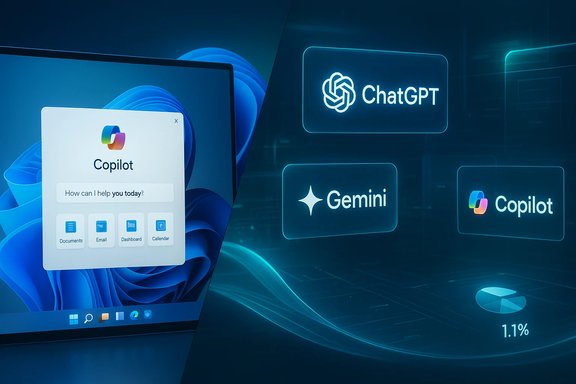
Microsoft’s Copilot — the assistant Microsoft baked into Windows, Office, and a growing slate of business tools — registers almost no share of web AI visits, according to the first global AI traffic tracker of 2026, a finding that exposes a deeper measurement mismatch between what users do on the web and where Microsoft is placing its bets. Similarweb’s snapshot shows Copilot at just 1.1% of global web visits to AI chat platforms, while ChatGPT and Google’s Gemini command the lion’s share of web traffic. These headline numbers are striking, but they don’t tell the whole story; this article parses the data, explains why Copilot looks small on the web despite Microsoft’s enterprise momentum, and evaluates the strategic risks and opportunities this gap reveals for Microsoft and Windows 11 users.
Microsoft launched the modern Copilot family as a cross‑platform AI assistant: a consumer-facing Copilot web app and mobile app, an integrated Copilot in Windows 11 and Microsoft 365, and an enterprise toolkit (Copilot Studio, Dynamics and Security Copilots) intended to power organizational workflows. The product strategy merges consumer discovery with deep enterprise integration — a two‑pronged approach that complicates any single ranking metric. Microsoft itself has emphasized enterprise adoption numbers, while independent web trackers measure browsing behavior on public web pages and web apps. That distinction matters when comparing Copilot’s presence to stand‑alone web chat tools.
Still, consumer sentiment matters. Third‑party reviews, OEM pushback (for example, TV makers offering ways to remove Copilot from smart TV interfaces), and social feedback indicate that some customers find the consumer Copilot experience inconsistent compared to stand‑alone rivals — particularly for casual Q&A tasks where ChatGPT’s conversational UX is favored. That user‑experience gap can erode brand perception among everyday consumers even when enterprise traction remains strong.
Key takeaways for Windows users and IT decision‑makers
Source: PCWorld Pretty much no one is using Microsoft's Copilot AI, report suggests
 Background
Microsoft launched the modern Copilot family as a cross‑platform AI assistant: a consumer-facing Copilot web app and mobile app, an integrated Copilot in Windows 11 and Microsoft 365, and an enterprise toolkit (Copilot Studio, Dynamics and Security Copilots) intended to power organizational workflows. The product strategy merges consumer discovery with deep enterprise integration — a two‑pronged approach that complicates any single ranking metric. Microsoft itself has emphasized enterprise adoption numbers, while independent web trackers measure browsing behavior on public web pages and web apps. That distinction matters when comparing Copilot’s presence to stand‑alone web chat tools. What the Similarweb numbers actually say
Similarweb’s “First Global AI Tracker of 2026” lists web‑visit market share for major AI chat sites as of January 2, 2026. The headline figures in that tracker:- ChatGPT: 64.5% of web visits to major AI chat platforms.
- Google Gemini: 21.5% (a major year‑over‑year gain).
- Grok (xAI): 3.4%.
- Perplexity and Claude: ~2% each.
- Microsoft Copilot: 1.1%.
Why Copilot looks small on web‑visit rankings
There are four primary reasons Copilot’s web‑share is low in Similarweb’s snapshot:- Distribution differences: ChatGPT and Gemini maintain prominent, stand‑alone web destinations that users visit directly. Copilot’s primary user touchpoints are embedded (Windows 11 Copilot pane, Microsoft 365 Copilot inside Office apps, or the Copilot mobile app). Those interactions may not register as visits to a Copilot web domain.
- Measurement scope: Similarweb’s metric is visits to web properties. It aggregates web traffic; it is not an app‑store or in‑app telemetry index. App usage, embedded API calls, and enterprise agent usage often fall outside its scope. That means a service can be hugely active inside apps or business tenants but still register a low web market share.
- Consumer discovery and habit: ChatGPT evolved as a simple, direct web destination that became synonymous with conversational AI. That brand advantage drives recurring direct visits and heavy web traffic, which magnifies its web share even when other assistants are widely used in other contexts. StatCounter and other trackers that measure referrals and sessions tell a related but different story.
- Platform fragmentation and redirects: Some AI platforms sit behind mobile apps, browser extensions, or platform‑native surfaces (e.g., Grok inside X, Gemini integrated into Google properties). The more tightly an assistant is married to a platform, the less it will appear in cross‑site web traffic tallies.
Cross‑checks and alternate measurements
A healthy analysis compares multiple trackers and metrics. Two useful contrasts:- StatCounter (referrals and sessions): StatCounter’s AI‑tracking data in 2025 showed ChatGPT commanding roughly 80%+ of sessions and Copilot at several percentage points in certain markets — numbers that diverge from Similarweb’s web‑visit snapshot because StatCounter focuses on referral behavior and session metrics derived from a large panel of site analytics. StatCounter’s data suggested Copilot was higher in specific regional or referral contexts than Similarweb’s global visits share captures.
- Microsoft’s own enterprise disclosures: Microsoft has announced strong enterprise adoption: its Ignite announcements and earnings transcripts claim that “nearly 70% of the Fortune 500 now use Microsoft 365 Copilot” and that Copilot‑related MAU metrics in Dynamics and CRM portfolios have risen substantially. Those numbers document deep enterprise traction but do not translate directly into public web visits or consumer app installs. Microsoft’s enterprise stats are real and relevant, but they’re not captured by web‑visit trackers in the same way as ChatGPT.com traffic is.
What this means for Windows 11 and consumer perception
Copilot’s low web share fed headlines claiming “pretty much no one is using Copilot,” but that interpretation is incomplete. For Windows 11 users, Copilot is an integrated UI element and utility, not a destination web page. If a user asks Copilot to summarize an email inside Outlook or generate a slide in PowerPoint, that interaction is valuable even if it never visits copilot.microsoft.com and therefore never shows up in Similarweb’s web‑visit ranking.Still, consumer sentiment matters. Third‑party reviews, OEM pushback (for example, TV makers offering ways to remove Copilot from smart TV interfaces), and social feedback indicate that some customers find the consumer Copilot experience inconsistent compared to stand‑alone rivals — particularly for casual Q&A tasks where ChatGPT’s conversational UX is favored. That user‑experience gap can erode brand perception among everyday consumers even when enterprise traction remains strong.
Strengths in Microsoft’s approach
Microsoft’s Copilot strategy has clear advantages:- Enterprise integration and workflow value: Copilot is less a consumer novelty and more a business productivity layer. The value proposition — automating SOPs, summarizing customer interactions, and embedding AI in vertical workflows — is highly defensible in B2B contexts. Microsoft’s published customer stories and earnings call references highlight wins at large enterprises where Copilot boosts measurable productivity.
- Default distribution inside Windows and Microsoft 365: Being the default assistant inside the world’s dominant desktop OS and a leading productivity suite gives Copilot a privileged distribution channel that other AI vendors lack. That can produce deep, persistent usage even without explicit web visits.
- End‑to‑end product stack: Microsoft’s Copilot strategy spans tools (Copilot Studio), platform (Azure AI), and devices (Copilot+ hardware), enabling end‑to‑end enterprise deployments and custom copilots tailored to organizational data. That technical breadth is an asset in enterprise sales and long‑term sticky deployments.
Risks and weaknesses
Despite the strengths above, the data and market signals expose real risks for Microsoft:- Perception versus reality gap: Public perception — driven by web metrics and high‑visibility comparisons — currently favors ChatGPT and Gemini for consumer AI. That perception can influence developer, partner, and individual user behavior, reducing organic adoption and third‑party experimentation for Copilot consumer features.
- Usability and consumer UX: Many users find stand‑alone assistants simpler for one‑off queries and explorations. Copilot’s deeper integration is valuable for workflows but may feel heavier or less approachable for casual use. If Microsoft wants to win the consumer mindshare that defines “AI assistant of choice,” it must invest in the front‑door experience as aggressively as in enterprise integrations.
- Measurement blind spots: Relying on internal telemetry for product assessment without independent consumer metrics invites public misinterpretation. Microsoft’s enterprise KPIs are strong, but the company should be transparent about consumer metrics (or explain measurement differences) to avoid headlines that claim Copilot “isn’t being used.” The lack of publicly published consumer MAU/DAU figures leaves space for competitors and media narratives to shape the story.
- Channel fragility: Meta’s change to WhatsApp’s Business API rules — which curbed third‑party AI assistants’ use of WhatsApp as a distribution channel — demonstrates how vulnerable Copilot’s user acquisition can be to external platform policy changes. Microsoft and others that relied on messaging platforms for low‑friction onboarding saw those channels curtailed and had to migrate users to app or web experiences. This increases acquisition friction and makes consumer discovery harder.
Strategic implications and where Microsoft should focus
If Copilot is to close the perception gap and grow meaningful consumer usage in addition to enterprise adoption, Microsoft should act on several strategic fronts:- Clarify and publish a consistent set of consumer metrics
- Publish clear definitions (what counts as a Copilot session across Windows, web, and mobile) and periodic consumer usage numbers. Transparency reduces speculation and reframes conversations around growth and engagement rather than single‑channel market share.
- Improve the consumer front door UX
- Invest in the Copilot web/mobile UI to make one‑off queries as snappy and delightful as ChatGPT. Ensure features like conversational memory, citations, and plugin‑style extensibility are easy for casual users to discover and use.
- Bridge embedded and web measurement
- Offer anonymized, aggregated telemetry that demonstrates how many Copilot interactions originate inside Windows or Office versus web visits. That will align internal and external narratives and help SEO/PR teams counter simplistic web‑share comparisons.
- Use enterprise wins as consumer proof points
- Surface consumer‑facing showcase stories that demonstrate Copilot’s benefits for individual productivity (e.g., saving time drafting emails, summarizing meetings), to convert enterprise credibility into consumer trust.
- Redouble on discovery partnerships and cross‑platform distribution
- With WhatsApp’s restrictive policy reducing discovery channels, Microsoft should expand distribution through Edge, OEMs, and preloads while ensuring opt‑in consent and clear user control to avoid backlash.
How to interpret the headline “Copilot is almost unused”
The media framing — “pretty much no one is using Copilot” — is a provocation, not a precise technical diagnosis. For web traffic to public chat sites, the claim is accurate: Copilot accounts for a low share of web visits. For office workers, enterprise customers, and Windows users, the picture is more complex. Microsoft’s Copilot is being used in contexts that web trackers cannot or do not measure reliably. The right interpretation: Copilot is small in web‑visit market share, but not necessarily small in enterprise adoption or embedded usage. The distinction matters for product strategy, investor conversations, and user expectations.Short‑term outlook and likely scenarios
- Scenario A — Microsoft leans into enterprise: Microsoft continues its current strategy: deepen enterprise integrations, monetize Copilot via Microsoft 365, Dynamics and Azure AI, and treat consumer web share as less important. This keeps revenue growth healthy but concedes consumer mindshare to OpenAI and Google.
- Scenario B — Microsoft pursues consumer parity: Microsoft invests heavily in the consumer Copilot front door, UX improvements, and transparent metrics. This is costly and slow, but could reclaim web mindshare and reduce negative headline risk. It requires product focus and marketing muscle.
- Scenario C — hybrid play: Blend both approaches: use enterprise deployments and OEM defaults to drive organic consumer adoption while making the consumer web app more compelling. This is the most resource‑efficient path but requires careful coordination across teams and clear metric alignment.
Conclusion
Similarweb’s 1.1% snapshot is an important data point — it captures the web‑visit reality of Copilot compared to stand‑alone web chat platforms — and it explains why headlines claim Copilot “isn’t being used.” However, the number must be read in context: Copilot’s strategic placement inside Windows and Microsoft 365 produces many interactions that do not appear in web‑visit tallies. Microsoft’s enterprise momentum is real and documented, but the public perception risk is material. To close the gap, Microsoft should clarify measurement, improve the consumer front door, and align enterprise wins with consumer storytelling. Doing so would address the immediate PR narrative while protecting the long‑term value Microsoft is building into the Copilot platform.Key takeaways for Windows users and IT decision‑makers
- Web metrics ≠ total usage: A low web share for Copilot does not automatically equal poor product adoption inside Windows or Office.
- Enterprise strength is a real competitive moat: Fortune 500 deployments and Copilot Studio traction make Copilot strategically valuable even if consumer web mindshare lags.
- Measurement transparency matters: Publicly released, consistent definitions of what counts as a Copilot use would help Microsoft control the narrative and aid customers assessing ROI.
Source: PCWorld Pretty much no one is using Microsoft's Copilot AI, report suggests
