

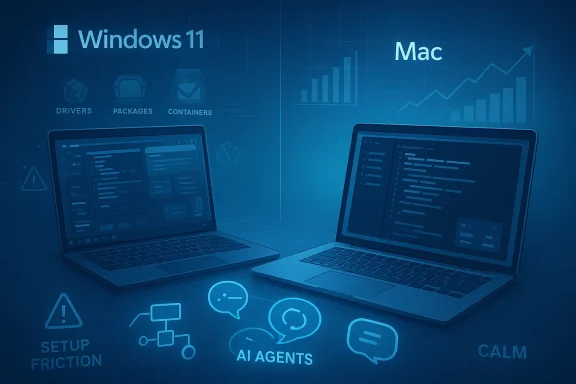
First Ring Daily’s latest Windows debate lands in a familiar but increasingly urgent place: the gap between Microsoft’s AI ambitions and the developer experience that makes those ambitions real. In the episode, Brad Sams and Paul Thurrott argue that many developers are gravitating toward Mac for building AI agents, citing better hardware, a smoother setup experience, and a more predictable environment than Windows. That critique matters because it is not really about one podcast segment; it is about the competitive shape of the next software platform war. If AI agents are the new frontier, then the operating system that makes them easiest to build, test, and ship will capture an outsized share of mindshare and, eventually, market share.
Microsoft has spent the last several years trying to reposition Windows 11 as more than a desktop operating system. The company has increasingly framed Windows as an AI-native platform, a direction Petri has covered repeatedly in recent First Ring Daily episodes discussing Microsoft’s broader AI push, including Windows 11 taskbar agents and other Ignite announcements. That effort is meant to make Windows not just the place where users run AI experiences, but the place where those experiences are built and surfaced. (petri.com)
At the same time, Microsoft has been trying to modernize the development story around Windows. In January 2026, Petri highlighted the release of the Windows App Development CLI, an attempt to simplify app creation and reduce friction for Windows developers. That release fits a long-running pattern: Microsoft knows developer tooling is a strategic lever, but it has also struggled for years to present a single, coherent stack that feels easy and durable enough for the broadest audience. (petri.com)
The reason the Mac comparison stings is that Apple’s developer experience has become synonymous with consistency. When developers buy a Mac, they usually know what they are getting: tightly integrated hardware, strong battery life, reliable Unix-style tooling, and a relatively stable path from laptop to production. Windows, by contrast, can feel like a vast and flexible ecosystem that requires more choices, more maintenance, and more tolerance for mismatch. That flexibility is a strength for consumers, but it can become a tax on developers who want to move quickly. In AI work, speed matters as much as capability.
The specific topic of AI agents raises the stakes further. Agents are not just another application category; they are workflows, toolchains, and orchestration layers wrapped into software that often depends on local testing, device capabilities, and frequent iteration. If a platform is clunky to set up, noisy to maintain, or inconsistent across devices, developers are likely to pick the environment that feels most frictionless. That is why a simple hardware and setup argument can become a platform-level problem.
This is also why the broader Windows history matters. Microsoft has often been strongest when it gives developers a clear reason to stay. It has also often been weakest when it asks them to navigate too many frameworks, too many packaging models, and too many UI paradigms. The Windows story has improved in recent years, but as this First Ring Daily discussion suggests, the market may now be judging Microsoft by a harsher metric: not whether Windows can support AI, but whether it can be the best place to build AI.
Apple has spent years turning that default choice into a moat. The company controls the hardware, the operating system, the core frameworks, and the user experience from first boot to daily use. That vertical integration produces a setup process that tends to be cleaner and a machine that is more predictable after setup. For AI agents, where developers are often juggling runtimes, local models, command-line tooling, and remote APIs, predictability is a real productivity feature.
This is why ease of setup is not a small detail. It is the first proof point of whether a platform respects the developer’s time. Once a developer has a machine that feels frictionless, they are more likely to trust it for experimental AI work, where the burden of complexity is already high.
Windows can absolutely provide strong tools, but the ecosystem still often feels like it asks developers to assemble their own experience. That may be acceptable in enterprise IT. It is less acceptable in a field where rapid prototyping is the norm.
Apple’s newer silicon has made a strong case that developer-friendly hardware is not simply about peak performance. It is also about battery life, thermals, and consistency under load. That combination makes MacBooks especially attractive for people who code away from a desk, travel often, or want a machine that can run demanding workloads without becoming loud and hot.
That matters for AI agent development because these workloads are often iterative. Developers try something, observe behavior, refine prompts or code, and repeat. A machine that stays cool and lasts longer makes those loops feel less costly. The best hardware vanishes into the rhythm of the work.
Windows hardware has improved dramatically, especially in the premium ultrabook and ARM categories. But the Windows ecosystem still lacks the same degree of uniformity. Depending on the model, chipset, and OEM tuning, two Windows laptops can feel like they belong to different product philosophies. That inconsistency makes it harder for developers to know what they are optimizing for.
Part of that baggage is the sheer breadth of the ecosystem. Windows supports an enormous range of hardware, vendors, and compatibility layers. That is a remarkable strength, but it also means more variability, more edge cases, and more things to debug. For a general user, that diversity is a feature. For a developer trying to build and test AI agents quickly, it can be a liability.
In the AI era, those costs become more visible. Developers want a machine that reliably launches a container, runs a model, and talks to APIs without asking for constant intervention. If they have to spend too much time on platform housekeeping, the allure of flexibility fades. That is why the developer experience is now a strategic issue, not a cosmetic one.
Microsoft has tried to answer this with newer tooling and frameworks, including the Windows App Development CLI and the continuing evolution of AI-first Windows experiences. But the company still faces the challenge of making the path feel obvious rather than merely possible. There is a difference between a platform that can support developers and a platform that actively attracts them.
Microsoft clearly understands this. Its recent Windows AI messaging has increasingly centered on new interfaces, taskbar-visible agents, and a broader vision of Windows 11 as an AI platform. Yet the irony is that the more Microsoft emphasizes AI-native experiences, the more obvious it becomes that the underlying developer stack still needs to feel compelling on its own. If the platform story is aspirational but the workflow is cumbersome, developers will go elsewhere. (petri.com)
That is why a Mac can win not because it has a magical AI feature set, but because it gets out of the way. If a developer can focus on the agent rather than the machine, the platform has done its job. That simplicity is deceptively powerful.
There is also a subtle psychological factor. Developers often prefer to build on the platform that feels current, especially when working on the most fashionable category in software. AI has become a prestige layer in tech, and the machine on the desk sends a signal about seriousness and capability. In that environment, Mac benefits from both reality and reputation.
The best modern developer ecosystems tend to minimize conceptual overhead. They make it easier to understand which tools to use, how they fit together, and what the path forward looks like. Windows has improved in all these areas, but it still too often feels like a platform where one must navigate history before reaching the future.
That means Microsoft must do more than ship capabilities. It must reduce choice overload, communicate clearer defaults, and ensure that the first-run experience feels modern. If it does not, developers will continue to admire Windows from a distance while building elsewhere.
This also has enterprise implications. Large organizations may prefer Windows because it fits existing management and security models. But enterprise is not immune to developer culture. If the best talent is more comfortable on Mac, then standardizing on Windows for the desktop can become harder to justify, especially in product groups that need to move fast.
If developers increasingly favor Mac for AI work, then companies have to decide whether to accommodate that preference or enforce Windows standardization. That choice affects hiring, onboarding, equipment budgets, and support policies. In other words, what starts as a personal workstation preference can become a procurement issue.
Narrative matters in technology. Developers talk to one another, write tutorials, recommend hardware, and shape the norms of startup culture. If that culture increasingly centers on Mac for AI development, Windows risks becoming the platform associated with legacy compatibility rather than future invention. That is a branding problem as much as a technical one.
At the same time, enterprises are not purely driven by fashion. They care about device management, identity, compliance, and total cost of ownership. Windows still has advantages there, and those advantages remain substantial. But if Microsoft wants Windows to remain relevant to the builder class, it cannot rely on enterprise inertia alone.
In the past, Windows often won because compatibility was king. If you wanted to run the broadest range of software and hardware, Windows was the obvious answer. Today, the center of gravity is shifting toward intelligence, iteration, and cloud-connected workflows. Compatibility still matters, but it no longer automatically defines the winning platform.
Microsoft has answered parts of that challenge through Windows 11, Copilot integration, ARM experimentation, and new developer tools. But the company still has to prove that these initiatives add up to a coherent story. Without that coherence, the market sees a series of features rather than a unified platform.
This is where the First Ring Daily conversation becomes useful. It condenses a broader industry mood into a simple observation: the better machine for building AI agents may not be the historically obvious one. That does not mean Windows is irrelevant. It means Windows can no longer rely on its legacy centrality to attract the most ambitious builders.
Microsoft also needs to prove that its AI-native Windows vision is not just a consumer-facing layer. If the company wants developers to build agents on Windows, it has to make the local environment feel first-class. That means tooling, documentation, defaults, and hardware all need to move in the same direction.
The long-term answer for Microsoft is not to argue that Windows can do everything. It is to demonstrate that Windows can do the right things with less friction, especially at the moment when developers are choosing where the next generation of AI software will be born. That is the real contest, and it is bigger than any single podcast episode.
Source: Petri IT Knowledgebase First Ring Daily: Windows Dreams - Petri IT Knowledgebase
 Background
Microsoft has spent the last several years trying to reposition Windows 11 as more than a desktop operating system. The company has increasingly framed Windows as an AI-native platform, a direction Petri has covered repeatedly in recent First Ring Daily episodes discussing Microsoft’s broader AI push, including Windows 11 taskbar agents and other Ignite announcements. That effort is meant to make Windows not just the place where users run AI experiences, but the place where those experiences are built and surfaced. (petri.com)At the same time, Microsoft has been trying to modernize the development story around Windows. In January 2026, Petri highlighted the release of the Windows App Development CLI, an attempt to simplify app creation and reduce friction for Windows developers. That release fits a long-running pattern: Microsoft knows developer tooling is a strategic lever, but it has also struggled for years to present a single, coherent stack that feels easy and durable enough for the broadest audience. (petri.com)
The reason the Mac comparison stings is that Apple’s developer experience has become synonymous with consistency. When developers buy a Mac, they usually know what they are getting: tightly integrated hardware, strong battery life, reliable Unix-style tooling, and a relatively stable path from laptop to production. Windows, by contrast, can feel like a vast and flexible ecosystem that requires more choices, more maintenance, and more tolerance for mismatch. That flexibility is a strength for consumers, but it can become a tax on developers who want to move quickly. In AI work, speed matters as much as capability.
The specific topic of AI agents raises the stakes further. Agents are not just another application category; they are workflows, toolchains, and orchestration layers wrapped into software that often depends on local testing, device capabilities, and frequent iteration. If a platform is clunky to set up, noisy to maintain, or inconsistent across devices, developers are likely to pick the environment that feels most frictionless. That is why a simple hardware and setup argument can become a platform-level problem.
This is also why the broader Windows history matters. Microsoft has often been strongest when it gives developers a clear reason to stay. It has also often been weakest when it asks them to navigate too many frameworks, too many packaging models, and too many UI paradigms. The Windows story has improved in recent years, but as this First Ring Daily discussion suggests, the market may now be judging Microsoft by a harsher metric: not whether Windows can support AI, but whether it can be the best place to build AI.
Why Mac Keeps Winning Mindshare
The first point Brad Sams and Paul Thurrott are really making is not that Macs are universally better computers. It is that, for a growing segment of developers, they are the path of least resistance. That distinction matters. Developer decisions are often driven by workflow efficiency, and when one platform saves time every day, it becomes the default choice even if another platform is more customizable or cheaper.Apple has spent years turning that default choice into a moat. The company controls the hardware, the operating system, the core frameworks, and the user experience from first boot to daily use. That vertical integration produces a setup process that tends to be cleaner and a machine that is more predictable after setup. For AI agents, where developers are often juggling runtimes, local models, command-line tooling, and remote APIs, predictability is a real productivity feature.
The setup experience is the product
One of the most underappreciated reasons developers choose Mac is that the first hour matters. If the machine boots cleanly, updates smoothly, and gets a coding environment running quickly, that creates confidence. If the machine instead requires hunting for drivers, reconciling package managers, or working around preinstalled vendor software, the emotional tone shifts immediately.This is why ease of setup is not a small detail. It is the first proof point of whether a platform respects the developer’s time. Once a developer has a machine that feels frictionless, they are more likely to trust it for experimental AI work, where the burden of complexity is already high.
- Less time spent on machine tuning
- Fewer surprises during initial setup
- More confidence in daily reliability
- Faster path to coding and testing
- Better fit for experimentation and iteration
Windows can absolutely provide strong tools, but the ecosystem still often feels like it asks developers to assemble their own experience. That may be acceptable in enterprise IT. It is less acceptable in a field where rapid prototyping is the norm.
Hardware Advantages Are More Than Specs
The podcast discussion also points to hardware as a differentiator, and that is increasingly correct. Raw benchmarks still matter, but the more important question is whether the hardware supports sustained, quiet, efficient, and portable AI work. For developers building agents, this can include everything from local inference and model experimentation to running multiple containers, debuggers, and browser instances at once.Apple’s newer silicon has made a strong case that developer-friendly hardware is not simply about peak performance. It is also about battery life, thermals, and consistency under load. That combination makes MacBooks especially attractive for people who code away from a desk, travel often, or want a machine that can run demanding workloads without becoming loud and hot.
Battery life as a developer feature
Battery life is often discussed as a consumer convenience, but for developers it is really a workflow multiplier. A laptop that lasts through a long workday without anxiety changes how and where work happens. It makes conference travel, coffee-shop coding, and long debugging sessions less dependent on power outlets.That matters for AI agent development because these workloads are often iterative. Developers try something, observe behavior, refine prompts or code, and repeat. A machine that stays cool and lasts longer makes those loops feel less costly. The best hardware vanishes into the rhythm of the work.
Windows hardware has improved dramatically, especially in the premium ultrabook and ARM categories. But the Windows ecosystem still lacks the same degree of uniformity. Depending on the model, chipset, and OEM tuning, two Windows laptops can feel like they belong to different product philosophies. That inconsistency makes it harder for developers to know what they are optimizing for.
- Better thermals mean fewer interruptions
- Stronger battery life supports long sessions
- Quiet operation helps focus
- Consistent performance reduces debugging confusion
- Integrated hardware/software design lowers friction
Windows Still Has Structural Friction
Windows does not lose developer loyalty only because Mac is polished. It also loses some of it because Windows remains structurally messy for certain modern development tasks. That is a painful statement for a platform that historically defined personal computing, but it is hard to avoid when evaluating the current moment. Microsoft has improved many things, yet the platform still carries a lot of historical baggage.Part of that baggage is the sheer breadth of the ecosystem. Windows supports an enormous range of hardware, vendors, and compatibility layers. That is a remarkable strength, but it also means more variability, more edge cases, and more things to debug. For a general user, that diversity is a feature. For a developer trying to build and test AI agents quickly, it can be a liability.
The cost of flexibility
Windows has long sold itself as the platform that can do anything, run anything, and connect to anything. That remains true, but flexibility comes with operational cost. Every additional option creates another decision point, another possible conflict, and another layer of support overhead.In the AI era, those costs become more visible. Developers want a machine that reliably launches a container, runs a model, and talks to APIs without asking for constant intervention. If they have to spend too much time on platform housekeeping, the allure of flexibility fades. That is why the developer experience is now a strategic issue, not a cosmetic one.
Microsoft has tried to answer this with newer tooling and frameworks, including the Windows App Development CLI and the continuing evolution of AI-first Windows experiences. But the company still faces the challenge of making the path feel obvious rather than merely possible. There is a difference between a platform that can support developers and a platform that actively attracts them.
- Too many framework choices
- Too much historical compatibility baggage
- More vendor variability than peers
- Less predictable “out-of-box” developer readiness
- Higher setup and maintenance overhead
AI Agents Change the Rules
AI agents are not a normal app category. They are a blend of code, prompt design, runtime behavior, orchestration, and frequently evolving APIs. That means the platform used to build them is part of the product experience itself. If developers are experimenting, shipping fast, and revising constantly, they need tools and hardware that reduce drag.Microsoft clearly understands this. Its recent Windows AI messaging has increasingly centered on new interfaces, taskbar-visible agents, and a broader vision of Windows 11 as an AI platform. Yet the irony is that the more Microsoft emphasizes AI-native experiences, the more obvious it becomes that the underlying developer stack still needs to feel compelling on its own. If the platform story is aspirational but the workflow is cumbersome, developers will go elsewhere. (petri.com)
Agents reward experimentation
Developing agents usually means testing the same idea many times. The developer changes a prompt, switches a model, edits a workflow, or modifies a tool call, then measures the result. This is a highly iterative loop, so even small bits of friction can become maddening after an hour.That is why a Mac can win not because it has a magical AI feature set, but because it gets out of the way. If a developer can focus on the agent rather than the machine, the platform has done its job. That simplicity is deceptively powerful.
There is also a subtle psychological factor. Developers often prefer to build on the platform that feels current, especially when working on the most fashionable category in software. AI has become a prestige layer in tech, and the machine on the desk sends a signal about seriousness and capability. In that environment, Mac benefits from both reality and reputation.
- Faster iteration cycles
- Lower distraction from platform issues
- Better fit for local experimentation
- Cleaner path to multi-tool workflows
- Stronger appeal in collaborative startup cultures
Microsoft’s Developer Strategy Needs a Simplification Pass
The podcast’s underlying critique aligns with a broader industry observation: Microsoft has many developer assets, but not enough of them feel unified. The company’s strengths are real. It has cloud scale, AI services, development tooling, enterprise relationships, and a massive user base. Yet those strengths do not automatically translate into a cohesive local developer experience.The best modern developer ecosystems tend to minimize conceptual overhead. They make it easier to understand which tools to use, how they fit together, and what the path forward looks like. Windows has improved in all these areas, but it still too often feels like a platform where one must navigate history before reaching the future.
Tooling is only half the answer
Releasing new tools is useful, but tools alone do not solve fragmentation. A CLI can streamline onboarding, but it cannot by itself erase years of accumulated complexity across frameworks, installers, and device types. The real task is to make the full developer path feel coherent from machine setup to deployment.That means Microsoft must do more than ship capabilities. It must reduce choice overload, communicate clearer defaults, and ensure that the first-run experience feels modern. If it does not, developers will continue to admire Windows from a distance while building elsewhere.
This also has enterprise implications. Large organizations may prefer Windows because it fits existing management and security models. But enterprise is not immune to developer culture. If the best talent is more comfortable on Mac, then standardizing on Windows for the desktop can become harder to justify, especially in product groups that need to move fast.
- Clearer default development paths
- Better integration across tooling layers
- More consistent setup and onboarding
- Stronger messaging around AI workflows
- Less reliance on legacy assumptions
Enterprise vs Consumer Impact
For consumers, the stakes are mostly about convenience, battery life, and the feeling that the computer “just works.” For enterprises, the issue is more complex. Windows still dominates many corporate environments because it is manageable, secure, and deeply integrated with Microsoft’s ecosystem. But developer preference has a way of filtering upward into business decisions.If developers increasingly favor Mac for AI work, then companies have to decide whether to accommodate that preference or enforce Windows standardization. That choice affects hiring, onboarding, equipment budgets, and support policies. In other words, what starts as a personal workstation preference can become a procurement issue.
Two different markets, one reputational effect
The consumer market may see Mac as a premium but easier choice. The enterprise market may see Windows as the default but less exciting choice. That split is dangerous for Microsoft because it creates a world where Windows owns the installed base but loses the narrative among people who create the next wave of software.Narrative matters in technology. Developers talk to one another, write tutorials, recommend hardware, and shape the norms of startup culture. If that culture increasingly centers on Mac for AI development, Windows risks becoming the platform associated with legacy compatibility rather than future invention. That is a branding problem as much as a technical one.
At the same time, enterprises are not purely driven by fashion. They care about device management, identity, compliance, and total cost of ownership. Windows still has advantages there, and those advantages remain substantial. But if Microsoft wants Windows to remain relevant to the builder class, it cannot rely on enterprise inertia alone.
- Consumer loyalty is driven by ease and polish
- Enterprise loyalty is driven by manageability
- Developer loyalty is driven by speed and coherence
- AI work increases the importance of all three
- Brand perception now travels faster than platform roadmaps
Historical Patterns Repeat
This debate is not new in shape, even if the technology has changed. Microsoft has spent decades alternating between periods of platform confidence and moments when its developer story felt less coherent than its rivals’. The specifics differ across eras, but the pattern is familiar: Apple emphasizes integration, Microsoft emphasizes breadth, and developers decide which tradeoff feels more productive.In the past, Windows often won because compatibility was king. If you wanted to run the broadest range of software and hardware, Windows was the obvious answer. Today, the center of gravity is shifting toward intelligence, iteration, and cloud-connected workflows. Compatibility still matters, but it no longer automatically defines the winning platform.
From compatibility to productivity
The deepest shift is philosophical. The old Windows advantage was that it could do more things. The new question is whether it helps developers do things faster and with less cognitive overhead. That is a different standard, and one that favors platforms with tight integration and opinionated defaults.Microsoft has answered parts of that challenge through Windows 11, Copilot integration, ARM experimentation, and new developer tools. But the company still has to prove that these initiatives add up to a coherent story. Without that coherence, the market sees a series of features rather than a unified platform.
This is where the First Ring Daily conversation becomes useful. It condenses a broader industry mood into a simple observation: the better machine for building AI agents may not be the historically obvious one. That does not mean Windows is irrelevant. It means Windows can no longer rely on its legacy centrality to attract the most ambitious builders.
- Compatibility is no longer the only advantage
- Productivity and setup speed matter more
- Integration beats fragmentation
- AI makes platform friction more visible
- Developer loyalty is easier to lose than regain
Strengths and Opportunities
Microsoft still has a real opportunity here, because the company is not starting from zero. It has the resources, reach, and technical breadth to improve the Windows developer experience if it chooses to make that a top-level priority. The key will be turning scattered progress into a more intentional, opinionated platform story that feels credible to builders.- Massive distribution gives Microsoft a chance to improve at scale.
- Enterprise trust remains a powerful advantage for Windows.
- Cloud integration ties Windows to Azure and Microsoft’s AI services.
- New tooling like the Windows App Development CLI can reduce friction.
- AI-native features may create new reasons to stay on Windows.
- Hardware diversity still offers flexibility for specialized workloads.
- Developer relationships can be rebuilt if the experience becomes coherent.
Risks and Concerns
The main risk is that Microsoft treats the problem as a messaging issue when it is really an experience issue. If developers keep feeling that Mac is faster to set up, easier to trust, and more pleasant to use, then no amount of AI branding will fully close the gap. Once a platform becomes associated with friction, it takes a long time to change that perception.- Fragmentation across tools and frameworks can scare off developers.
- Setup friction makes first impressions worse than they need to be.
- Hardware inconsistency weakens the Windows laptop story.
- Legacy complexity keeps competing with modern workflows.
- AI hype can outpace actual utility if the platform feels clumsy.
- Brand perception may drift further toward Apple for builders.
- Enterprise inertia can hide consumer and developer erosion until it is too late.
What to Watch Next
The next few months will show whether Microsoft can turn AI ambition into a more grounded developer story, or whether the Mac advantage keeps widening in the most important segments. Watch not just for product announcements, but for whether the company can reduce setup time, simplify choices, and make its hardware story more compelling for builders. The market is increasingly judging platforms by how they feel in daily use, not by how many features they can name in a keynote.Microsoft also needs to prove that its AI-native Windows vision is not just a consumer-facing layer. If the company wants developers to build agents on Windows, it has to make the local environment feel first-class. That means tooling, documentation, defaults, and hardware all need to move in the same direction.
- More Windows developer tooling aimed at onboarding
- Clearer guidance for AI agent development on Windows
- Better alignment between Windows hardware and AI workflows
- Stronger proof that Windows can rival Mac in setup simplicity
- More visible integration between Windows and Microsoft’s AI stack
The long-term answer for Microsoft is not to argue that Windows can do everything. It is to demonstrate that Windows can do the right things with less friction, especially at the moment when developers are choosing where the next generation of AI software will be born. That is the real contest, and it is bigger than any single podcast episode.
Source: Petri IT Knowledgebase First Ring Daily: Windows Dreams - Petri IT Knowledgebase
Last edited:
