

Microsoft matters to the Nasdaq Composite because it is one of the index’s largest Nasdaq-listed companies, and in a market-capitalization-weighted benchmark its share-price moves can materially sway the headline “Nasdaq” number watched by investors, fund managers, and technology-sector observers every trading day. The short version is arithmetic; the longer version is that Microsoft has become one of the main vehicles through which Wall Street prices cloud computing, enterprise software, artificial intelligence, and the durability of Big Tech earnings. As Kalkine Media framed the question in its stock-market explainer, Microsoft is not merely another blue-chip component inside the Composite — it is one of the companies that helps define what the index now represents.
That distinction matters because the Nasdaq Composite is often treated as shorthand for “technology stocks,” even though Nasdaq itself describes the index as a broad measure of more than 3,000 Nasdaq-listed securities. Microsoft’s influence exposes the tension inside that shorthand. The Composite is broad in membership, but not necessarily broad in impact.
The Nasdaq Composite’s marketing pitch is breadth. Nasdaq says the index tracks more than 3,000 domestic and international stocks listed on the Nasdaq Stock Market, spanning technology, consumer, healthcare, and other sectors. That makes it much wider than the Nasdaq-100, which is limited to 100 of the largest non-financial Nasdaq-listed companies.
But the Composite is not an equal-vote democracy. Nasdaq’s own index materials describe it as market-cap weighted, meaning the largest companies have the largest effect on the index’s direction. A small biotech stock can double and barely move the number on a brokerage app; Microsoft can rise or fall a few percentage points and help set the tone for the whole session.
That is the first reason Microsoft matters. It is not just included in the Nasdaq Composite; it is structurally amplified by the index’s rules. The bigger Microsoft becomes, the more the Composite reflects Microsoft’s fortunes.
This is why the “Nasdaq is up” headline can be misleading. It may suggest a broad rally across thousands of names, when in practice a handful of mega-cap companies can do much of the lifting. Microsoft is one of those companies, and its weight turns its earnings calls, AI spending plans, Azure growth rates, and Windows strategy into index-level events.
That matters to the Nasdaq Composite because investors no longer value Microsoft as a single-product software company. They treat it as a proxy for the durability of enterprise technology spending. When Microsoft reports strong cloud growth, Wall Street reads it as evidence that corporate IT budgets remain healthy; when Azure growth slows, the market asks whether the broader AI and cloud trade is cooling.
Microsoft’s fiscal third-quarter 2026 results show why. In its April 29 earnings release, Microsoft reported continued double-digit growth, with Azure and other cloud services revenue up sharply year over year. The company also said Microsoft Cloud revenue reached tens of billions of dollars for the quarter, reinforcing the idea that cloud and AI are no longer side bets but the operating core of the business.
For the Nasdaq Composite, this turns Microsoft into a transmission mechanism. A reassessment of Azure demand is not just a reassessment of Microsoft. It can ripple into semiconductor names, cloud software companies, cybersecurity vendors, data-center infrastructure suppliers, and AI-adjacent stocks that share the same investor narrative.
That does not mean every AI feature is equally convincing. Windows users have watched Microsoft promote Copilot with a persistence that sometimes feels more like platform pressure than product delight. Windows Central and TechRadar have both reported on recent Copilot-centered experiments and leaked concepts, including visions of a lighter AI-first operating environment. Those reports are interesting not because every prototype will ship, but because they show how deeply Microsoft wants AI to become the interface layer across devices, cloud services, and productivity software.
For investors, the question is simpler: can Microsoft convert AI enthusiasm into revenue at a scale that justifies its spending and valuation? Azure AI consumption, Copilot subscriptions, GitHub Copilot adoption, Microsoft 365 upselling, and Windows AI features all feed that answer. When the answer looks positive, Microsoft can help pull the Nasdaq Composite higher. When skepticism rises, the reverse can happen.
This is where Microsoft’s role differs from many smaller AI names. A speculative AI startup might move dramatically on a single announcement, but it does not anchor the Composite. Microsoft does. Its AI story is not just narrative fuel; it is built into one of the largest market caps on the exchange.
The two conversations are more connected than they look. Microsoft’s Windows strategy affects the company’s ability to distribute AI experiences at scale. Copilot+ PCs, Windows AI APIs, local models, NPUs, and developer tooling are not just product features; they are part of Microsoft’s attempt to make Windows relevant in the next computing cycle.
Microsoft has said Copilot+ PCs require neural processing hardware capable of more than 40 trillion operations per second, positioning the category as a new class of Windows device. At the same time, Microsoft’s developer materials have increasingly emphasized Windows as a platform for local and hybrid AI workloads. That is a bet that the PC does not become merely a browser terminal for cloud AI, but a client-side participant in the AI stack.
The risk is execution. Windows users have long memories, and Microsoft’s history with unwanted prompts, account nudges, Edge promotion, and confusing feature rollouts has created suspicion around anything branded “AI.” If Microsoft overplays its hand, the Windows installed base becomes a source of friction rather than leverage.
Microsoft sits at the center of several of those concerns. AI data centers require enormous capital spending. Cloud customers want productivity gains, not just demos. Regulators continue scrutinizing platform power, cloud contracts, software bundling, and AI partnerships. Enterprise customers are willing to pay for useful tools, but they are also sensitive to licensing complexity and vendor lock-in.
The bullish case is that Microsoft is uniquely positioned to absorb those pressures. It has enterprise relationships, cloud infrastructure, developer reach, security products, productivity software, and operating-system distribution. Few companies can turn a new computing trend into a bundle as efficiently as Microsoft.
The bearish case is that the same bundling power can become a political, technical, and customer-relations liability. If AI margins disappoint, if Copilot adoption is slower than expected, or if cloud growth normalizes faster than investors hope, Microsoft’s size could become a drag on the Composite rather than a support.
That is the Nasdaq Composite’s Microsoft problem. The index includes thousands of securities, but its day-to-day story is often dominated by the largest platform companies. Microsoft’s influence is earned, but it still narrows the practical meaning of the benchmark.
This creates a perception gap. A retail investor may hear that the Nasdaq Composite is rising and assume the average Nasdaq-listed company is doing well. In reality, the index can climb while many smaller software, biotech, or growth companies lag. Microsoft’s strength can mask weakness elsewhere.
That does not make the Composite useless. It makes it necessary to read the index correctly. The Composite is a broad listing benchmark filtered through a market-cap lens, not a health check on the median tech company.
That combination is powerful. Microsoft can be viewed as defensive because of its recurring revenue and enterprise base, while also being treated as a growth stock because of Azure and AI. Few companies get to wear both labels at once.
For the Nasdaq Composite, that dual identity matters. In risk-on markets, Microsoft participates in the AI and growth trade. In more cautious markets, it can still attract investors looking for quality, cash flow, and platform durability. That makes Microsoft a stabilizer in some periods and an accelerator in others.
But sentiment cuts both ways. If investors decide that AI spending is running ahead of returns, Microsoft will not be immune just because it is profitable. Its credibility raises the stakes: disappointment from Microsoft would carry more weight than disappointment from a smaller AI vendor.
The company matters because it has become a central tollbooth in modern computing. Businesses pay Microsoft for identity, email, collaboration, security, cloud hosting, databases, developer tools, analytics, Windows management, and increasingly AI assistance. That recurring commercial footprint gives investors confidence that Microsoft can monetize new technology waves without starting from zero.
It also matters because Microsoft’s product decisions shape the broader Windows ecosystem. If Microsoft makes Copilot a default enterprise assistant, software vendors, IT departments, device makers, and security teams have to respond. If it changes Windows hardware expectations around AI acceleration, PC refresh cycles and procurement policies change with it.
In other words, Microsoft is not merely heavy in the index because its stock went up. Its stock went up because Microsoft sits across so many layers of the technology stack that investors treat it as infrastructure.
For IT professionals, this can feel strange. The same Microsoft that frustrates administrators with licensing sprawl and Windows nags is also one of the companies holding up the world’s most watched growth benchmark. The market often sees strategic inevitability where users see product annoyance.
Both views can be true. Microsoft can be a financial powerhouse and still make questionable interface decisions. It can lead in enterprise AI distribution and still face user resistance. It can lift the Nasdaq Composite while leaving parts of its own customer base unconvinced.
That tension is the real story. Microsoft matters to the Nasdaq Composite not because it is universally admired, but because it is deeply embedded. In markets, embeddedness often matters more than affection.
That distinction matters because the Nasdaq Composite is often treated as shorthand for “technology stocks,” even though Nasdaq itself describes the index as a broad measure of more than 3,000 Nasdaq-listed securities. Microsoft’s influence exposes the tension inside that shorthand. The Composite is broad in membership, but not necessarily broad in impact.
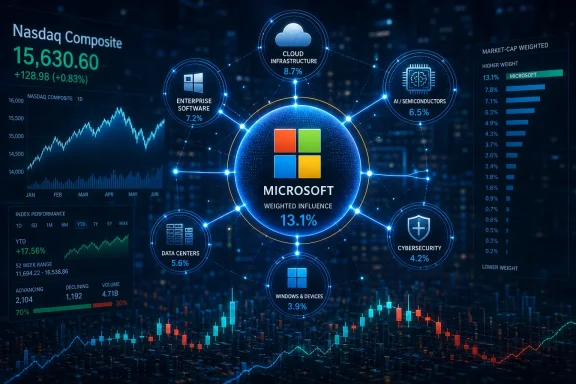 The Nasdaq Composite Is Broad, But Its Center of Gravity Is Narrow
The Nasdaq Composite’s marketing pitch is breadth. Nasdaq says the index tracks more than 3,000 domestic and international stocks listed on the Nasdaq Stock Market, spanning technology, consumer, healthcare, and other sectors. That makes it much wider than the Nasdaq-100, which is limited to 100 of the largest non-financial Nasdaq-listed companies.But the Composite is not an equal-vote democracy. Nasdaq’s own index materials describe it as market-cap weighted, meaning the largest companies have the largest effect on the index’s direction. A small biotech stock can double and barely move the number on a brokerage app; Microsoft can rise or fall a few percentage points and help set the tone for the whole session.
That is the first reason Microsoft matters. It is not just included in the Nasdaq Composite; it is structurally amplified by the index’s rules. The bigger Microsoft becomes, the more the Composite reflects Microsoft’s fortunes.
This is why the “Nasdaq is up” headline can be misleading. It may suggest a broad rally across thousands of names, when in practice a handful of mega-cap companies can do much of the lifting. Microsoft is one of those companies, and its weight turns its earnings calls, AI spending plans, Azure growth rates, and Windows strategy into index-level events.
Microsoft Became an Index Engine by Becoming an Infrastructure Company
The old Microsoft was a software monopoly with Windows and Office at the center of the story. The current Microsoft is something larger and harder to categorize: a cloud landlord, enterprise software bundle, developer platform, cybersecurity vendor, gaming owner, AI distributor, and still, yes, the company behind Windows.That matters to the Nasdaq Composite because investors no longer value Microsoft as a single-product software company. They treat it as a proxy for the durability of enterprise technology spending. When Microsoft reports strong cloud growth, Wall Street reads it as evidence that corporate IT budgets remain healthy; when Azure growth slows, the market asks whether the broader AI and cloud trade is cooling.
Microsoft’s fiscal third-quarter 2026 results show why. In its April 29 earnings release, Microsoft reported continued double-digit growth, with Azure and other cloud services revenue up sharply year over year. The company also said Microsoft Cloud revenue reached tens of billions of dollars for the quarter, reinforcing the idea that cloud and AI are no longer side bets but the operating core of the business.
For the Nasdaq Composite, this turns Microsoft into a transmission mechanism. A reassessment of Azure demand is not just a reassessment of Microsoft. It can ripple into semiconductor names, cloud software companies, cybersecurity vendors, data-center infrastructure suppliers, and AI-adjacent stocks that share the same investor narrative.
AI Has Made Microsoft’s Weight Feel Even Heavier
Microsoft’s current market relevance is inseparable from artificial intelligence. The company’s OpenAI partnership, Copilot product line, Azure AI services, and push to make Windows an AI development platform have made it one of the central names in the market’s AI thesis.That does not mean every AI feature is equally convincing. Windows users have watched Microsoft promote Copilot with a persistence that sometimes feels more like platform pressure than product delight. Windows Central and TechRadar have both reported on recent Copilot-centered experiments and leaked concepts, including visions of a lighter AI-first operating environment. Those reports are interesting not because every prototype will ship, but because they show how deeply Microsoft wants AI to become the interface layer across devices, cloud services, and productivity software.
For investors, the question is simpler: can Microsoft convert AI enthusiasm into revenue at a scale that justifies its spending and valuation? Azure AI consumption, Copilot subscriptions, GitHub Copilot adoption, Microsoft 365 upselling, and Windows AI features all feed that answer. When the answer looks positive, Microsoft can help pull the Nasdaq Composite higher. When skepticism rises, the reverse can happen.
This is where Microsoft’s role differs from many smaller AI names. A speculative AI startup might move dramatically on a single announcement, but it does not anchor the Composite. Microsoft does. Its AI story is not just narrative fuel; it is built into one of the largest market caps on the exchange.
The Windows Angle Still Matters More Than Wall Street Sometimes Admits
For WindowsForum readers, the easy temptation is to separate the stock-market Microsoft from the Windows Microsoft. Investors talk about Azure, AI run rate, and enterprise productivity. Enthusiasts and administrators talk about forced updates, Recall, Copilot integration, hardware requirements, privacy defaults, and whether Windows 11 is becoming more coherent or more cluttered.The two conversations are more connected than they look. Microsoft’s Windows strategy affects the company’s ability to distribute AI experiences at scale. Copilot+ PCs, Windows AI APIs, local models, NPUs, and developer tooling are not just product features; they are part of Microsoft’s attempt to make Windows relevant in the next computing cycle.
Microsoft has said Copilot+ PCs require neural processing hardware capable of more than 40 trillion operations per second, positioning the category as a new class of Windows device. At the same time, Microsoft’s developer materials have increasingly emphasized Windows as a platform for local and hybrid AI workloads. That is a bet that the PC does not become merely a browser terminal for cloud AI, but a client-side participant in the AI stack.
The risk is execution. Windows users have long memories, and Microsoft’s history with unwanted prompts, account nudges, Edge promotion, and confusing feature rollouts has created suspicion around anything branded “AI.” If Microsoft overplays its hand, the Windows installed base becomes a source of friction rather than leverage.
The Composite Reflects Belief in Big Tech’s Ability to Keep Scaling
A market-cap-weighted index rewards scale, and few companies have scaled as successfully as Microsoft. That is why the Nasdaq Composite’s performance increasingly depends on whether the largest technology platforms can continue compounding revenue without running into margin pressure, regulation, customer fatigue, or infrastructure limits.Microsoft sits at the center of several of those concerns. AI data centers require enormous capital spending. Cloud customers want productivity gains, not just demos. Regulators continue scrutinizing platform power, cloud contracts, software bundling, and AI partnerships. Enterprise customers are willing to pay for useful tools, but they are also sensitive to licensing complexity and vendor lock-in.
The bullish case is that Microsoft is uniquely positioned to absorb those pressures. It has enterprise relationships, cloud infrastructure, developer reach, security products, productivity software, and operating-system distribution. Few companies can turn a new computing trend into a bundle as efficiently as Microsoft.
The bearish case is that the same bundling power can become a political, technical, and customer-relations liability. If AI margins disappoint, if Copilot adoption is slower than expected, or if cloud growth normalizes faster than investors hope, Microsoft’s size could become a drag on the Composite rather than a support.
Market-Cap Weighting Turns Success Into Concentration
There is nothing inherently wrong with market-cap weighting. It is transparent, cheap to replicate, and reflects where public investors have assigned value. But it also means winners become more influential precisely because they have already won.That is the Nasdaq Composite’s Microsoft problem. The index includes thousands of securities, but its day-to-day story is often dominated by the largest platform companies. Microsoft’s influence is earned, but it still narrows the practical meaning of the benchmark.
This creates a perception gap. A retail investor may hear that the Nasdaq Composite is rising and assume the average Nasdaq-listed company is doing well. In reality, the index can climb while many smaller software, biotech, or growth companies lag. Microsoft’s strength can mask weakness elsewhere.
That does not make the Composite useless. It makes it necessary to read the index correctly. The Composite is a broad listing benchmark filtered through a market-cap lens, not a health check on the median tech company.
Microsoft Is a Sentiment Stock Without Being a Speculative Stock
Microsoft is not a meme stock, a thinly traded growth story, or a binary clinical-trial bet. It is a mature, profitable, globally embedded company. Yet it still carries enormous sentiment value because it is one of the cleanest expressions of the market’s belief in enterprise AI and cloud computing.That combination is powerful. Microsoft can be viewed as defensive because of its recurring revenue and enterprise base, while also being treated as a growth stock because of Azure and AI. Few companies get to wear both labels at once.
For the Nasdaq Composite, that dual identity matters. In risk-on markets, Microsoft participates in the AI and growth trade. In more cautious markets, it can still attract investors looking for quality, cash flow, and platform durability. That makes Microsoft a stabilizer in some periods and an accelerator in others.
But sentiment cuts both ways. If investors decide that AI spending is running ahead of returns, Microsoft will not be immune just because it is profitable. Its credibility raises the stakes: disappointment from Microsoft would carry more weight than disappointment from a smaller AI vendor.
The Kalkine Framing Gets the Question Right, But the Answer Is Bigger Than One Stock
Kalkine Media’s explainer asks why Microsoft matters to the Nasdaq Composite, and the most direct answer is weighting. Microsoft’s market value gives it a large role in a market-cap-weighted index. But that answer is incomplete unless we explain why Microsoft commands that market value in the first place.The company matters because it has become a central tollbooth in modern computing. Businesses pay Microsoft for identity, email, collaboration, security, cloud hosting, databases, developer tools, analytics, Windows management, and increasingly AI assistance. That recurring commercial footprint gives investors confidence that Microsoft can monetize new technology waves without starting from zero.
It also matters because Microsoft’s product decisions shape the broader Windows ecosystem. If Microsoft makes Copilot a default enterprise assistant, software vendors, IT departments, device makers, and security teams have to respond. If it changes Windows hardware expectations around AI acceleration, PC refresh cycles and procurement policies change with it.
In other words, Microsoft is not merely heavy in the index because its stock went up. Its stock went up because Microsoft sits across so many layers of the technology stack that investors treat it as infrastructure.
The Risk Is That One Company’s Narrative Becomes the Market’s Narrative
The Nasdaq Composite’s dependence on mega-cap technology names is not new, but the AI cycle has intensified it. Microsoft’s narrative now overlaps with Nvidia’s chips, OpenAI’s models, Azure’s capacity, Windows’ future, GitHub’s developer workflow, and Office’s enterprise lock-in. That is a remarkably large amount of market psychology to concentrate in one company.For IT professionals, this can feel strange. The same Microsoft that frustrates administrators with licensing sprawl and Windows nags is also one of the companies holding up the world’s most watched growth benchmark. The market often sees strategic inevitability where users see product annoyance.
Both views can be true. Microsoft can be a financial powerhouse and still make questionable interface decisions. It can lead in enterprise AI distribution and still face user resistance. It can lift the Nasdaq Composite while leaving parts of its own customer base unconvinced.
That tension is the real story. Microsoft matters to the Nasdaq Composite not because it is universally admired, but because it is deeply embedded. In markets, embeddedness often matters more than affection.
The Microsoft Trade Is Really a Bet on Platform Control
The concrete lesson is that Microsoft’s Nasdaq influence is not a mystery of ticker symbolism. It is the result of index math, enterprise dependence, and a market that has decided platform companies deserve premium weight.- Microsoft has outsized influence on the Nasdaq Composite because the index is weighted by market capitalization rather than by equal company representation.
- Microsoft’s Azure and AI performance can affect investor sentiment across cloud, semiconductor, software, and infrastructure stocks.
- Windows remains strategically important because it gives Microsoft a distribution channel for Copilot, local AI features, and developer tools.
- The Nasdaq Composite can rise even when many smaller Nasdaq-listed companies struggle, because mega-cap names such as Microsoft can dominate index movement.
- Microsoft’s biggest opportunity is turning AI into durable enterprise revenue, while its biggest risk is that spending, regulation, or user resistance weakens the market’s confidence in that story.
References
- Primary source: Kalkine Media
Published: 2026-07-06T07:12:08.224391
Loading…
kalkinemedia.com - Related coverage: nasdaq.com
Loading…
www.nasdaq.com - Related coverage: www2.stockmarketwatch.com
Loading…
www2.stockmarketwatch.com - Related coverage: indexes.nasdaq.com
Loading…
indexes.nasdaq.com - Related coverage: sinfera.com
Loading…
sinfera.com - Related coverage: legalclarity.org
Loading…
legalclarity.org
- Related coverage: supermoney.com
Loading…
www.supermoney.com - Related coverage: geeksforgeeks.org
Loading…
www.geeksforgeeks.org - Related coverage: marketcap.company
Loading…
marketcap.company - Related coverage: kalkine.com
Loading…
www.kalkine.com - Related coverage: invesco.com
Loading…
www.invesco.com - Related coverage: windowscentral.com
Microsoft Copilot OS revealed in LEAKED video: Lightweight Windows OS exploration features new desktop UI built entirely around Copilot and agentic AI | Windows Central
A leaked video from 2024 has revealed all about Microsoft's internal explorations for a Copilot OS running on a stripped back Windows codebase.www.windowscentral.com - Related coverage: techradar.com
Microsoft suggests Copilot is the 'button you can press to fix everything' in Windows 11 — here's hoping it can fix the company's marketing department | TechRadar
It's key to bring the PR back under (right) controlwww.techradar.com - Official source: microsoft.com
FY26 Q3 - Press Releases - Investor Relations - Microsoft
FY26 Q3 - Press Releases - Investor Relations - Microsoftwww.microsoft.com
- Official source: support.microsoft.com
Windows Copilot+ AI components - Microsoft Support
 support.microsoft.com
- Official source: developer.microsoft.com
Windows AI | Microsoft Developer
A unified, reliable and secure platform supporting the AI developer lifecycle from model selection, fine-tuning, optimizing and deployment across CPU, GPU, NPU and cloud.developer.microsoft.com - Official source: blogs.microsoft.com
The next phase of the Microsoft-OpenAI partnership - The Official Microsoft Blog
Amended Agreement Provides Long-Term Clarity The rapid pace of innovation requires us to continue to evolve our partnership to benefit our customers and both companies. Today, we are announcing an amended agreement to simplify our partnership and the way we work together, grounded in...blogs.microsoft.com - Related coverage: doolpa.com
Microsoft Q3 FY26: $82.9B Revenue, Azure +40%, AI Hits $37B Run-Rate | Doolpa
Microsoft posted $82.89B Q3 FY26 revenue April 29 2026: Azure +40%, AI run-rate $37B (+123% YoY), capex $31.9B. Shares slipped 3% despite the beat.doolpa.com - Related coverage: windowslatest.com
Microsoft pledges to make Windows 11 the OS for building AI, after years of Copilot backlash
Microsoft is turning Windows 11 into agent-native at Build 2026, adding local AI models and OS-level security to fix its developer platform. www.windowslatest.com
- Official source: azure.microsoft.com
Loading…
azure.microsoft.com - Related coverage: tomshardware.com
Microsoft unveils Project Solara AI, a chip-to-cloud platform built to power a new generation of 'agent-first' enterprise devices — hardware designed to run AI agents instead of traditional apps | Tom's Hardware
Microsoft ditches Windows to build OS on Androidwww.tomshardware.com - Related coverage: techxplore.com
Loading…
techxplore.com - Related coverage: channelpartners.net