

As of May 2026, a substantial minority of PC gamers on Steam still use Windows 10, even though Microsoft ended mainstream support on October 14, 2025, and the consumer Extended Security Updates runway is scheduled to expire on October 13, 2026. That is not merely nostalgia for a familiar Start menu. It is the visible edge of a hardware, economics, and trust problem Microsoft created when Windows 11 turned an operating-system upgrade into a platform eligibility test. Gamers are not refusing the future so much as refusing to be hurried into one that looks expensive, restrictive, and only intermittently better.
Windows 10 had an unusually long second life because it became the default PC gaming environment during the years when Steam, DirectX 12, Game Pass for PC, Discord, OBS, anti-cheat middleware, and GPU driver stacks all settled into a workable rhythm. For many players, “it works” is not a lazy defense of old software; it is the highest compliment a gaming PC can earn.
That matters because gaming PCs are not managed like office laptops. A work fleet moves because a procurement department, a security baseline, or a compliance deadline says it must. A gaming desktop moves when its owner is convinced the change will preserve frame rates, mod compatibility, peripheral behavior, capture workflows, and all the little rituals that make a machine feel personal.
Windows 10’s durability is therefore not surprising. It is the OS many users installed when PC gaming exploded again, when esports rigs, pandemic-era upgrades, and midrange GPUs became the center of home entertainment. It survived bad feature updates, privacy complaints, driver regressions, and Microsoft’s own uneven messaging because it eventually became boring in the best possible way.
Windows 11, by contrast, arrived with a sales pitch that was only partly about gaming. It promised a cleaner interface, tighter security assumptions, better window management, newer platform plumbing, and, eventually, AI-forward hardware positioning. But for a Windows 10 gamer with a stable library and no immediate security incident, the upgrade has often looked less like a reward than a negotiation.
A supported-but-doomed operating system is a strange thing. It is not abandoned enough to force action, but not alive enough to inspire confidence. Users can keep playing, patch narrowly, and tell themselves they will revisit the issue when the next GPU sale, tax refund, motherboard failure, or blockbuster game release changes the math.
That delay is rational. For a gamer, the risk of staying on Windows 10 is probabilistic and mostly invisible; the cost of replacing a machine or reinstalling an OS is immediate and personal. Security professionals may see an unsupported platform as an unacceptable exposure, but consumers tend to experience risk through incidents, not lifecycle documents.
Microsoft’s ESU program also muddies the psychological line. If the company says Windows 10 is finished but still sells or offers a path to security updates, many users will hear the second part louder than the first. In consumer markets, a deadline with an extension is not a deadline; it is an invitation to wait.
The story is that the memo did not overcome the friction. Windows 11 has grown into the dominant Windows version on Steam, but dominance is not the same as completion. A platform can win the headline share and still leave behind a large installed base that is difficult to move.
The stubborn Windows 10 cohort is probably a mix of several groups. Some own perfectly capable systems that simply have not been upgraded because nothing broke. Some are blocked by TPM 2.0, Secure Boot, CPU generation requirements, or firmware settings they do not want to touch. Some dislike Windows 11’s interface and account pressure. Some are running older machines that still deliver acceptable performance in the games they actually play.
That last clause is doing a lot of work. The PC gaming market is not only made of people chasing 4K path tracing. It is also made of players living inside Counter-Strike, Dota 2, Minecraft, Final Fantasy XIV, Stardew Valley, The Sims, emulators, older strategy games, and heavily modded Bethesda installs. For those users, Windows 10 is not obsolete if the experience they care about remains smooth.
Gamers understand hardware requirements when they come from games. If a new title needs more VRAM, a faster CPU, or DirectX 12 Ultimate features, the demand is annoying but legible. The software is doing something visibly more ambitious. An operating system requirement is different because the user may not see what changed enough to justify excluding a machine that still boots quickly and runs games well.
That is where Microsoft’s messaging has struggled. The company has long argued that Windows 11’s security baseline is better suited to modern threats, and that is credible. But consumer adoption is not driven by threat models alone. It is driven by whether the user believes the upgrade respects the value of the hardware they already own.
For many holdouts, Windows 11 feels less like the next version of Windows than a policy decision wearing a glassy coat of paint. That impression may be unfair in places, but it is powerful. Once users believe a requirement exists to accelerate hardware churn, every prompt to upgrade starts to sound like a sales funnel.
A Windows 10 gamer with an older but serviceable rig is therefore making a broader economic judgment. Replacing a motherboard may mean replacing a CPU and RAM. Replacing a GPU may mean checking the power supply, case clearance, monitor expectations, and whether the upgrade makes sense before the next architecture cycle. What Microsoft describes as OS modernization can quickly become a multi-hundred-dollar rebuild.
That is especially true for users on the edge of compatibility. A machine may fail the official Windows 11 check not because it is slow, but because it sits just outside the supported CPU list or has firmware features disabled. Enthusiast forums are full of advice about bypasses, registry edits, Rufus-created installers, and unsupported upgrade paths, but those are not mainstream solutions. They convert a supported Windows ecosystem into a self-supporting hobby project.
Gamers are comfortable tinkering, but they are also sensitive to blame. If an unsupported Windows 11 install later breaks an update, anti-cheat system, driver package, or feature release, the user owns the problem. Staying on Windows 10 can look risky; moving to unsupported Windows 11 can look like volunteering to become your own help desk.
Gamers sometimes underestimate this because they think of their PCs as entertainment boxes. But gaming machines are high-value personal systems. They often store payment credentials, session cookies, saved passwords, private messages, tax documents in the Downloads folder, and authenticated launchers tied to expensive libraries. They also run kernel-level anti-cheat drivers, RGB utilities, motherboard tools, overlays, mod managers, and third-party launchers — a messy software stack with plenty of attack surface.
The problem for Microsoft is that the security argument is negative motivation. It says: move, or something bad might happen. That can work in enterprises, where risk committees and cyber-insurance requirements translate fear into budget. It is less effective for consumers who have heard versions of the same warning for years and have not personally been burned.
Windows 11 needed a positive consumer story stronger than “safer by default.” For some users, it has one: better HDR handling, DirectStorage support in the right circumstances, ongoing driver attention, and tighter integration with modern Microsoft services. But those benefits are unevenly felt. If a Windows 10 system plays the user’s library reliably, the security uplift can feel abstract until the day it is not.
At first, the shift will be subtle. A new game may list Windows 11 as recommended and Windows 10 as minimum. A launcher may stop troubleshooting edge cases on Windows 10. A driver release may continue to install but receive less validation. A competitive game may update its anti-cheat stack and leave older configurations in a gray zone.
Then the economics will take over. Developers do not want to support old operating systems out of sentiment. They support them when the audience is large enough to justify QA time and when platform differences do not complicate the build. As Windows 10’s share declines, every compatibility bug becomes easier to close with a line in the minimum requirements.
This is why the Steam data matters beyond Microsoft. A quarter of Windows users on Steam is still too large for most publishers to ignore. But it is also small enough that teams planning 2027 and 2028 releases can imagine a Windows 11-first PC baseline. The holdouts have leverage today; they may have much less by the time the next wave of engines, anti-cheat systems, and platform SDK assumptions settles.
But Linux is not simply “Windows 10 without Microsoft.” It is a different contract. Users gain control, transparency, and a feeling that their hardware is not being sunset by an OS vendor’s product strategy. They may also inherit compatibility gaps, anti-cheat exclusions, peripheral quirks, modding differences, HDR rough edges, launcher workarounds, and the occasional weekend sacrificed to diagnosing something that Windows would have hidden.
For the right gamer, that trade is energizing. For the average Windows 10 holdout, it may be a bridge too far. Many people staying on Windows 10 are not ideological refuseniks; they are convenience maximizers. They want their existing machine to keep doing the thing it already does.
The Steam Deck has changed the emotional terrain, however. Valve proved that Linux can be made invisible enough for a consumer gaming device, and that matters more than any desktop distro victory lap. If SteamOS-style systems become more common on living-room PCs or handhelds, Microsoft’s Windows 10 problem could become something larger: a slow erosion of Windows as the default assumption for gaming hardware that is not a traditional desktop tower.
The company has always depended on the PC ecosystem to pull users forward. New CPUs, new laptops, new form factors, and new Windows versions usually moved together. Windows 11 disrupted that rhythm by leaving many working systems behind while the benefits of new Windows hardware were still unevenly distributed.
For gamers, the AI PC pitch can sound orthogonal. They care about frame pacing, shader compilation, GPU drivers, monitor support, latency, storage speed, and whether a new Windows update will break their setup before raid night. An NPU may matter someday for game-adjacent workloads, creator tools, streaming effects, or local assistants, but it is not yet the reason most people replace a gaming rig.
That gap creates a messaging problem. Microsoft is selling the next PC, while many Windows 10 gamers are defending the current one. Those are different conversations. If the company wants the holdouts to move willingly, it needs to make Windows 11 feel like a better gaming home rather than the entry fee for Microsoft’s broader platform ambitions.
That difference is easy to dismiss as irresponsibility, but it is really a market-design issue. Consumer PCs are sold as durable personal property. Operating systems are experienced as part of that property. When support ends before the user believes the hardware is finished, the user sees a broken promise even if the lifecycle page was always clear.
Microsoft has tried to soften this with tools, prompts, upgrade checks, and the ESU bridge. But the Windows ecosystem is too diverse for a clean migration. A ten-year-old budget laptop, a Haswell-era gaming tower, a Ryzen system with fTPM disabled, and a boutique desktop with odd firmware settings may all register as “Windows 10 machines,” yet the path forward is different for each.
That is why the remaining Windows 10 gaming base will not vanish in one neat wave. Some users will enable TPM and upgrade in an afternoon. Some will buy new systems before ESU ends. Some will run Windows 10 offline or semi-offline as a dedicated game box. Some will jump to Linux. Some will ignore the whole thing until a launcher, bank website, driver package, or multiplayer game finally makes the decision for them.
That trust has been inconsistent. Windows 11 is a capable OS, and on modern hardware it is often the obvious choice. But Microsoft’s habit of using Windows as a surface for services, recommendations, account prompts, and experiments has trained some users to approach upgrades defensively. Gamers are particularly unforgiving because small annoyances compound quickly when a machine is supposed to disappear into the game.
The irony is that Microsoft has largely won PC gaming at the technical platform level. Windows remains the default target for developers, GPU vendors, peripheral makers, and competitive gaming infrastructure. The company’s problem is not that gamers cannot move. It is that enough of them do not see why they should move on Microsoft’s schedule.
A better migration story would acknowledge the legitimacy of that hesitation. It would separate security urgency from hardware upselling, make compatibility explanations clearer, reduce nagging, and treat Windows 10 users less like laggards than customers with sunk investment. The hard sell may move some machines; it will also harden others.
Source: extremetech.com Windows 10 Gamers Are Holding on Despite Encroaching EOL
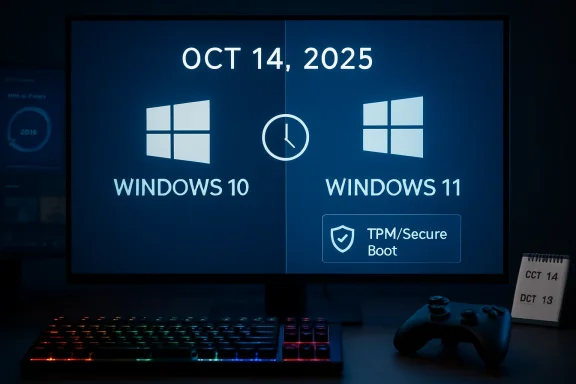 Windows 10 Became the Gaming Baseline Microsoft Cannot Easily Retire
Windows 10 had an unusually long second life because it became the default PC gaming environment during the years when Steam, DirectX 12, Game Pass for PC, Discord, OBS, anti-cheat middleware, and GPU driver stacks all settled into a workable rhythm. For many players, “it works” is not a lazy defense of old software; it is the highest compliment a gaming PC can earn.That matters because gaming PCs are not managed like office laptops. A work fleet moves because a procurement department, a security baseline, or a compliance deadline says it must. A gaming desktop moves when its owner is convinced the change will preserve frame rates, mod compatibility, peripheral behavior, capture workflows, and all the little rituals that make a machine feel personal.
Windows 10’s durability is therefore not surprising. It is the OS many users installed when PC gaming exploded again, when esports rigs, pandemic-era upgrades, and midrange GPUs became the center of home entertainment. It survived bad feature updates, privacy complaints, driver regressions, and Microsoft’s own uneven messaging because it eventually became boring in the best possible way.
Windows 11, by contrast, arrived with a sales pitch that was only partly about gaming. It promised a cleaner interface, tighter security assumptions, better window management, newer platform plumbing, and, eventually, AI-forward hardware positioning. But for a Windows 10 gamer with a stable library and no immediate security incident, the upgrade has often looked less like a reward than a negotiation.
The Countdown Is Real, but It Is Not Yet Painful Enough
The calendar is doing Microsoft’s work now. Windows 10 Home and Pro stopped receiving ordinary free security updates on October 14, 2025, and consumer ESU gives eligible users only a temporary reprieve through October 13, 2026. That makes the current moment uncomfortable but not yet decisive.A supported-but-doomed operating system is a strange thing. It is not abandoned enough to force action, but not alive enough to inspire confidence. Users can keep playing, patch narrowly, and tell themselves they will revisit the issue when the next GPU sale, tax refund, motherboard failure, or blockbuster game release changes the math.
That delay is rational. For a gamer, the risk of staying on Windows 10 is probabilistic and mostly invisible; the cost of replacing a machine or reinstalling an OS is immediate and personal. Security professionals may see an unsupported platform as an unacceptable exposure, but consumers tend to experience risk through incidents, not lifecycle documents.
Microsoft’s ESU program also muddies the psychological line. If the company says Windows 10 is finished but still sells or offers a path to security updates, many users will hear the second part louder than the first. In consumer markets, a deadline with an extension is not a deadline; it is an invitation to wait.
Steam’s Numbers Are a Referendum on Friction
Steam’s hardware survey is not a census, and it should never be treated as a perfect map of the PC universe. But it is one of the best recurring signals for the gaming market because it captures the machines people actually use to play. When roughly a quarter of Steam’s Windows users remain on Windows 10 in 2026, the story is not that gamers missed the memo.The story is that the memo did not overcome the friction. Windows 11 has grown into the dominant Windows version on Steam, but dominance is not the same as completion. A platform can win the headline share and still leave behind a large installed base that is difficult to move.
The stubborn Windows 10 cohort is probably a mix of several groups. Some own perfectly capable systems that simply have not been upgraded because nothing broke. Some are blocked by TPM 2.0, Secure Boot, CPU generation requirements, or firmware settings they do not want to touch. Some dislike Windows 11’s interface and account pressure. Some are running older machines that still deliver acceptable performance in the games they actually play.
That last clause is doing a lot of work. The PC gaming market is not only made of people chasing 4K path tracing. It is also made of players living inside Counter-Strike, Dota 2, Minecraft, Final Fantasy XIV, Stardew Valley, The Sims, emulators, older strategy games, and heavily modded Bethesda installs. For those users, Windows 10 is not obsolete if the experience they care about remains smooth.
Windows 11 Turned an Upgrade Into a Hardware Audit
The great difference between Windows 10 and Windows 11 adoption is that Windows 11 asks a more personal question: is your PC worthy? That was the strategic trade Microsoft made when it tied the new OS to stricter hardware requirements, including TPM 2.0 and supported modern processors. From a security architecture perspective, the logic is clear. From the user’s side of the monitor, it can feel arbitrary.Gamers understand hardware requirements when they come from games. If a new title needs more VRAM, a faster CPU, or DirectX 12 Ultimate features, the demand is annoying but legible. The software is doing something visibly more ambitious. An operating system requirement is different because the user may not see what changed enough to justify excluding a machine that still boots quickly and runs games well.
That is where Microsoft’s messaging has struggled. The company has long argued that Windows 11’s security baseline is better suited to modern threats, and that is credible. But consumer adoption is not driven by threat models alone. It is driven by whether the user believes the upgrade respects the value of the hardware they already own.
For many holdouts, Windows 11 feels less like the next version of Windows than a policy decision wearing a glassy coat of paint. That impression may be unfair in places, but it is powerful. Once users believe a requirement exists to accelerate hardware churn, every prompt to upgrade starts to sound like a sales funnel.
The PC Market Made Waiting Feel Sensible
The timing could hardly have been worse for a forced-feeling transition. PC gaming hardware has spent years passing through crypto hangovers, supply-chain distortions, AI-driven component pressure, high GPU prices, uneven availability, and a general sense that the old midrange bargain has eroded. Even when prices improve, the memory of scarcity lingers.A Windows 10 gamer with an older but serviceable rig is therefore making a broader economic judgment. Replacing a motherboard may mean replacing a CPU and RAM. Replacing a GPU may mean checking the power supply, case clearance, monitor expectations, and whether the upgrade makes sense before the next architecture cycle. What Microsoft describes as OS modernization can quickly become a multi-hundred-dollar rebuild.
That is especially true for users on the edge of compatibility. A machine may fail the official Windows 11 check not because it is slow, but because it sits just outside the supported CPU list or has firmware features disabled. Enthusiast forums are full of advice about bypasses, registry edits, Rufus-created installers, and unsupported upgrade paths, but those are not mainstream solutions. They convert a supported Windows ecosystem into a self-supporting hobby project.
Gamers are comfortable tinkering, but they are also sensitive to blame. If an unsupported Windows 11 install later breaks an update, anti-cheat system, driver package, or feature release, the user owns the problem. Staying on Windows 10 can look risky; moving to unsupported Windows 11 can look like volunteering to become your own help desk.
The Security Argument Is Stronger Than the Upgrade Pitch
There is a real security case against staying on Windows 10 indefinitely. Once ESU ends for consumers, newly discovered vulnerabilities will not receive normal public fixes for Home and Pro users. Attackers do not need every Windows 10 machine to be vulnerable forever; they need enough unpatched systems to make targeting worth the effort.Gamers sometimes underestimate this because they think of their PCs as entertainment boxes. But gaming machines are high-value personal systems. They often store payment credentials, session cookies, saved passwords, private messages, tax documents in the Downloads folder, and authenticated launchers tied to expensive libraries. They also run kernel-level anti-cheat drivers, RGB utilities, motherboard tools, overlays, mod managers, and third-party launchers — a messy software stack with plenty of attack surface.
The problem for Microsoft is that the security argument is negative motivation. It says: move, or something bad might happen. That can work in enterprises, where risk committees and cyber-insurance requirements translate fear into budget. It is less effective for consumers who have heard versions of the same warning for years and have not personally been burned.
Windows 11 needed a positive consumer story stronger than “safer by default.” For some users, it has one: better HDR handling, DirectStorage support in the right circumstances, ongoing driver attention, and tighter integration with modern Microsoft services. But those benefits are unevenly felt. If a Windows 10 system plays the user’s library reliably, the security uplift can feel abstract until the day it is not.
Game Developers Will Move the Deadline More Efficiently Than Microsoft
The real end of Windows 10 gaming will not arrive in a Microsoft blog post. It will arrive piecemeal, through launchers, anti-cheat providers, GPU driver branches, middleware, and game studios deciding that Windows 11 is the oldest environment worth testing seriously. That is how platforms really die.At first, the shift will be subtle. A new game may list Windows 11 as recommended and Windows 10 as minimum. A launcher may stop troubleshooting edge cases on Windows 10. A driver release may continue to install but receive less validation. A competitive game may update its anti-cheat stack and leave older configurations in a gray zone.
Then the economics will take over. Developers do not want to support old operating systems out of sentiment. They support them when the audience is large enough to justify QA time and when platform differences do not complicate the build. As Windows 10’s share declines, every compatibility bug becomes easier to close with a line in the minimum requirements.
This is why the Steam data matters beyond Microsoft. A quarter of Windows users on Steam is still too large for most publishers to ignore. But it is also small enough that teams planning 2027 and 2028 releases can imagine a Windows 11-first PC baseline. The holdouts have leverage today; they may have much less by the time the next wave of engines, anti-cheat systems, and platform SDK assumptions settles.
Linux Is the Escape Hatch, Not Yet the Main Exit
The Linux gaming story is no longer a punchline. Proton, Steam Deck, Mesa, Vulkan, and years of painful compatibility work have made Linux a plausible daily gaming environment for more users than at any previous point in PC history. The fact that Linux has been flirting with historically high Steam shares is meaningful, even when monthly numbers wobble.But Linux is not simply “Windows 10 without Microsoft.” It is a different contract. Users gain control, transparency, and a feeling that their hardware is not being sunset by an OS vendor’s product strategy. They may also inherit compatibility gaps, anti-cheat exclusions, peripheral quirks, modding differences, HDR rough edges, launcher workarounds, and the occasional weekend sacrificed to diagnosing something that Windows would have hidden.
For the right gamer, that trade is energizing. For the average Windows 10 holdout, it may be a bridge too far. Many people staying on Windows 10 are not ideological refuseniks; they are convenience maximizers. They want their existing machine to keep doing the thing it already does.
The Steam Deck has changed the emotional terrain, however. Valve proved that Linux can be made invisible enough for a consumer gaming device, and that matters more than any desktop distro victory lap. If SteamOS-style systems become more common on living-room PCs or handhelds, Microsoft’s Windows 10 problem could become something larger: a slow erosion of Windows as the default assumption for gaming hardware that is not a traditional desktop tower.
Microsoft’s AI PC Push Risks Talking Past the Holdouts
Microsoft’s current PC story is increasingly wrapped around Copilot+ PCs, NPUs, local AI features, and a hardware refresh cycle that makes sense to OEMs. That may be the right strategy for selling new laptops. It is less obviously persuasive to the gamer trying to keep a six-year-old desktop relevant.The company has always depended on the PC ecosystem to pull users forward. New CPUs, new laptops, new form factors, and new Windows versions usually moved together. Windows 11 disrupted that rhythm by leaving many working systems behind while the benefits of new Windows hardware were still unevenly distributed.
For gamers, the AI PC pitch can sound orthogonal. They care about frame pacing, shader compilation, GPU drivers, monitor support, latency, storage speed, and whether a new Windows update will break their setup before raid night. An NPU may matter someday for game-adjacent workloads, creator tools, streaming effects, or local assistants, but it is not yet the reason most people replace a gaming rig.
That gap creates a messaging problem. Microsoft is selling the next PC, while many Windows 10 gamers are defending the current one. Those are different conversations. If the company wants the holdouts to move willingly, it needs to make Windows 11 feel like a better gaming home rather than the entry fee for Microsoft’s broader platform ambitions.
Enterprise Lessons Do Not Translate Cleanly to the Bedroom Desk
IT departments understand end-of-life schedules because they live by them. They inventory machines, test images, define rings, buy extended support, and accept that lifecycle management is part of the job. A gamer’s PC under a bedroom desk or beside a TV console is governed by a different logic.That difference is easy to dismiss as irresponsibility, but it is really a market-design issue. Consumer PCs are sold as durable personal property. Operating systems are experienced as part of that property. When support ends before the user believes the hardware is finished, the user sees a broken promise even if the lifecycle page was always clear.
Microsoft has tried to soften this with tools, prompts, upgrade checks, and the ESU bridge. But the Windows ecosystem is too diverse for a clean migration. A ten-year-old budget laptop, a Haswell-era gaming tower, a Ryzen system with fTPM disabled, and a boutique desktop with odd firmware settings may all register as “Windows 10 machines,” yet the path forward is different for each.
That is why the remaining Windows 10 gaming base will not vanish in one neat wave. Some users will enable TPM and upgrade in an afternoon. Some will buy new systems before ESU ends. Some will run Windows 10 offline or semi-offline as a dedicated game box. Some will jump to Linux. Some will ignore the whole thing until a launcher, bank website, driver package, or multiplayer game finally makes the decision for them.
The Last Mile Will Be Messy Because Trust Is the Missing Feature
The Windows 10 holdout story is often framed as a resistance to change, but trust is the more important variable. Users need to trust that Windows 11 will not make their machine worse. They need to trust that Microsoft’s requirements are genuinely about security and reliability, not just nudging hardware sales. They need to trust that the interface, account system, ads, defaults, and AI integrations will not keep shifting under them.That trust has been inconsistent. Windows 11 is a capable OS, and on modern hardware it is often the obvious choice. But Microsoft’s habit of using Windows as a surface for services, recommendations, account prompts, and experiments has trained some users to approach upgrades defensively. Gamers are particularly unforgiving because small annoyances compound quickly when a machine is supposed to disappear into the game.
The irony is that Microsoft has largely won PC gaming at the technical platform level. Windows remains the default target for developers, GPU vendors, peripheral makers, and competitive gaming infrastructure. The company’s problem is not that gamers cannot move. It is that enough of them do not see why they should move on Microsoft’s schedule.
A better migration story would acknowledge the legitimacy of that hesitation. It would separate security urgency from hardware upselling, make compatibility explanations clearer, reduce nagging, and treat Windows 10 users less like laggards than customers with sunk investment. The hard sell may move some machines; it will also harden others.
The Five-Month Grace Period Is Really a Planning Window
Windows 10 gamers do not need panic, but they do need a plan. The remaining ESU runway should be treated as time to decide what kind of PC future they want, not as proof that nothing has changed. The worst outcome is not staying on Windows 10 for a few more months; it is drifting past support with no backup, no migration path, and no understanding of which applications will break first.- Windows 10 remains a viable gaming environment today, but its consumer security runway is scheduled to narrow sharply after October 13, 2026.
- Windows 11 adoption among Steam users is strong, yet the remaining Windows 10 share is large enough to shape publisher and hardware-vendor decisions for a while longer.
- Unsupported Windows 11 installs may solve the upgrade block for enthusiasts, but they also move users outside the cleanest support path.
- Linux is now a credible option for some gamers, especially Steam-heavy users, but anti-cheat, launcher, and peripheral realities still matter.
- The practical deadline for many players will be set less by Microsoft than by the first must-play game, driver, launcher, or security requirement that leaves Windows 10 behind.
Source: extremetech.com Windows 10 Gamers Are Holding on Despite Encroaching EOL
