

Valve’s April 2026 Steam Hardware & Software Survey shows roughly a quarter of Windows gamers still running Windows 10 months after Microsoft ended mainstream support on October 14, 2025, even as Windows 11 dominates Steam and Microsoft’s paid Extended Security Updates bridge runs through October 13, 2026. That stubborn remainder is not just nostalgia. It is the market telling Microsoft, GPU vendors, and game publishers that the average gaming PC is aging more slowly than their roadmaps assume.
The Windows 10 holdout story is easy to frame as gamer obstinacy: people dislike change, Windows 11 moved the furniture, and Steam users can be impressively loyal to whatever setup keeps Counter-Strike, Baldur’s Gate 3, or a heavily modded Bethesda install from breaking. But the more convincing explanation is economic. The same survey that shows Windows 10 refusing to vanish also shows the GeForce RTX 3060 still near the top of the GPU pile and 8GB of VRAM remaining stubbornly common.
That combination matters. If the operating system refuses to move, the graphics card refuses to move, and the RAM baseline refuses to move, the story is not one bad upgrade prompt. It is a consumer hardware cycle that has stretched under the weight of high prices, uneven performance gains, compatibility rules, and a software industry increasingly comfortable designing for machines many players do not actually own.
Microsoft’s official position is straightforward: Windows 10 reached end of support on October 14, 2025, and users should move to Windows 11 or buy into Extended Security Updates if they insist on staying. For businesses, that framing makes sense. Unsupported operating systems become audit findings, insurance headaches, and attack surfaces.
For home PC gamers, the calculus is messier. A gaming PC is often a machine assembled over years, not bought as a single corporate asset with a depreciation schedule. A motherboard from 2017, a CPU from 2018, a used GPU from 2022, and a boot drive cloned twice can still feel like a perfectly functional rig if it runs the games the owner actually plays.
That is why Windows 10 has taken on a strange second life. It is no longer the current Windows, but it is still familiar, compatible, and performant enough. In practice, it has become a kind of accidental consumer LTS release: not because Microsoft designed it that way, but because users have decided that “still works” is a stronger argument than “officially replaced.”
The problem for Microsoft is that Windows 11’s upgrade pitch was never just “newer is better.” It was bound to a hardware floor: TPM 2.0, supported CPUs, Secure Boot expectations, and a security model that made sense on paper but instantly divided the installed base. A gamer with a perfectly usable six- or eight-core CPU outside the supported list was asked to accept that their machine had become obsolete by policy rather than by performance.
That distinction is toxic in enthusiast circles. PC gaming culture is built around squeezing value from hardware: undervolting, repasting, used-market upgrades, BIOS tweaks, modded drivers, and the quiet pride of making an old box punch above its class. When Windows 11 says a system is unsupported even though the frame-rate counter says otherwise, many users trust the counter.
But the long-term pattern is hard to dismiss. Windows 11 has won the Steam majority, yet Windows 10 remains large enough to matter. The RTX 3060 keeps reappearing as a defining GPU of the platform. Sixteen gigabytes of system memory and 8GB of graphics memory continue to function as the center of gravity for a massive part of the audience.
That is a brutally practical signal to developers. If you build your PC version around a fantasy median machine with 32GB of RAM, a 12GB or 16GB GPU, and a fresh Windows 11 install, you are not building for the Steam mainstream. You are building for the audience you wish existed.
This is where gamers’ complaints about optimization become more than forum noise. When a new AAA release stutters on mainstream GPUs, demands 12GB of VRAM for high textures, or treats shader compilation as the player’s problem, it is colliding with the same installed-base reality that keeps Windows 10 alive. Players are not refusing the future because they hate progress. They are refusing to pay full price for games and hardware that make their still-capable machines feel prematurely disposable.
The Steam survey’s greatest value is not precision. It is humility. It reminds the industry that the PC is not one platform but a moving pile of compromises, and most users are not living at the benchmark-chart frontier.
Its continued presence says something important about the upgrade cycle. Many gamers who moved to an RTX 3060-class card did so after years of waiting out absurd prices. They did not buy it as a disposable stepping stone. They bought it as the machine-saving upgrade that would get them through several more years.
That makes the modern GPU market’s messaging difficult to swallow. Newer cards bring better ray tracing, frame generation, AI upscaling, power efficiency, and codec support. But for the owner of a 1080p or 1440p display who mostly plays competitive titles, older single-player games, indies, and a handful of optimized blockbusters, those advances may not justify a platform overhaul.
The 8GB VRAM issue sharpens the tension. In 2026, 8GB is both common and increasingly uncomfortable. It is enough for many games, especially at 1080p, but it is no longer a no-drama configuration for the highest texture settings in demanding releases. The average gamer is therefore stuck in a strange place: their GPU is too capable to discard, but too constrained to satisfy every new title’s appetite.
That is exactly the kind of limbo that encourages operating system inertia. If a player already feels squeezed by game requirements, GPU pricing, and upgrade ambiguity, Windows 11 becomes one more risk with unclear reward. The current setup may be imperfect, but it is known. In PC gaming, known often beats new.
The trouble is that security is rarely the only priority on a gaming machine. Anti-cheat compatibility, driver behavior, peripheral software, capture tools, mod managers, RGB utilities, fan-control apps, and years of accumulated configuration cruft all shape whether an upgrade feels safe. A PC that exists partly as a hobby project is more fragile than a spec sheet suggests.
Windows 11 has improved since launch, and for many gamers the upgrade is now uneventful. The performance horror stories that accompanied early transitions have faded, and support for new CPUs increasingly assumes the newer OS. Yet reputation lags reality. Once an operating system becomes associated with forced change, ads, account nudges, altered defaults, and compatibility anxiety, each incremental improvement has to fight the emotional residue of the launch.
That is the bind Microsoft created for itself. Windows 11 may be the technically correct answer, but Windows 10 is the socially trusted answer. The former has the roadmap; the latter has the installed base’s muscle memory.
Extended Security Updates complicate the message further. By offering a paid runway after end of support, Microsoft acknowledges what everyone already knew: too many machines were not going to move by October 2025. ESU is a safety valve, but it also normalizes delay. For users already reluctant to upgrade, the existence of ESU can feel less like an emergency measure and more like permission to wait.
Yes, bypasses exist. Enthusiasts have found ways around CPU and TPM checks, and plenty of unsupported systems run Windows 11 without obvious catastrophe. But unofficial paths are not a mass-market solution. They move responsibility from Microsoft to the user, which is acceptable for hobbyists and unacceptable for ordinary people who just want their PC to remain safe.
For gamers, that matters because many machines sit in a gray zone. They are not ancient e-waste. They are not ideal Windows 11 candidates either. They are functional PCs with enough GPU power to run most of the Steam library and enough CPU power to remain relevant, but they violate a line Microsoft drew for reasons that do not always feel visible in daily use.
The result is a credibility gap. Microsoft says the PC is too old. Steam says it is still part of the active gaming population. Game developers say it is part of the minimum or recommended audience. The owner says it runs fine. In that argument, Microsoft may be right about risk, but it is losing the lived-experience debate.
That is why the Windows 10 holdout number feels less like a failure of communication and more like a failure of alignment. Microsoft’s platform policy, the hardware industry’s sales cycle, and gamers’ budgets are not moving at the same speed.
That is how a free upgrade becomes a $600 to $1,500 decision. The user begins with a Windows support deadline and ends up pricing an AM5 platform, DDR5 memory, a GPU with more VRAM, and a case with better airflow. The rational response is often to do nothing until something breaks.
This is especially true after several years in which the PC market trained buyers to be skeptical. GPU prices became detached from old expectations. Motherboard pricing climbed. High-end parts grew hotter and more power-hungry. Even midrange builds started feeling less midrange in total platform cost.
The industry likes to talk about the enthusiast upgrade cycle as if it were a law of nature. In reality, it is a confidence game. People upgrade when they believe the next purchase will last, deliver visible gains, and not be embarrassed by next year’s software assumptions. When confidence erodes, the cycle stretches.
Steam’s Windows 10 population is therefore a pocketbook indicator. It tells us many players are not convinced that the combined Windows 11-era platform jump is worth the money yet. They may get there eventually, but not on Microsoft’s preferred calendar.
A well-optimized game can still scale beautifully across old and new machines. PC players understand that ultra settings are not a human right. What they resent is when medium settings look bad, shader stutter ruins the first hour, VRAM spills cause hitching, and day-one patches feel like outsourced QA.
Windows 10 holdouts are part of that same frustration economy. They are players who have learned that new does not always mean better. A new OS can introduce new annoyances. A new GPU generation can bring disappointing value. A new game can launch half-cooked. The safest move becomes patience.
This is not merely conservatism. It is learned behavior. PC gamers have spent years being told to wait for patches, wait for driver updates, wait for discounts, wait for refreshes, wait for the real midrange, wait for the next Windows feature drop. Now the industry is discovering that users can also wait on the operating system.
The irony is that PC gaming’s flexibility is both its strength and its drag. Consoles reset the baseline by generation. PCs drag old baselines forward until enough users leave them behind. In 2026, Windows 10 and the RTX 3060 are part of that drag.
Still, Linux’s Steam share remains small compared with Windows. Its movement is interesting, but not yet an existential threat to Microsoft on the desktop. The average Windows 10 gamer who is reluctant to move to Windows 11 is not automatically ready to install Arch, Bazzite, Nobara, or any other distribution, no matter how good Proton has become.
The more realistic threat is subtler. Linux gives dissatisfied users a place to point their imagination. It turns Windows frustration from a dead end into a comparison. Every time a game runs well on SteamOS, every time a handheld avoids Windows overhead, and every time a user discovers that their library is less Windows-dependent than they assumed, Microsoft’s default status weakens by a millimeter.
That does not mean a mass migration is imminent. Anti-cheat support, multiplayer compatibility, launcher friction, creative software, hardware utilities, and plain habit still keep Windows entrenched. But Windows’ dominance is no longer the same as Windows’ emotional monopoly.
For Microsoft, that distinction should matter. The danger is not that a quarter of Steam users on Windows 10 will all become Linux users next month. The danger is that Windows 11 becomes the thing people accept reluctantly while Valve becomes the company associated with making aging hardware feel useful.
That is harder than it sounds. PC gamers are ruthless about value, and a Steam Machine that costs too much will be compared against self-built desktops, discounted laptops, used GPUs, consoles, and the machine already under the desk. But if Valve can hit the right price-performance target, the Windows 10 hangover becomes an opportunity.
The pitch is not “abandon Windows because Linux is pure.” That pitch has failed for decades. The pitch is “here is a stable gaming appliance that plays your Steam library, avoids Windows 11 friction, and costs less than rebuilding your PC.” That is a much more dangerous proposition.
Microsoft should not panic, but it should pay attention. The Steam Deck did not win by converting every PC gamer into a Linux evangelist. It won by making the OS fade into the background. If Valve can repeat that trick in a living-room or small-desktop format, Windows becomes less central to the identity of PC gaming.
The Windows 10 holdouts reveal the opening. They are not necessarily looking for an ideological alternative. They are looking for a practical one.
The difference is that businesses usually have governance structures to manage that risk. Home users have vibes, Reddit threads, YouTube tutorials, and the occasional family IT person. That makes the Windows 10 tail more chaotic. Some users will enroll in ESU. Some will upgrade properly. Some will bypass requirements. Some will do nothing and hope their browser, Steam client, and antivirus stack continue to carry them.
From a security standpoint, that is not great. Unsupported or semi-supported consumer machines are attractive targets precisely because they are numerous, inconsistent, and often administered casually. A gaming PC is also a high-value personal device: logged into stores, payment systems, Discord, email, password managers, and sometimes work accounts.
But risk does not automatically create budget. This is the lesson enterprise IT learns every cycle. The correct answer can be obvious and still unfunded.
Microsoft’s challenge is to make the secure path feel less like a punishment. If users believe the only official way forward is to discard hardware they still trust, many will choose unofficial risk over official expense. That may be irrational in the long run, but it is deeply human in the short run.
That is how platform transitions actually finish. Users do not abandon old systems because a lifecycle page says so. They abandon them when the practical world stops accommodating them: drivers stop arriving, launchers drop support, anti-cheat systems require newer security features, new CPUs perform better elsewhere, and games quietly assume APIs or behaviors the old platform cannot provide.
Windows 7 lingered in a similar way. It remained beloved long after Microsoft wanted it gone, then gradually became inconvenient enough that even holdouts moved on. Windows 10 is likely to follow that pattern, but the slope may be gentler because it is much closer to Windows 11 architecturally and still broadly compatible with modern software.
That creates a drawn-out twilight. Windows 10 will not vanish from Steam quickly, especially while ESU exists and while mainstream games continue to support it. Developers will be reluctant to cut off a large paying audience unless technical reasons force the issue. Hardware makers will also move gradually because driver support decisions affect reputation.
So yes, the bitter end is coming. But in PC gaming, the bitter end tends to last years.
Source: Windows Central https://www.windowscentral.com/gami...holding-out-in-steam-by-choice-or-priced-out/
The Windows 10 holdout story is easy to frame as gamer obstinacy: people dislike change, Windows 11 moved the furniture, and Steam users can be impressively loyal to whatever setup keeps Counter-Strike, Baldur’s Gate 3, or a heavily modded Bethesda install from breaking. But the more convincing explanation is economic. The same survey that shows Windows 10 refusing to vanish also shows the GeForce RTX 3060 still near the top of the GPU pile and 8GB of VRAM remaining stubbornly common.
That combination matters. If the operating system refuses to move, the graphics card refuses to move, and the RAM baseline refuses to move, the story is not one bad upgrade prompt. It is a consumer hardware cycle that has stretched under the weight of high prices, uneven performance gains, compatibility rules, and a software industry increasingly comfortable designing for machines many players do not actually own.
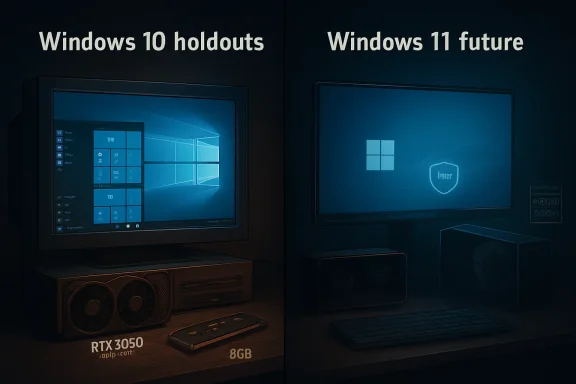 Windows 10 Became the Poor Man’s Long-Term Servicing Channel
Microsoft’s official position is straightforward: Windows 10 reached end of support on October 14, 2025, and users should move to Windows 11 or buy into Extended Security Updates if they insist on staying. For businesses, that framing makes sense. Unsupported operating systems become audit findings, insurance headaches, and attack surfaces.For home PC gamers, the calculus is messier. A gaming PC is often a machine assembled over years, not bought as a single corporate asset with a depreciation schedule. A motherboard from 2017, a CPU from 2018, a used GPU from 2022, and a boot drive cloned twice can still feel like a perfectly functional rig if it runs the games the owner actually plays.
That is why Windows 10 has taken on a strange second life. It is no longer the current Windows, but it is still familiar, compatible, and performant enough. In practice, it has become a kind of accidental consumer LTS release: not because Microsoft designed it that way, but because users have decided that “still works” is a stronger argument than “officially replaced.”
The problem for Microsoft is that Windows 11’s upgrade pitch was never just “newer is better.” It was bound to a hardware floor: TPM 2.0, supported CPUs, Secure Boot expectations, and a security model that made sense on paper but instantly divided the installed base. A gamer with a perfectly usable six- or eight-core CPU outside the supported list was asked to accept that their machine had become obsolete by policy rather than by performance.
That distinction is toxic in enthusiast circles. PC gaming culture is built around squeezing value from hardware: undervolting, repasting, used-market upgrades, BIOS tweaks, modded drivers, and the quiet pride of making an old box punch above its class. When Windows 11 says a system is unsupported even though the frame-rate counter says otherwise, many users trust the counter.
The Steam Survey Is Noisy, but the Pattern Is Not
Steam’s monthly hardware survey is not a census. It is optional, sample-based, and sometimes prone to odd swings that appear to reflect who was sampled rather than an overnight revolution in global PC ownership. Individual month-to-month movements should be handled carefully, especially when language distribution, regional participation, or reporting bugs distort the picture.But the long-term pattern is hard to dismiss. Windows 11 has won the Steam majority, yet Windows 10 remains large enough to matter. The RTX 3060 keeps reappearing as a defining GPU of the platform. Sixteen gigabytes of system memory and 8GB of graphics memory continue to function as the center of gravity for a massive part of the audience.
That is a brutally practical signal to developers. If you build your PC version around a fantasy median machine with 32GB of RAM, a 12GB or 16GB GPU, and a fresh Windows 11 install, you are not building for the Steam mainstream. You are building for the audience you wish existed.
This is where gamers’ complaints about optimization become more than forum noise. When a new AAA release stutters on mainstream GPUs, demands 12GB of VRAM for high textures, or treats shader compilation as the player’s problem, it is colliding with the same installed-base reality that keeps Windows 10 alive. Players are not refusing the future because they hate progress. They are refusing to pay full price for games and hardware that make their still-capable machines feel prematurely disposable.
The Steam survey’s greatest value is not precision. It is humility. It reminds the industry that the PC is not one platform but a moving pile of compromises, and most users are not living at the benchmark-chart frontier.
The RTX 3060 Is the Real Windows 10 of GPUs
The GeForce RTX 3060’s staying power explains the Windows 10 holdout better than any Start menu grievance. It was not the fastest Ampere card, not the most glamorous, and not the card enthusiasts dreamed about. But it arrived in the messy aftermath of pandemic-era supply shocks, crypto distortion, and inflated GPU pricing, then settled into the role of the card people actually bought.Its continued presence says something important about the upgrade cycle. Many gamers who moved to an RTX 3060-class card did so after years of waiting out absurd prices. They did not buy it as a disposable stepping stone. They bought it as the machine-saving upgrade that would get them through several more years.
That makes the modern GPU market’s messaging difficult to swallow. Newer cards bring better ray tracing, frame generation, AI upscaling, power efficiency, and codec support. But for the owner of a 1080p or 1440p display who mostly plays competitive titles, older single-player games, indies, and a handful of optimized blockbusters, those advances may not justify a platform overhaul.
The 8GB VRAM issue sharpens the tension. In 2026, 8GB is both common and increasingly uncomfortable. It is enough for many games, especially at 1080p, but it is no longer a no-drama configuration for the highest texture settings in demanding releases. The average gamer is therefore stuck in a strange place: their GPU is too capable to discard, but too constrained to satisfy every new title’s appetite.
That is exactly the kind of limbo that encourages operating system inertia. If a player already feels squeezed by game requirements, GPU pricing, and upgrade ambiguity, Windows 11 becomes one more risk with unclear reward. The current setup may be imperfect, but it is known. In PC gaming, known often beats new.
Microsoft’s Security Argument Is Right and Still Not Enough
Microsoft is not wrong to want Windows users on a more secure baseline. TPM-backed features, virtualization-based security, modern driver expectations, and tighter platform assumptions are not marketing fluff. They reflect real security lessons from an era when consumer PCs are targets, not toys.The trouble is that security is rarely the only priority on a gaming machine. Anti-cheat compatibility, driver behavior, peripheral software, capture tools, mod managers, RGB utilities, fan-control apps, and years of accumulated configuration cruft all shape whether an upgrade feels safe. A PC that exists partly as a hobby project is more fragile than a spec sheet suggests.
Windows 11 has improved since launch, and for many gamers the upgrade is now uneventful. The performance horror stories that accompanied early transitions have faded, and support for new CPUs increasingly assumes the newer OS. Yet reputation lags reality. Once an operating system becomes associated with forced change, ads, account nudges, altered defaults, and compatibility anxiety, each incremental improvement has to fight the emotional residue of the launch.
That is the bind Microsoft created for itself. Windows 11 may be the technically correct answer, but Windows 10 is the socially trusted answer. The former has the roadmap; the latter has the installed base’s muscle memory.
Extended Security Updates complicate the message further. By offering a paid runway after end of support, Microsoft acknowledges what everyone already knew: too many machines were not going to move by October 2025. ESU is a safety valve, but it also normalizes delay. For users already reluctant to upgrade, the existence of ESU can feel less like an emergency measure and more like permission to wait.
Unsupported Does Not Mean Unusable, and That Is Microsoft’s Problem
The harshest criticism of Windows 11’s system requirements has always been that they broke the old emotional contract of Windows. Historically, Windows upgrades might be annoying, heavier, or visually divisive, but a reasonably competent user could often push an older machine forward. Windows 11 turned that into a gatekeeping exercise.Yes, bypasses exist. Enthusiasts have found ways around CPU and TPM checks, and plenty of unsupported systems run Windows 11 without obvious catastrophe. But unofficial paths are not a mass-market solution. They move responsibility from Microsoft to the user, which is acceptable for hobbyists and unacceptable for ordinary people who just want their PC to remain safe.
For gamers, that matters because many machines sit in a gray zone. They are not ancient e-waste. They are not ideal Windows 11 candidates either. They are functional PCs with enough GPU power to run most of the Steam library and enough CPU power to remain relevant, but they violate a line Microsoft drew for reasons that do not always feel visible in daily use.
The result is a credibility gap. Microsoft says the PC is too old. Steam says it is still part of the active gaming population. Game developers say it is part of the minimum or recommended audience. The owner says it runs fine. In that argument, Microsoft may be right about risk, but it is losing the lived-experience debate.
That is why the Windows 10 holdout number feels less like a failure of communication and more like a failure of alignment. Microsoft’s platform policy, the hardware industry’s sales cycle, and gamers’ budgets are not moving at the same speed.
The Cost of Moving Is Bigger Than the Windows License
The phrase “upgrade to Windows 11” sounds cheap because the software upgrade is often free. But for many users, the real upgrade is not the OS. It is the motherboard, CPU, RAM, maybe cooler, maybe power supply, maybe a fresh SSD, and perhaps a GPU if the system is being opened anyway.That is how a free upgrade becomes a $600 to $1,500 decision. The user begins with a Windows support deadline and ends up pricing an AM5 platform, DDR5 memory, a GPU with more VRAM, and a case with better airflow. The rational response is often to do nothing until something breaks.
This is especially true after several years in which the PC market trained buyers to be skeptical. GPU prices became detached from old expectations. Motherboard pricing climbed. High-end parts grew hotter and more power-hungry. Even midrange builds started feeling less midrange in total platform cost.
The industry likes to talk about the enthusiast upgrade cycle as if it were a law of nature. In reality, it is a confidence game. People upgrade when they believe the next purchase will last, deliver visible gains, and not be embarrassed by next year’s software assumptions. When confidence erodes, the cycle stretches.
Steam’s Windows 10 population is therefore a pocketbook indicator. It tells us many players are not convinced that the combined Windows 11-era platform jump is worth the money yet. They may get there eventually, but not on Microsoft’s preferred calendar.
Game Developers Are Shipping Into the Gap
The Windows Central argument about affordability lands because gamers see the contradiction every week. Publishers chase visual spectacle and premium pricing while a large chunk of the audience remains on hardware that looks decidedly ordinary by 2026 standards. That mismatch turns every bad PC port into a referendum on the industry’s priorities.A well-optimized game can still scale beautifully across old and new machines. PC players understand that ultra settings are not a human right. What they resent is when medium settings look bad, shader stutter ruins the first hour, VRAM spills cause hitching, and day-one patches feel like outsourced QA.
Windows 10 holdouts are part of that same frustration economy. They are players who have learned that new does not always mean better. A new OS can introduce new annoyances. A new GPU generation can bring disappointing value. A new game can launch half-cooked. The safest move becomes patience.
This is not merely conservatism. It is learned behavior. PC gamers have spent years being told to wait for patches, wait for driver updates, wait for discounts, wait for refreshes, wait for the real midrange, wait for the next Windows feature drop. Now the industry is discovering that users can also wait on the operating system.
The irony is that PC gaming’s flexibility is both its strength and its drag. Consoles reset the baseline by generation. PCs drag old baselines forward until enough users leave them behind. In 2026, Windows 10 and the RTX 3060 are part of that drag.
Linux Is a Pressure Valve, Not Yet the Escape Hatch
The Steam Deck changed the Linux gaming conversation by proving that a non-Windows gaming environment could be polished, friendly, and commercially relevant. Proton did what years of desktop Linux advocacy could not: it made many Windows games simply run. Valve’s ecosystem gave Linux gaming a product story rather than just a philosophy.Still, Linux’s Steam share remains small compared with Windows. Its movement is interesting, but not yet an existential threat to Microsoft on the desktop. The average Windows 10 gamer who is reluctant to move to Windows 11 is not automatically ready to install Arch, Bazzite, Nobara, or any other distribution, no matter how good Proton has become.
The more realistic threat is subtler. Linux gives dissatisfied users a place to point their imagination. It turns Windows frustration from a dead end into a comparison. Every time a game runs well on SteamOS, every time a handheld avoids Windows overhead, and every time a user discovers that their library is less Windows-dependent than they assumed, Microsoft’s default status weakens by a millimeter.
That does not mean a mass migration is imminent. Anti-cheat support, multiplayer compatibility, launcher friction, creative software, hardware utilities, and plain habit still keep Windows entrenched. But Windows’ dominance is no longer the same as Windows’ emotional monopoly.
For Microsoft, that distinction should matter. The danger is not that a quarter of Steam users on Windows 10 will all become Linux users next month. The danger is that Windows 11 becomes the thing people accept reluctantly while Valve becomes the company associated with making aging hardware feel useful.
The Steam Machine Question Is Really a Price Question
Valve’s planned return to living-room PC hardware arrives into exactly this environment. If the average Steam user is still clustered around modest GPUs, mainstream RAM capacities, and Windows inertia, a SteamOS box does not need to beat a boutique gaming tower. It needs to be credible, affordable, and boring in the right ways.That is harder than it sounds. PC gamers are ruthless about value, and a Steam Machine that costs too much will be compared against self-built desktops, discounted laptops, used GPUs, consoles, and the machine already under the desk. But if Valve can hit the right price-performance target, the Windows 10 hangover becomes an opportunity.
The pitch is not “abandon Windows because Linux is pure.” That pitch has failed for decades. The pitch is “here is a stable gaming appliance that plays your Steam library, avoids Windows 11 friction, and costs less than rebuilding your PC.” That is a much more dangerous proposition.
Microsoft should not panic, but it should pay attention. The Steam Deck did not win by converting every PC gamer into a Linux evangelist. It won by making the OS fade into the background. If Valve can repeat that trick in a living-room or small-desktop format, Windows becomes less central to the identity of PC gaming.
The Windows 10 holdouts reveal the opening. They are not necessarily looking for an ideological alternative. They are looking for a practical one.
Enterprise IT Will Recognize This Movie
Sysadmins watching this drama may feel a grim familiarity. Consumer gamers are now behaving like underfunded enterprise departments: extending the life of known-good systems, paying for security runway where necessary, delaying disruptive migrations, and treating vendor deadlines as negotiation points rather than commandments.The difference is that businesses usually have governance structures to manage that risk. Home users have vibes, Reddit threads, YouTube tutorials, and the occasional family IT person. That makes the Windows 10 tail more chaotic. Some users will enroll in ESU. Some will upgrade properly. Some will bypass requirements. Some will do nothing and hope their browser, Steam client, and antivirus stack continue to carry them.
From a security standpoint, that is not great. Unsupported or semi-supported consumer machines are attractive targets precisely because they are numerous, inconsistent, and often administered casually. A gaming PC is also a high-value personal device: logged into stores, payment systems, Discord, email, password managers, and sometimes work accounts.
But risk does not automatically create budget. This is the lesson enterprise IT learns every cycle. The correct answer can be obvious and still unfunded.
Microsoft’s challenge is to make the secure path feel less like a punishment. If users believe the only official way forward is to discard hardware they still trust, many will choose unofficial risk over official expense. That may be irrational in the long run, but it is deeply human in the short run.
The Real Deadline Is When Games Move On
October 14, 2025, was Microsoft’s deadline. October 13, 2026, is the first ESU cliff. But for many Steam users, the deadline that matters is when the games they care about stop behaving well on Windows 10.That is how platform transitions actually finish. Users do not abandon old systems because a lifecycle page says so. They abandon them when the practical world stops accommodating them: drivers stop arriving, launchers drop support, anti-cheat systems require newer security features, new CPUs perform better elsewhere, and games quietly assume APIs or behaviors the old platform cannot provide.
Windows 7 lingered in a similar way. It remained beloved long after Microsoft wanted it gone, then gradually became inconvenient enough that even holdouts moved on. Windows 10 is likely to follow that pattern, but the slope may be gentler because it is much closer to Windows 11 architecturally and still broadly compatible with modern software.
That creates a drawn-out twilight. Windows 10 will not vanish from Steam quickly, especially while ESU exists and while mainstream games continue to support it. Developers will be reluctant to cut off a large paying audience unless technical reasons force the issue. Hardware makers will also move gradually because driver support decisions affect reputation.
So yes, the bitter end is coming. But in PC gaming, the bitter end tends to last years.
The Calendar Says Upgrade, but the Installed Base Says Wait
The most concrete lesson from the April 2026 Steam numbers is that the PC gaming mainstream remains more modest, more price-sensitive, and more cautious than the industry’s premium narratives suggest. Windows 10 is not surviving because users missed the memo. It is surviving because the memo arrived attached to costs, caveats, and trust problems.- Windows 10 remains a significant Steam presence because many gaming PCs are still useful even when they fall outside Microsoft’s preferred Windows 11 hardware boundary.
- The RTX 3060’s staying power shows that the average gaming rig is aging in place rather than sprinting toward each new GPU generation.
- The persistence of 8GB VRAM and mainstream RAM configurations should keep developers honest about optimization, scalability, and texture-memory assumptions.
- Extended Security Updates buy time, but they also prove that Microsoft’s original Windows 10 support deadline did not match the reality of the installed base.
- Linux and SteamOS are not replacing Windows at scale yet, but they are becoming credible pressure points whenever Windows feels more like a tollbooth than a platform.
- The next major shift will come less from Microsoft’s calendar than from game, driver, and hardware ecosystems gradually making Windows 10 inconvenient.
Source: Windows Central https://www.windowscentral.com/gami...holding-out-in-steam-by-choice-or-priced-out/
