

The internet’s backbone hiccuped in late October, and the resulting cascade of outages — most notably a major Microsoft Azure interruption on October 29 and a preceding AWS incident in mid‑October — reopened a crucial conversation for Windows administrators and enterprise architects: single‑vendor cloud dependence is a systemic risk that must be engineered away, not accepted as inevitable.
The October 29 Microsoft incident began when an inadvertent configuration change in Azure Front Door (AFD), Microsoft’s global application delivery and edge routing fabric, propagated to points of presence and produced DNS and routing anomalies that prevented token issuance and broke portal access for many tenants. Microsoft’s remediation process involved halting configuration changes, rolling back to a last‑known‑good configuration, and rebalancing traffic — actions that restored service for most users after several hours.
This interruption did not occur in isolation. Less than two weeks earlier, Amazon Web Services experienced a separate, high‑impact outage in its US‑EAST‑1 region tied to DNS/endpoint resolution problems affecting a widely used managed database endpoint. Both events shared a common structural theme: failures inside control‑plane primitives (DNS, global ingress/routing, identity) can manifest as widespread application outages even when origin compute is healthy.
Market concentration magnifies the stakes. Independent market trackers place AWS and Azure well ahead of competitors in public cloud infrastructure market share, with AWS often around the low‑30% band and Microsoft Azure in the low‑to‑mid‑20% range — a concentration that makes provider outages disproportionately consequential for global commerce and public services.
For Windows administrators, SREs and enterprise leaders, the immediate imperative is clear: treat the cloud’s control planes as first‑class failure domains. Map dependencies, harden DNS and identity fallbacks, test portal‑loss scenarios, demand transparency from vendors, and accept that resilience carries operational and financial cost — but so does being offline when customers, regulators or the public depend on your services.
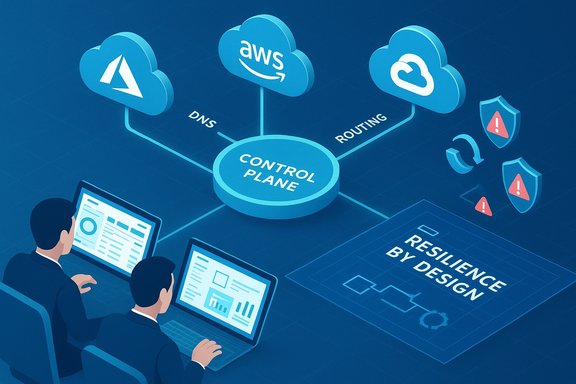
The practical response is neither to abandon hyperscale cloud nor to assume providers will prevent every rare mistake. Instead, adopt a pragmatic resilience posture that preserves the cloud’s value while deliberately engineering for the inevitability of outages: resilience by design, not fear.
Conclusion: the cloud will continue to power much of modern IT, but after October’s incidents the lesson is unambiguous — vendor dependence is a solvable risk only when organizations treat it as an engineering and procurement priority rather than an accidental byproduct of convenience.
Source: Red Hot Cyber AWS and Azure Disruption: Vendor Dependence Is a Serious Risk
 Background / Overview
The October 29 Microsoft incident began when an inadvertent configuration change in Azure Front Door (AFD), Microsoft’s global application delivery and edge routing fabric, propagated to points of presence and produced DNS and routing anomalies that prevented token issuance and broke portal access for many tenants. Microsoft’s remediation process involved halting configuration changes, rolling back to a last‑known‑good configuration, and rebalancing traffic — actions that restored service for most users after several hours.This interruption did not occur in isolation. Less than two weeks earlier, Amazon Web Services experienced a separate, high‑impact outage in its US‑EAST‑1 region tied to DNS/endpoint resolution problems affecting a widely used managed database endpoint. Both events shared a common structural theme: failures inside control‑plane primitives (DNS, global ingress/routing, identity) can manifest as widespread application outages even when origin compute is healthy.
Market concentration magnifies the stakes. Independent market trackers place AWS and Azure well ahead of competitors in public cloud infrastructure market share, with AWS often around the low‑30% band and Microsoft Azure in the low‑to‑mid‑20% range — a concentration that makes provider outages disproportionately consequential for global commerce and public services.
What happened — technical anatomy in plain language
Azure Front Door, DNS and the blast radius
Azure Front Door is more than a CDN; it is an edge control plane that handles TLS termination, routing, caching and often overlays identity flows used by Microsoft 365, Xbox, and other Microsoft services. When an invalid configuration was propagated through AFD’s control plane, it resulted in hostname misrouting, token issuance failures and timeouts at the edge. Those failures then cascaded into management consoles and consumer services that depended on the same routing and identity fabric. Microsoft’s mitigation sequence — freeze, rollback, reroute — is textbook containment but still required significant time for DNS caches and global routing state to converge.AWS DynamoDB DNS automation — a different bug, similar consequence
The AWS outage was technically distinct: it reportedly involved a race condition within DNS automation for a managed database endpoint (DynamoDB) in the US‑EAST‑1 region. The result was an empty or incorrect DNS answer for a widely used endpoint, which prevented SDKs and orchestration components from establishing connections and generated cascading service degradation across the region. The visible impacts were extended recovery times and broad downstream service failures.Why DNS and control planes matter
DNS, TLS termination and identity systems are the “glue” that connects millions of microservices, SDKs and client apps. When those glue layers fail, the failure is indistinguishable from a complete application outage to the end user — and it’s often much harder to mitigate, because the usual failover mechanisms assume the control plane itself is functional. Both October incidents underscore this architectural reality and why control‑plane safety must be a core design priority.Impact: who felt the pain
The outage affected a broad cross‑section of consumer and enterprise services. Reported or widely publicized impacts included airline check‑in and boarding systems, retail and food apps, content and gaming platforms, and administrative portals used by IT teams.- Airlines and travel operators reported website and check‑in disruptions.
- Retail chains and food‑service apps experienced intermittent checkout and order failures.
- Gaming ecosystems relying on Microsoft identity (Xbox Live, Minecraft) logged sign‑in failures and storefront issues.
- Windows and Azure administrators reported partial loss of portal blades and management operations, forcing use of programmatic or out‑of‑band controls.
Cross‑checked facts and technical validation
To ensure accuracy for readers making real operational decisions, the major technical claims above have been cross‑checked against multiple independent reconstructions and status timelines contained in industry post‑incident summaries and outage trackers. Key validations:- Microsoft acknowledged an Azure Front Door‑related configuration misstep and described rollback/rebalance remediation steps. Independent reconstructions and telemetry corroborate an AFD control‑plane propagation problem.
- AWS’s mid‑October outage involved DNS/endpoint resolution problems rooted in DynamoDB control‑plane automation; independent observability vendors logged the failure and recovery pattern.
- Market share figures from multiple industry trackers place AWS and Azure as the dominant cloud infrastructure providers — the concentration that explains the outsized ripple effects when either platform experiences a control‑plane failure. These market metrics are consistent across vendor analyses cited in post‑incident industry writeups.
Why this matters for Windows administrators and enterprise architects
The Azure and AWS incidents are not theoretical risk scenarios; they are operational reality checks for anyone responsible for uptime, compliance and business continuity.- Identity and management plane fragility: Many organizations put their admin consoles, user management, and automation behind the same edge fabrics that front their apps. When those fabrics fail, the usual “spin up a new server in another region” response can be impossible without a separate management path.
- DNS caching amplifies recovery time: Even after a rollback, DNS cache convergence and CDN edge state synchronization can keep user‑visible problems alive for minutes to hours. Low‑TTL strategies, where appropriate, can reduce this tail.
- Vendor concentration increases correlated risk: When a minority of providers host the majority of cloud infrastructure, failures at one provider correlate to systemic exposure for many enterprises. Procurement and architecture decisions must reflect that concentration.
Practical, prioritized resilience checklist (for immediate action)
Below are short, practical steps Windows admins and cloud architects can implement in weeks to months to reduce the blast radius of vendor outages.- Map your dependency graph now. Inventory every external dependency (identity providers, CDNs/AFDs, DNS providers, third‑party APIs) and classify by business criticality.
- Establish at least one out‑of‑band admin path. Maintain break‑glass credentials and programmatic service principals (CLI/PowerShell) that do not rely on the same public edge fabric as the portal. Test them monthly.
- Harden identity resilience. Cache critical tokens where possible, or implement federated fallback auth (secondary OAuth/OIDC provider) for essential control flows. Validate token issuance paths under failure scenarios.
- Add DNS failover playbooks. Where possible, use low TTLs for management records during critical maintenance windows and preconfigure failover records to alternate origins or a secondary CDN. Test failovers end‑to‑end.
- Implement multi‑path ingress for customer‑facing services. Adopt multi‑CDN / multi‑fabric routing for high‑impact endpoints; use traffic managers that can redirect to origin servers when an edge fabric is impaired.
- Rehearse portal loss and token failure scenarios. Tabletop exercises should include manual checkout flows, offline POS procedures, and scripted CLI runbooks. Practice recoveries until the playbooks are frictionless.
- Negotiate contractual clarity. Update SLAs and procurement terms to require timely post‑incident reports, tenant‑level telemetry, and explicit commitments around control‑plane change governance.
- Monitor external observability feeds. Integrate synthetic transactions from vendor‑independent vantage points to detect control‑plane impairments before internal dashboards indicate outages.
Architectural approaches that reduce vendor lock‑in without abandoning cloud benefits
- Use abstractions and anti‑corruption layers to decouple application logic from provider‑specific features. This reduces migration friction when a region or service is impaired.
- Adopt multi‑region writes for stateful stores where RTO/RPO requirements demand it. While more complex and more expensive, multi‑region replication reduces the chance that a single region control‑plane failure causes permanent data loss or ongoing downtime.
- Consider polyglot provider strategies for high‑risk primitives: use a specialized identity provider separate from your primary cloud, or a secondary CDN for critical checkout flows. These are targeted diversifications, not wholesale migration.
- Where regulatory or sovereignty concerns apply, evaluate regional or sovereign cloud options as complementary controls rather than full replacements — useful for critical public‑service workloads.
Governance, contracts and the policy angle
These outages are catalyzing conversations beyond architecture. Expect increased procurement scrutiny, insurer questions about correlated cloud losses, and regulatory interest in minimum resilience obligations for services that underpin public life.- Procurement teams should demand post‑incident forensic deliverables and timeline commitments in contracts for critical services.
- Insurers and risk modelers will push for measurable resilience investments as a condition of coverage; prepare to demonstrate tested failovers and dependency maps.
- Policymakers may push for incident transparency rules for cloud providers that host critical infrastructure, but regulatory choices must balance innovation and safety to avoid unintended fragmentation of global digital supply chains.
Strengths demonstrated — and why not to panic
It’s important to balance critique with recognition of the strengths evident in vendor responses.- Rapid containment and rollback capability was displayed; Microsoft and AWS used practiced incident playbooks to stop change propagation and restore service. These are nontrivial operational competencies at hyperscale.
- Mature global telemetry and public status reporting allowed customers to take rapid mitigation steps and communicate with end users. Real‑time status feeds are a practical advantage of hyperscalers.
- For many workloads, the cloud remains the only economically viable path to global scale, feature velocity, and AI capability; the cloud’s value proposition has not evaporated.
Risks and unresolved questions — what to watch for in vendor post‑incident reviews
While vendor initial statements and community reconstructions are informative, several items require independent verification and close reading of formal post‑incident reports.- The precise causal chain for the Azure configuration change: Was it human error, a flawed deployment pipeline, insufficient canarying, or an automated control‑plane regression? The answer affects the effectiveness of proposed mitigations. Treat early vendor narrations as preliminary until the full RCA is published.
- Exact counts of affected tenants and real economic losses. Public outage trackers are helpful signals but are not authoritative for contractual claims; preserved tenant logs and vendor telemetry will determine SLA outcomes.
- Whether vendor promises to harden rollout validation, canarying and change‑management will translate into structural controls that materially reduce blast radii for global changes. Look for concrete, deliverable engineering commitments in the PIRs.
A short, tactical action plan for the next 90 days
- Run a dependency inventory sprint and deliver a one‑page executive summary that maps critical services to control‑plane dependencies.
- Validate break‑glass admin paths and test emergency CLI/PowerShell accounts for all critical tenants. Document and rehearse the steps.
- Implement at least one synthetic transaction per critical customer journey from three independent geographic vantage points. Configure alerts that bypass vendor‑hosted dashboards.
- Conduct a tabletop where the portal is unavailable for four hours and identity tokens cannot be refreshed. Record lessons and update runbooks.
- Update procurement templates to require timely PIR delivery and tenant‑level telemetry for critical services.
Final assessment — resilience by design, not convenience
The October outages are a practical, live demonstration that convenience and scale are not substitutes for intentional resilience engineering. Hyperscalers deliver capabilities that are otherwise unattainable at scale — global CDN, identity fabrics, managed databases and AI accelerators — but those same capabilities concentrate systemic risk when control planes are not governed with the same rigor enterprises apply to their own mission‑critical systems.For Windows administrators, SREs and enterprise leaders, the immediate imperative is clear: treat the cloud’s control planes as first‑class failure domains. Map dependencies, harden DNS and identity fallbacks, test portal‑loss scenarios, demand transparency from vendors, and accept that resilience carries operational and financial cost — but so does being offline when customers, regulators or the public depend on your services.
The practical response is neither to abandon hyperscale cloud nor to assume providers will prevent every rare mistake. Instead, adopt a pragmatic resilience posture that preserves the cloud’s value while deliberately engineering for the inevitability of outages: resilience by design, not fear.
Conclusion: the cloud will continue to power much of modern IT, but after October’s incidents the lesson is unambiguous — vendor dependence is a solvable risk only when organizations treat it as an engineering and procurement priority rather than an accidental byproduct of convenience.
Source: Red Hot Cyber AWS and Azure Disruption: Vendor Dependence Is a Serious Risk
