

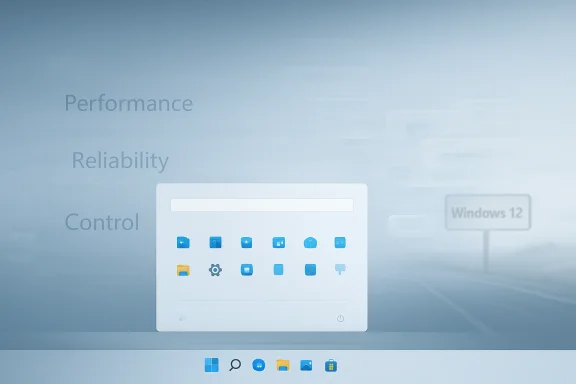
Microsoft is trying to do something unusually hard in 2026: make Windows 11 feel less like a moving target and more like a finished product. That matters because the operating system has spent years accumulating complaints about inconsistency, friction, bloat, and the sense that new features were arriving faster than the core experience could absorb them. At the same time, the company’s own messaging now suggests a shift toward performance, reliability, and control rather than spectacle, which is exactly the kind of change Windows users have been asking for. The open question is whether that kind of repair is enough to redeem Windows 11’s reputation, or whether Microsoft really does need a clean break with a new version.
Windows has been here before, and that history explains why the current debate feels so familiar. The platform has a long pattern of shipping a major release that is technically ambitious, socially unpopular, and eventually improved enough to become respectable. That was true of Windows Vista, which introduced important under-the-hood changes but landed badly because the hardware ecosystem was not ready and the experience felt heavy, intrusive, and uneven. It was also true of Windows 8, which brought foundational platform work but alienated users with a radically different interface and a sense that familiar desktop habits had been pushed aside.
The key lesson from those eras is not that Microsoft cannot improve a flawed product. It clearly can. The lesson is that reputation is sticky, and once users decide an OS is the “bad one,” no amount of patching always changes the emotional verdict. Vista eventually became genuinely good after service packs and stabilization, but most people moved on to Windows 7, which functioned as a symbolic reset as much as a product upgrade. Windows 8 followed the same script: Microsoft fixed many of the rough edges in Windows 8.1, but the market still treated Windows 10 as the real correction because it represented a fresh start. Those shifts mattered because users weren’t only buying features; they were buying permission to trust Windows again.
That historical pattern is exactly why some observers now argue that Microsoft may be wasting time trying to rehab Windows 11 instead of simply advancing to Windows 12. The argument is emotionally intuitive. If the current version has a bad reputation, then a new name can reset expectations, wash away some baggage, and create momentum with OEMs, enthusiasts, and enterprise buyers alike. The current forum material reflects that tension clearly: one thread argues that Microsoft is trying to turn Windows 11 into a more disciplined, quality-first platform, while another says the better strategy might be to label those improvements as a new release and start fresh.
But there is a crucial difference between today and those earlier transitions. Windows 11 is popular in a way Vista and Windows 8 never were. That makes the reset problem much more complicated. Microsoft has spent years consolidating users onto a single major version, and it has little incentive to fragment the ecosystem again if it can avoid it. A new version would mean another migration cycle, another round of hardware questions, and another period of uncertainty for enterprises that are already slow to move. The forum material explicitly points out that Microsoft is reluctant to disrupt that installed base, even if the branding logic of a new version is appealing.
There is also a broader strategic backdrop. Microsoft has spent the past several years using Windows 11 as the platform for AI, new shell experiments, and service-connected experiences. That makes the operating system more than a desktop release; it is now a distribution layer for Microsoft’s larger product ambitions. The trouble is that many users don’t experience that as innovation. They experience it as noise. Recent forum coverage captures that frustration well: users want fewer Copilot intrusions, better update behavior, faster File Explorer performance, and more flexibility in core shell behavior. That is not a demand for gimmicks. It is a demand for Windows to stop getting in the way.
The current debate, then, is less about whether Microsoft can improve Windows 11 and more about whether improvement alone is enough. That distinction matters. A technically better product is not always a politically better one. In operating systems, brand psychology can be as important as code quality, and that is why the Windows 12 conversation keeps resurfacing even when Microsoft appears committed to keeping Windows 11 alive.
The problem got worse as Microsoft layered Copilot and AI surfaces into more corners of the shell. Instead of feeling like optional enhancements, those features often appeared as if they were being forced into workflows that didn’t need them. The result was a strange paradox: Windows 11 was becoming more capable while also becoming more irritating. That contradiction appears throughout the forum material and is probably the most important reason the product’s reputation has remained fragile.
The company’s wording around trust is especially revealing. Once users begin to believe the OS is working against them, even small changes become suspect. That is why update behavior, default app surfacing, and shell consistency matter so much. They are not glamorous issues, but they directly shape the everyday relationship between user and system. Windows regains credibility when it starts behaving predictably again.
Microsoft’s recent Insider-facing work also suggests that this is not just a PR cleanup. The discussion around taskbar behavior, File Explorer reliability, Bluetooth stability, and servicing improvements implies that the company is making concrete changes in the places people actually notice. That is encouraging because Windows trust is rebuilt in increments, not in slogans. A press release can’t fix a reputation; a year of fewer annoyances can.
That shift should not be dismissed as cosmetic. In desktop software, restraint can be more valuable than novelty. If Microsoft can make Windows 11 feel lighter, quieter, and more respectful, it may recover more goodwill than it would by launching yet another version number. Still, the caveat is obvious: people only believe quality promises after they see repeated evidence of them. Words are cheap; stable daily use is expensive.
That dynamic is still relevant now. If Microsoft shipped a new major version with better defaults, stronger control, cleaner update behavior, and a calmer AI footprint, many users would probably be more willing to give it the benefit of the doubt than they are giving Windows 11. A fresh release can also help enterprise messaging because it gives IT departments a new planning horizon, a new lifecycle chart, and a new excuse to reset internal migration strategy. In other words, the name is not just branding; it is governance.
There is also a strategic reason to stay the course. Microsoft wants Windows to be the stable foundation beneath AI features, not a constantly resetting platform that forces every new idea to fight for adoption. A new version could help perception, but it could also slow execution. If the company believes it can rehabilitate Windows 11 quietly over time, that may be the better business choice even if it is the weaker headline. Not every real improvement needs a new box on the shelf.
The forum material suggests Microsoft is now trying to reverse that impression by making Copilot more intentional and less aggressive. That is a good sign, but it also reveals the scale of the earlier mistake. The company had to learn, apparently the hard way, that ubiquity is not the same thing as utility. Users are more tolerant of AI when it appears as an option than when it appears as an assumption.
The competitive angle is straightforward. If Microsoft gets this right, it can make Copilot feel like an advantage instead of a nuisance. If it gets it wrong, users will keep reaching for third-party tools, disabling features, or simply ignoring Microsoft’s additions. In a market as mature as desktop operating systems, attention is scarce and irritation is expensive. That is why the AI question is really a usability question in disguise.
Consumers are more flexible in one sense, but they are also more opinionated. They are willing to move faster if the new release feels exciting, elegant, or obviously better. That is why Windows 7 and Windows 10 mattered so much after their predecessors. They didn’t just arrive with fixes; they arrived with a new social contract. Users felt they were being asked to trust a different product, not merely a better patch set.
That tension is why a broad Windows 12 launch is not just a software decision. It is a channel strategy, a hardware strategy, and an enterprise migration strategy all at once. If Microsoft wants a new version to succeed, it needs a reason that is bigger than “this one has better AI.” It needs a reason that makes both IT departments and ordinary users feel that the transition is worth the pain. That is a very high bar.
The opportunity is to make Windows feel more mature, not more ambitious. That means fewer surprises, more consistent design, more controllable updates, and better performance on ordinary hardware. If Microsoft can deliver those gains in a way users can feel within days, not months, it may win back more credibility than a rushed Windows 12 launch could.
There is also a danger that Microsoft could fix the wrong layer. Better visuals, cleaner positioning, and more polished messaging will not matter if the shell still feels intrusive, if updates still disrupt, or if AI continues to show up where it is not needed. In other words, the company has to fix the everyday experience, not just the headline features. That is harder, slower work.
A Windows 12 launch could still happen someday, but the more interesting question is whether Microsoft can earn one. New version numbers are only powerful when they symbolize a real shift. If the company ever decides to move on, it will need more than a fresh label; it will need a believable promise that the next Windows is not just different, but better in the ways users actually live with every day.
What to watch next:
Source: Windows Central Is Microsoft wasting its time trying to fix Windows 11? Maybe it's time for Windows 12
 Background
Windows has been here before, and that history explains why the current debate feels so familiar. The platform has a long pattern of shipping a major release that is technically ambitious, socially unpopular, and eventually improved enough to become respectable. That was true of Windows Vista, which introduced important under-the-hood changes but landed badly because the hardware ecosystem was not ready and the experience felt heavy, intrusive, and uneven. It was also true of Windows 8, which brought foundational platform work but alienated users with a radically different interface and a sense that familiar desktop habits had been pushed aside.The key lesson from those eras is not that Microsoft cannot improve a flawed product. It clearly can. The lesson is that reputation is sticky, and once users decide an OS is the “bad one,” no amount of patching always changes the emotional verdict. Vista eventually became genuinely good after service packs and stabilization, but most people moved on to Windows 7, which functioned as a symbolic reset as much as a product upgrade. Windows 8 followed the same script: Microsoft fixed many of the rough edges in Windows 8.1, but the market still treated Windows 10 as the real correction because it represented a fresh start. Those shifts mattered because users weren’t only buying features; they were buying permission to trust Windows again.
That historical pattern is exactly why some observers now argue that Microsoft may be wasting time trying to rehab Windows 11 instead of simply advancing to Windows 12. The argument is emotionally intuitive. If the current version has a bad reputation, then a new name can reset expectations, wash away some baggage, and create momentum with OEMs, enthusiasts, and enterprise buyers alike. The current forum material reflects that tension clearly: one thread argues that Microsoft is trying to turn Windows 11 into a more disciplined, quality-first platform, while another says the better strategy might be to label those improvements as a new release and start fresh.
But there is a crucial difference between today and those earlier transitions. Windows 11 is popular in a way Vista and Windows 8 never were. That makes the reset problem much more complicated. Microsoft has spent years consolidating users onto a single major version, and it has little incentive to fragment the ecosystem again if it can avoid it. A new version would mean another migration cycle, another round of hardware questions, and another period of uncertainty for enterprises that are already slow to move. The forum material explicitly points out that Microsoft is reluctant to disrupt that installed base, even if the branding logic of a new version is appealing.
There is also a broader strategic backdrop. Microsoft has spent the past several years using Windows 11 as the platform for AI, new shell experiments, and service-connected experiences. That makes the operating system more than a desktop release; it is now a distribution layer for Microsoft’s larger product ambitions. The trouble is that many users don’t experience that as innovation. They experience it as noise. Recent forum coverage captures that frustration well: users want fewer Copilot intrusions, better update behavior, faster File Explorer performance, and more flexibility in core shell behavior. That is not a demand for gimmicks. It is a demand for Windows to stop getting in the way.
The current debate, then, is less about whether Microsoft can improve Windows 11 and more about whether improvement alone is enough. That distinction matters. A technically better product is not always a politically better one. In operating systems, brand psychology can be as important as code quality, and that is why the Windows 12 conversation keeps resurfacing even when Microsoft appears committed to keeping Windows 11 alive.
Why Windows 11 Got Here
Windows 11 was launched as a cleaner, more modern platform, but many users read it as a reduction in control. The centered Start menu, the constrained taskbar, the trimmed shell customization, and the more opinionated default surfaces made the OS feel polished on the surface but less accommodating underneath. For some people, that was a reasonable trade-off. For power users, it was a sign that Microsoft had mistaken simplification for improvement. The forum material repeatedly frames that tension as a central source of resentment.The UI Problem Was Never Just Cosmetic
A lot of the anger around Windows 11 was never about aesthetics alone. It was about agency. If a user cannot easily move the taskbar, trim recommendations, or avoid unwanted prompts, the OS begins to feel possessive rather than helpful. That sensation is hard to quantify, but it is one of the strongest predictors of whether a desktop platform earns long-term loyalty. Microsoft’s recent willingness to revisit those decisions suggests it understands that the design argument was never just about style. It was about how much the system trusts the person using it.The problem got worse as Microsoft layered Copilot and AI surfaces into more corners of the shell. Instead of feeling like optional enhancements, those features often appeared as if they were being forced into workflows that didn’t need them. The result was a strange paradox: Windows 11 was becoming more capable while also becoming more irritating. That contradiction appears throughout the forum material and is probably the most important reason the product’s reputation has remained fragile.
- Users want control before they want novelty.
- Visual polish does not offset workflow friction.
- AI features only land well when they feel relevant, not omnipresent.
- The desktop still needs to behave like a tool, not a campaign.
- Customization is part of trust, not a luxury.
Microsoft’s Quality Reset
The most interesting thing about Microsoft’s current messaging is that it reads like an admission that the old formula was not enough. The company is now emphasizing performance, reliability, and a calmer experience in Windows 11, which suggests it understands that the OS has been losing points on the basics. In the forum discussion, this is framed as a shift from feature churn to product discipline, with Microsoft trying to make Windows feel more deliberate and less chaotic.From Feature Churn to Product Discipline
That pivot matters because Windows users are not asking for less ambition. They are asking for better sequencing. Microsoft can keep pursuing AI, touch support, and cloud-connected experiences, but it has to stop doing so in a way that makes the core desktop feel unstable or crowded. The best reading of the current roadmap is that Microsoft is trying to restore the idea that quality is not a side effect of innovation; it is the precondition for it.The company’s wording around trust is especially revealing. Once users begin to believe the OS is working against them, even small changes become suspect. That is why update behavior, default app surfacing, and shell consistency matter so much. They are not glamorous issues, but they directly shape the everyday relationship between user and system. Windows regains credibility when it starts behaving predictably again.
Microsoft’s recent Insider-facing work also suggests that this is not just a PR cleanup. The discussion around taskbar behavior, File Explorer reliability, Bluetooth stability, and servicing improvements implies that the company is making concrete changes in the places people actually notice. That is encouraging because Windows trust is rebuilt in increments, not in slogans. A press release can’t fix a reputation; a year of fewer annoyances can.
What Microsoft Is Trying to Signal
The messaging also has a political dimension. By making quality the headline, Microsoft is signaling that it heard the criticism that Windows 11 became too busy, too promotional, and too willing to interrupt. This is especially important after a period in which Copilot seemed to appear everywhere, whether the user wanted it or not. The latest forum material suggests Microsoft is now trying to make those experiences feel more selective and less intrusive.That shift should not be dismissed as cosmetic. In desktop software, restraint can be more valuable than novelty. If Microsoft can make Windows 11 feel lighter, quieter, and more respectful, it may recover more goodwill than it would by launching yet another version number. Still, the caveat is obvious: people only believe quality promises after they see repeated evidence of them. Words are cheap; stable daily use is expensive.
- Reliability is now part of the brand, not a back-end concern.
- Less noise may matter more than more features.
- Insider builds are becoming a trust laboratory.
- Performance improvements must show up on ordinary hardware, not just demos.
- The quality reset only works if it reaches the stable channel intact.
The Windows 12 Argument
The case for Windows 12 is not irrational. In fact, it is probably the cleanest marketing answer to Windows 11’s reputation problem. A new version number provides a reset button, a story OEMs can sell, and a way for Microsoft to say that the future is not just a patched-up continuation of the past. The forum material captures that instinct well: if the company is already reworking the platform’s feel, why not package the improvements as a new era instead of as repairs to an old one?Why a New Name Matters
Operating systems are not judged purely on technical merit. They are judged on memory. A bad version can remain psychologically “bad” long after the bugs are gone, because users remember the frustration, not the patch notes. That is why Windows 7 was so powerful after Vista and why Windows 10 was so important after Windows 8. The name change itself created emotional distance. It allowed people to say, this is the corrected one.That dynamic is still relevant now. If Microsoft shipped a new major version with better defaults, stronger control, cleaner update behavior, and a calmer AI footprint, many users would probably be more willing to give it the benefit of the doubt than they are giving Windows 11. A fresh release can also help enterprise messaging because it gives IT departments a new planning horizon, a new lifecycle chart, and a new excuse to reset internal migration strategy. In other words, the name is not just branding; it is governance.
Why Microsoft Probably Won’t Do It Soon
The counterargument is stronger in practical terms. Windows 11 is already the dominant version in the market, and Microsoft has spent years getting users there. A Windows 12 launch would restart the exact fragmentation problem the company has been trying to avoid. It would also create confusion around support, hardware eligibility, and feature tiers at a time when Microsoft is already balancing consumer PCs, Copilot+ branding, and enterprise compatibility.There is also a strategic reason to stay the course. Microsoft wants Windows to be the stable foundation beneath AI features, not a constantly resetting platform that forces every new idea to fight for adoption. A new version could help perception, but it could also slow execution. If the company believes it can rehabilitate Windows 11 quietly over time, that may be the better business choice even if it is the weaker headline. Not every real improvement needs a new box on the shelf.
- Windows 12 would offer a clean narrative reset.
- It would also create new migration overhead.
- OEM partners love fresh launches, but enterprises hate churn.
- Microsoft’s current strategy favors continuity over spectacle.
- A new version might improve perception faster than code changes alone, but it would not remove the underlying product challenge.
AI, Copilot, and the Identity Problem
One of the reasons Windows 11 has become such a lightning rod is that its identity has shifted under users’ feet. For Microsoft, the OS is now a platform for AI-native experiences. For many users, it is still just the desktop they want to use without friction. Those two ideas are not incompatible, but Microsoft has often presented them as if the only path forward was to make AI impossible to miss. That approach has drawn a predictable backlash.When AI Feels Like Overreach
The problem is not AI in principle. It is placement. Snipping Tool, Notepad, Photos, Widgets, and other inbox apps have traditional jobs that do not automatically benefit from a Copilot prompt. When Microsoft inserts AI everywhere, it risks turning practical tools into showcases. That creates a perception that Windows is less about helping the user and more about advertising Microsoft’s broader ambitions.The forum material suggests Microsoft is now trying to reverse that impression by making Copilot more intentional and less aggressive. That is a good sign, but it also reveals the scale of the earlier mistake. The company had to learn, apparently the hard way, that ubiquity is not the same thing as utility. Users are more tolerant of AI when it appears as an option than when it appears as an assumption.
The Copilot Recalibration
If Microsoft really is dialing back some of the most visible Copilot entry points, that will be one of the most consequential product corrections of the Windows 11 era. It would not mean abandoning AI. It would mean treating AI as a feature tier rather than a wallpaper layer. That distinction is important because it lets Windows remain modern without becoming exhausting.The competitive angle is straightforward. If Microsoft gets this right, it can make Copilot feel like an advantage instead of a nuisance. If it gets it wrong, users will keep reaching for third-party tools, disabling features, or simply ignoring Microsoft’s additions. In a market as mature as desktop operating systems, attention is scarce and irritation is expensive. That is why the AI question is really a usability question in disguise.
- AI works best when it is contextual.
- Users reject AI that feels intrusive.
- Microsoft needs to separate feature value from product placement.
- Copilot must feel optional to feel credible.
- The OS should support AI, not constantly perform it.
Enterprise vs. Consumer Reality
The Windows 12 versus Windows 11 debate looks different depending on who is actually paying the bills. Consumers often react to reputation, aesthetics, and annoyance levels. Enterprises care far more about lifecycle stability, compatibility, deployment planning, and the cost of change. Microsoft has to satisfy both groups, and that makes the argument for a new version more complicated than it sounds in a forum thread.Why Enterprises Prefer Continuity
Businesses generally dislike forced migration cycles unless there is a compelling security or compliance reason to move. A new Windows version means more testing, more validation, more help-desk strain, and often more hardware churn. If Microsoft launched Windows 12 too quickly, many IT teams would simply delay adoption and wait for the new platform to mature. That would weaken the very reset effect that a new name is supposed to create.Consumers are more flexible in one sense, but they are also more opinionated. They are willing to move faster if the new release feels exciting, elegant, or obviously better. That is why Windows 7 and Windows 10 mattered so much after their predecessors. They didn’t just arrive with fixes; they arrived with a new social contract. Users felt they were being asked to trust a different product, not merely a better patch set.
The Hardware Layer Complicates Everything
Microsoft’s current AI ambitions also complicate any Windows 12 story because they intersect with hardware gating. Copilot+ devices, NPU requirements, and tiered AI experiences all make sense as part of a platform strategy, but they also create the impression that future Windows innovation may depend on new machines. That is fine for OEMs and premium buyers. It is less appealing for the huge installed base of normal PCs that will remain in service for years.That tension is why a broad Windows 12 launch is not just a software decision. It is a channel strategy, a hardware strategy, and an enterprise migration strategy all at once. If Microsoft wants a new version to succeed, it needs a reason that is bigger than “this one has better AI.” It needs a reason that makes both IT departments and ordinary users feel that the transition is worth the pain. That is a very high bar.
- Enterprises optimize for predictability.
- Consumers optimize for perceived improvement.
- Hardware gating can boost premium positioning but hurt broad adoption.
- A new Windows release requires ecosystem alignment, not just code.
- Compatibility remains the silent gatekeeper of every major Windows move.
Strengths and Opportunities
Microsoft actually has a lot working in its favor if it can execute the current reset well. The company owns the platform, the distribution channel, the productivity stack, and a huge portion of the enterprise workflow fabric. That gives it room to repair Windows 11 without asking users to think about the OS as a destination in itself. If the improvements are real, many people will simply accept them and move on.The opportunity is to make Windows feel more mature, not more ambitious. That means fewer surprises, more consistent design, more controllable updates, and better performance on ordinary hardware. If Microsoft can deliver those gains in a way users can feel within days, not months, it may win back more credibility than a rushed Windows 12 launch could.
- Huge installed base gives Microsoft room to improve without forcing a reset.
- Windows Insider feedback can catch rough edges before broad release.
- Quality-first messaging aligns with user frustration.
- AI restraint could improve Copilot adoption by reducing backlash.
- Enterprise continuity favors iterative repair over abrupt version changes.
- Hardware ecosystem breadth means Windows 11 can keep serving both old and new PCs.
- Trust repair is possible if Microsoft sustains the effort across multiple releases.
Risks and Concerns
The biggest risk is that Microsoft’s quality push becomes another round of promises without enough visible payoff. Windows users are not short on memory, and they are highly sensitive to the gap between what Microsoft says and what the OS does. If the company improves some things but leaves the same friction points intact, the narrative will harden again very quickly.There is also a danger that Microsoft could fix the wrong layer. Better visuals, cleaner positioning, and more polished messaging will not matter if the shell still feels intrusive, if updates still disrupt, or if AI continues to show up where it is not needed. In other words, the company has to fix the everyday experience, not just the headline features. That is harder, slower work.
- Users may see quality messaging as delay rather than progress.
- Microsoft could overcorrect by making Windows bland instead of calm.
- AI restraint might come too late to repair earlier annoyance.
- A Windows 12 pivot could fragment the ecosystem again.
- Enterprises may resist a new version if the business case is weak.
- Consumers may still associate Windows 11 with its original frustrations.
- Third-party utilities will continue to fill gaps if Microsoft’s changes are incomplete.
Looking Ahead
The next phase of Windows will probably not be decided by a single launch. It will be decided by whether Microsoft can make the operating system feel steadier over time. If the company keeps reducing friction, improving responsiveness, and backing away from unnecessary AI clutter, Windows 11 may gradually acquire the reputation it should have had from the start: modern, capable, and mostly out of the way.A Windows 12 launch could still happen someday, but the more interesting question is whether Microsoft can earn one. New version numbers are only powerful when they symbolize a real shift. If the company ever decides to move on, it will need more than a fresh label; it will need a believable promise that the next Windows is not just different, but better in the ways users actually live with every day.
What to watch next:
- Whether Microsoft continues reducing Copilot entry points in inbox apps.
- Whether taskbar, Start menu, and update behavior keep becoming more user-controlled.
- Whether File Explorer and shell performance improvements are noticeable on mainstream hardware.
- Whether the quality push reaches stable builds without being softened by new feature creep.
- Whether Microsoft starts talking about Windows in terms of trust, not just AI.
Source: Windows Central Is Microsoft wasting its time trying to fix Windows 11? Maybe it's time for Windows 12
Last edited:
