

Microsoft’s latest push to frame Windows 10 and Surface as not just one-off purchases but as ongoing experiences reached two clear touchpoints: a set of tightly produced promotional videos that put Windows 10, the Surface Book, and the Surface Pro 4 in everyday workflows, and a formal announcement that Microsoft will offer subscription-style options for Windows 10 Enterprise and Surface hardware aimed squarely at businesses.
Microsoft’s Surface hardware and Windows 10 have moved from early-adopter curiosities to cornerstone offerings in the company’s device-and-services strategy. The Surface Book and Surface Pro 4—launched in the product wave that followed Windows 10’s debut—are most often positioned as examples of how hardware and software together can change workflows for creators and knowledge workers. Early marketing, retail launches, and broadcast-quality B-roll emphasized the devices’ design and creative capabilities, while later advertising and short documentary-style videos foregrounded real-world customer stories and platform features like Windows Ink, Cortana, and Windows Hello. Alongside those product narratives, Microsoft has quietly and steadily moved to offer subscription and managed-service alternatives to traditional license-and-buy models. For businesses, Microsoft announced a Cloud Solution Provider (CSP) route for Windows 10 Enterprise E3 and a “Surface as a Service” option that enables partners to lease devices and bundle them with Office 365, device management, and other services. The move reflects a broader industry trend: migrating capital expenditures into predictable operational costs while offering partners opportunities to provide managed services.
The videos also surface Microsoft’s strengths in hardware storytelling: Surface’s design cues, hinge mechanics, and pen interactions make for strong visual material, and Microsoft consistently highlights these attributes to separate Surface from commodity PC designs. That visual storytelling helps partners sell a premium, managed experience rather than a lowest-price commodity.
However, the value of these offerings depends heavily on partner execution, regional availability, and the rigor of procurement teams in modeling true lifecycle costs. The $7/user/month headline for Windows 10 Enterprise E3 is real, but it is only one line item in a broader procurement choice. Surface as a Service promises operational simplicity and frequent refreshes, but organizations should negotiate the details—support SLAs, data-handling, and exit costs—before trading traditional ownership for a managed subscription.
Ultimately, Microsoft’s moves here underscore a larger truth in enterprise IT: software and hardware are increasingly sold as bundled experiences, and partners who can deliver predictable, secure, and well-documented managed services will find strong demand from organizations looking to reduce complexity and shift to predictable operational spending. The promotional videos make the use cases visible; the subscription programs make them actionable—provided procurement, IT, and partner together shape the contracts to match organizational needs.
Source: BetaNews https://betanews.com/article/micros...rosoft-windows-10-and-surface-subscriptions/]
 Background
Microsoft’s Surface hardware and Windows 10 have moved from early-adopter curiosities to cornerstone offerings in the company’s device-and-services strategy. The Surface Book and Surface Pro 4—launched in the product wave that followed Windows 10’s debut—are most often positioned as examples of how hardware and software together can change workflows for creators and knowledge workers. Early marketing, retail launches, and broadcast-quality B-roll emphasized the devices’ design and creative capabilities, while later advertising and short documentary-style videos foregrounded real-world customer stories and platform features like Windows Ink, Cortana, and Windows Hello. Alongside those product narratives, Microsoft has quietly and steadily moved to offer subscription and managed-service alternatives to traditional license-and-buy models. For businesses, Microsoft announced a Cloud Solution Provider (CSP) route for Windows 10 Enterprise E3 and a “Surface as a Service” option that enables partners to lease devices and bundle them with Office 365, device management, and other services. The move reflects a broader industry trend: migrating capital expenditures into predictable operational costs while offering partners opportunities to provide managed services. What Microsoft released (the facts)
New videos: storytelling, feature highlights, product placement
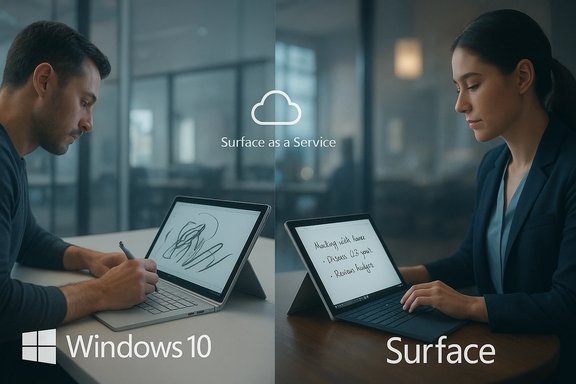
Microsoft published a collection of short videos that pair Windows 10 features and Surface hardware with human stories: creators, entrepreneurs, parents, and niche professionals. The films are short, polished, and designed for social sharing and embedded playback on news sites and retail pages. They highlight:- Windows Ink: inking, sketching, and annotation scenarios that show pen-to-screen workflows.
- Cortana: voice-assist scenarios for everyday tasks and reminders.
- Windows Hello: biometric sign-in for convenience and security.
- Surface Book / Surface Pro 4: real-world tasks mapped to device form factors—architects sketching, forensic artists using touch and pen, and portable productivity for nontraditional office settings.
Subscription moves: Windows 10 Enterprise E3 (CSP) and Surface as a Service
Microsoft confirmed two subscription-style offerings for businesses:- Windows 10 Enterprise E3 via CSP: A partner-delivered cloud subscription for Windows 10 Enterprise functionality, priced at approximately $7 per user per month (or roughly $84/year), available through Cloud Solution Providers. This plan packages enterprise security and management capabilities—such as Device Guard and Credential Guard—into a partner-managed subscription.
- Surface as a Service (SaaS for hardware): A managed leasing and refresh program that allows Cloud Solution Providers (who are also Surface Authorized Distributors) to deliver Surface devices as part of a managed offering alongside Office 365 and Windows 10. Microsoft noted the initial launch partner (ALSO in Europe) and signaled an intent to expand the program; it also named enterprise partners such as IBM and Booz Allen Hamilton to provide verticalized services and systems integration.
Why this matters: strategic and market implications
From product to platform-plus-service
Microsoft’s strategy has shifted away from one-off hardware or boxed OS sales toward integrated device-plus-service bundles. There are three strategic reasons for that:- Predictable revenue: Subscriptions convert large one-time revenues into recurring income, which is easier to forecast and monetize over time.
- Partner enablement: CSP and managed-service channels let Microsoft lean on partners to deliver, service, and customize sales models—critically important for enterprise procurement and deployments.
- Lifecycle control: Leasing hardware (Surface as a Service) shortens device refresh cycles and ensures customers run supported hardware and software combinations, simplifying management and security postures.
Marketing meets engineering: product stories that sell workflows
The video campaign isn’t just advertising; it serves a product-led-sales purpose. By showing the Surface Book and Surface Pro 4 in real workflows, Microsoft is selling how Windows 10 features (Ink, Hello, Cortana) solve real problems. That narrative matters for buyers evaluating Total Cost of Ownership (TCO) and productivity gains—not just raw specs. The creative emphasis on pen input, detachable displays, and mobile productivity supports Surface’s premium pricing and helps justify managed-service bundles where the hardware and software are treated as a packaged utility.Technical and commercial verification (what was checked)
Microsoft’s announcements and the reporting around them included specific, verifiable claims; these were cross-checked against multiple independent sources:- The Windows 10 Enterprise E3 through CSP and the $7/user/month pricing were documented in Microsoft’s Windows experience blog and confirmed by independent channel coverage. The $7/month figure appears consistently across Microsoft’s partner announcements and reporting by Redmond-focused channels and trade press.
- The Surface as a Service program, including partner names (ALSO, IBM, Booz Allen Hamilton) and the program’s initial focus on CSP partners, appears in Microsoft’s official communications and was covered by TechCrunch and other technology outlets at the time. Those independent outlets described Surface as a Service as a managed leasing model that bundled Windows and Office 365 options with refresh and servicing terms.
- The consumer-facing video campaign and retail / B-roll footage were published by Microsoft and surfaced on news sites, which linked to Microsoft-hosted videos and YouTube playback clips. The promotional content is archival and remains viewable in Microsoft’s press material and across platform embeds.
Strengths: what Microsoft does well here
- Integrated narrative: Microsoft links product storytelling (videos about Surface and Windows 10 features) to a commercial model that makes it easier for partners to sell integrated solutions. The result is coherent messaging across marketing and partner channels.
- Partner-centric execution: By routing Windows 10 subscriptions and Surface leasing through CSPs and Surface Authorized Distributors, Microsoft leverages partner relationships rather than competing with them. The decision reduces friction for enterprise purchasing and positions partners to offer services on top of Microsoft’s core commodities.
- Lowered entry barriers for SMBs: The $7/user/month pricing for Windows 10 Enterprise E3 via CSP makes advanced security and management capabilities accessible to smaller organizations without volume licensing agreements. That creates a route for firms of all sizes to adopt enterprise-grade controls.
- Device lifecycle control: Surface as a Service addresses IT pain points—capital budgets, device refresh cycles, support burden—by offering refresh and managed services. This can reduce shadow-IT and fragmentation.
Risks and caveats: what procurement and IT teams should watch
- Not a consumer play: Microsoft’s subscription offerings were explicitly targeted to businesses. Consumers and typical individual buyers should not expect Windows 10 or Surface leasing to be broadly available through the same channels or at the same price points. Confusion between consumer marketing and partner offerings could create mismatched expectations if not clarified during procurement.
- Partner variability: The value of CSP-delivered Windows and Surface leasing depends heavily on the partner. SLA quality, support responsiveness, device replacement terms, and pricing may vary. Procurement teams must evaluate partner contracts, not just Microsoft’s headline claims.
- Region- and partner-dependent availability: Early rollouts of Surface as a Service were limited to certain partners and regions. Global enterprises should verify local availability and compliance with local procurement rules before relying on a leasing program. Microsoft’s announcements announced pilots and initial partners rather than guaranteeing global parity on day one.
- Lock-in perceptions: Bundled subscription models can increase vendor lock-in. While predictable OPEX is attractive, organizations should weigh the ability to switch hardware or adjust software stacks against the convenience of an integrated managed offering. Contracts should include clear exit terms and data/asset-handling procedures.
- Cost modeling complexity: The $7/user/month pricing for Windows 10 Enterprise E3 sounds straightforward, but total costs must include partner margins, device lease fees, management overhead, and potential currency- and region-linked charges. A simple per-seat comparison to perpetual licensing may miss hidden costs or benefits (e.g., included support services, hardware refresh cadence).
Practical guidance for IT buyers and decision-makers
- Evaluate use cases first, procurement model second.
- Confirm whether the organization truly benefits from an OPEX model (predictable cash flow, faster device refresh) versus CAPEX (one-off purchase, asset ownership).
- Treat partner selection as central to the deal.
- Assess CSPs and leasing partners for SLAs, logistics, security certifications, and vertical experience (e.g., government, healthcare).
- Confirm regional availability and legal/compliance fit.
- Some Surface as a Service pilot partners and terms vary by geography—confirm local partner coverage and contractual compliance before committing.
- Build a TCO comparison with realistic assumptions.
- Include device lease costs, Windows 10 subscription fees, expected refresh cycles, management overhead, and potential trade-in or buyout clauses.
- Negotiate clear exit and data-handling terms.
- Ensure contract language covers device return, data wiping, and replacement timelines in case of service disputes or corporate reorgs.
What the videos reveal about Microsoft’s positioning
Microsoft’s short-form videos are more than PR: they are a statement about what the company believes matters in modern work—fluidity between pen, touch, and keyboard; secure yet frictionless login; and context-aware assistant features. Those pieces of the narrative are intended to support enterprise sales conversations: if a Surface device demonstrably increases worker productivity, then a partner can justify a subscription or leasing model that spreads cost and bundles management.The videos also surface Microsoft’s strengths in hardware storytelling: Surface’s design cues, hinge mechanics, and pen interactions make for strong visual material, and Microsoft consistently highlights these attributes to separate Surface from commodity PC designs. That visual storytelling helps partners sell a premium, managed experience rather than a lowest-price commodity.
Critical perspective: what’s missing or underemphasized
- Detailed pricing scenarios: Public communications emphasized headline pricing ($7/user/month for Windows E3) but did not deeply model blended scenarios including device lease fees, partner service margins, or volume discounts. For organizations that must justify spend to finance departments, more transparent TCO examples would have been helpful.
- Consumer pathway: Microsoft was careful to say these subscription models are for businesses, which leaves ambiguous whether consumers would ever see an equivalent managed lease for personal Surface ownership. Consumer demand exists (leasing, buy-now-pay-later), but Microsoft’s messaging kept the consumer market out of scope. That omission is understandable but means the program—if successful—may create demand that partners can’t serve for individual buyers.
- Interoperability guarantees: Bundling hardware, Windows, and Office is compelling but raises questions about interoperability with third-party device-management platforms. Enterprises with existing SCCM, Intune, or third-party MDM investments need clear guidance on integration and co-management. Microsoft’s partner messaging has historically emphasized co-management, but product teams must continue to publish clear technical how-tos.
Conclusion — where this leaves the market
Microsoft’s simultaneous storytelling and commercial maneuvers—promotional videos that show Windows 10 and Surface hardware in realistic workflows, plus partner-oriented subscription and managed-device programs—represent a pragmatic evolution of its go-to-market approach. For businesses, the change offers easier paths to enterprise-grade security and device refreshes on an operational budget, delivered by partners who can layer industry services on top.However, the value of these offerings depends heavily on partner execution, regional availability, and the rigor of procurement teams in modeling true lifecycle costs. The $7/user/month headline for Windows 10 Enterprise E3 is real, but it is only one line item in a broader procurement choice. Surface as a Service promises operational simplicity and frequent refreshes, but organizations should negotiate the details—support SLAs, data-handling, and exit costs—before trading traditional ownership for a managed subscription.
Ultimately, Microsoft’s moves here underscore a larger truth in enterprise IT: software and hardware are increasingly sold as bundled experiences, and partners who can deliver predictable, secure, and well-documented managed services will find strong demand from organizations looking to reduce complexity and shift to predictable operational spending. The promotional videos make the use cases visible; the subscription programs make them actionable—provided procurement, IT, and partner together shape the contracts to match organizational needs.
Source: BetaNews https://betanews.com/article/micros...rosoft-windows-10-and-surface-subscriptions/]
