

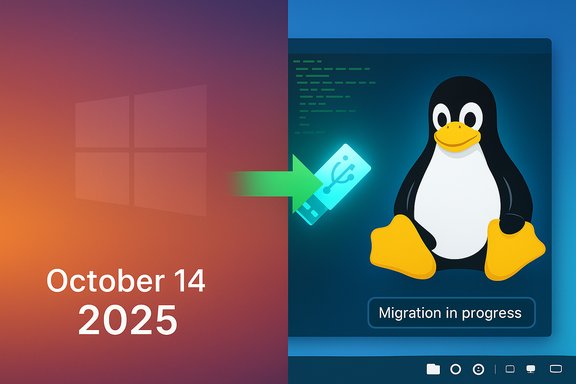
The end of support for Windows 10 has produced one of the clearest real‑world inflection points the desktop market has seen in years: faced with an October 14, 2025 cutoff for free security updates and a Windows 11 upgrade path gated by TPM, Secure Boot and newer CPUs, a measurable wave of users — from budget‑conscious households to hobbyist gamers — are testing and in many cases switching to Linux distributions rather than buying new hardware or paying for temporary Extended Security Updates.
Microsoft’s lifecycle calendar set a firm deadline: mainstream support for Windows 10 ended on October 14, 2025. After that date, typical Home and Pro installations stopped receiving routine feature and security updates unless devices were enrolled in Microsoft’s Extended Security Updates (ESU) program. That operational reality forced a large installed base to make a practical choice — upgrade to Windows 11 where possible, pay for ESU as a short bridge, refresh hardware, or migrate to an alternate, actively maintained operating system.
Windows 11’s minimum requirements (notably TPM 2.0, UEFI Secure Boot and a list of supported CPU families) mean that a significant share of still‑useful PCs cannot be upgraded in a vendor‑supported way without firmware changes or hardware replacement. For many users the calculus has been straightforward: either accept the ongoing cost of remaining in Microsoft’s upgrade cycle or adopt a different route that keeps the machine secure and usable.
At the same time, multiple community trackers, distro mirrors and tech outlets observed spikes in ISO downloads, forum traffic and “how‑to” requests for migration guidance. Those raw numbers reflect strong interest: tens or hundreds of thousands of downloads in short windows are not trivial for community projects and smaller vendors. But they are early indicators — downloads show curiosity and intent to test, not completed, long‑term conversions.
However, a mass shift to Linux also implies demand for commercial support, preinstalled devices and targeted OEM partnerships. Early signals show some OEMs and retail vendors exploring Linux‑preloaded systems to capture this opportunity. The commercial viability of mainstream Linux as a preinstalled consumer option depends on driver partnerships and retail support ecosystems.
For many streamers, indie creators, and web‑first workflows, the Linux ecosystem now offers mature toolchains, low overhead and robust alternatives — another reason why migration is proving viable for those user segments.
That said, the headline that “thousands switch to Linux” should be read with nuance: downloads and exploratory installs have increased noticeably, but durable, large‑scale desktop share gains will depend on continued improvements to app compatibility, vendor driver ecosystems, managed support offerings, and the ability of projects to convert trials into supported, long‑term use. The next 6–18 months will be decisive: if distributions and commercial partners can reduce risk, offer clear migration playbooks and provide dependable support, a measurable and lasting shift in some market segments is plausible. If not, the near‑term surge may settle into a longer, incremental growth trend concentrated in education, charities, and cost‑sensitive households.
The practical bottom line for readers is simple and actionable: do not run unpatched Windows 10 installations online without a clear mitigation plan. Treat ESU as a runway, not a solution; test Linux with live USBs and VMs before committing; pilot carefully; and keep a Windows fallback for workflows that cannot be reproduced on Linux. Those steps protect security and give you the time to choose the right long‑term path — whether that remains within the Windows ecosystem or on a Linux desktop that finally meets mainstream needs.
In sum: the Windows 10 sunset created a rare, externally‑imposed choice point for millions of users, and Linux distributions engineered for familiarity and migration captured the earliest converts. The movement is real and meaningful, but it is the start of a long, practical migration story — one that will be written device by device, pilot by pilot, and depends on solving the last mile problems that still keep many enterprises and power users attached to Windows.
Source: Readly | All magazines - one magazine app subscription Thousands switch to linux distro as windows 10 support ends - 5 Nov 2025 - Computeractive Magazine - Readly
 Background / Overview
Microsoft’s lifecycle calendar set a firm deadline: mainstream support for Windows 10 ended on October 14, 2025. After that date, typical Home and Pro installations stopped receiving routine feature and security updates unless devices were enrolled in Microsoft’s Extended Security Updates (ESU) program. That operational reality forced a large installed base to make a practical choice — upgrade to Windows 11 where possible, pay for ESU as a short bridge, refresh hardware, or migrate to an alternate, actively maintained operating system.Windows 11’s minimum requirements (notably TPM 2.0, UEFI Secure Boot and a list of supported CPU families) mean that a significant share of still‑useful PCs cannot be upgraded in a vendor‑supported way without firmware changes or hardware replacement. For many users the calculus has been straightforward: either accept the ongoing cost of remaining in Microsoft’s upgrade cycle or adopt a different route that keeps the machine secure and usable.
What actually happened: downloads, launches and visible momentum
Within days of the support cutoff, several mainstream Linux distributors and migration‑focused projects reported a clear surge in activity. Zorin Group’s Zorin OS 18 release — timed to coincide with the Windows 10 end‑of‑support milestone — reached six‑figure download milestones in its opening window and publicly stated that a large majority of those downloads came from Windows systems. That launch became the most visible indicator that the calendar event had translated into real curiosity and migration attempts.At the same time, multiple community trackers, distro mirrors and tech outlets observed spikes in ISO downloads, forum traffic and “how‑to” requests for migration guidance. Those raw numbers reflect strong interest: tens or hundreds of thousands of downloads in short windows are not trivial for community projects and smaller vendors. But they are early indicators — downloads show curiosity and intent to test, not completed, long‑term conversions.
Why Linux is suddenly an attractive option
Several concrete, recurring drivers explain why this moment has pushed more users to consider Linux:- Broken upgrade economics. Replacing a perfectly functional PC to satisfy Windows 11’s compatibility checks is expensive for individuals and institutions. Linux provides a free, actively maintained alternative that can extend hardware life for years.
- A hard security deadline. When a vendor stops shipping security updates, the risk model for connected devices changes immediately. For users who do not want to pay for ESU or buy new hardware, Linux restores a path to vendor‑patched security updates.
- Lower system overhead and longer usable life. Many mainstream distros and lightweight desktop environments run noticeably better on older CPUs, producing snappier user experiences on aging machines. That practical improvement is compelling for anyone who wants to avoid unnecessary e‑waste.
- Improved application compatibility. The Proton/Wine ecosystem and container/VM options have matured to the point where many Windows games and apps are usable on Linux, reducing a long‑standing friction point.
- Control and privacy. Linux’s open‑source model and transparent update systems appeal to users who want explicit control over telemetry, updates and third‑party services.
Who is switching — and who is merely testing?
The migration picture is heterogeneous:- Home users and budget households. These users are the most likely to install a friendly, Windows‑like distro to keep older machines productive and secure without spending on hardware upgrades. Distros positioned for easy migration (Zorin OS, Linux Mint, KDE Neon) are targeting this group explicitly.
- Hobbyists and privacy‑minded users. Those who already had a technical comfort zone are accelerating migration or experimenting with multi‑boot setups, containers and VMs to replace Windows for daily tasks.
- Gamers and creators. A subset of gamers and creators with titles supported under Proton or who can use Linux‑native toolchains are testing Steam+Proton setups and moving to Linux for performance or privacy reasons. This is helped by continuing Proton compatibility improvements.
- Small businesses, charities and schools. Some smaller organisations with web‑first workflows are using Linux to avoid refresh costs and to extend device lifecycles — especially for endpoints used primarily for browsing, document work and remote learning. Enterprise migrations are more cautious and typically involve pilots.
The technical reality: compatibility, drivers and app gaps
Switching to Linux is far easier today than it was a decade ago, but there remain practical risks and friction points that every prospective switcher must weigh.Hardware and driver support
- Most mainstream Intel/AMD systems have good kernel and distro support for CPU, storage and network stacks — but peripheral drivers (Wi‑Fi adapters, specialized printers, some webcams, VPN appliances and certain fingerprint readers) can still be problematic. Always test hardware in a live session before committing.
- GPU support has improved, but vendor drivers can be a sticking point for high‑end gaming or workstation GPU features. NVIDIA’s proprietary driver situation continues to be nuanced; recent upstream efforts reduce friction but some edge cases remain. Validate GPU driver performance for your workload.
Application compatibility
- Browser‑based and cross‑platform apps (Chrome/Edge, Firefox, Slack, Office‑web suites) generally work without issue.
- Native Windows-only apps (some accounting packages, specialized enterprise software, device vendor tools) may require virtualization or a retained Windows machine/VM. For power users, Wine/Proton and containerized Windows apps have made big strides but are not universal solutions. Plan for fallbacks.
Security and update models
- Linux distributions offer a range of update cadences — LTS releases focus on stability and security patches, while rolling or frequent update distros provide newer packages. Pick the update model that matches your appetite for change and risk.
Practical, step‑by‑step guidance for safe migration
For home users and IT pros alike, a measured plan reduces risk and avoids costly mistakes. The practical sequence below reflects the consensus best practices that have emerged in community guides and migration playbooks.- Inventory devices and software dependencies. Identify machines that absolutely require Windows‑only software.
- Back up everything. Create full external backups or disk images before touching disks. Data loss is the leading cause of migration regret.
- Test with a Live USB. Boot the Linux distro from USB in “Try” mode and test Wi‑Fi, audio, printing and key apps. Live sessions are the safest way to validate hardware compatibility without installing.
- Pilot on a non‑critical device. Run your chosen distro for two weeks on a spare or less critical machine to surface issues. Document issues and workarounds.
- Maintain a Windows fallback. Keep a Windows VM (Hyper‑V, VirtualBox, QEMU/KVM) or retain a Windows machine for any apps that won’t run on Linux.
- Use migration assistants and cloud sync cautiously. Many distros ship migration tools and OneDrive/Google integration — validate authentication and conditional access behavior in your environment before decommissioning Windows endpoints.
Which distros are proving most appealing (and why)
- Zorin OS 18. Marketed explicitly as a migration‑focused, Windows‑like experience, it proved one of the most visible beneficiaries of the Windows 10 EoS moment, with a rapid early download milestone tied to the launch. Its UI paradigms and migration tools reduce the cognitive barrier for newcomers.
- Linux Mint (Cinnamon). A perennial recommendation for former Windows users; Cinnamon is intentionally Windows‑familiar and Mint’s tools (Timeshift snapshots, Driver Manager) make migration and rollbacks accessible.
- KDE Neon and KDE Plasma spins. KDE’s configurable interface can be themed and arranged to resemble classic or modern Windows layouts; KDE Neon pairs the Plasma desktop with Ubuntu’s hardware support.
- Ubuntu / Pop!_OS / Fedora (KDE/GNOME). These are solid general‑purpose options with broad hardware and package ecosystems; they suit users looking for mainstream support and vendor partnerships.
The risks that headlines underplay
The widely circulated narrative that “thousands switch to Linux” is directionally true, but a careful reading shows several caveats:- Downloads ≠ installed, daily‑use conversions. A surge in ISOs shows intent and exploration; long‑term retention data is harder to measure and unavailable in raw download figures. Treat early numbers as a leading indicator, not proof of permanent market share shift.
- Peripherals and vendor software remain a friction point. Printers, specialized scanners, proprietary VPN clients and device vendor utilities can block full migration. These often require enterprise testing and vendor engagement to resolve.
- Enterprise complexity and compliance. For regulated environments, certified Windows apps and vendor‑supported stacks make sweeping migrations rare without dedicated vendor collaboration. Expect long, staged transition projects rather than overnight switchovers.
- Support and user training costs. Even if licensing and hardware costs fall, migration demands time and support resources. For many organisations the hidden costs of retraining and support can offset device‑refresh savings unless handled deliberately.
Economic and environmental implications
The interplay of hardware gating and vendor lifecycle decisions created both economic stress for households and environmental consequences at scale. Replacing hundreds of millions of still‑functional devices to meet a vendor’s new baseline would be costly and generate substantial e‑waste. Linux offers a practical path to extend device life and reduce needless replacement — an outcome that aligns with both household budgets and sustainability aims if migrations are executed responsibly.However, a mass shift to Linux also implies demand for commercial support, preinstalled devices and targeted OEM partnerships. Early signals show some OEMs and retail vendors exploring Linux‑preloaded systems to capture this opportunity. The commercial viability of mainstream Linux as a preinstalled consumer option depends on driver partnerships and retail support ecosystems.
Gaming, creative work and the remaining app gaps
Gaming was historically a major reason users stayed on Windows. In 2025 the Proton project and Valve’s investments narrowed that gap dramatically: thousands of Windows games are playable through Proton, and ongoing compatibility fixes expand that list routinely. Still, triple‑A titles with specific anti‑cheat or driver dependencies can remain a challenge. For creators using certain Windows‑only pro apps, virtualization or a retained Windows machine is still the safest fallback.For many streamers, indie creators, and web‑first workflows, the Linux ecosystem now offers mature toolchains, low overhead and robust alternatives — another reason why migration is proving viable for those user segments.
What IT managers and decision‑makers should do now
- Treat October 14, 2025 as an operational deadline: inventory devices, map app dependencies, and decide between ESU, hardware refresh, or migration pilots.
- Run small, instrumented pilots and acceptance testing for critical peripherals and authentication flows (conditional access, SSO, device management). Do not rely solely on anecdotal success stories.
- Compare the cost of short‑term ESU coverage against the total cost of a measured migration (time, training, support, and residual Windows fallbacks) rather than making decisions on sticker price alone.
Final analysis and outlook
The end of free support for Windows 10 was a calendar event with immediate operational consequences — and it produced a clear spike in Linux interest and migration‑focused activity. Well‑timed distro releases and migration tooling lowered the barrier for many and helped Linux projects capture mainstream attention.That said, the headline that “thousands switch to Linux” should be read with nuance: downloads and exploratory installs have increased noticeably, but durable, large‑scale desktop share gains will depend on continued improvements to app compatibility, vendor driver ecosystems, managed support offerings, and the ability of projects to convert trials into supported, long‑term use. The next 6–18 months will be decisive: if distributions and commercial partners can reduce risk, offer clear migration playbooks and provide dependable support, a measurable and lasting shift in some market segments is plausible. If not, the near‑term surge may settle into a longer, incremental growth trend concentrated in education, charities, and cost‑sensitive households.
The practical bottom line for readers is simple and actionable: do not run unpatched Windows 10 installations online without a clear mitigation plan. Treat ESU as a runway, not a solution; test Linux with live USBs and VMs before committing; pilot carefully; and keep a Windows fallback for workflows that cannot be reproduced on Linux. Those steps protect security and give you the time to choose the right long‑term path — whether that remains within the Windows ecosystem or on a Linux desktop that finally meets mainstream needs.
In sum: the Windows 10 sunset created a rare, externally‑imposed choice point for millions of users, and Linux distributions engineered for familiarity and migration captured the earliest converts. The movement is real and meaningful, but it is the start of a long, practical migration story — one that will be written device by device, pilot by pilot, and depends on solving the last mile problems that still keep many enterprises and power users attached to Windows.
Source: Readly | All magazines - one magazine app subscription Thousands switch to linux distro as windows 10 support ends - 5 Nov 2025 - Computeractive Magazine - Readly
