

Microsoft's lifecycle calendar just collided with the real world: despite official end of support for Windows 10 on October 14, 2025, industry figures released during a recent Dell earnings call suggest roughly 1 billion active Windows PCs remain tethered to the decade-old OS — and that number creates a major, immediate upgrade headache for Microsoft, OEMs, IT teams, and everyday users.
But these figures are directional estimates, not full population counts. Dell did not publish the underlying telemetry distribution by geography, industry vertical, or device class on the call; the numbers should be treated as OEM‑level market math rather than precise census figures. The 500/500 breakdown is highly useful as a planning heuristic, but it lacks the granular verification enterprises will need for large deployments.
Mustafa Suleyman, Microsoft’s AI chief, publicly pushed back against critics by calling surprise that people find AI “underwhelming” “mindblowing,” arguing the technology’s conversational and generative leaps are worth celebrating. That public posture highlights a growing disconnect: executives see technological progress; many users see half‑baked features, privacy trade‑offs, and a shift in priorities away from day‑to‑day reliability. This dynamic matters because when upgrade hesitancy is driven by perceived value deficit rather than technical barriers, Microsoft and OEMs must solve for product and messaging — not just subsidized pricing or ESU windows.
For enterprises, the practical takeaway is straightforward: inventory, classify, pilot, and budget. For OEMs, this is a sales opportunity that requires disciplined messaging and financing. For Microsoft, the path forward is product credibility and migration tooling — with security and compatibility as non‑negotiable anchors.
The result is a messy, opportunity‑rich migration epoch: one that will keep CIOs, OEMs, and Microsoft busy for years, and that will determine whether Windows 11 becomes a rapid business‑driven refresh or a prolonged generational shuffle fraught with security trade‑offs and platform disaggregation.
Source: Windows Report Windows 10 Still Runs on 1 Billion PCs — A Major Upgrade Headache for Microsoft
 Background
The deadline and the bridge
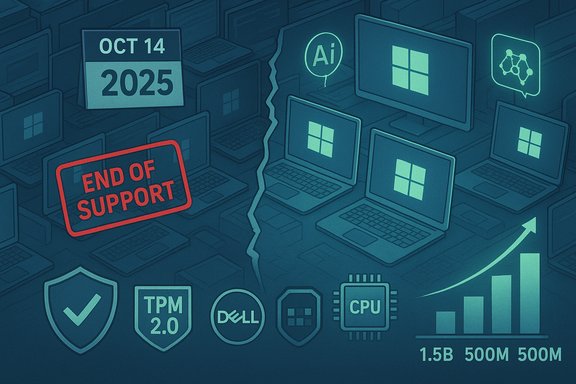
Microsoft formally ended mainstream support for Windows 10 on October 14, 2025. That means no more security updates, feature updates, or technical assistance for most Windows 10 SKUs after that date — though Microsoft did publish formal programs to extend security coverage for devices that cannot or will not migrate immediately. For consumers, Microsoft published enrollment paths for a one‑year Consumer Extended Security Updates (ESU) window ending October 13, 2026; commercial customers can buy multi‑year ESU coverage under standard licensing channels.How we got here: Windows 11’s stricter baseline
Windows 11 shipped with a much stricter minimum hardware baseline than previous Windows releases. The checklist includes UEFI/Secure Boot and TPM 2.0, a supported 64‑bit CPU family and generation list, plus modest RAM and storage minimums — but in practice CPU family and TPM gating have excluded a large installed base of otherwise functional Windows 10 machines from a fully supported Windows 11 upgrade path. Microsoft’s documentation and OEM guidance make these hardware requirements explicit.The Dell shock: numbers that reshape the lifecycle story
What Dell actually said
On its Q3 earnings call Dell’s Vice Chairman and COO Jeffrey Clarke offered a blunt installed‑base snapshot: Dell estimates an installed base of roughly 1.5 billion Windows PCs; about 500 million of those are capable of running Windows 11 but have not been upgraded, and a further 500 million are more than four years old and effectively cannot run Windows 11 without hardware replacement. Dell framed this as both a short‑term headwind to growth and a long‑term upgrade opportunity for OEMs selling Windows 11 and AI‑capable PCs.Why Dell’s estimate matters (and what it doesn’t)
Those three round numbers — 1.5 billion installed units, 500 million eligible-but-unupgraded, 500 million incompatible — are the most consequential single data points any OEM could offer today. They matter because they connect Microsoft’s product decisions (hardware gates, feature direction) to tangible market demand (who must buy new hardware and who can simply upgrade).But these figures are directional estimates, not full population counts. Dell did not publish the underlying telemetry distribution by geography, industry vertical, or device class on the call; the numbers should be treated as OEM‑level market math rather than precise census figures. The 500/500 breakdown is highly useful as a planning heuristic, but it lacks the granular verification enterprises will need for large deployments.
What the numbers mean for Microsoft, OEMs, and IT
Microsoft’s short list of problems
- Security risk mass: A large population of Windows 10 devices poses immediate security risk unless enrolled in ESU or isolated from sensitive networks. Microsoft’s consumer ESU path exists, but adoption friction and awareness vary.
- Upgrade economics: When half of the un‑upgraded pool can move to Windows 11 but won’t, the driver is not technical impossibility but hesitancy — perceived value, app compatibility, management tooling, or the cost of interruption. Convincing those users to spend money is not trivial.
- Hardware cliff: The other half — machines that simply cannot meet TPM/CPU gating — require a hardware refresh to reach Microsoft’s modern platform goals. That’s a multi‑year hardware replacement problem that will not be solved by OS updates alone.
OEM and channel implications
OEMs like Dell see a multi‑year refresh runway — but it will be segmented. Early adopters and enterprise AI buyers will replace first; mainstream consumers will delay until they perceive clear value. That dynamic favors OEMs with flexible financing, trade‑in programs, and midrange devices that pair reasonable price points with the new Windows/AI experience. Dell’s remarks explicitly folded their AI‑server optimism into the client refresh thesis: on‑device AI (NPUs/MPUs) can be the concrete reason consumers replace otherwise serviceable Windows 10 PCs.Windows 11 adoption: The data point everyone cites
By mid‑2025, market tracking showed Windows 11 catching up with, and then surpassing, Windows 10 in desktop share in many global samples. StatCounter and multiple industry outlets reported that by June–July 2025 Windows 11 had pulled ahead in aggregate desktop OS share — an important inflection, but one that still coexists with a massive remaining Windows 10 base. That split — adoption momentum happening alongside a large laggard cohort — is the exact tension Dell flagged.The security and risk calculus for staying on Windows 10
What “end of support” actually means for risk
Without security patches, devices become progressively more vulnerable to newly discovered exploits. For organizations that cannot patch, the options are:- Enroll in Extended Security Updates (ESU) (commercial customers can pay multi‑year fees; consumer options include Microsoft’s one‑year consumer ESU enrollment with choices such as using Microsoft Rewards or paying a fee). Microsoft explicitly designed ESU as a bridge, not a long‑term solution.
- Migrate to Windows 365 Cloud PC or other cloud/virtual desktop options; Microsoft allows Windows 10 Cloud PC access to be entitled to ESU at no extra cost in certain scenarios, offering an alternative path for legacy workloads.
- Replace/refurbish hardware with Windows 11–capable devices.
Practical effects on users and applications
Legacy line‑of‑business applications — particularly on‑premises, non‑containerized apps — are the main reason enterprises delay. Compatibility testing, driver validation, and the need for change control windows mean migration is rarely a “flip a switch” exercise. For many organizations, the cleanest path is staggered: migrate critical endpoints first, leave isolated or offline systems on ESU while planning replacement.The AI factor and public backlash: why some users won’t move
Microsoft’s push to make Windows 11 an AI‑centric or “agentic” OS is a strategic bet: deliver value that a plain‑vanilla upgrade can’t match and create a hardware refresh incentive. Yet the move has produced user resistance.Mustafa Suleyman, Microsoft’s AI chief, publicly pushed back against critics by calling surprise that people find AI “underwhelming” “mindblowing,” arguing the technology’s conversational and generative leaps are worth celebrating. That public posture highlights a growing disconnect: executives see technological progress; many users see half‑baked features, privacy trade‑offs, and a shift in priorities away from day‑to‑day reliability. This dynamic matters because when upgrade hesitancy is driven by perceived value deficit rather than technical barriers, Microsoft and OEMs must solve for product and messaging — not just subsidized pricing or ESU windows.
The hard numbers: costs and choices for consumers and businesses
ESU economics (what Microsoft made available)
- Consumer ESU: Microsoft announced consumer enrollment options for a one‑year window after October 14, 2025, including methods that can make the extension effectively free (redeeming Microsoft Rewards points or following specified enrollment steps), or a paid option where local pricing applies. The consumer ESU period runs Oct. 15, 2025 through Oct. 13, 2026 for enrolled devices.
- Commercial ESU: Organizations can subscribe to ESU through volume licensing; pricing for commercial enrollment has explicit per‑device fees and renewals available for up to three years in tiered pricing.
The refresh math for the “can't run Windows 11” cohort
Devices that fail TPM/CPU checks are not always ancient; many are 3–6 years old with otherwise acceptable performance for everyday tasks. Replacing them en masse is an expensive, logistics‑heavy exercise for large organizations. Expect the market to bifurcate:- High‑value business and AI workloads — fast refresh with premium devices and managed deployment.
- Mid‑market and consumer — gradual churn, trade‑in programs, and buy‑on‑failure replacement.
- Low‑value/isolated systems — ESU or migration to Linux/Cloud PC where feasible.
Strategic options and recommended playbook
For Microsoft
- Improve the perceived value of Windows 11: shipping reliable, demonstrable daily productivity wins (not only flashy agentic demos) will move more users off Windows 10 than scaremongering around end of support.
- Broaden migration tooling and incentives: make application compatibility tooling and driver rollouts simpler for OEMs, and maintain transparent telemetry on upgrade eligibility and progress.
- Work with OEMs on financing: targeted trade‑in and upgrade financing reduces friction for price‑sensitive customers.
For OEMs (Dell, HP, Lenovo)
- Segmented offers: tie AI‑capable hardware to clear, proven scenarios (e.g., on‑device ML for creatives, real‑time transcription for hybrid workers) rather than vague “AI inside” messaging.
- Refurbish and repurpose: create clear pathways to monetize the 4‑year+ devices through refurb programs or OEM‑supported Linux images for customers unwilling to buy new hardware.
For IT leaders
- Inventory and classify existing Windows 10 devices by upgrade eligibility, criticality, and app compatibility.
- Prioritize critical systems for upgrade or ESU; isolate or migrate lower‑risk devices using virtualization or segmentation.
- Budget refresh cycles based on a three‑year staged replacement plan that aligns with warranty, lifecycle, and ROI metrics.
- Test and pilot Windows 11 across representative app sets before wide rollout.
- Communicate the upgrade benefits tangibly to end users: explain what changes and why it matters for their work.
Alternatives: Linux, cloud PCs, and unsupported installs
Not every Windows 10 holdout will or should move to Windows 11. Three viable alternatives have emerged:- Linux distributions (desktop‑focused): For many older devices, modern Linux distributions (Ubuntu, Zorin OS, etc. provide secure, supported environments that are lighter on hardware and cost. Recent OS migrations and download spikes demonstrate this option’s momentum among consumers and small businesses.
- Windows 365 / Cloud PC: For legacy apps that must remain Windows‑based but where local hardware cannot be refreshed, Cloud PC options permit access to a managed Windows 11 environment without immediate local replacements; Microsoft has signalled ESU entitlements tied to certain cloud scenarios.
- Unsupported Windows 11 installs: Technically possible workarounds exist to install Windows 11 on unsupported hardware, but these are explicitly discouraged: Microsoft warns such systems may be ineligible for future updates and could expose users to security and stability issues.
Risks and unknowns (what to watch for)
- Telemetry ambiguity: OEM estimates (like Dell’s 1.5 billion base and 500/500 split) are useful but not a substitute for cross‑industry telemetry. Relying on single‑vendor numbers to forecast precise refresh volumes risks over‑ or under‑investing. Treat these as directional indicators.
- Security lag: Even with ESU enrollments, organizations that delay broad replacements will carry elevated attack surface risk, especially as threat actors shift focus to unpatched endpoints.
- Consumer backlash and brand risk: Microsoft’s aggressive AI positioning — and executives’ public comments in defense of the tech — may alienate a subset of users who prioritize control, privacy, and predictability. A prolonged brand–user disconnect could slow migration further, pushing more users to alternatives like Linux or macOS.
- Macroeconomic & supply constraints: Global device supply, component availability, and consumer budgets will affect how quickly replacement demand translates into shipments.
Final analysis: a crowded transition, not a single cliff
The Windows 10 sunset is not a one‑day cliff that forces universal change; it’s a multi‑year complex transition where technical gating, user value perception, pricing, and AI feature roadmaps intersect. Dell’s figures crystallize that complexity in stark numbers: hundreds of millions can upgrade but decline to, and hundreds of millions can’t upgrade without buying new hardware. That reality reframes Microsoft’s challenge: the company must deliver clear, everyday value for Windows 11 — beyond demos — while managing the security reality of a large, aging installed base.For enterprises, the practical takeaway is straightforward: inventory, classify, pilot, and budget. For OEMs, this is a sales opportunity that requires disciplined messaging and financing. For Microsoft, the path forward is product credibility and migration tooling — with security and compatibility as non‑negotiable anchors.
The result is a messy, opportunity‑rich migration epoch: one that will keep CIOs, OEMs, and Microsoft busy for years, and that will determine whether Windows 11 becomes a rapid business‑driven refresh or a prolonged generational shuffle fraught with security trade‑offs and platform disaggregation.
Source: Windows Report Windows 10 Still Runs on 1 Billion PCs — A Major Upgrade Headache for Microsoft
